PU LEET 2027 Sample Paper
Finished viewing? Save it for later —
Download PU LEET 2027 Sample Paper (PDF · 15 pages)About PU LEET 2027 Sample Paper
PU LEET 2027 Sample Paper is available here for free download. Published by Panjab University for PU LEET, this sample paper can be viewed online or downloaded as a PDF (15 pages). Candidates preparing for PU LEET can use PU LEET 2027 Sample Paper to understand the exam pattern, the type of questions asked, and the overall difficulty level.
Frequently Asked Questions
How can I download PU LEET 2027 Sample Paper?
Open this page and click the Download button to save PU LEET 2027 Sample Paper as a PDF. It is completely free on AglaSem Docs.
Is PU LEET 2027 Sample Paper free to download?
Yes. PU LEET 2027 Sample Paper can be viewed online and downloaded as a PDF free of cost on AglaSem Docs.
How many pages does PU LEET 2027 Sample Paper have?
PU LEET 2027 Sample Paper contains 15 pages, which you can read online or download together as a single PDF.
Where can I find more PU LEET study material?
You can find more PU LEET question papers, sample papers, syllabus, and answer keys on AglaSem Docs.
PU LEET 2027 Sample Paper – Text
Read the full text of this sample paper below — useful to quickly search, copy and reference the content online without downloading the PDF.
📄 View text version (15 pages)
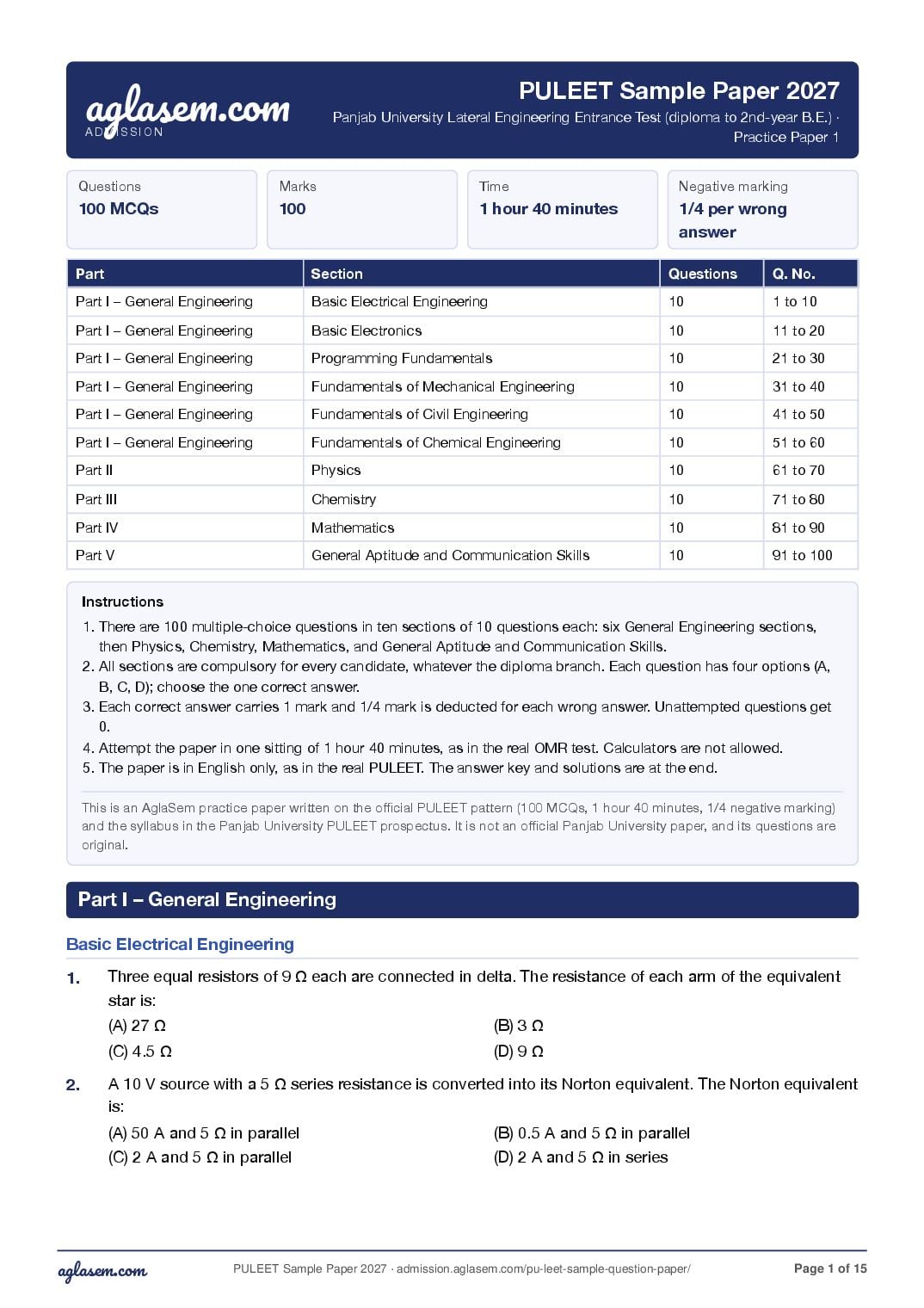
Page 1
Panjab University Lateral Engineering Entrance Test (diploma to 2nd-year B.E.) ·
ADMISSION
Practice Paper 1
Questions Marks Time Negative marking
100 MCQs 100 1 hour 40 minutes 1/4 per wrong
answer
Part Section Questions Q. No.
Part I – General Engineering Basic Electrical Engineering 10 1 to 10
Part I – General Engineering Basic Electronics 10 11 to 20
Part I – General Engineering Programming Fundamentals 10 21 to 30
Part I – General Engineering Fundamentals of Mechanical Engineering 10 31 to 40
Part I – General Engineering Fundamentals of Civil Engineering 10 41 to 50
Part I – General Engineering Fundamentals of Chemical Engineering 10 51 to 60
Part II Physics 10 61 to 70
Part III Chemistry 10 71 to 80
Part IV Mathematics 10 81 to 90
Part V General Aptitude and Communication Skills 10 91 to 100
Instructions
1. There are 100 multiple-choice questions in ten sections of 10 questions each: six General Engineering sections,
then Physics, Chemistry, Mathematics, and General Aptitude and Communication Skills.
2. All sections are compulsory for every candidate, whatever the diploma branch. Each question has four options (A,
B, C, D); choose the one correct answer.
3. Each correct answer carries 1 mark and 1/4 mark is deducted for each wrong answer. Unattempted questions get
0.
4. Attempt the paper in one sitting of 1 hour 40 minutes, as in the real OMR test. Calculators are not allowed.
5. The paper is in English only, as in the real PULEET. The answer key and solutions are at the end.
This is an AglaSem practice paper written on the official PULEET pattern (100 MCQs, 1 hour 40 minutes, 1/4 negative marking)
and the syllabus in the Panjab University PULEET prospectus. It is not an official Panjab University paper, and its questions are
original.
Part I – General Engineering
Basic Electrical Engineering
1. Three equal resistors of 9 Ω each are connected in delta. The resistance of each arm of the equivalent
star is:
(A) 27 Ω (B) 3 Ω
(C) 4.5 Ω (D) 9 Ω
2. A 10 V source with a 5 Ω series resistance is converted into its Norton equivalent. The Norton equivalent
is:
(A) 50 A and 5 Ω in parallel (B) 0.5 A and 5 Ω in parallel
(C) 2 A and 5 Ω in parallel (D) 2 A and 5 Ω in series
PULEET Sample Paper 2027 · admission./pu-leet-sample-question-paper/ Page 1 of 15
Page 2
(A) 0.1 s (B) 10 s
(C) 1 s (D) 5 s
4. The RMS value of a sinusoidal voltage with a peak value of 325 V is about:
(A) 460 V (B) 207 V
(C) 325 V (D) 230 V
5. In a balanced delta-connected load, the phase current is 10 A. The line current is about:
(A) 10 A (B) 5.77 A
(C) 30 A (D) 17.3 A
6. In a magnetic circuit, the quantity analogous to resistance in an electric circuit is:
(A) Magnetomotive force (B) Permeance
(C) Reluctance (D) Magnetic flux
7. A single-phase transformer has 2000 primary turns and 200 secondary turns. If the primary is
connected to 230 V, the secondary voltage is:
(A) 23 V (B) 115 V
(C) 2300 V (D) 46 V
8. A transformer has a full-load copper loss of 400 W and an iron loss of 100 W. Its efficiency is maximum
at:
(A) Twice full load (B) One-fourth of full load
(C) Half of full load (D) Full load
9. A 220 V DC shunt motor draws an armature current of 10 A. If the armature resistance is 0.5 Ω, the back
EMF is:
(A) 225 V (B) 215 V
(C) 210 V (D) 220 V
10. A stepper motor has a step angle of 1.8°. The number of steps it takes to complete one revolution is:
(A) 200 (B) 360
(C) 180 (D) 100
Basic Electronics
11. A varactor diode is used mainly as a:
(A) Voltage regulator (B) Variable capacitor
(C) Rectifier for high current (D) Light emitter
12. The maximum theoretical efficiency of a half-wave rectifier is:
(A) 40.6% (B) 81.2%
(C) 100% (D) 50%
13. In a common-emitter transistor amplifier, the base current is 20 μA and β = 100. The collector current is:
(A) 20 mA (B) 2 A
(C) 0.2 mA (D) 2 mA
14. An inverting op-amp amplifier has R_f = 100 kΩ and R₁ = 10 kΩ. Its voltage gain is:
(A) −10 (B) +11
(C) −11 (D) +10
PULEET Sample Paper 2027 · admission./pu-leet-sample-question-paper/ Page 2 of 15
Page 3
(A) Less than one, with zero phase shift
(B) Zero, with any phase shift
(C) Unity, with zero net phase shift
(D) Unity, with a 180° phase shift
16. Which of the following is a universal logic gate?
(A) AND (B) NOR
(C) XOR (D) OR
17. The Boolean expression A + AB simplifies to:
(A) A (B) B
(C) AB (D) A + B
18. The number of select lines needed for an 8-to-1 multiplexer is:
(A) 3 (B) 2
(C) 4 (D) 8
19. Which of the following transducers generates its own output voltage (an active transducer)?
(A) Thermistor (B) Strain gauge
(C) LVDT (D) Thermocouple
20. In amplitude modulation with a modulation index of 1, the total transmitted power is how many times
the carrier power?
(A) 2 (B) 1
(C) 1.5 (D) 0.5
Programming Fundamentals
21. Which memory in a computer has the shortest access time?
(A) Hard disk (B) Main memory (RAM)
(C) Cache memory (D) CPU registers
22. Which Linux command prints the full path of the current working directory?
(A) pwd (B) cd
(C) dir (D) ls
23. What does the following C code print?
int a = 7, b = 2;
printf("%d", a / b);
(A) 3 (B) 3.0
(C) 3.5 (D) 4
24. After the following C statements execute, what are the values of a and b?
int a = 5, b;
b = a++ * 2;
(A) a = 6, b = 12 (B) a = 6, b = 10
(C) a = 5, b = 10 (D) a = 5, b = 12
25. What is the value of the C expression 12 >> 2?
(A) 10 (B) 3
(C) 48 (D) 6
PULEET Sample Paper 2027 · admission./pu-leet-sample-question-paper/ Page 3 of 15
Page 4
for (i = 0; i < 10; i += 3)
printf("*");
(A) 10 (B) 3
(C) 5 (D) 4
27. What does this code print?
int a[] = {10, 20, 30, 40};
int *p = a;
printf("%d", *(p + 2));
(A) 12 (B) 30
(C) 20 (D) 40
28. For the recursive function below, what does f(4) return?
int f(int n) {
if (n == 0) return 0;
return n + f(n - 1);
}
(A) 4 (B) 0
(C) 10 (D) 24
29. In C, the memory allocated to a union is equal to:
(A) The size of its first member
(B) The sum of the sizes of all its members
(C) The size of its smallest member
(D) The size of its largest member
30. In object-oriented programming, binding data and the functions that work on it into a single unit is
called:
(A) Inheritance (B) Polymorphism
(C) Data abstraction (D) Encapsulation
Fundamentals of Mechanical Engineering
31. The Kelvin–Planck statement of the second law says that no heat engine working in a cycle can:
(A) Work between a hot reservoir and a cold reservoir
(B) Have an efficiency greater than zero in practice
(C) Transfer heat from a colder body to a hotter body by itself
(D) Turn all the heat from a single reservoir into work
32. A refrigerator works on a reversed Carnot cycle between 250 K and 300 K. Its coefficient of
performance is:
(A) 1.2 (B) 0.83
(C) 6 (D) 5
33. A sample of wet steam contains 0.8 kg of dry vapour and 0.2 kg of water in suspension. Its dryness
fraction is:
(A) 0.25 (B) 0.8
(C) 0.2 (D) 4
34. The air-standard efficiency of an Otto cycle with a compression ratio of 8 (γ = 1.4) is about:
(A) 56.5% (B) 43.5%
(C) 60.0% (D) 35.0%
PULEET Sample Paper 2027 · admission./pu-leet-sample-question-paper/ Page 4 of 15
Page 5
(A) Volume (B) Pressure
(C) Temperature (D) Entropy
36. Water flows through a pipe whose diameter reduces from 20 cm to 10 cm. If the velocity in the larger
section is 2 m/s, the velocity in the smaller section is:
(A) 16 m/s (B) 8 m/s
(C) 4 m/s (D) 1 m/s
37. A steel bar 1 m long with a cross-section of 100 mm² carries an axial pull of 10 kN. If E = 200 GPa, its
elongation is:
(A) 0.05 mm (B) 0.5 mm
(C) 5 mm (D) 1 mm
38. A cantilever of length L carries a point load W at its free end. The maximum bending moment is:
(A) WL, at the free end (B) WL/2, at mid-span
(C) WL, at the fixed end (D) WL/4, at the fixed end
39. A simply supported beam of span L carries a uniformly distributed load of w per unit length over the
whole span. The maximum bending moment is:
(A) wL/8 (B) wL²/8
(C) wL²/4 (D) wL²/2
40. The polar moment of inertia of a solid circular shaft of diameter d is:
(A) πd⁴/32 (B) πd²/4
(C) πd⁴/64 (D) πd³/16
Fundamentals of Civil Engineering
41. A damp-proof course (DPC) in a building is generally laid at:
(A) Plinth level (B) Lintel level
(C) Sill level (D) Roof level
42. The hydrostatic pressure at a depth of 10 m below the free surface of water is about (g = 9.81 m/s²):
(A) 981 kPa (B) 98.1 kPa
(C) 9.81 kPa (D) 10 kPa
43. The slump test of fresh concrete is used to measure its:
(A) Durability (B) Setting time
(C) Workability (D) Compressive strength
44. In an under-reinforced RCC beam, failure starts by:
(A) Buckling of the compression steel
(B) Crushing of concrete in compression
(C) Shear failure of the support
(D) Yielding of the tension steel
45. A rolled steel I-section is designated ISMB 300. The number 300 denotes the:
(A) Weight per metre in kg (B) Depth of the section in mm
(C) Length of the beam in cm (D) Width of the flange in mm
46. A staff reading of 1.500 m is taken on a bench mark of RL 100.000 m, and the next reading of 2.000 m
on point P. The reduced level of P is:
(A) 99.500 m (B) 98.500 m
(C) 101.500 m (D) 100.500 m
PULEET Sample Paper 2027 · admission./pu-leet-sample-question-paper/ Page 5 of 15
Page 6
(A) S 60° E (B) S 30° W
(C) S 60° W (D) N 60° W
48. For a crop with a base period of 120 days, the duty of water is 1728 hectares per cumec. The delta is:
(A) 0.3 m (B) 1.2 m
(C) 6 m (D) 0.6 m
49. The camber given to a road surface is mainly meant for:
(A) Reducing the cost of the pavement
(B) Draining rainwater off the surface
(C) Improving the sight distance
(D) Counteracting the centrifugal force on curves
50. A soil sample has a void ratio of 0.5. Its porosity is about:
(A) 0.33 (B) 0.50
(C) 1.00 (D) 0.67
Fundamentals of Chemical Engineering
51. A temperature of 300 K is about:
(A) 572 °F (B) 48.3 °F
(C) 26.9 °F (D) 80.3 °F
52. The SI unit of dynamic viscosity is:
(A) kg/m³ (B) Pa·s
(C) N/m (D) m²/s
53. A gas mixture contains 64 g of O₂ and 28 g of N₂. The mole fraction of oxygen is:
(A) 0.696 (B) 0.5
(C) 0.333 (D) 0.667
54. Which of the following is a unit operation (a physical change) rather than a unit process (a chemical
change)?
(A) Distillation (B) Hydrogenation
(C) Sulphonation (D) Nitration
55. An evaporator concentrates 1000 kg/h of a 10% (by mass) salt solution to 40%. The rate of water
evaporation is:
(A) 300 kg/h (B) 600 kg/h
(C) 250 kg/h (D) 750 kg/h
56. How much oxygen is needed to burn 24 kg of carbon completely to CO₂?
(A) 48 kg (B) 32 kg
(C) 64 kg (D) 88 kg
57. The number of moles of an ideal gas that occupies 24.6 L at 2 atm and 300 K is about (R = 0.082 L atm
mol⁻¹ K⁻¹):
(A) 0.5 (B) 4
(C) 1 (D) 2
PULEET Sample Paper 2027 · admission./pu-leet-sample-question-paper/ Page 6 of 15
Page 7
(A) The mass of the molecules
(B) The finite volume of the molecules
(C) Attraction between the molecules
(D) Collisions with the container wall
59. The Clausius–Clapeyron equation relates:
(A) Solubility of a gas to its partial pressure
(B) Density of a gas to its molar mass
(C) Volume to pressure at constant temperature
(D) Vapour pressure of a liquid to temperature
60. In an ideal binary solution the mole fraction of A is 0.4. If the vapour pressures of pure A and pure B are
100 kPa and 50 kPa, the total vapour pressure is:
(A) 75 kPa (B) 70 kPa
(C) 150 kPa (D) 60 kPa
Part II
Physics
61. A ball is projected at 45° to the horizontal with a speed of 20 m/s. Its horizontal range is (g = 10 m/s²):
(A) 10 m (B) 20 m
(C) 80 m (D) 40 m
62. In an Atwood machine, masses of 3 kg and 2 kg hang from a light string over a frictionless pulley. The
acceleration of the masses is (g = 10 m/s²):
(A) 10 m/s² (B) 5 m/s²
(C) 3.3 m/s² (D) 2 m/s²
63. The moment of inertia of a uniform solid sphere of mass M and radius R about a diameter is:
(A) (2/3) MR² (B) (2/5) MR²
(C) (7/5) MR² (D) (1/2) MR²
64. Two tuning forks of frequencies 256 Hz and 260 Hz are sounded together. The number of beats heard
per second is:
(A) 516 (B) 2
(C) 4 (D) 8
65. An object is placed 30 cm in front of a convex lens of focal length 20 cm. The image is formed:
(A) 60 cm behind the lens (B) 12 cm behind the lens
(C) 20 cm behind the lens (D) 60 cm in front of the lens
66. In Young's double-slit experiment, light of wavelength 600 nm is used, the slit separation is 1 mm and
the screen is 1 m away. The fringe width is:
(A) 1.2 mm (B) 0.6 mm
(C) 0.06 mm (D) 6 mm
67. A 10 μF capacitor is charged to 100 V. The energy stored in it is:
(A) 0.05 J (B) 0.001 J
(C) 5 J (D) 0.5 J
PULEET Sample Paper 2027 · admission./pu-leet-sample-question-paper/ Page 7 of 15
Page 8
room temperature is:
(A) 3R/2 (B) 5R/2
(C) 7R/2 (D) 3R
69. In the Bohr model of the hydrogen atom, the energy of the electron in the second orbit (n = 2) is:
(A) −6.8 eV (B) −13.6 eV
(C) −3.4 eV (D) −1.51 eV
70. The half-life of a radioactive sample is 10 days. The fraction of the sample left undecayed after 30 days
is:
(A) 1/27 (B) 1/6
(C) 1/8 (D) 1/3
Part III
Chemistry
71. The maximum number of electrons that can be accommodated in the shell with n = 3 is:
(A) 32 (B) 8
(C) 18 (D) 9
72. The ground-state electronic configuration of chromium (Z = 24) is:
(A) [Ar] 3d⁵ 4s¹ (B) [Ar] 3d⁶
(C) [Ar] 4s² 4p⁴ (D) [Ar] 3d⁴ 4s²
73. Which of the following elements has the highest first ionisation enthalpy?
(A) B (B) O
(C) N (D) C
74. The higher calorific value of a fuel containing 10% hydrogen is 8000 kcal/kg. Taking the latent heat of
steam as 587 kcal/kg, its lower calorific value is about:
(A) 7941 kcal/kg (B) 7413 kcal/kg
(C) 8528 kcal/kg (D) 7472 kcal/kg
75. On the octane rating scale, the two reference fuels assigned ratings of 100 and 0 respectively are:
(A) n-Heptane and iso-octane
(B) Benzene and n-hexane
(C) Iso-octane and n-heptane
(D) n-Hexadecane and α-methylnaphthalene
76. A water sample contains 16.2 mg/L of Ca(HCO₃)₂ (molar mass 162). Its hardness in terms of CaCO₃
equivalent is:
(A) 10 ppm (B) 16.2 ppm
(C) 1.62 ppm (D) 20 ppm
77. Temporary hardness of water is caused by:
(A) Chlorides of Ca and Mg
(B) Nitrates of sodium and potassium
(C) Sulphates of Ca and Mg
(D) Bicarbonates of Ca and Mg
PULEET Sample Paper 2027 · admission./pu-leet-sample-question-paper/ Page 8 of 15
Page 9
and Mg²⁺ ions by:
(A) H⁺ ions (B) Na⁺ ions
(C) Cl⁻ ions (D) OH⁻ ions
79. Minamata disease, a well-known case of heavy-metal poisoning, was caused by:
(A) Arsenic (B) Lead
(C) Mercury (D) Cadmium
80. Galvanised iron is iron coated with:
(A) Tin (B) Zinc
(C) Chromium (D) Nickel
Part IV
Mathematics
81. If α and β are the roots of x² − 5x + 6 = 0, then α² + β² equals:
(A) 25 (B) 12
(C) 37 (D) 13
82. The rank of the matrix below is:
1 2 3
2 4 6
1 1 1
(A) 2 (B) 0
(C) 3 (D) 1
83. The value of sin 75° is:
(A) (√6 − √2)/4 (B) (√3 − 1)/2
(C) (√6 + √2)/4 (D) (√3 + 1)/2
84. The perpendicular distance of the point (3, 4) from the line 3x + 4y − 5 = 0 is:
(A) 4 (B) 5
(C) 3 (D) 20
85. The centre and radius of the circle x² + y² − 4x + 6y − 12 = 0 are:
(A) (2, −3) and 5 (B) (2, −3) and 25
(C) (−2, 3) and √12 (D) (−2, 3) and 5
86. The radius of curvature of the curve y = x² at the origin is:
(A) 1/2 (B) 1/4
(C) 1 (D) 2
87. If x = r cos θ and y = r sin θ, the Jacobian ∂(x, y)/∂(r, θ) is:
(A) r (B) r²
(C) 1 (D) 1/r
88. The value of ∫₀^(π/2) sin⁴x dx is:
(A) π/16 (B) 3π/16
(C) 3π/8 (D) π/4
PULEET Sample Paper 2027 · admission./pu-leet-sample-question-paper/ Page 9 of 15
Page 10
(A) r (B) 1
(C) 0 (D) 3
90. The integrating factor of the equation dy/dx + 2y = eˣ is:
(A) 2x (B) e^(2x)
(C) e^x (D) e^(−2x)
Part V
General Aptitude and Communication Skills
91. If COLD is written as DPME in a certain code, how is WARM written in that code?
(A) VZQL (B) XASN
(C) XBSN (D) XBSM
92. In a certain code, TABLE is written as GZYOV. How is CHAIR written in that code?
(A) XSZIR (B) XTZRI
(C) WSZRI (D) XSZRI
93. Ravi walks 5 km north, turns right and walks 3 km, then turns right again and walks 9 km. How far is he
now from his starting point?
(A) 17 km (B) 4 km
(C) 7 km (D) 5 km
94. A man is facing north. He turns 90° clockwise and then 180° anticlockwise. Which direction is he facing
now?
(A) South (B) East
(C) West (D) North
95. Find the next number in the series: 2, 6, 12, 20, 30, ?
(A) 36 (B) 40
(C) 42 (D) 44
96. Choose the pair that shows the same relationship as DOCTOR : HOSPITAL
(A) Lawyer : Judgement (B) Author : Book
(C) Teacher : School (D) Farmer : Harvest
97. Fill in the blank: By next June, she ___ her diploma.
(A) would have been completed (B) will have completed
(C) has completed (D) had completed
98. Fill in the blank with the correct article: ___ Ganga rises in the Himalayas.
(A) No article (B) A
(C) The (D) An
99. Choose the passive form of: 'Who wrote this report?'
(A) Who was this report written?
(B) By whom was this report written?
(C) Who has written this report?
(D) By whom this report was written?
PULEET Sample Paper 2027 · admission./pu-leet-sample-question-paper/ Page 10 of 15
Page 11
(A) She always reaches the office on time.
(B) She reaches the office always time on.
(C) Always she reaches on time the office.
(D) She reaches always the office on time.
PULEET Sample Paper 2027 · admission./pu-leet-sample-question-paper/ Page 11 of 15
Page 12
1 B 2 C 3 C 4 D 5 D 6 C 7 A 8 C 9 B 10 A
11 B 12 A 13 D 14 A 15 C 16 B 17 A 18 A 19 D 20 C
21 D 22 A 23 A 24 B 25 B 26 D 27 B 28 C 29 D 30 D
31 D 32 D 33 B 34 A 35 B 36 B 37 B 38 C 39 B 40 A
41 A 42 B 43 C 44 D 45 B 46 A 47 C 48 D 49 B 50 A
51 D 52 B 53 D 54 A 55 D 56 C 57 D 58 C 59 D 60 B
61 D 62 D 63 B 64 C 65 A 66 B 67 A 68 B 69 C 70 C
71 C 72 A 73 C 74 D 75 C 76 A 77 D 78 A 79 C 80 B
81 D 82 A 83 C 84 A 85 A 86 A 87 A 88 B 89 D 90 B
91 C 92 D 93 D 94 C 95 C 96 C 97 B 98 C 99 B 100 A
Solutions
Basic Electrical Engineering
1. (B) For a balanced network, R_star = R_delta/3 = 9/3 = 3 Ω.
2. (C) I_N = short-circuit current = 10/5 = 2 A, with R_N = 5 Ω in parallel with the current source.
3. (C) τ = RC = 10 × 10³ × 100 × 10⁻⁶ = 1 s. (About 5τ = 5 s is the time to charge almost fully.)
4. (D) V_rms = V_m/√2 = 325/1.414 ≈ 230 V. (207 V is the average value over a half cycle, 0.637 V_m.)
5. (D) In delta connection I_line = √3 × I_phase = 1.732 × 10 ≈ 17.3 A.
6. (C) Reluctance (S = l/μA) opposes flux as resistance opposes current. MMF is analogous to EMF, flux to current and
permeance to conductance.
7. (A) V₂ = V₁ × N₂/N₁ = 230 × 200/2000 = 23 V (a step-down transformer).
8. (C) Maximum efficiency occurs where copper loss = iron loss: x² × 400 = 100, so x = 0.5, i.e. half load.
9. (B) E_b = V − I_a R_a = 220 − 10 × 0.5 = 215 V.
10. (A) Steps per revolution = 360°/1.8° = 200.
Basic Electronics
11. (B) A reverse-biased varactor's junction capacitance changes with the applied voltage, so it works as a voltage-
controlled (variable) capacitor, e.g. in tuning circuits. The Zener is the voltage regulator.
12. (A) η_max = 4/π² ≈ 0.406 = 40.6% for a half-wave rectifier. A full-wave rectifier reaches 81.2%.
13. (D) I_C = β I_B = 100 × 20 μA = 2000 μA = 2 mA.
14. (A) Inverting gain = −R_f/R₁ = −100/10 = −10. (+11 would be the non-inverting gain 1 + R_f/R₁.)
15. (C) For sustained oscillation the loop gain magnitude |Aβ| = 1 and the total phase shift round the loop is 0° (or
360°).
16. (B) NAND and NOR are universal gates: any logic function can be built using only one of them.
17. (A) A + AB = A(1 + B) = A · 1 = A (absorption law).
18. (A) n select lines choose among 2ⁿ inputs; 2³ = 8, so 3 select lines are needed.
19. (D) A thermocouple produces an EMF (Seebeck effect) without an external supply. Strain gauges, thermistors and
LVDTs need an excitation source, so they are passive.
20. (C) P_t = P_c (1 + m²/2) = P_c (1 + 1/2) = 1.5 P_c.
PULEET Sample Paper 2027 · admission./pu-leet-sample-question-paper/ Page 12 of 15
Page 13
21. (D) In the memory hierarchy, registers inside the CPU are fastest, followed by cache, main memory and secondary
storage.
22. (A) pwd (print working directory) shows the full path. ls and dir list files and cd changes the directory.
23. (A) Both operands are int, so integer division truncates 3.5 to 3.
24. (B) Post-increment uses the old value 5 in the expression (b = 10) and then increases a to 6.
25. (B) 12 = 1100 in binary; shifting right by 2 gives 0011 = 3 (the same as 12/4). 12 << 2 would give 48.
26. (D) i takes the values 0, 3, 6 and 9; at i = 12 the condition fails. So the body runs 4 times.
27. (B) p points to a[0]; p + 2 points to a[2], whose value is 30.
28. (C) f(4) = 4 + 3 + 2 + 1 + 0 = 10. (24 would be 4!, the product.)
29. (D) All members of a union share the same memory, so its size is that of the largest member (plus any alignment
padding). A structure takes the sum of its members.
30. (D) Encapsulation wraps data and methods together in a class. Abstraction hides details, inheritance reuses a
class and polymorphism gives one interface many forms.
Fundamentals of Mechanical Engineering
31. (D) Kelvin–Planck: it is impossible for a cyclic engine to exchange heat with a single reservoir and convert all of it
into work, i.e. no engine is 100% efficient. The heat-transfer statement is Clausius's.
32. (D) COP_ref = T_L/(T_H − T_L) = 250/50 = 5. (6 is the COP of a heat pump between the same temperatures.)
33. (B) x = mass of dry vapour ÷ total mass = 0.8/(0.8 + 0.2) = 0.8.
34. (A) η = 1 − 1/r^(γ−1) = 1 − 1/8^0.4 = 1 − 1/2.297 ≈ 0.565 = 56.5%.
35. (B) The Diesel cycle adds heat at constant pressure. The Otto cycle adds it at constant volume.
36. (B) Continuity: A₁V₁ = A₂V₂. Halving the diameter makes the area one-fourth, so V₂ = 4 × 2 = 8 m/s.
37. (B) δ = PL/(AE) = (10 000 N × 1000 mm)/(100 mm² × 200 000 N/mm²) = 0.5 mm.
38. (C) The bending moment at distance x from the free end is Wx, which is largest (WL) at the fixed end and zero at
the free end.
39. (B) Each reaction is wL/2; at mid-span M = (wL/2)(L/2) − (wL/2)(L/4) = wL²/8. (wL²/2 is the cantilever value.)
40. (A) J = πd⁴/32, which is twice the second moment of area about a diameter (πd⁴/64).
Fundamentals of Civil Engineering
41. (A) The DPC is laid at plinth level to stop ground moisture rising into the walls.
42. (B) p = ρgh = 1000 × 9.81 × 10 = 98 100 Pa ≈ 98.1 kPa (gauge).
43. (C) The slump test measures the consistency (workability) of fresh concrete. Strength is found by cube tests.
44. (D) In an under-reinforced section the steel reaches yield before the concrete crushes, giving a ductile failure with
warning. Over-reinforced beams fail by concrete crushing.
45. (B) ISMB 300 is an Indian Standard Medium weight Beam with an overall depth of 300 mm.
46. (A) Height of instrument = 100.000 + 1.500 = 101.500 m. RL of P = 101.500 − 2.000 = 99.500 m.
47. (C) 240° lies in the third (SW) quadrant. RB = WCB − 180° = 60°, written S 60° W.
48. (D) Δ = 8.64 B/D = 8.64 × 120/1728 = 0.6 m (Δ in m, B in days, D in ha/cumec).
49. (B) Camber is the cross slope that drains rainwater to the sides. Super-elevation on curves counteracts centrifugal
force.
50. (A) n = e/(1 + e) = 0.5/1.5 ≈ 0.33.
Fundamentals of Chemical Engineering
51. (D) 300 K = 26.85 °C. °F = 1.8 × 26.85 + 32 ≈ 80.3 °F. (48.3 forgets to add 32.)
PULEET Sample Paper 2027 · admission./pu-leet-sample-question-paper/ Page 13 of 15
Page 14
viscosity.
53. (D) Moles: O₂ = 64/32 = 2, N₂ = 28/28 = 1. Mole fraction of O₂ = 2/3 ≈ 0.667. (0.696 is the mass fraction.)
54. (A) Distillation separates components physically, so it is a unit operation. Nitration, sulphonation and hydrogenation
are chemical reactions (unit processes).
55. (D) Salt in = 100 kg/h = 0.4 × product, so product = 250 kg/h. Water evaporated = 1000 − 250 = 750 kg/h.
56. (C) C + O₂ → CO₂: 12 kg C needs 32 kg O₂, so 24 kg C needs 64 kg O₂. (88 kg is the CO₂ formed.)
57. (D) n = PV/RT = (2 × 24.6)/(0.082 × 300) = 49.2/24.6 = 2.
58. (C) 'a' accounts for intermolecular attraction, which lowers the observed pressure. 'b' accounts for the finite
volume of the molecules.
59. (D) ln(p₂/p₁) = (ΔH_vap/R)(1/T₁ − 1/T₂) links vapour pressure with temperature. Boyle's law and Henry's law cover
the next two.
60. (B) Raoult's law: P = 0.4 × 100 + 0.6 × 50 = 40 + 30 = 70 kPa.
Physics
61. (D) R = u² sin 2θ/g = 400 × 1/10 = 40 m.
62. (D) a = (m₁ − m₂)g/(m₁ + m₂) = (1 × 10)/5 = 2 m/s².
63. (B) For a solid sphere I = (2/5)MR². (2/3)MR² is a thin spherical shell and (7/5)MR² is about a tangent.
64. (C) Beat frequency = difference of frequencies = 260 − 256 = 4 per second.
65. (A) 1/v − 1/u = 1/f with u = −30 cm, f = +20 cm: 1/v = 1/20 − 1/30 = 1/60, so v = +60 cm (real image on the other
side).
66. (B) β = λD/d = (600 × 10⁻⁹ × 1)/(1 × 10⁻³) = 6 × 10⁻⁴ m = 0.6 mm.
67. (A) U = ½CV² = ½ × 10 × 10⁻⁶ × 10⁴ = 0.05 J.
68. (B) A diatomic molecule has 3 translational + 2 rotational degrees of freedom; each contributes R/2, so C_v = 5R/2.
ₙ
69. (C) E = −13.6/n² eV, so E₂ = −13.6/4 = −3.4 eV. (−1.51 eV is n = 3.)
70. (C) 30 days = 3 half-lives, so the fraction left is (1/2)³ = 1/8.
Chemistry
71. (C) A shell holds 2n² electrons: 2 × 3² = 18.
72. (A) Chromium has the exceptional configuration 3d⁵ 4s¹ because a half-filled d subshell is extra stable.
73. (C) Ionisation enthalpy generally rises across period 2, but N (half-filled 2p³) is higher than O (2p⁴), from which one
paired electron is removed easily. Order: N > O > C > B.
74. (D) LCV = HCV − 0.09 H × 587 = 8000 − 0.09 × 10 × 587 = 8000 − 528.3 ≈ 7472 kcal/kg. (Each kg of H gives 9 kg
of water.)
75. (C) Iso-octane (2,2,4-trimethylpentane) is rated 100 and n-heptane 0. n-Hexadecane and α-methylnaphthalene are
the references for the cetane scale.
76. (A) Hardness as CaCO₃ = 16.2 × 100/162 = 10 mg/L = 10 ppm (1 mol of Ca(HCO₃)₂ ≡ 1 mol of CaCO₃, molar mass
100).
77. (D) Temporary hardness comes from the bicarbonates of calcium and magnesium and is removed by boiling.
Chlorides and sulphates cause permanent hardness.
78. (A) The cation exchanger RH₂ takes up Ca²⁺/Mg²⁺ and releases H⁺. The anion exchanger then replaces anions by
OH⁻.
79. (C) Minamata disease in Japan was caused by methylmercury in fish from contaminated sea water. Cadmium
caused itai-itai disease.
80. (B) Galvanising coats iron with zinc, which protects it sacrificially even if scratched. Tin plating is used for food
cans.
PULEET Sample Paper 2027 · admission./pu-leet-sample-question-paper/ Page 14 of 15
Page 15
81. (D) α + β = 5 and αβ = 6, so α² + β² = (α + β)² − 2αβ = 25 − 12 = 13.
82. (A) Row 2 = 2 × row 1, so the determinant is 0 and the rank is less than 3. Rows 1 and 3 are not proportional, so
the rank is 2.
83. (C) sin 75° = sin(45° + 30°) = (1/√2)(√3/2) + (1/√2)(1/2) = (√3 + 1)/(2√2) = (√6 + √2)/4.
84. (A) d = |3 × 3 + 4 × 4 − 5|/√(3² + 4²) = 20/5 = 4.
85. (A) Centre (−g, −f) = (2, −3); radius = √(g² + f² − c) = √(4 + 9 + 12) = 5.
86. (A) ρ = (1 + y′²)^(3/2)/|y″|. At the origin y′ = 0 and y″ = 2, so ρ = 1/2.
87. (A) J = xᵣ y_θ − x_θ yᵣ = cos θ · r cos θ − (−r sin θ) · sin θ = r.
88. (B) By the reduction (Wallis) formula: (3/4)(1/2)(π/2) = 3π/16.
89. (D) div r = ∂x/∂x + ∂y/∂y + ∂z/∂z = 1 + 1 + 1 = 3.
90. (B) IF = e^(∫2 dx) = e^(2x).
General Aptitude and Communication Skills
91. (C) Each letter is moved one place forward: W→X, A→B, R→S, M→N, giving XBSN.
92. (D) Each letter is replaced by its mirror letter (A↔Z, B↔Y, ...): position p becomes 27 − p. C→X, H→S, A→Z, I→R,
R→I gives XSZRI.
93. (D) He ends 3 km east and 9 − 5 = 4 km south of the start. Distance = √(3² + 4²) = 5 km.
94. (C) North → 90° clockwise → East → 180° anticlockwise → West.
95. (C) The terms are 1×2, 2×3, 3×4, 4×5, 5×6, so the next is 6×7 = 42 (differences 4, 6, 8, 10, 12).
96. (C) A doctor works in a hospital; a teacher works in a school. The other pairs link a person to something produced,
not to a workplace.
97. (B) 'By next June' marks an action finished before a future point, which needs the future perfect: 'will have
completed'.
98. (C) Names of rivers take the definite article: 'The Ganga'.
99. (B) 'Who' becomes 'By whom', and the question keeps the auxiliary before the subject: 'By whom was this report
written?'
100. (A) Frequency adverbs such as 'always' come before the main verb, and the object comes before the adverbial
'on time'.
PULEET Sample Paper 2027 · admission./pu-leet-sample-question-paper/ Page 15 of 15
Document Details
| Board / Org | Panjab University |
| Exam | PU LEET |
| Type | Sample Paper |
| Pages | 15 |
| Language | english |
| Updated | 27 Oct 2026 |