C-CAT 2027 Sample Paper Sections A and B
Finished viewing? Save it for later —
Download C-CAT 2027 Sample Paper Sections A and B (PDF · 17 pages)About C-CAT 2027 Sample Paper Sections A and B
C-CAT 2027 Sample Paper Sections A and B is available here for free download. Published by Centre for Development of Advanced Computing (CDAC) for C-CAT, this sample paper can be viewed online or downloaded as a PDF (17 pages). Candidates preparing for C-CAT can use C-CAT 2027 Sample Paper Sections A and B to understand the exam pattern, the type of questions asked, and the overall difficulty level.
Frequently Asked Questions
How can I download C-CAT 2027 Sample Paper Sections A and B?
Open this page and click the Download button to save C-CAT 2027 Sample Paper Sections A and B as a PDF. It is completely free on AglaSem Docs.
Is C-CAT 2027 Sample Paper Sections A and B free to download?
Yes. C-CAT 2027 Sample Paper Sections A and B can be viewed online and downloaded as a PDF free of cost on AglaSem Docs.
How many pages does C-CAT 2027 Sample Paper Sections A and B have?
C-CAT 2027 Sample Paper Sections A and B contains 17 pages, which you can read online or download together as a single PDF.
Where can I find more C-CAT study material?
You can find more C-CAT question papers, sample papers, syllabus, and answer keys on AglaSem Docs.
C-CAT 2027 Sample Paper Sections A and B – Text
Read the full text of this sample paper below — useful to quickly search, copy and reference the content online without downloading the PDF.
📄 View text version (17 pages)
Page 1
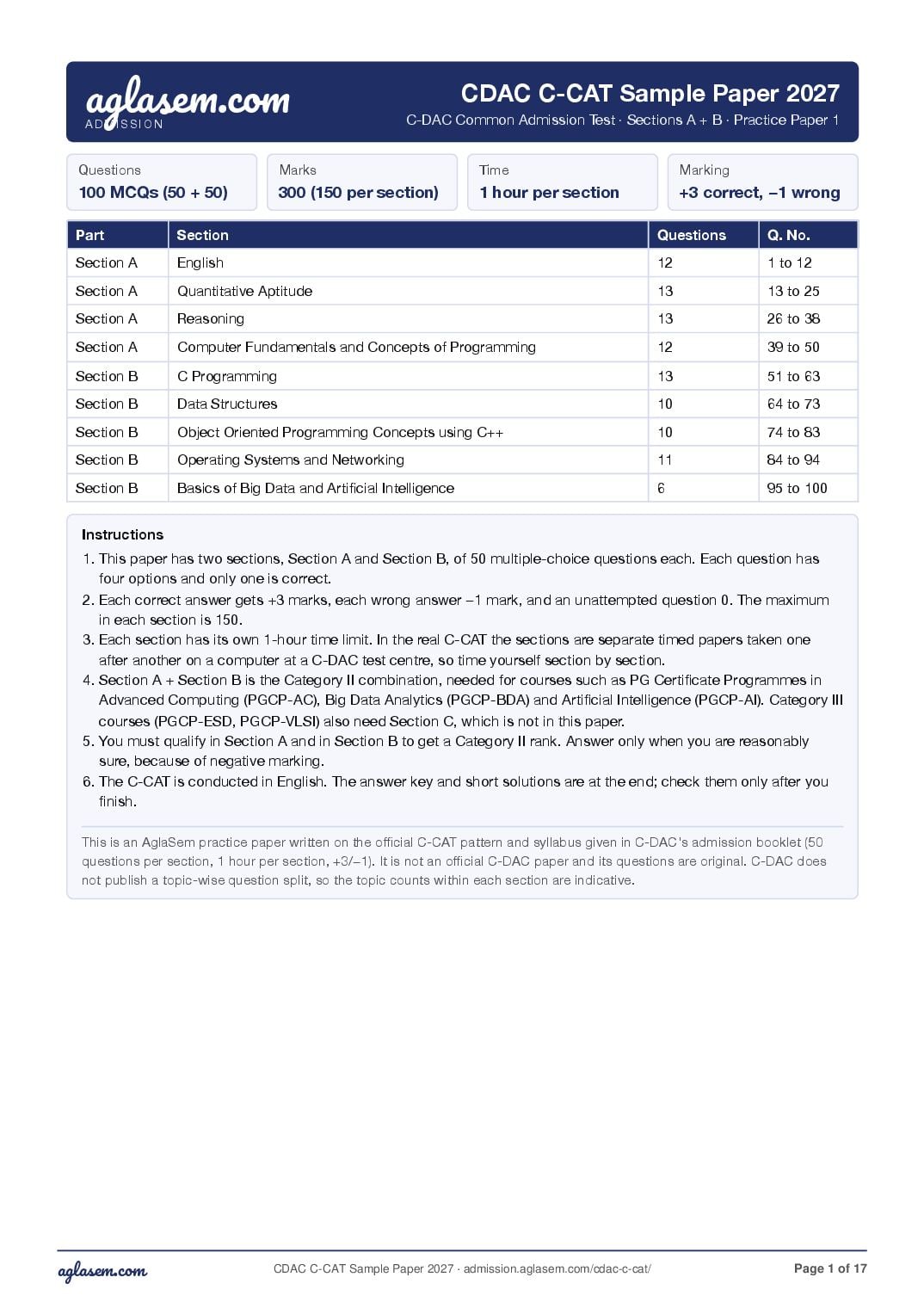
CDAC C-CAT Sample Paper 2027
C-DAC Common Admission Test · Sections A + B · Practice Paper 1
Questions Marks Time Marking
100 MCQs (50 + 50) 300 (150 per section) 1 hour per section +3 correct, −1 wrong
Part Section Questions Q. No.
Section A English 12 1 to 12
Section A Quantitative Aptitude 13 13 to 25
Section A Reasoning 13 26 to 38
Section A Computer Fundamentals and Concepts of Programming 12 39 to 50
Section B C Programming 13 51 to 63
Section B Data Structures 10 64 to 73
Section B Object Oriented Programming Concepts using C++ 10 74 to 83
Section B Operating Systems and Networking 11 84 to 94
Section B Basics of Big Data and Artificial Intelligence 6 95 to 100
Instructions
1. This paper has two sections, Section A and Section B, of 50 multiple-choice questions each. Each question has
four options and only one is correct.
2. Each correct answer gets +3 marks, each wrong answer −1 mark, and an unattempted question 0. The maximum
in each section is 150.
3. Each section has its own 1-hour time limit. In the real C-CAT the sections are separate timed papers taken one
after another on a computer at a C-DAC test centre, so time yourself section by section.
4. Section A + Section B is the Category II combination, needed for courses such as PG Certificate Programmes in
Advanced Computing (PGCP-AC), Big Data Analytics (PGCP-BDA) and Artificial Intelligence (PGCP-AI). Category III
courses (PGCP-ESD, PGCP-VLSI) also need Section C, which is not in this paper.
5. You must qualify in Section A and in Section B to get a Category II rank. Answer only when you are reasonably
sure, because of negative marking.
6. The C-CAT is conducted in English. The answer key and short solutions are at the end; check them only after you
finish.
This is an AglaSem practice paper written on the official C-CAT pattern and syllabus given in C-DAC's admission booklet (50
questions per section, 1 hour per section, +3/−1). It is not an official C-DAC paper and its questions are original. C-DAC does
not publish a topic-wise question split, so the topic counts within each section are indicative.
CDAC C-CAT Sample Paper 2027 · admission./cdac-c-cat/ Page 1 of 17
Page 2
English
Read the passage and answer the next four questions:
When a software team is racing to meet a deadline, it often takes shortcuts: a quick fix instead of a clean
design, a test that is skipped, a module copied rather than reused. Engineers call the accumulated cost of
such shortcuts technical debt. Like financial debt, it is not always a mistake. A young company that must
show a working product to investors next month may sensibly borrow against the future, just as a family
may take a loan to buy a house.
The trouble begins when the debt is forgotten. Every later change to the tangled code takes longer, bugs
hide in places no one fully understands, and new team members need weeks to become productive. This
slowing down is the interest on the debt. Eventually the interest can become so high that the team spends
most of its time keeping the old system alive and very little building anything new.
Wise teams therefore treat debt as a deliberate decision rather than an accident. They record where
shortcuts were taken, set aside time in each cycle to repay the most expensive ones, and resist the
temptation to declare a project finished merely because it runs.
1. Which of the following best states the main idea of the passage?
(A) Technical debt mainly affects new members who join a team
(B) Shortcuts in software can be sensible if they are tracked and repaid
(C) Investors are the main cause of poor-quality software today
(D) Software teams should never take any shortcuts, whatever the deadline they face
Read the passage and answer the next four questions:
When a software team is racing to meet a deadline, it often takes shortcuts: a quick fix instead of a clean
design, a test that is skipped, a module copied rather than reused. Engineers call the accumulated cost of
such shortcuts technical debt. Like financial debt, it is not always a mistake. A young company that must
show a working product to investors next month may sensibly borrow against the future, just as a family
may take a loan to buy a house.
The trouble begins when the debt is forgotten. Every later change to the tangled code takes longer, bugs
hide in places no one fully understands, and new team members need weeks to become productive. This
slowing down is the interest on the debt. Eventually the interest can become so high that the team spends
most of its time keeping the old system alive and very little building anything new.
Wise teams therefore treat debt as a deliberate decision rather than an accident. They record where
shortcuts were taken, set aside time in each cycle to repay the most expensive ones, and resist the
temptation to declare a project finished merely because it runs.
2. In the passage, the 'interest' on technical debt refers to:
(A) the curiosity new engineers show in an old system
(B) the reward a team gets for finishing a project early
(C) the extra time and effort later changes need because of old shortcuts
(D) the money a young company must pay back to its investors for early funding
CDAC C-CAT Sample Paper 2027 · admission./cdac-c-cat/ Page 2 of 17
Page 3
When a software team is racing to meet a deadline, it often takes shortcuts: a quick fix instead of a clean
design, a test that is skipped, a module copied rather than reused. Engineers call the accumulated cost of
such shortcuts technical debt. Like financial debt, it is not always a mistake. A young company that must
show a working product to investors next month may sensibly borrow against the future, just as a family
may take a loan to buy a house.
The trouble begins when the debt is forgotten. Every later change to the tangled code takes longer, bugs
hide in places no one fully understands, and new team members need weeks to become productive. This
slowing down is the interest on the debt. Eventually the interest can become so high that the team spends
most of its time keeping the old system alive and very little building anything new.
Wise teams therefore treat debt as a deliberate decision rather than an accident. They record where
shortcuts were taken, set aside time in each cycle to repay the most expensive ones, and resist the
temptation to declare a project finished merely because it runs.
3. Why does the author compare a young company to a family taking a loan for a house?
(A) To argue that all debt should be repaid at once
(B) To prove that families usually manage their money better than software firms
(C) To show that borrowing against the future can be a sensible choice
(D) To show that software companies often buy property
Read the passage and answer the next four questions:
When a software team is racing to meet a deadline, it often takes shortcuts: a quick fix instead of a clean
design, a test that is skipped, a module copied rather than reused. Engineers call the accumulated cost of
such shortcuts technical debt. Like financial debt, it is not always a mistake. A young company that must
show a working product to investors next month may sensibly borrow against the future, just as a family
may take a loan to buy a house.
The trouble begins when the debt is forgotten. Every later change to the tangled code takes longer, bugs
hide in places no one fully understands, and new team members need weeks to become productive. This
slowing down is the interest on the debt. Eventually the interest can become so high that the team spends
most of its time keeping the old system alive and very little building anything new.
Wise teams therefore treat debt as a deliberate decision rather than an accident. They record where
shortcuts were taken, set aside time in each cycle to repay the most expensive ones, and resist the
temptation to declare a project finished merely because it runs.
4. The word 'deliberate', as used in the last paragraph, is closest in meaning to:
(A) unpremeditated (B) hurried
(C) accidental (D) intentional
5. Choose the word closest in meaning to METICULOUS.
(A) Careless (B) Hesitant
(C) Unpredictable (D) Painstaking
6. Choose the word closest in meaning to AUGMENT.
(A) Undermine (B) Reduce
(C) Increase (D) Replace
7. Choose the word most nearly OPPOSITE in meaning to OBSOLETE.
(A) Current (B) Broken
(C) Outdated (D) Ancient
CDAC C-CAT Sample Paper 2027 · admission./cdac-c-cat/ Page 3 of 17
Page 4
(A) unless (B) although
(C) so (D) but
9. Fill in the blank: She has been working in this company ____ 2019.
(A) for (B) since
(C) by (D) from
10. Find the part of the sentence that has an error: 'Each of the students / have submitted / the assignment
on time.'
(A) Each of the students (B) have submitted
(C) the assignment on time (D) No error
11. The idiom 'to cut corners' means:
(A) to take the shortest road while driving
(B) to do something cheaply or carelessly to save time
(C) to avoid meeting someone on purpose
(D) to reduce one's expenses sensibly
12. Choose the correct form of the underlined part: 'If I would have known about the meeting, I would have
attended it.'
(A) If I had known (B) If I have known
(C) If I would know (D) If I knew
Quantitative Aptitude
13. A's salary is 20% less than B's. By what percentage is B's salary more than A's?
(A) 20% (B) 30%
(C) 15% (D) 25%
14. A can do a piece of work in 10 days and B in 15 days. Working together, they will finish it in:
(A) 6 days (B) 5 days
(C) 8 days (D) 12.5 days
15. A train 150 m long crosses a platform 250 m long in 20 seconds. Its speed is:
(A) 54 km/h (B) 90 km/h
(C) 72 km/h (D) 45 km/h
16. The compound interest on ₹8,000 at 10% per annum for 2 years, compounded annually, is:
(A) ₹1,600 (B) ₹1,680
(C) ₹1,520 (D) ₹1,760
17. A shopkeeper marks an article 20% above its cost price and then allows a discount of 10% on the
marked price. His profit is:
(A) 8% (B) 10%
(C) 12% (D) 6%
18. The average of five consecutive odd numbers is 21. The largest of them is:
(A) 25 (B) 27
(C) 29 (D) 23
19. Two fair coins are tossed together. The probability of getting at least one head is:
(A) 1/4 (B) 1/2
(C) 2/3 (D) 3/4
CDAC C-CAT Sample Paper 2027 · admission./cdac-c-cat/ Page 4 of 17
Page 5
(A) 210 (B) 21
(C) 35 (D) 42
21. The HCF of two numbers is 12 and their LCM is 360. If one number is 72, the other is:
(A) 30 (B) 84
(C) 48 (D) 60
22. What is the remainder when 2¹⁰ is divided by 7?
(A) 2 (B) 4
(C) 3 (D) 1
23. A 40-litre mixture has milk and water in the ratio 3 : 1. How much water must be added to make the
ratio 3 : 2?
(A) 10 litres (B) 15 litres
(C) 5 litres (D) 20 litres
24. Pipe A can fill a tank in 12 hours and pipe B can empty it in 18 hours. If both are opened together on an
empty tank, it will be filled in:
(A) 30 hours (B) 36 hours
(C) 7.2 hours (D) 24 hours
25. The present ages of A and B are in the ratio 4 : 5. After 6 years the ratio will be 6 : 7. A's present age is:
(A) 8 years (B) 12 years
(C) 16 years (D) 20 years
Reasoning
26. Find the next number in the series: 4, 9, 19, 39, 79, ?
(A) 160 (B) 158
(C) 149 (D) 159
27. Find the next number in the series: 7, 10, 16, 28, 52, ?
(A) 96 (B) 100
(C) 104 (D) 76
28. Find the next letter in the series: B, D, G, K, P, ?
(A) W (B) T
(C) V (D) U
29. In a code, each letter is replaced by the letter in the same position from the other end of the alphabet (A
↔ Z, B ↔ Y and so on), so LOGIC becomes OLTRX. How is DATA written in this code?
(A) XZGZ (B) WZHZ
(C) WAGA (D) WZGZ
30. Introducing a woman, Arjun says, "Her mother is the only daughter of my mother." How is the woman
related to Arjun?
(A) Sister (B) Cousin
(C) Daughter (D) Niece
31. Meera walks 6 km east, turns left and walks 8 km, then turns left again and walks 6 km. How far and in
which direction is she from her starting point?
(A) 14 km, North (B) 10 km, North-East
(C) 8 km, South (D) 8 km, North
CDAC C-CAT Sample Paper 2027 · admission./cdac-c-cat/ Page 5 of 17
Page 6
Conclusions: I. Some servers are not printers. II. Some printers are servers.
Which conclusion(s) follow?
(A) Both I and II follow (B) Neither I nor II follows
(C) Only II follows (D) Only I follows
33. Find the odd one out: Python, Java, HTML, C++
(A) Java (B) HTML
(C) Python (D) C++
34. Byte : Bit :: Kilobyte : ?
(A) Byte (B) Megabyte
(C) Nibble (D) Word
35. 1 January 2027 is a Friday. What day of the week will 1 March 2027 be?
(A) Sunday (B) Monday
(C) Tuesday (D) Saturday
36. What is the angle between the hour hand and the minute hand of a clock at 3:40?
(A) 150° (B) 130°
(C) 120° (D) 140°
37. Five friends A, B, C, D and E sit in a row facing north. C is in the middle. A is immediately to the left of
C. B is at the right end. E is not next to A. Who sits at the left end?
(A) A (B) D
(C) E (D) B
38. In a class of 40 students, Ravi is 12th from the top. What is his rank from the bottom?
(A) 28th (B) 30th
(C) 29th (D) 27th
Computer Fundamentals and Concepts of Programming
39. The binary equivalent of the decimal number 45 is:
(A) 100101 (B) 101101
(C) 101011 (D) 110101
40. The hexadecimal number 1A is equal to the decimal number:
(A) 26 (B) 31
(C) 16 (D) 25
41. The 8-bit two's complement representation of −22 is:
(A) 11101010 (B) 11101001
(C) 00010110 (D) 10010110
42. Which of the following memories loses its contents when power is switched off?
(A) Hard disk (B) RAM
(C) ROM (D) Flash drive
43. Cache memory is used mainly to:
(A) connect input devices to the main processor
(B) store data permanently when power is switched off
(C) reduce the average time the CPU takes to access memory
(D) increase the total storage capacity of the system
CDAC C-CAT Sample Paper 2027 · admission./cdac-c-cat/ Page 6 of 17
Page 7
(A) It loads programs from disk into main memory
(B) It translates and runs the program one line at a time
(C) It converts assembly language into high-level code
(D) It translates the whole program into machine code before execution
45. In a flowchart, a decision (a yes/no condition) is shown by a:
(A) rectangle (B) diamond
(C) oval (D) parallelogram
46. The worst-case time complexity of binary search on a sorted array of n elements is:
(A) O(log n) (B) O(1)
(C) O(n log n) (D) O(n)
47. Which of the following is system software?
(A) Media player (B) Spreadsheet
(C) Operating system (D) Web browser
48. By De Morgan's law, NOT (A AND B) is equal to:
(A) (NOT A) AND (NOT B) (B) A OR B
(C) NOT (A OR B) (D) (NOT A) OR (NOT B)
49. What is printed by the following pseudocode?
x = 1
for i = 1 to 4
x = x * i
end for
print x
(A) 120 (B) 24
(C) 4 (D) 10
50. What is printed by the following pseudocode? (div is integer division and mod is the remainder.)
n = 10
s = 0
while n > 0
s = s + (n mod 3)
n = n div 3
end while
print s
(A) 2 (B) 3
(C) 4 (D) 1
Section B
C Programming
51. What is the output of this C code?
int x = 17, y = 5;
printf("%d %d", x / y, x % y);
(A) 3 3 (B) 2 3
(C) 3.4 2 (D) 3 2
CDAC C-CAT Sample Paper 2027 · admission./cdac-c-cat/ Page 7 of 17
Page 8
char s[] = "CDAC";
printf("%zu %zu", sizeof(s), strlen(s));
(A) 5 5 (B) 5 4
(C) 4 4 (D) 4 5
53. What is the output?
int a[] = {10, 20, 30, 40};
int *p = a + 1;
printf("%d", *p + *(p + 2));
(A) 40 (B) 50
(C) 70 (D) 60
54. What is the output?
void f(void) { static int c = 0; c++; printf("%d ", c); }
int main(void) { f(); f(); f(); return 0; }
(A) 1 2 3 (B) 3 3 3
(C) 0 1 2 (D) 1 1 1
55. What is the output?
int i, s = 0;
for (i = 1; i <= 10; i++) {
if (i % 3 == 0) continue;
s += i;
}
printf("%d", s);
(A) 18 (B) 40
(C) 55 (D) 37
56. What is the output?
int k = 2;
switch (k) {
case 1: printf("A");
case 2: printf("B");
case 3: printf("C"); break;
default: printf("D");
}
(A) BCD (B) B
(C) BC (D) ABC
57. What is the value printed by printf("%d", 12 & 10 | 1 << 2); ?
(A) 14 (B) 4
(C) 8 (D) 12
58. What does the following call print?
int f(int n) { return n <= 1 ? 1 : n * f(n - 2); }
/* in main */ printf("%d", f(7));
(A) 48 (B) 5040
(C) 105 (D) 15
CDAC C-CAT Sample Paper 2027 · admission./cdac-c-cat/ Page 8 of 17
Page 9
int i = 0;
while (i++ < 5);
printf("%d", i);
(A) 4 (B) 0
(C) 5 (D) 6
60. Which standard library function allocates memory for an array and sets all its bytes to zero?
(A) malloc() (B) calloc()
(C) free() (D) realloc()
61. What is the output?
char c = 'A' + 2;
printf("%c %d", c, c);
(A) B 66 (B) C 65
(C) A 67 (D) C 67
62. What is the output?
#define SQ(x) x * x
printf("%d", SQ(2 + 3));
(A) 13 (B) 25
(C) 10 (D) 11
63. What is the output?
int a = 0, b = 5;
int r = a && ++b;
printf("%d %d", r, b);
(A) 0 6 (B) 0 5
(C) 1 5 (D) 1 6
Data Structures
64. What is the value of the postfix expression 6 2 3 + − 3 8 2 / + × ?
(A) 49 (B) 1
(C) 7 (D) 14
65. The postfix form of the infix expression A + B * C − D is:
(A) A B C * + D − (B) A B + C * D −
(C) A B C D * + − (D) A B C + * D −
66. In a circular queue of size n implemented with an array, using front and rear indices (one slot kept
empty), the queue is full when:
(A) front == 0 (B) (rear + 1) % n == front
(C) front == rear (D) rear == n − 1
67. A tree with n nodes has how many edges?
(A) n − 1 (B) n + 1
(C) 2n (D) n
68. The keys 50, 30, 70, 20, 40, 60, 80 are inserted in this order into an empty binary search tree. Its
postorder traversal is:
(A) 50 30 20 40 70 60 80 (B) 20 40 30 60 80 70 50
(C) 20 30 40 50 60 70 80 (D) 20 30 40 60 70 80 50
CDAC C-CAT Sample Paper 2027 · admission./cdac-c-cat/ Page 9 of 17
Page 10
(A) Heap sort (B) Quick sort
(C) Merge sort (D) Selection sort
70. Keys 10, 17 and 24 are inserted in that order into an empty hash table of size 7 using h(k) = k mod 7
and linear probing. At which index is 24 stored?
(A) 6 (B) 4
(C) 5 (D) 3
71. The time needed to insert a new node at the beginning of a singly linked list of n nodes is:
(A) O(n²) (B) O(n)
(C) O(1) (D) O(log n)
72. Breadth-first search (BFS) of a graph is normally implemented using a:
(A) queue (B) heap
(C) hash table (D) stack
73. The maximum number of comparisons binary search needs to find a key in a sorted array of 1000
elements is:
(A) 11 (B) 9
(C) 10 (D) 500
Object Oriented Programming Concepts using C++
74. What is the output of this C++ program?
class A { public: A() { cout << "A"; } ~A() { cout << "a"; } };
class B : public A { public: B() { cout << "B"; } ~B() { cout << "b"; } };
int main() { B obj; return 0; }
(A) BAba (B) ABab
(C) BAab (D) ABba
75. What is the output?
class Base { public:
virtual void show() { cout << "Base"; }
void hello() { cout << "BH"; } };
class Derived : public Base { public:
void show() { cout << "Derived"; }
void hello() { cout << "DH"; } };
int main() { Base *p = new Derived; p->show(); cout << " "; p->hello(); }
(A) Derived DH (B) Base DH
(C) Derived BH (D) Base BH
76. A class that contains at least one pure virtual function:
(A) is an abstract class and cannot be instantiated
(B) must not have any data members at all
(C) has all its member functions made virtual
(D) cannot be used as a base class for others
77. Which of the following is an example of compile-time (static) polymorphism?
(A) Virtual functions (B) Pure virtual functions
(C) Dynamic binding (D) Function overloading
CDAC C-CAT Sample Paper 2027 · admission./cdac-c-cat/ Page 10 of 17
Page 11
(A) private (B) protected
(C) friend (D) public
79. Why must the parameter of a copy constructor be passed by reference?
(A) It lets the constructor change the original object
(B) The compiler forbids objects as value parameters
(C) Passing by value would call the copy constructor endlessly
(D) References are faster for every kind of function
80. What is the output?
class C { public: static int n; C() { n++; } };
int C::n = 0;
int main() { C a, b, c; cout << C::n; }
(A) 1 (B) 3
(C) Compilation error (D) 0
81. Which of the following operators cannot be overloaded in C++?
(A) + (addition)
(B) [] (subscript)
(C) << (stream insertion or left shift)
(D) :: (scope resolution)
82. What is the output?
int sum(int a, int b = 5, int c = 10) { return a + b + c; }
int main() { cout << sum(1) << " " << sum(1, 2); }
(A) 16 13 (B) 13 16
(C) 1 3 (D) 16 16
83. What is the output?
void sw(int &x, int y) { int t = x; x = y; y = t; }
int main() { int a = 1, b = 2; sw(a, b); cout << a << " " << b; }
(A) 2 1 (B) 1 1
(C) 2 2 (D) 1 2
Operating Systems and Networking
84. Which of the following is NOT one of the four necessary conditions for a deadlock?
(A) Starvation (B) Mutual exclusion
(C) Hold and wait (D) Circular wait
85. The Banker's algorithm is used for:
(A) deadlock avoidance (B) CPU scheduling
(C) page replacement (D) deadlock detection
86. Processes P1, P2 and P3 arrive at times 0, 1 and 2 with burst times 8, 4 and 2. Using non-preemptive
Shortest Job First, the average waiting time is:
(A) 5 (B) 7
(C) 6 (D) 4
CDAC C-CAT Sample Paper 2027 · admission./cdac-c-cat/ Page 11 of 17
Page 12
reference string 7, 0, 1, 2, 0, 3, 0, 4?
(A) 7 (B) 5
(C) 8 (D) 6
88. Thrashing occurs when:
(A) a process is never given CPU time at all
(B) processes spend more time paging than executing
(C) the CPU runs one process for a very long time
(D) two processes wait for each other's resources
89. How many times will "hi" be printed by this C program on a UNIX-like system?
int main(void) {
fork(); fork(); fork();
printf("hi\n");
return 0;
}
(A) 4 (B) 6
(C) 3 (D) 8
90. Routing of packets between different networks is a function of which OSI layer?
(A) Transport layer (B) Network layer
(C) Session layer (D) Data link layer
91. The default port number for HTTPS is:
(A) 21 (B) 25
(C) 443 (D) 80
92. How many usable host addresses are there in an IPv4 subnet with the mask /26?
(A) 64 (B) 126
(C) 30 (D) 62
93. Which protocol finds the MAC address of a host when its IPv4 address is known?
(A) DNS (B) ICMP
(C) DHCP (D) ARP
94. The correct order of segments in the TCP three-way handshake is:
(A) ACK, SYN, SYN-ACK (B) SYN, ACK, SYN-ACK
(C) SYN, SYN-ACK, ACK (D) SYN, SYN, ACK
Basics of Big Data and Artificial Intelligence
95. In the 'three Vs' of big data (volume, velocity, variety), 'velocity' refers to:
(A) the different formats and sources of the data
(B) the total amount of data stored in a system
(C) the speed at which data is generated and processed
(D) the accuracy and trustworthiness of the data collected
96. The default block size in HDFS (Hadoop 2.x and later) is:
(A) 64 MB (B) 512 MB
(C) 128 MB (D) 256 MB
CDAC C-CAT Sample Paper 2027 · admission./cdac-c-cat/ Page 12 of 17
Page 13
reducer is called:
(A) record reading (B) shuffle and sort
(C) block replication across nodes (D) input splitting
98. Which of these is a supervised learning task?
(A) Finding items often bought together in baskets
(B) Grouping customers into segments with k-means
(C) Predicting house prices from past sales with known prices
(D) Reducing the number of features with PCA
99. A model that performs very well on its training data but poorly on new, unseen data is said to be:
(A) underfitting (B) overfitting
(C) regularised (D) normalised
100. MongoDB is an example of which type of NoSQL database?
(A) Document store (B) Relational database
(C) Column-family store (D) Graph database
CDAC C-CAT Sample Paper 2027 · admission./cdac-c-cat/ Page 13 of 17
Page 14
1 B 2 C 3 C 4 D 5 D 6 C 7 A 8 C 9 B 10 B
11 B 12 A 13 D 14 A 15 C 16 B 17 A 18 A 19 D 20 C
21 D 22 A 23 A 24 B 25 B 26 D 27 B 28 C 29 D 30 D
31 D 32 D 33 B 34 A 35 B 36 B 37 B 38 C 39 B 40 A
41 A 42 B 43 C 44 D 45 B 46 A 47 C 48 D 49 B 50 A
51 D 52 B 53 D 54 A 55 D 56 C 57 D 58 C 59 D 60 B
61 D 62 D 63 B 64 C 65 A 66 B 67 A 68 B 69 C 70 C
71 C 72 A 73 C 74 D 75 C 76 A 77 D 78 A 79 C 80 B
81 D 82 A 83 C 84 A 85 A 86 A 87 A 88 B 89 D 90 B
91 C 92 D 93 D 94 C 95 C 96 C 97 B 98 C 99 B 100 A
Solutions
English
1. (B) The passage says debt is 'not always a mistake' but must be treated as a deliberate decision, recorded and
repaid.
2. (C) The second paragraph calls the slowing down of every later change 'the interest on the debt'.
3. (C) The comparison supports the point that technical debt, like a home loan, is not always a mistake.
4. (D) A deliberate decision is one made on purpose, that is, intentionally; the passage contrasts it with 'an accident'.
5. (D) Meticulous means showing great attention to detail; painstaking means the same.
6. (C) To augment is to make something greater by adding to it.
7. (A) Obsolete means no longer in use; its opposite is current or up to date.
8. (C) The second clause is a result of the first, so the connector of result, 'so', fits.
9. (B) 'Since' is used with a point of time in the present perfect continuous; 'for' is used with a period.
10. (B) 'Each of' takes a singular verb: 'Each of the students has submitted the assignment on time.'
11. (B) To cut corners is to do a job less thoroughly than one should in order to save time or money.
12. (A) A third conditional uses the past perfect in the if-clause: 'If I had known ..., I would have attended it.'
Quantitative Aptitude
13. (D) Let B = 100, so A = 80. B exceeds A by 20 on 80, which is 20/80 × 100 = 25%.
14. (A) Together they do 1/10 + 1/15 = 5/30 = 1/6 of the work per day, so they need 6 days.
15. (C) Distance = 150 + 250 = 400 m; speed = 400/20 = 20 m/s = 20 × 18/5 = 72 km/h.
16. (B) Amount = 8000 × 1.1² = ₹9,680, so CI = 9,680 − 8,000 = ₹1,680.
17. (A) If CP = 100, MP = 120 and SP = 120 × 0.9 = 108, so the profit is 8%.
18. (A) The middle number equals the average, so the numbers are 17, 19, 21, 23, 25.
19. (D) P(no head) = 1/4, so P(at least one head) = 1 − 1/4 = 3/4.
20. (C) ⁷C₃ = 7 × 6 × 5 / 3! = 35. (210 would be the number of ordered selections.)
21. (D) Product of the numbers = HCF × LCM = 12 × 360 = 4320, so the other number is 4320/72 = 60.
22. (A) 2³ = 8 leaves remainder 1, so 2⁹ leaves 1 and 2¹⁰ leaves 2. Check: 1024 = 7 × 146 + 2.
23. (A) Milk = 30 L and water = 10 L. For 3 : 2, water must be 20 L, so 10 L of water is added.
24. (B) Net filling rate = 1/12 − 1/18 = (3 − 2)/36 = 1/36 of the tank per hour, so it takes 36 hours.
25. (B) (4x + 6)/(5x + 6) = 6/7 gives 28x + 42 = 30x + 36, so x = 3 and A = 4 × 3 = 12 years.
CDAC C-CAT Sample Paper 2027 · admission./cdac-c-cat/ Page 14 of 17
Page 15
26. (D) Each term is twice the previous term plus 1: 79 × 2 + 1 = 159.
27. (B) The differences 3, 6, 12, 24 double each time, so the next difference is 48: 52 + 48 = 100.
28. (C) The positions 2, 4, 7, 11, 16 increase by 2, 3, 4, 5, so add 6: 16 + 6 = 22 = V.
29. (D) D ↔ W, A ↔ Z, T ↔ G, A ↔ Z, so DATA becomes WZGZ.
30. (D) The only daughter of Arjun's mother is Arjun's sister, so the woman is his sister's daughter: his niece.
31. (D) East 6, North 8, West 6: the east and west moves cancel, leaving her 8 km north of the start.
32. (D) The servers that are routers cannot be printers, so some servers are not printers (I). Nothing links printers to
servers definitely, so II does not follow.
33. (B) Python, Java and C++ are programming languages; HTML is a markup language for structuring web pages.
34. (A) A byte is made up of bits; in the same way, a kilobyte is made up of bytes.
35. (B) 2027 is not a leap year. From 1 January to 1 March there are 31 + 28 = 59 days = 8 weeks + 3 days, so Friday +
3 = Monday.
36. (B) Angle = |30H − 5.5M| = |90 − 220| = 130°.
37. (B) Positions 1 to 5 from the left: C = 3, A = 2, B = 5. E cannot be at 1 (next to A), so E = 4 and D = 1.
38. (C) Rank from bottom = 40 − 12 + 1 = 29.
Computer Fundamentals and Concepts of Programming
39. (B) 45 = 32 + 8 + 4 + 1 = 101101 in binary.
40. (A) 1A₁₆ = 1 × 16 + 10 = 26.
41. (A) +22 = 00010110. Inverting gives 11101001 and adding 1 gives 11101010.
42. (B) RAM is volatile. ROM, hard disks and flash drives keep their data without power.
43. (C) Cache is a small, fast memory between the CPU and main memory that holds frequently used data, cutting
average access time.
44. (D) A compiler translates the entire source program first; an interpreter translates and executes statement by
statement. An assembler handles assembly language and a loader loads programs.
45. (B) A diamond (rhombus) is used for decisions, a rectangle for processing, a parallelogram for input/output and an
oval for start/end.
46. (A) Binary search halves the search range at each step, so it needs at most about log₂n comparisons.
47. (C) An operating system manages the hardware and runs other programs; the others are application software.
48. (D) De Morgan's law: the complement of a product is the sum of the complements, (A·B)' = A' + B'.
49. (B) x becomes 1 × 1 × 2 × 3 × 4 = 24, which is 4!.
50. (A) n = 10: s = 1, n = 3; n = 3: s = 1, n = 1; n = 1: s = 2, n = 0. It prints 2 (the sum of the base-3 digits of 10 = 101₃).
C Programming
51. (D) Integer division 17/5 gives 3, and 17 % 5 gives the remainder 2.
52. (B) sizeof counts the terminating '\0' (5 bytes); strlen counts only the characters before it (4).
53. (D) p points to a[1] = 20 and p + 2 points to a[3] = 40, so the sum is 60.
54. (A) A static local variable is initialised once and keeps its value between calls.
55. (D) The sum 1 to 10 is 55; skipping 3, 6 and 9 (total 18) leaves 37.
56. (C) Control enters at case 2 and falls through to case 3 because there is no break after case 2; the break after case
3 stops it.
57. (D) Precedence is << then & then |. 1 << 2 = 4; 12 & 10 = 8; 8 | 4 = 12.
58. (C) f(7) = 7 × 5 × 3 × f(1) = 7 × 5 × 3 × 1 = 105.
59. (D) The semicolon makes the loop body empty. The test fails when i is 5, but the post-increment still makes i = 6.
60. (B) calloc(n, size) allocates n × size bytes and initialises them to zero; malloc leaves the memory uninitialised.
CDAC C-CAT Sample Paper 2027 · admission./cdac-c-cat/ Page 15 of 17
Page 16
62. (D) The macro expands to 2 + 3 * 2 + 3 = 2 + 6 + 3 = 11, because the argument is not parenthesised.
63. (B) Since a is 0, && short-circuits and ++b is never evaluated, so r = 0 and b stays 5.
Data Structures
64. (C) 2 + 3 = 5; 6 − 5 = 1; 8 / 2 = 4; 3 + 4 = 7; 1 × 7 = 7.
65. (A) * is applied first (B C *), then + with A, then − with D: A B C * + D −.
66. (B) When one slot is kept empty, the queue is full when advancing rear would make it equal front; front == rear
means empty.
67. (A) A tree is connected and acyclic, so it always has exactly one edge fewer than its nodes.
68. (B) The root is 50 with left subtree 30 (20, 40) and right subtree 70 (60, 80). Postorder (left, right, root) gives 20 40
30 60 80 70 50.
69. (C) Merge sort keeps equal keys in their original order; the standard quick, heap and selection sorts do not
guarantee this.
70. (C) All three hash to 3. 10 goes to 3, 17 probes to 4, and 24 probes 3 and 4 and is stored at 5.
71. (C) Only the new node's next pointer and the head pointer change, whatever the length of the list.
72. (A) BFS visits nodes level by level in FIFO order, so it uses a queue; depth-first search uses a stack.
73. (C) The maximum is ⌊log₂1000⌋ + 1 = 9 + 1 = 10, since 2¹⁰ = 1024 ≥ 1000.
Object Oriented Programming Concepts using C++
74. (D) Base constructors run before derived ones (A then B); destructors run in reverse (b then a).
75. (C) show() is virtual, so the Derived version runs through the base pointer; hello() is not virtual, so the Base version
is called.
76. (A) A pure virtual function (= 0) makes the class abstract; objects cannot be created, but pointers and references to
it can be used.
77. (D) Overloaded functions are resolved by the compiler from their signatures; virtual functions use run-time binding.
78. (A) Class members are private by default; struct members are public by default.
79. (C) Passing the object by value would itself need a copy, which would call the copy constructor again, recursively
without end.
80. (B) A static data member is shared by all objects; each of the three constructor calls increments the same n.
81. (D) ::, ., .*, ?: and sizeof cannot be overloaded. +, [] and << are commonly overloaded.
82. (A) sum(1) = 1 + 5 + 10 = 16 and sum(1, 2) = 1 + 2 + 10 = 13, using the default arguments for missing values.
83. (C) x is a reference to a, so a becomes 2; y is a copy of b, so swapping it does not change b, which stays 2.
Operating Systems and Networking
84. (A) The four conditions are mutual exclusion, hold and wait, no preemption and circular wait. Starvation is a
different problem.
85. (A) The Banker's algorithm grants a request only if the system stays in a safe state, so it avoids deadlock.
86. (A) P1 runs 0–8 (it is alone at time 0). Then P3 runs 8–10 and P2 10–14. Waiting times are 0, 9 and 6, so the
average is 15/3 = 5.
87. (A) Faults occur at 7, 0, 1, 2 (replaces 7), 3 (replaces 0), 0 (replaces 1) and 4 (replaces 2); the second reference to 0
is a hit. Total 7.
88. (B) Too little memory per process causes continuous page faults, so the system is busy swapping pages and useful
work collapses.
89. (D) Each fork() doubles the number of processes: 2 × 2 × 2 = 8 processes, and each prints once.
90. (B) The network layer (layer 3) handles logical addressing and routing, for example with IP.
91. (C) HTTPS uses TCP port 443. Port 80 is HTTP, 21 is FTP and 25 is SMTP.
CDAC C-CAT Sample Paper 2027 · admission./cdac-c-cat/ Page 16 of 17
Page 17
93. (D) ARP (Address Resolution Protocol) maps an IPv4 address to a MAC address on a local network.
94. (C) The client sends SYN, the server replies SYN-ACK and the client completes with ACK.
Basics of Big Data and Artificial Intelligence
95. (C) Velocity is the speed of data arrival and processing; volume is the amount and variety the range of formats.
Accuracy (veracity) is a V added later.
96. (C) HDFS stores files in 128 MB blocks by default from Hadoop 2.x onwards; Hadoop 1.x used 64 MB.
97. (B) After the map phase, the framework shuffles and sorts the intermediate key-value pairs so that each reducer
receives all values for its keys.
98. (C) Supervised learning uses labelled examples (here, known prices). Clustering, PCA and association rules are
unsupervised.
99. (B) Overfitting means the model has learnt noise in the training data and does not generalise.
100. (A) MongoDB stores data as JSON-like (BSON) documents, so it is a document-oriented database.
CDAC C-CAT Sample Paper 2027 · admission./cdac-c-cat/ Page 17 of 17
Document Details
| Board / Org | Centre for Development of Advanced Computing (CDAC) |
| Exam | C-CAT |
| Type | Sample Paper |
| Pages | 17 |
| Language | english |
| Updated | 27 Oct 2026 |