CDAC C-CAT 2025 Question Paper
Finished viewing? Save it for later —
Download CDAC C-CAT 2025 Question Paper (PDF · 25 pages)About CDAC C-CAT 2025 Question Paper
CDAC C-CAT 2025 Question Paper is available here for free download. Published by Centre for Development of Advanced Computing (CDAC) for CDAC CAT, this question paper can be viewed online or downloaded as a PDF (25 pages). Candidates preparing for CDAC CAT can use CDAC C-CAT 2025 Question Paper to understand the exam pattern, the type of questions asked, and the overall difficulty level.
Frequently Asked Questions
How can I download CDAC C-CAT 2025 Question Paper?
Open this page and click the Download button to save CDAC C-CAT 2025 Question Paper as a PDF. It is completely free on AglaSem Docs.
Is CDAC C-CAT 2025 Question Paper free to download?
Yes. CDAC C-CAT 2025 Question Paper can be viewed online and downloaded as a PDF free of cost on AglaSem Docs.
How many pages does CDAC C-CAT 2025 Question Paper have?
CDAC C-CAT 2025 Question Paper contains 25 pages, which you can read online or download together as a single PDF.
Where can I find more CDAC CAT study material?
You can find more CDAC CAT question papers, sample papers, syllabus, and answer keys on AglaSem Docs.
CDAC C-CAT 2025 Question Paper – Text
Read the full text of this question paper below — useful to quickly search, copy and reference the content online without downloading the PDF.
📄 View text version (25 pages)
Page 1
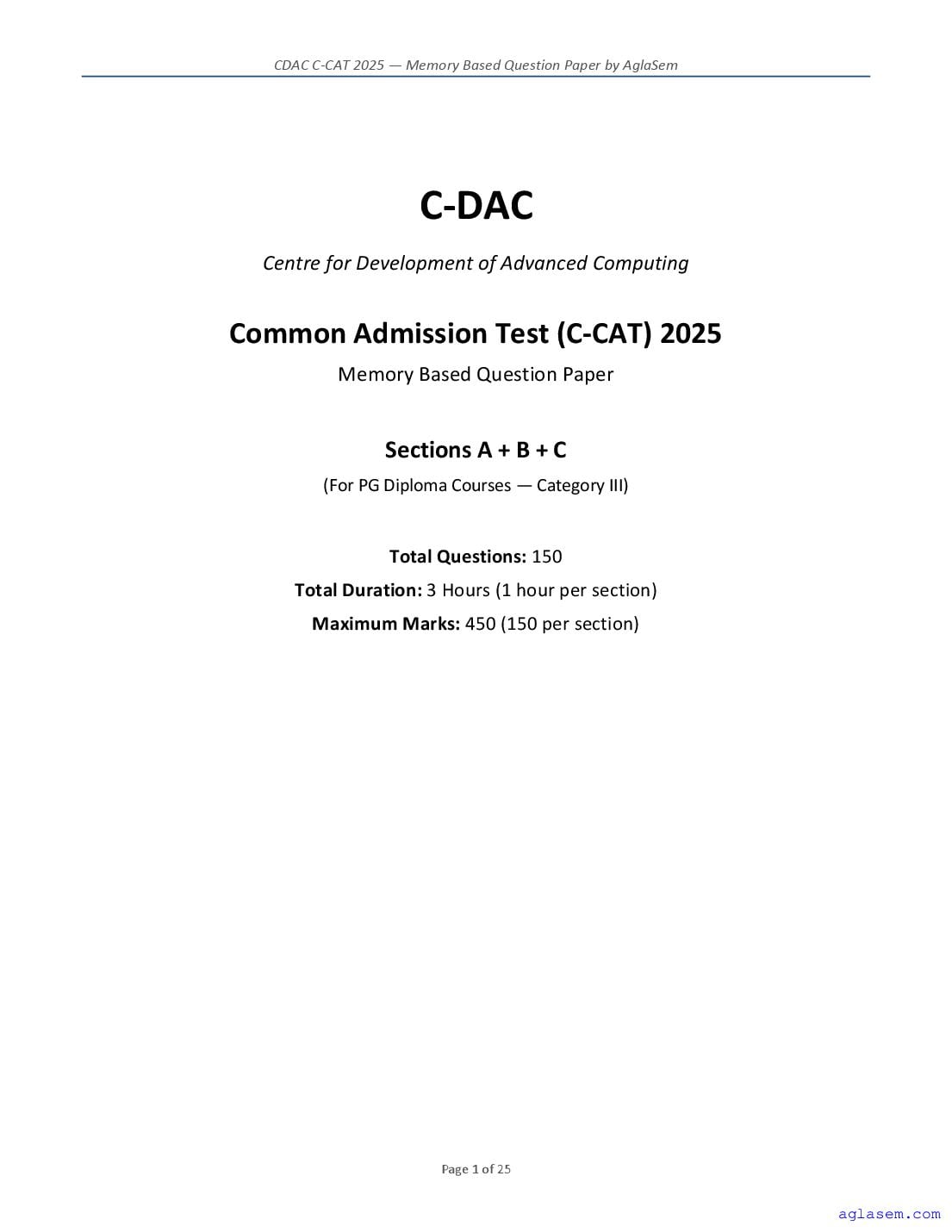
Centre for Development of Advanced Computing
Common Admission Test (C-CAT) 2025
Memory Based Question Paper
Sections A + B + C
(For PG Diploma Courses — Category III)
Total Questions: 150
Total Duration: 3 Hours (1 hour per section)
Maximum Marks: 450 (150 per section)
Page 1 of 25
Page 2
1. The C-CAT consists of three test papers — Section A, Section B and Section C. Each section is of one (1) hour
duration.
2. Every section contains 50 objective-type multiple-choice questions. Each question carries four answer choices
of which exactly one is correct.
3. Marking scheme: +3 marks for every correct answer, −1 mark for every wrong answer, and 0 marks for an
unattempted question.
4. The maximum mark obtainable in any one section of C-CAT is 150.
5. Candidates applying for Category I courses (e.g. PG Diploma in Geoinformatics) must appear for Section A
only.
6. Candidates applying for Category II courses (e.g. PG Diploma in Advanced Computing) must appear for
Sections A and B.
7. Candidates applying for Category III courses (e.g. PG Diploma in Embedded Systems Design, VLSI Design) must
appear for Sections A, B and C.
8. The question paper is set in English only. Use of any electronic device (calculator, mobile phone, smart-watch,
etc.) is strictly prohibited.
9. Rough work may be done on the sheets provided by the invigilator. No part of the question paper or rough
sheets is to be carried out of the examination hall.
10. In case of a tie in marks, the candidate with higher Section-A marks will be ranked higher. If tied again, the
ratio (correct answers / attempted questions) in the relevant section will be used.
Section-wise Subject Distribution
Section Subjects Covered Questions Duration
A English, Quantitative Aptitude, Reasoning 50 1 hour
B Computer Fundamentals, C Programming, Data 50 1 hour
Structures, OOP, Operating Systems, Networking
C Computer Architecture, Digital Electronics, 50 1 hour
Microprocessors
Page 2 of 25
Page 3
English, Quantitative Aptitude and Reasoning
50 questions | Duration: 1 hour | +3 / −1 marking
English Language
Q1. Choose the word most similar in meaning to ABERRATION.
(A) Conformity
(B) Standard practice
(C) Anomaly
(D) Endorsement
Q2. Choose the word most similar in meaning to LUCID.
(A) Confused
(B) Clear
(C) Bright
(D) Concealed
Q3. Choose the word most similar in meaning to OBSOLETE.
(A) Modern
(B) Outdated
(C) Useful
(D) Essential
Q4. Choose the word most similar in meaning to TENACIOUS.
(A) Weak
(B) Persistent
(C) Tender
(D) Brief
Q5. Choose the word most similar in meaning to CANDID.
(A) Frank
(B) Devious
(C) Shy
(D) Reserved
Q6. Choose the word OPPOSITE in meaning to FRUGAL.
(A) Thrifty
(B) Economical
(C) Extravagant
(D) Cautious
Q7. Choose the word OPPOSITE in meaning to BENEVOLENT.
(A) Kind
(B) Charitable
(C) Malicious
(D) Generous
Page 3 of 25
Page 4
(A) Plentiful
(B) Scarce
(C) Ample
(D) Sufficient
Q9. Choose the word OPPOSITE in meaning to TRANSPARENT.
(A) Clear
(B) Opaque
(C) Visible
(D) Lucid
Q10. Choose the correct preposition: "She is proficient ____ French."
(A) at
(B) in
(C) with
(D) on
Q11. Choose the correct article: "He is ____ honest man."
(A) a
(B) an
(C) the
(D) No article
Q12. Fill in the blank: "Neither the teacher nor the students ____ present for the function."
(A) was
(B) were
(C) has been
(D) is
Q13. Identify the error in the sentence: "Each of the players have a unique skill set."
(A) Each of
(B) the players
(C) have a
(D) unique skill set
Q14. Choose the one-word substitute for: "A person who knows many languages."
(A) Bilingual
(B) Linguist
(C) Polyglot
(D) Orator
Q15. Choose the one-word substitute for: "One who hates mankind."
(A) Philanthropist
(B) Misanthrope
(C) Misogynist
(D) Egoist
Page 4 of 25
Page 5
(A) Eulogy
(B) Soliloquy
(C) Extempore
(D) Rhetoric
Q17. The idiom "to bury the hatchet" means:
(A) to start a quarrel
(B) to make peace after a dispute
(C) to hide weapons
(D) to forget a promise
Q18. The idiom "a blessing in disguise" means:
(A) an obvious advantage
(B) a hidden danger
(C) an apparent misfortune that proves beneficial
(D) a wish that comes true
Q19. Change to passive voice: "The chef cooked a delicious meal."
(A) A delicious meal is cooked by the chef.
(B) A delicious meal was cooked by the chef.
(C) A delicious meal has been cooked by the chef.
(D) The chef has cooked a delicious meal.
Q20. Choose the correctly spelt word:
(A) Accomodate
(B) Acommodate
(C) Accommodate
(D) Acomodate
Quantitative Aptitude
Q21. If 5x − 3 = 2x + 12, then the value of x is:
(A) 3
(B) 4
(C) 5
(D) 6
Q22. A train travels 60 km in 1 hour 30 minutes. Its average speed (in km/h) is:
(A) 30
(B) 40
(C) 45
(D) 50
Q23. Simplify: (√49 + √25) × √16
(A) 36
(B) 42
(C) 48
Page 5 of 25
Page 6
Q24. The compound interest on ₹10,000 at 5% per annum for 2 years (compounded annually) is:
(A) ₹1000
(B) ₹1025
(C) ₹1050
(D) ₹1100
Q25. In a class the ratio of boys to girls is 3 : 2 and there are 30 students in total. The number of girls is:
(A) 10
(B) 12
(C) 15
(D) 18
Q26. A shopkeeper marks his goods 20% above cost and allows a discount of 10%. His profit percentage is:
(A) 6%
(B) 8%
(C) 10%
(D) 12%
Q27. The average of five consecutive integers is 15. The largest of these integers is:
(A) 15
(B) 16
(C) 17
(D) 18
Q28. If a : b = 3 : 4 and b : c = 5 : 6, then a : c equals:
(A) 5 : 8
(B) 3 : 6
(C) 15 : 18
(D) 9 : 16
Q29. 12 men complete a piece of work in 9 days. The number of days in which 18 men can complete the same
work is:
(A) 5
(B) 6
(C) 7
(D) 8
Q30. Two pipes A and B can fill a tank in 6 hours and 8 hours respectively. If both are opened together, the tank
will be full in approximately:
(A) 3 hours 25 minutes
(B) 3 hours 26 minutes
(C) 4 hours
(D) 4 hours 12 minutes
Q31. The simple interest on ₹5,000 at 4% per annum for 3 years is:
(A) ₹400
(B) ₹500
Page 6 of 25
Page 7
(D) ₹700
Q32. The angles of a triangle are in the ratio 2 : 3 : 4. The largest angle is:
(A) 60°
(B) 70°
(C) 80°
(D) 90°
Q33. The perimeter of a square is 64 cm. Its area (in sq. cm) is:
(A) 196
(B) 225
(C) 256
(D) 324
Q34. A box contains 5 red and 3 blue balls. The probability of drawing a red ball at random is:
(A) 3/8
(B) 5/8
(C) 3/5
(D) 5/3
Q35. A boat travels 12 km downstream and returns. If still-water speed is 5 km/h and stream speed is 1 km/h,
total time taken is:
(A) 4 hours
(B) 5 hours
(C) 6 hours
(D) 7 hours
Logical Reasoning
Q36. If WATER is coded as XBUFS, how is FIRE coded?
(A) GJSF
(B) GJTF
(C) GJSE
(D) FJSG
Q37. Find the next number in the series: 2, 6, 12, 20, 30, ?
(A) 36
(B) 40
(C) 42
(D) 44
Q38. A is the brother of B. B is the daughter of C. How is A related to C?
(A) Son
(B) Daughter
(C) Nephew
(D) Cannot be determined
Q39. Pointing to a man, Anjali said, "He is the only son of my mother's father." How is the man related to Anjali?
Page 7 of 25
Page 8
(B) Uncle
(C) Grandfather
(D) Brother
Q40. If South-East becomes North and North-East becomes West, then what does West become?
(A) North-East
(B) North-West
(C) South-East
(D) South-West
Q41. Statements: All cats are dogs. All dogs are animals.
Conclusion: All cats are animals.
(A) Conclusion follows
(B) Conclusion does not follow
(C) Cannot be determined
(D) Data inadequate
Q42. Find the odd one out:
(A) Apple
(B) Banana
(C) Mango
(D) Carrot
Q43. Doctor : Hospital :: Teacher : ?
(A) Education
(B) School
(C) Student
(D) Book
Q44. If in a code A=1, B=2 ... Z=26, then the sum of letters in the word GIRL is:
(A) 44
(B) 45
(C) 46
(D) 47
Q45. Arrange the following in a logical sequence:
1) Cocoon 2) Egg 3) Caterpillar 4) Butterfly
(A) 2, 3, 1, 4
(B) 1, 2, 3, 4
(C) 2, 1, 3, 4
(D) 4, 3, 1, 2
Q46. Find the next term: 3, 7, 15, 31, ?
(A) 47
(B) 55
(C) 63
(D) 127
Page 8 of 25
Page 9
(A) EV
(B) EU
(C) FV
(D) EW
Q48. At 3:15, the angle between the hour hand and the minute hand of a clock is:
(A) 0°
(B) 7.5°
(C) 15°
(D) 22.5°
Q49. A man walks 5 km East, turns left and walks 3 km, then turns left and walks 5 km. How far is he from the
starting point and in which direction?
(A) 3 km East
(B) 3 km West
(C) 3 km North
(D) 5 km South
Q50. Choose the figure that does NOT belong with the others (verbal analogy): Pen, Pencil, Marker, Eraser.
(A) Pen
(B) Pencil
(C) Marker
(D) Eraser
Page 9 of 25
Page 10
Computer Fundamentals, C Programming, Data Structures, OOP, Operating Systems, Networking
50 questions | Duration: 1 hour | +3 / −1 marking
Computer Fundamentals
Q1. Which of the following is a volatile memory?
(A) ROM
(B) Hard Disk
(C) RAM
(D) Flash Drive
Q2. Standard ASCII uses how many bits to represent a character?
(A) 4
(B) 7
(C) 16
(D) 32
Q3. The binary equivalent of decimal 25 is:
(A) 11001
(B) 10011
(C) 10101
(D) 11010
Q4. Which of the following gates is known as a universal gate?
(A) AND
(B) OR
(C) NOT
(D) NAND
Q5. Full form of URL is:
(A) Uniform Resource Locator
(B) Universal Resource Link
(C) Uniform Routing Locator
(D) Unified Resource List
Q6. Which of the following is NOT an operating system?
(A) Linux
(B) Windows 10
(C) MS Word
(D) macOS
Q7. 1 Kilobyte (KB) equals how many bytes?
(A) 1000
(B) 1024
(C) 1048
(D) 8000
Page 10 of 25
Page 11
(A) High-level language to machine code
(B) Machine code to high-level language
(C) Assembly to high-level language
(D) Bytecode to assembly
C Programming
Q9. What does the following code print?
int x = 5;
printf("%d", ++x);
(A) 4
(B) 5
(C) 6
(D) Compilation error
Q10. Output of:
int a = 10, b = 3;
printf("%d", a % b);
(A) 0
(B) 1
(C) 3
(D) 10
Q11. On a typical 64-bit system, the size of an int in C is:
(A) 1 byte
(B) 2 bytes
(C) 4 bytes
(D) 8 bytes
Q12. Which of the following is NOT a valid C identifier?
(A) _value
(B) total1
(C) 2name
(D) rate_of_pay
Q13. Which storage-class specifier limits the scope of a variable to the file in which it is declared?
(A) auto
(B) extern
(C) register
(D) static
Q14. The function malloc() returns:
(A) int *
(B) char *
(C) void *
Page 11 of 25
Page 12
Q15. Which header file must be included to use printf()?
(A) conio.h
(B) stdio.h
(C) stdlib.h
(D) string.h
Q16. The default initial value of a global static int variable is:
(A) Undefined
(B) 0
(C) 1
(D) −1
Q17. Which loop in C is guaranteed to execute its body at least once?
(A) for
(B) while
(C) do-while
(D) if
Q18. What does the following snippet print?
char s[] = "HELLO";
printf("%d", strlen(s));
(A) 4
(B) 5
(C) 6
(D) Compilation error
Q19. The keyword typedef in C is used to:
(A) Declare global variables
(B) Create a new data type alias
(C) Allocate memory
(D) Define a macro
Q20. Which is the correct way to declare a pointer to int?
(A) int p*;
(B) ptr int p;
(C) int *p;
(D) *int p;
Q21. A function that calls itself directly or indirectly is called:
(A) Inline function
(B) Recursive function
(C) Static function
(D) Friend function
Q22. The macro NULL is typically defined in:
(A) stdio.h
Page 12 of 25
Page 13
(C) ctype.h
(D) time.h
Q23. What is the output?
int a = 5;
printf("%d", a == 5 ? a + 1 : a - 1);
(A) 4
(B) 5
(C) 6
(D) 7
Data Structures
Q24. The time complexity of binary search on a sorted array of n elements is:
(A) O(n)
(B) O(n log n)
(C) O(log n)
(D) O(1)
Q25. A stack follows which order?
(A) FIFO
(B) LIFO
(C) LILO
(D) Random
Q26. Which data structure is used to implement BFS of a graph?
(A) Stack
(B) Queue
(C) Linked list
(D) Tree
Q27. The worst-case time complexity of QuickSort is:
(A) O(n)
(B) O(n log n)
(C) O(n²)
(D) O(2ⁿ)
Q28. Which sorting algorithm is best for an already (almost) sorted array?
(A) Merge sort
(B) Quick sort
(C) Insertion sort
(D) Heap sort
Q29. The maximum number of nodes in a binary tree of height h (root at h = 0) is:
(A) 2ʰ
(B) 2ʰ − 1
Page 13 of 25
Page 14
(D) h²
Q30. Accessing the nth element of a singly linked list takes time:
(A) O(1)
(B) O(log n)
(C) O(n)
(D) O(n²)
Q31. Trying to push onto a full stack causes:
(A) Stack underflow
(B) Stack overflow
(C) Memory leak
(D) No effect
Q32. The postfix expression of A + B * C is:
(A) ABC*+
(B) AB+C*
(C) A+BC*
(D) *+ABC
Q33. The average-case lookup time in a well-designed hash table is:
(A) O(1)
(B) O(log n)
(C) O(n)
(D) O(n²)
Object-Oriented Programming Concepts
Q34. Which OOP feature hides internal details and exposes only necessary functionality?
(A) Inheritance
(B) Encapsulation
(C) Polymorphism
(D) Abstraction
Q35. Which of these enables a class to acquire properties of another class?
(A) Encapsulation
(B) Abstraction
(C) Inheritance
(D) Overloading
Q36. Function overloading is an example of:
(A) Runtime polymorphism
(B) Compile-time polymorphism
(C) Inheritance
(D) Encapsulation
Q37. Virtual functions in C++ are used to implement:
Page 14 of 25
Page 15
(B) Runtime polymorphism
(C) Multiple inheritance
(D) Static binding
Q38. A constructor that takes no arguments is called:
(A) Parameterised constructor
(B) Copy constructor
(C) Default constructor
(D) Virtual constructor
Q39. In C++, which of the following CANNOT be virtual?
(A) Constructor
(B) Destructor
(C) Member function
(D) Public method
Q40. Which of the following is NOT an object-oriented language?
(A) C++
(B) Java
(C) C
(D) Python
Operating Systems
Q41. Mutual exclusion in a critical section is best achieved using:
(A) Pipes
(B) Mutex / Semaphore
(C) DMA
(D) Interrupts
Q42. Banker's algorithm is used for:
(A) Process scheduling
(B) Memory allocation
(C) Deadlock avoidance
(D) Page replacement
Q43. Which of the following is NOT a process state?
(A) New
(B) Ready
(C) Running
(D) Compiled
Q44. Demand paging is associated with:
(A) Virtual memory
(B) File systems
(C) Caching
(D) Pipelining
Page 15 of 25
Page 16
(A) Burst time
(B) Priority
(C) Time quantum
(D) Arrival time
Q46. Thrashing in an operating system is caused by:
(A) Excessive CPU scheduling
(B) Excessive paging activity
(C) Low interrupt rate
(D) Deadlock detection
Data Communication & Networking
Q47. How many layers are there in the OSI reference model?
(A) 4
(B) 5
(C) 7
(D) 8
Q48. The default TCP port number for HTTP is:
(A) 21
(B) 23
(C) 80
(D) 443
Q49. An IPv4 address consists of how many bits?
(A) 16
(B) 24
(C) 32
(D) 64
Q50. Which transport layer protocol is connectionless?
(A) TCP
(B) UDP
(C) FTP
(D) HTTP
Page 16 of 25
Page 17
Computer Architecture, Digital Electronics and Microprocessors
50 questions | Duration: 1 hour | +3 / −1 marking
Computer Architecture
Q1. In Von Neumann architecture:
(A) Data and instructions are stored in separate memories
(B) Data and instructions share the same memory
(C) Only data is stored in memory
(D) Only instructions are stored in memory
Q2. Cache memory is faster than:
(A) CPU registers
(B) Main memory (RAM)
(C) L1 cache
(D) All of the above
Q3. The primary benefit of instruction pipelining is improved:
(A) Clock period
(B) Instruction set size
(C) Throughput
(D) Memory access time
Q4. In a cache, if the hit ratio is 0.9, hit time is 2 ns and miss penalty is 100 ns, the average memory access time
is:
(A) 10 ns
(B) 12 ns
(C) 20 ns
(D) 100 ns
Q5. A direct-mapped cache has a total size of 1 KB with a block size of 16 bytes. The number of cache lines is:
(A) 32
(B) 64
(C) 128
(D) 256
Q6. A classic 5-stage RISC pipeline has the stages:
(A) IF, ID, EX, MEM, WB
(B) FETCH, DECODE, ALU
(C) IF, EX, WB
(D) DECODE, EX, MEM
Q7. Which of the following is NOT a type of pipeline hazard?
(A) Structural
(B) Data
(C) Control
Page 17 of 25
Page 18
Q8. Branch prediction is used primarily to mitigate:
(A) Data hazards
(B) Control hazards
(C) Structural hazards
(D) Cache misses
Q9. DMA transfers are advantageous because they:
(A) Bypass the CPU during data transfer
(B) Increase the CPU clock rate
(C) Reduce memory size
(D) Eliminate cache misses
Q10. When multiple interrupts occur simultaneously, the one serviced first has the:
(A) Lowest priority
(B) Highest priority
(C) Random selection
(D) Earliest arrival
Q11. In a typical microprocessor, the stack pointer (SP) points to:
(A) Bottom of stack
(B) Top of stack
(C) Middle of memory
(D) Program counter
Q12. Order the memory hierarchy from fastest to slowest:
(A) Registers → Cache → Main memory → Disk
(B) Cache → Registers → Main memory → Disk
(C) Disk → Main memory → Cache → Registers
(D) Main memory → Cache → Registers → Disk
Q13. Compared to DRAM, SRAM is:
(A) Slower and cheaper
(B) Faster, more expensive, and needs no refresh
(C) Slower and requires refresh
(D) Used as main memory
Q14. The word size of a 32-bit processor (in bytes) is:
(A) 1
(B) 2
(C) 4
(D) 8
Q15. Which bus carries the memory address from the CPU?
(A) Data bus
(B) Address bus
(C) Control bus
Page 18 of 25
Page 19
Q16. The accumulator is a special register located in:
(A) Main memory
(B) Hard disk
(C) CPU
(D) I/O device
Q17. How many general-purpose registers does the MIPS architecture have?
(A) 8
(B) 16
(C) 32
(D) 64
Q18. An instruction set with very few addressing modes and fixed-length instructions is characteristic of:
(A) CISC
(B) RISC
(C) VLIW
(D) EPIC
Digital Electronics
Q19. The output of an XOR gate when both inputs are equal is:
(A) 0
(B) 1
(C) High impedance
(D) Indeterminate
Q20. The output of a NAND gate when both inputs are 1 is:
(A) 0
(B) 1
(C) Floating
(D) Don't care
Q21. Boolean simplification: A + AʹB equals:
(A) A
(B) B
(C) A + B
(D) AB
Q22. A JK flip-flop has how many possible output states?
(A) 1
(B) 2
(C) 3
(D) 4
Q23. A T flip-flop toggles its output when T equals:
(A) 0
Page 19 of 25
Page 20
(C) Both 0 and 1
(D) Neither
Q24. An n-to-2ⁿ line decoder has:
(A) n inputs and 2ⁿ outputs
(B) 2ⁿ inputs and n outputs
(C) n inputs and n outputs
(D) 2ⁿ inputs and 2ⁿ outputs
Q25. A 4-bit ripple counter can count through how many distinct states?
(A) 4
(B) 8
(C) 15
(D) 16
Q26. A Mod-10 counter is also commonly known as a:
(A) Decade counter
(B) Ring counter
(C) Johnson counter
(D) Up/down counter
Q27. The invalid (race) input combination of an SR flip-flop using NOR gates is:
(A) S = 0, R = 0
(B) S = 0, R = 1
(C) S = 1, R = 0
(D) S = 1, R = 1
Q28. The Gray-code equivalent of the binary number 1010 is:
(A) 1100
(B) 1111
(C) 1010
(D) 0101
Q29. The hexadecimal equivalent of binary 11010110 is:
(A) C6
(B) D6
(C) E6
(D) B6
Q30. The 2's complement of the binary number 0101 is:
(A) 1010
(B) 1011
(C) 1100
(D) 1001
Q31. For odd parity, the parity bit appended to the data 1011001 is:
(A) 0
Page 20 of 25
Page 21
(C) Either 0 or 1
(D) Cannot be determined
Q32. A demultiplexer (DEMUX):
(A) Routes one input to one of several outputs
(B) Combines several inputs into one output
(C) Stores data
(D) Generates a clock
Q33. Which of the following statements about ROM is TRUE?
(A) Volatile and read/write
(B) Non-volatile and primarily read-only
(C) Volatile and read-only
(D) Non-volatile and read/write
Q34. A Schmitt trigger is primarily used for:
(A) Amplification
(B) Signal conditioning with hysteresis
(C) Memory storage
(D) Frequency division
Q35. The number of select lines needed for an 8-to-1 multiplexer is:
(A) 1
(B) 2
(C) 3
(D) 8
Q36. Half-adder is a combinational circuit that adds:
(A) Two bits without carry input
(B) Two bits with carry input
(C) Three bits
(D) Four bits
Microprocessors
Q37. The Intel 8085 is what kind of microprocessor?
(A) 4-bit
(B) 8-bit
(C) 16-bit
(D) 32-bit
Q38. The number of address lines in the 8085 microprocessor is:
(A) 8
(B) 16
(C) 20
(D) 32
Page 21 of 25
Page 22
(A) 16 KB
(B) 32 KB
(C) 64 KB
(D) 1 MB
Q40. In the 8085, the register that stores status information (such as Zero, Carry, Sign) is the:
(A) Accumulator
(B) Flag register
(C) Program counter
(D) Stack pointer
Q41. The 8086 microprocessor is a:
(A) 8-bit
(B) 16-bit
(C) 32-bit
(D) 64-bit
Q42. In the 8085, the stack grows:
(A) Upward (SP incremented)
(B) Downward (SP decremented)
(C) Both directions
(D) Does not change
Q43. The number of flag bits in the 8085 microprocessor is:
(A) 3
(B) 4
(C) 5
(D) 6
Q44. ALE in the 8085 stands for:
(A) Address Latch Enable
(B) Arithmetic Logic Extension
(C) Address Line Encoder
(D) Asynchronous Latch Enable
Q45. The instruction MVI A, 05H in 8085 performs:
(A) Adds 05H to A
(B) Moves 05H into register A
(C) Compares A with 05H
(D) Subtracts 05H from A
Q46. The number of T-states required for the opcode-fetch machine cycle in the 8085 is:
(A) 3
(B) 4
(C) 5
(D) 6
Page 22 of 25
Page 23
(A) 0024H
(B) 002CH
(C) 0034H
(D) 003CH
Q48. In the 8086, the physical address is computed as:
(A) Segment + Offset
(B) Segment × 16 + Offset
(C) Segment × 10 + Offset
(D) Segment × 8 + Offset
Q49. The total memory directly addressable by the 8086 is:
(A) 64 KB
(B) 256 KB
(C) 1 MB
(D) 16 MB
Q50. Which of the following 8085 interrupts is maskable?
(A) TRAP
(B) RST 7.5
(C) INTR
(D) Both B and C
Page 23 of 25
Page 24
(C-CAT 2025 Model Paper)
Section A — Answer Key
Q.No Ans Q.No Ans Q.No Ans Q.No Ans Q.No Ans
1 C 11 B 21 C 31 C 41 A
2 B 12 B 22 B 32 C 42 D
3 B 13 C 23 C 33 C 43 B
4 B 14 C 24 B 34 B 44 C
5 A 15 B 25 B 35 B 45 A
6 C 16 C 26 B 36 A 46 C
7 C 17 B 27 C 37 C 47 A
8 B 18 C 28 A 38 A 48 B
9 B 19 B 29 B 39 B 49 C
10 B 20 C 30 B 40 C 50 D
Section B — Answer Key
Q.No Ans Q.No Ans Q.No Ans Q.No Ans Q.No Ans
1 C 11 C 21 B 31 B 41 B
2 B 12 C 22 A 32 A 42 C
3 A 13 D 23 C 33 A 43 D
4 D 14 C 24 C 34 B 44 A
5 A 15 B 25 B 35 C 45 C
6 C 16 B 26 B 36 B 46 B
7 B 17 C 27 C 37 B 47 C
8 A 18 B 28 C 38 C 48 C
9 C 19 B 29 C 39 A 49 C
10 B 20 C 30 C 40 C 50 B
Section C — Answer Key
Q.No Ans Q.No Ans Q.No Ans Q.No Ans Q.No Ans
1 B 11 B 21 C 31 B 41 B
2 B 12 A 22 B 32 A 42 B
3 C 13 B 23 B 33 B 43 C
4 B 14 C 24 A 34 B 44 A
5 B 15 B 25 D 35 C 45 B
Page 24 of 25
Page 25
6 A 16 C 26 A 36 A 46 B
7 D 17 C 27 D 37 B 47 B
8 B 18 B 28 B 38 B 48 B
9 A 19 A 29 B 39 C 49 C
10 B 20 A 30 B 40 B 50 D
— End of Question Paper —
Page 25 of 25
Document Details
| Board / Org | Centre for Development of Advanced Computing (CDAC) |
| Exam | CDAC CAT |
| Type | Question Paper |
| Pages | 25 |
| Updated | 24 Sep 2026 |