Odisha CPET 2020 Question Paper Anthropology (Arts)
Finished viewing? Save it for later —
Download Odisha CPET 2020 Question Paper Anthropology (Arts) (PDF · 15 pages)About Odisha CPET 2020 Question Paper Anthropology (Arts)
Odisha CPET 2020 Question Paper Anthropology (Arts) is available here for free download. Published by Odisha Exams for Odisha CPET, this question paper can be viewed online or downloaded as a PDF (15 pages). Candidates preparing for Odisha CPET can use Odisha CPET 2020 Question Paper Anthropology (Arts) to understand the exam pattern, the type of questions asked, and the overall difficulty level.
Frequently Asked Questions
How can I download Odisha CPET 2020 Question Paper Anthropology (Arts)?
Open this page and click the Download button to save Odisha CPET 2020 Question Paper Anthropology (Arts) as a PDF. It is completely free on AglaSem Docs.
Is Odisha CPET 2020 Question Paper Anthropology (Arts) free to download?
Yes. Odisha CPET 2020 Question Paper Anthropology (Arts) can be viewed online and downloaded as a PDF free of cost on AglaSem Docs.
How many pages does Odisha CPET 2020 Question Paper Anthropology (Arts) have?
Odisha CPET 2020 Question Paper Anthropology (Arts) contains 15 pages, which you can read online or download together as a single PDF.
Where can I find more Odisha CPET study material?
You can find more Odisha CPET question papers, sample papers, syllabus, and answer keys on AglaSem Docs.
Odisha CPET 2020 Question Paper Anthropology (Arts) – Text
Read the full text of this question paper below — useful to quickly search, copy and reference the content online without downloading the PDF.
📄 View text version (15 pages)
Page 1
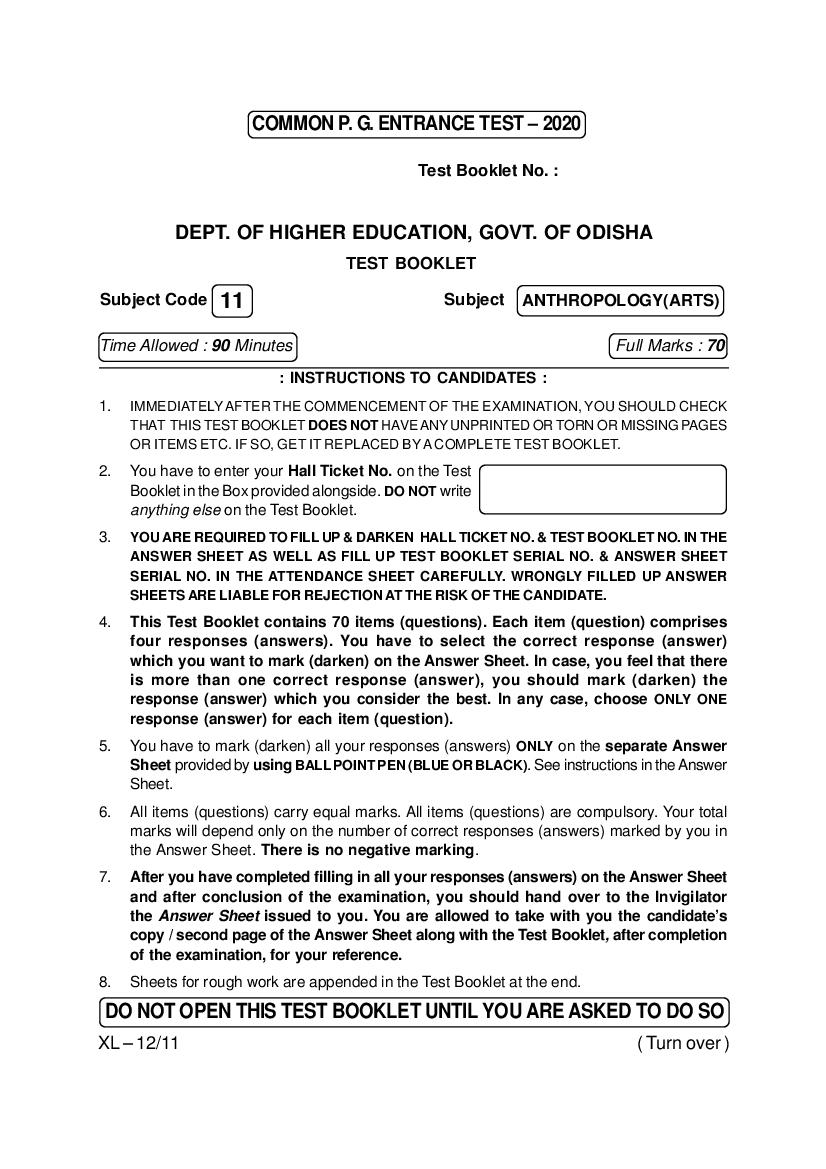
Test Booklet No. :
DEPT. OF HIGHER EDUCATION, GOVT. OF ODISHA
TEST BOOKLET
Subject Code 11 Subject ANTHROPOLOGY(ARTS)
Time Allowed : 90 Minutes Full Marks : 70
: INSTRUCTIONS TO CANDIDATES :
1. IMMEDIATELY AFTER THE COMMENCEMENT OF THE EXAMINATION, YOU SHOULD CHECK
THAT THIS TEST BOOKLET DOES NOT HAVE ANY UNPRINTED OR TORN OR MISSING PAGES
OR ITEMS ETC. IF SO, GET IT REPLACED BY A COMPLETE TEST BOOKLET.
2. You have to enter your Hall Ticket No. on the Test
Booklet in the Box provided alongside. DO NOT write
anything else on the Test Booklet.
3. YOU ARE REQUIRED TO FILL UP & DARKEN HALL TICKET NO. & TEST BOOKLET NO. IN THE
ANSWER SHEET AS WELL AS FILL UP TEST BOOKLET SERIAL NO. & ANSWER SHEET
SERIAL NO. IN THE ATTENDANCE SHEET CAREFULLY. WRONGLY FILLED UP ANSWER
SHEETS ARE LIABLE FOR REJECTION AT THE RISK OF THE CANDIDATE.
4. This Test Booklet contains 70 items (questions). Each item (question) comprises
four responses (answers). You have to select the correct response (answer)
which you want to mark (darken) on the Answer Sheet. In case, you feel that there
is more than one correct response (answer), you should mark (darken) the
response (answer) which you consider the best. In any case, choose ONLY ONE
response (answer) for each item (question).
5. You have to mark (darken) all your responses (answers) ONLY on the separate Answer
Sheet provided by using BALL POINT PEN (BLUE OR BLACK). See instructions in the Answer
Sheet.
6. All items (questions) carry equal marks. All items (questions) are compulsory. Your total
marks will depend only on the number of correct responses (answers) marked by you in
the Answer Sheet. There is no negative marking.
7. After you have completed filling in all your responses (answers) on the Answer Sheet
and after conclusion of the examination, you should hand over to the Invigilator
the Answer Sheet issued to you. You are allowed to take with you the candidate’s
copy / second page of the Answer Sheet along with the Test Booklet, after completion
of the examination, for your reference.
8. Sheets for rough work are appended in the Test Booklet at the end.
DO NOT OPEN THIS TEST BOOKLET UNTIL YOU ARE ASKED TO DO SO
XL – 12/11 ( Turn over )
Page 2
Page 3
(A) Franz Boas
(B) Fredrich Blumenbach
(C) C. R. Darwin
(D) E. B. Taylor
2. Who introduced the concept of ‘New Physical Anthropology’ ?
(A) Franz Boas
(B) E. B. Taylor
(C) R. M. Sarkar
(D) S. L. Washburn
3. The measurement of human body is known as ——————.
(A) Osteology
(B) Demography
(C) Anthropometry
(D) Gerontology
4. The study of ancient human fossils is known as ——————.
(A) Primatology
(B) Evolution
(C) Palaeoanthropology
(D) Anatomy
5. The total number chromosomes present in a human cell ——————.
(A) 23
(B) 46
(C) 48
(D) 22
6. Who is the author of the book “On the Origin of Species by means of Natural Selection’’ ?
(A) J. B Lamarck
(B) C. R Darwin
(C) Thomas Huxley
(D) Thomas Malthus
XL – 12/11 (3) ( Turn over )
Page 4
(A) Nucleus
(B) Endoplasmic Reticulum
(C) Chromosomes
(D) Mitochondria
8. Man belongs to the order ——————.
(A) Chordata
(B) Vertebrata
(C) Mammalian
(D) Primate
9. ‘Erthroblasosis foetalis’ is caused due to the incompatibility of ——————.
(A) ABO blood group
(B) Rh blood group
(C) MNS blood group
(D) Lewis and Duffy blood group
10. Body Mass Index (BMI) is :
(A) Height (cm)/Weight(Kg)
(B) Weight(Kg)/Height(cm)
(C) Height(m)/Weight(Kg)2
(D) Weight(Kg)/Height(m)2
11. The term ‘anthropoid’ refers to a unit of classification that includes :
(A) Monkeys and apes but not human
(B) Apes and humans but not monkeys
(C) Monkeys, apes and humans
(D) Lemurs, lorises, monkeys, apes and humans
12. Who substituted the term bride-price with bride-wealth ?
(A) M.N Srinivas
(B) S. C. Roy
(C) L.H.Morgan
(D) E. E. Evans-Pritchard
XL – 12/11 (4) ( Continued )
Page 5
(A) Ethnic group
(B) Class
(C) Clan
(D) Caste
14. Which of these is typically an ‘achieved’ status in most societies ?
(A) Age
(B) Education
(C) Gender
(D) Race
15. The ability to move or change one’s position in a system of social inequality is called :
(A) Social mobility
(B) Social institution
(C) Social stratification
(D) Social status
16. —————— is the systematic study of human behaviour in social and cultural
context.
(A) Applied Anthropology
(B) Sociology
(C) Socio-cultural Anthropology
(D) Psychology
17. Who has defined anthropology as ‘Mirror of Man’ ?
(A) B. Malinowski
(B) C. Kluckhohn
(C) A. Kroeber
(D) A. Radcliffe Brown
18. The author of Homo Hierarchicus is ——————.
(A) Wilbert Moore
(B) Richard B. Davis
(C) Louis Dumont
(D) None of these
XL – 12/11 (5) ( Turn over )
Page 6
(A) Physical proximity among group members
(B) Large size of the group
(C) Personal relationships
(D) Control over the members
20. Family is a ——————.
(A) Social Organization
(B) Social Institution
(C) Association
(D) Secondary Group
21. Which of the following is a component of ethnographic research ?
(A) Participant observation
(B) interviews, and/or documentary analysis
(C) Survey
(D) All of these
22. The study of the material culture of past people is called ——————.
(A) ethnology
(B) archaeology
(C) ethnography
(D) analogy
23. Any portable object made or altered by human hands is called an ——————.
(A) Artefact
(B) Art
(C) Antler
(D) Ash mound
24. Similar artefacts which are made of the same material found at a site is called as an
——————.
(A) Arrow
(B) Industry
(C) Assemblage
(D) Aggregate
XL – 12/11 (6) ( Continued )
Page 7
(A) Radiocarbon
(B) Fission track
(C) Thermo luminescence
(D) Palaeontology
26. A blade is a ——————.
(A) blade tool
(B) flake tool
(C) core tool
(D) bone tool
27. Burin may have been used as —————— tools.
(A) a cutting
(B) a polishing
(C) an engraving
(D) a grinding
28. Chronologically arrange the glacial period of Europe :
(A) Gunz – Riss- Mindel- Wurm
(B) Riss- Gunz- Mindel-Wurm
(C) Gunz- Mindel- Riss- Wurm
(D) Wurm- Riss- Gunz- Mindel
29. Palynology is the study of ——————.
(A) Pollens
(B) Fossils
(C) Skeletal remains
(D) Tree rings
30. Which among the following is a Neolithic tool ?
(A) Adze
(B) Handaxe
(C) Cleaver
(D) Knife
XL – 12/11 (7) ( Turn over )
Page 8
(A) Soan Valley
(B) Breede River Valley
(C) Rift Valley
(D) Nile River Valley
32. The Prehistoric site of Dmanisi is located at ——————.
(A) Turkey
(B) Georgia
(C) Armenia
(D) Azerbaijan
33. Khasi language comes under which linguistic family ?
(A) Austro Asiatic
(B) Dravidian
(C) Indo-European
(D) Tibeto-Burman
34. Which one of the following is known as close category ?
(A) Family
(B) Class
(C) Caste
(D) Society
35. Who gave the concept of Sanskritization ?
(A) L. P. Vidyarthi
(B) Leela Dube
(C) S. C. Roy
(D) M. N. Srinivas
36. Which state has the highest number of PVTGs in India ?
(A) Rajasthan
(B) Odisha
(C) Madhya Pradesh.
(D) Nagaland
XL – 12/11 (8) ( Continued )
Page 9
(A) Horticulture
(B) Agriculture
(C) Shifting Cultivation
(D) Organic Cultivation
38. Who gave the concept of Nature-Man-Spirit Complex ?
(A) L.P. Vidyarthi
(B) Leela Dube
(C) S.C Roy
(D) M.N Srinivas
39. Which is not the feature of Dominant Caste ?
(A) Decision making power
(B) Numerical Strength
(C) High Education status
(D) High Social position
40. Article 341 empowers the president for ——————.
(A) Making notification of SC
(B) Making notification of ST
(C) Both SC and ST
(D) PVTGs
41. The three primary races of mankind are ——————.
(A) Caucasoid, Mongoloid, Negroid
(B) Caucasoid, Australoid, Negroid
(C) Mongoloid, Negroid, Australoid
(D) Negroid, Australoid, Bantu
42. Among the living apes, the genetically closest to humans is ——————.
(A) Gorilla
(B) Chimpanzee
(C) Gibbon
(D) Orangutan
XL – 12/11 (9) ( Turn over )
Page 10
—————.
(A) Stereoscopic vision
(B) Dichromatic vision
(C) Panoramic vision
(D) Binocular vision
44. How many number of Scheduled Tribe reside in the state of Odisha ?
(A) 52
(B) 62
(C) 61
(D) 71
45. The National Tribal Policy was drafted in the year ——————.
(A) 2010
(B) 2005
(C) 2006
(D) 2011
46. The protest against the Vedanta Alumina Limited at Lanjigarh in Kalahandi district
was led by the —————— tribes.
(A) Gadaba
(B) Paraja
(C) Kondh
(D) Bonda
47. Who coined the term ecosystem ?
(A) Ernst Haeckel
(B) A. G. Tansley
(C) Marvin Haris
(D) Julian Steward
48. Hypoxia is associated with —————— environment.
(A) High altitude
(B) Desert
(C) Cold
(D) Rainforest
XL – 12/11 ( 10 ) ( Continued )
Page 11
(A) Acclimatization
(B) Adaptation
(C) adaptability
(D) Acculturation
50. The scientific study or diagnostic examination of blood serum is known as
——————.
(A) Biology
(B) Serology
(C) Morphology
(D) Physiology
51. In UNESCO statements of race, UNESCO stands for :
(A) United Nations Educational, Scientific and Cultural Organization
(B) United Nations Economic, Scientific and Cultural Organization
(C) United Nations Educational, Social and Cultural Organization
(D) United Nations Economic, Social and Cultural Organization
52. What is a DNA marker ?
(A) A gene or DNA sequence
(B) Cell
(C) Blood groups
(D) Dermatoglyphics
53. Who among the following is regarded as an arm-chair anthropologist ?
(A) Edmund Leach
(B) James Frazer
(C) Evans-Prichard
(D) B. Malinowski
54. Claude Levi-Strauss is closely associated with the theoretical perspective of :
(A) Cultural evolution
(B) Social Darwinism
(C) Functionalism
(D) Structuralism
XL – 12/11 ( 11 ) ( Turn over )
Page 12
(A) B. Malinowski
(B) Julian Steward
(C) L. H. Morgan
(D) Leslie White
56. The study of growth is also known as :
(A) Auxolology
(B) Anatomy
(C) Morphology
(D) Palaeontology
57. Age – related deterioration process is known as :
(A) Senescence
(B) Dementia
(C) Spurt
(D) Maturation
58. “Heath and Carter” method is used for studying :
(A) Human Physiology
(B) Human Physique
(C) Human Growth
(D) Human Nutrition Status
59. Research is ——————.
(A) Searching again and again
(B) Finding solution to any problem
(C) Working in a scientific way to search for truth of any problem
(D) None of these
60. Inductive logic proceeds from :
(A) General to General
(B) Particular to General
(C) General to Particular
(D) Particular to Particular
XL – 12/11 ( 12 ) ( Continued )
Page 13
(A) Raw Data
(B) Processed Data
(C) Input data
(D) Organized data
62. The half-life period of radio carbon dating is —————— years.
(A) 5730 ± 40
(B) 1250
(C) 5930 ± 40
(D) 10000
63. Who conducted the Yale Cambridge Expedition at Potwar region ?
(A) N.K. Bose and D. Sen
(B) H. de Terra and T.T. Paterson
(C) H. D. Sankalia
(D) R.D. Banerjee and V.N Mishra
64. Kuliana site belongs to which lithic culture ?
(A) Palaeolithic
(B) Mesolithic
(C) Neolithic
(D) Chalcolithic
65. Who among the following proposed the term ‘Action Anthropology’ ?
(A) Karl Marx
(B) Sol Tax
(C) Marx Weber
(D) R. Ottenburg
66. The United Nations Conference on Sustainable Development (UNCSD) is also known
as :
(A) Kyoto Protocol
(B) Agenda 21
(C) Sustainable Development Goals
(D) Rio 2012
XL – 12/11 ( 13 ) ( Turn over )
Page 14
(A) Ethnography
(B) Visual Anthropology
(C) Somatoscopy
(D) Applied Anthropology
68. The place where skull bones fuses are known as :
(A) Sutures
(B) Epiphysis
(C) Anatomy
(D) Diaphysis
69. —————— is the study of the ways in which various processes affect the skeleton
after death and it is used to asses natural bone damage done by human activity.
(A) Bioarcheology
(B) Morphology
(C) Taphonomy
(D) Odontology
70. Odontology deals with ——————.
(A) Teeth
(B) Bones
(C) Saliva
(D) Serum
XL – 12/11 ( 14 ) ( Continued )
Page 15
XL – 12/11 (540) ( 15 ) Anthropology (Arts)
Document Details
| Board / Org | Odisha Exams |
| Exam | Odisha CPET |
| Type | Question Paper |
| Pages | 15 |
| Updated | 22 Jul 2026 |