Odisha CPET 2020 Question Paper Anthropology (Science)
Finished viewing? Save it for later —
Download Odisha CPET 2020 Question Paper Anthropology (Science) (PDF · 15 pages)About Odisha CPET 2020 Question Paper Anthropology (Science)
Odisha CPET 2020 Question Paper Anthropology (Science) is available here for free download. Published by Odisha Exams for Odisha CPET, this question paper can be viewed online or downloaded as a PDF (15 pages). Candidates preparing for Odisha CPET can use Odisha CPET 2020 Question Paper Anthropology (Science) to understand the exam pattern, the type of questions asked, and the overall difficulty level.
Frequently Asked Questions
How can I download Odisha CPET 2020 Question Paper Anthropology (Science)?
Open this page and click the Download button to save Odisha CPET 2020 Question Paper Anthropology (Science) as a PDF. It is completely free on AglaSem Docs.
Is Odisha CPET 2020 Question Paper Anthropology (Science) free to download?
Yes. Odisha CPET 2020 Question Paper Anthropology (Science) can be viewed online and downloaded as a PDF free of cost on AglaSem Docs.
How many pages does Odisha CPET 2020 Question Paper Anthropology (Science) have?
Odisha CPET 2020 Question Paper Anthropology (Science) contains 15 pages, which you can read online or download together as a single PDF.
Where can I find more Odisha CPET study material?
You can find more Odisha CPET question papers, sample papers, syllabus, and answer keys on AglaSem Docs.
Odisha CPET 2020 Question Paper Anthropology (Science) – Text
Read the full text of this question paper below — useful to quickly search, copy and reference the content online without downloading the PDF.
📄 View text version (15 pages)
Page 1
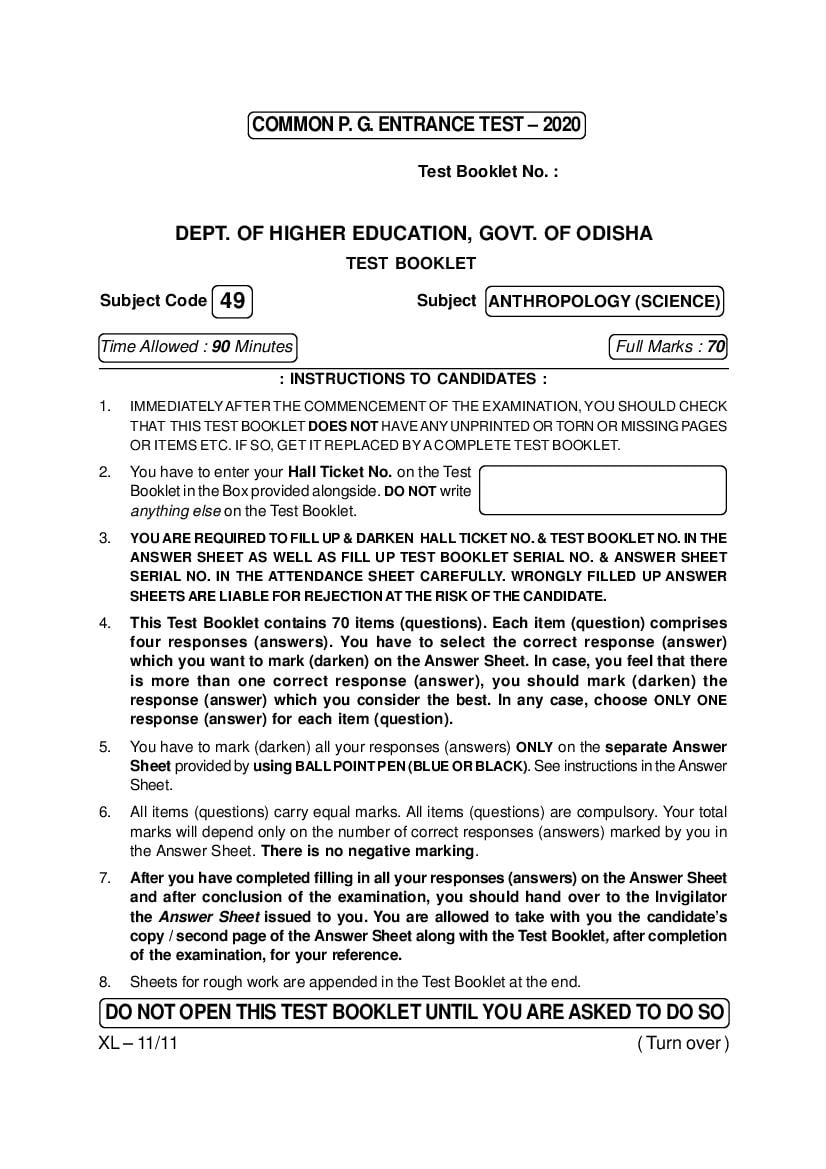
Test Booklet No. :
DEPT. OF HIGHER EDUCATION, GOVT. OF ODISHA
TEST BOOKLET
Subject Code 49 Subject ANTHROPOLOGY (SCIENCE)
Time Allowed : 90 Minutes Full Marks : 70
: INSTRUCTIONS TO CANDIDATES :
1. IMMEDIATELY AFTER THE COMMENCEMENT OF THE EXAMINATION, YOU SHOULD CHECK
THAT THIS TEST BOOKLET DOES NOT HAVE ANY UNPRINTED OR TORN OR MISSING PAGES
OR ITEMS ETC. IF SO, GET IT REPLACED BY A COMPLETE TEST BOOKLET.
2. You have to enter your Hall Ticket No. on the Test
Booklet in the Box provided alongside. DO NOT write
anything else on the Test Booklet.
3. YOU ARE REQUIRED TO FILL UP & DARKEN HALL TICKET NO. & TEST BOOKLET NO. IN THE
ANSWER SHEET AS WELL AS FILL UP TEST BOOKLET SERIAL NO. & ANSWER SHEET
SERIAL NO. IN THE ATTENDANCE SHEET CAREFULLY. WRONGLY FILLED UP ANSWER
SHEETS ARE LIABLE FOR REJECTION AT THE RISK OF THE CANDIDATE.
4. This Test Booklet contains 70 items (questions). Each item (question) comprises
four responses (answers). You have to select the correct response (answer)
which you want to mark (darken) on the Answer Sheet. In case, you feel that there
is more than one correct response (answer), you should mark (darken) the
response (answer) which you consider the best. In any case, choose ONLY ONE
response (answer) for each item (question).
5. You have to mark (darken) all your responses (answers) ONLY on the separate Answer
Sheet provided by using BALL POINT PEN (BLUE OR BLACK). See instructions in the Answer
Sheet.
6. All items (questions) carry equal marks. All items (questions) are compulsory. Your total
marks will depend only on the number of correct responses (answers) marked by you in
the Answer Sheet. There is no negative marking.
7. After you have completed filling in all your responses (answers) on the Answer Sheet
and after conclusion of the examination, you should hand over to the Invigilator
the Answer Sheet issued to you. You are allowed to take with you the candidate’s
copy / second page of the Answer Sheet along with the Test Booklet, after completion
of the examination, for your reference.
8. Sheets for rough work are appended in the Test Booklet at the end.
DO NOT OPEN THIS TEST BOOKLET UNTIL YOU ARE ASKED TO DO SO
XL – 11/11 ( Turn over )
Page 2
Page 3
(A) Time and area
(B) Time and space
(C) Time and location
(D) None of these
2. According to Human Genome Project, genetic similarity among all the humans is
————.
(A) 90%
(B) 95%
(C) 95.5%
(D) 99.9%
3. The largest gene in human genome is ————.
(A) Titin
(B) Dystrophin
(C) Insulin
(D) Phosphofruckinase
4. The first draft of Human Genome Project was published in 2001 in the journal
—————.
(A) Science
(B) Cell
(C) Nature
(D) Plos Biology
5. The most important example of point mutation is found in a disease called :
(A) Thalassemia
(B) Night blindness
(C) Sickle cell anaemia
(D) Down’s syndrome
XL – 11/11 (3) ( Turn over )
Page 4
(A) Macronutrient
(B) Micronutrient
(C) Vitamins
(D) Nonessential nutrients
7. Osteoporosis can result from a lack of sufficient amounts of ————.
(A) Iron
(B) Folic acid
(C) Calcium
(D) Magnesium
8. An eating disorder typical of teenage girls who feel fat even though they are
extremely thin is ———— .
(A) Obesity
(B) Bulimia
(C) Anorexia nervosa
(D) Hypoxia
9. Human L1 and Alu are the examples of :
(A) P-elements
(B) Transposons
(C) Crossover suppressors
(D) Deletions
10. All the organisms that feed at a particular link in a food chain are called as ————.
(A) Trophic level
(B) Food web
(C) Pyramid of numbers
(D) Detrital food chain
XL – 11/11 (4) ( Continued )
Page 5
smog ?
(A) Carbon
(B) Hydrologic
(C) Nitrogen
(D) Phosphorus
12. What order do humans belong to ?
(A) Vertebrate
(B) Mammalian
(C) Hominidae
(D) Primate
13. Mitochondrial DNA is advantageous for evolutionary studies because ————.
(A) It is inserted into the X-chromosomes
(B) It evolves more slowly than the genes in the nucleus
(C) It first appeared in humans and is not found in other animals
(D) It is inherited only through female parent and thus evolves in a way that allows
tress relationship to be easily constructed
14. Ligase is used in genetic engineering to ————.
(A) Seal genes into bacterial plasmids
(B) Open bacterial plasmids
(C) Cut genes from a donor chromosome
(D) Remove cell wall from plant cells
15. Large triplet repeat expansions can be detected by ————.
(A) Polymerase chain reaction
(B) Southern blotting
(C) Western blotting
(D) Single strand conformational polymorphism analysis
XL – 11/11 (5) ( Turn over )
Page 6
————.
(A) Caping
(B) Selfing
(C) Crossing
(D) Emasculation
17. The place where skull bones fused are known as ————.
(A) Sutures
(B) Epiphysis
(C) Anatomy
(D) Diaphysis
18. The sex chromosomes of females are ———— and those of males are ————.
(A) Homologous; homologous
(B) Homologous; hemizygous
(C) Hemizygous; homologous
(D) Hemizygous; hemizygous
19. Karyotype is a ————.
(A) General term used for any type of chromosome
(B) Type of abnormal chromosome that is associated with Down’s syndrome
(C) Picture of an individual’s chromosome arranged in a standardized way
(D) None of these
20. Somatic cells reproduce by ————, while gonad cells reproduce by ————.
(A) Meiosis; mitosis
(B) Mitosis; mitosis
(C) Meiosis; meiosis
(D) Mitosis; meiosis
21. Twins that result from the splitting of one zygote are called ————.
(A) Universal
(B) Monozygotic
(C) Dizygotic
(D) None of these
XL – 11/11 (6) ( Continued )
Page 7
(A) Botany
(B) Biology
(C) Biometry
(D) Biodiversity
23. Men with red-green colour blindness inherited the gene for it from ————.
(A) Their mother
(B) Their father
(C) Either their mother or father
(D) None of these
24. Which of the following Epoch is called the “Age of Apes” ?
(A) Oligocene
(B) Eocene
(C) Pleistocene
(D) Miocene
25. Odontology deals with :
(A) Teeth
(B) Bones
(C) Saliva
(D) Serum
26. Who did the most to defend Darwin and his idea ?
(A) A. R. Wallace
(B) E. Darwin
(C) Samuel Wilberforce
(D) Thomas Huxley
27. Identify the correct sequence of the following in the descending order based on their
genetic relatedness :
(A) Gibbon-Orangutan-Gorilla- Chimpanzee-Human
(B) Gorilla-Chimpanzee-Orangutan- Human-Gibbon
(C) Human-Gorilla-Chimpanzee-Orangutan-Gorilla
(D) Human-Chimpanzee-Gorilla-Orangutan-Gibbon
XL – 11/11 (7) ( Turn over )
Page 8
(A) Auxolology
(B) Anatomy
(C) Morphology
(D) Palaeontology
29. Arrange the following pioneers in an ascending order on the basis of their contributions :
(A) Hardy-Weinberg – Watson & Crick – Karry Mullis-Mendel
(B) Watson & Crick-Hardy-Weinberg-Mendel – Karry Mullis
(C) Karry Mullis – Watson & Crick – Hardy-Weinberg – Mendel
(D) Mendel – Hardy-Weinberg – Watson &Crick – Karry Mulis
30. “Secular trend in growth” means ————.
(A) Age at menarche is increasing and children are growing taller
(B) Children are growing taller and age at menarche is decreasing
(C) Children are getting shorter and age at menarche increasing
(D) None of these
31. The average adult skeleton consists of ———— bones, however this number
———— with age.
(A) 206, increases
(B) 206, decreases
(C) 260, increases
(D) 260, decreases
32. Inbreeding and consanguinity manifest ———— to express their effect.
(A) dominant genes
(B) sex-linked genes
(C) recessive genes
(D) sex-limited genes
XL – 11/11 (8) ( Continued )
Page 9
(A) Alec Jeffreys
(B) Watson & Crick
(C) Griffith
(D) Steele & Berg
34. Jane Goodall has spent her entire life studying the behaviour of ————.
(A) Orangutans
(B) Baboon
(C) Gibbons
(D) Chimpanzees
35. The human histocompatibility complex is located on ————.
(A) Chromosome 4
(B) Chromosome 6
(C) Chromosome 17
(D) Chromosome 21
36. The chromosomal constitution of Klinefelter’s syndrome is ————.
(A) 47, XXY
(B) 47, XYY
(C) 47, XXX
(D) None of these
37. Identify the correct chronological sequence of stage of human evolution :
(A) Neanderthal man-Australopithecus-Cro-Magnon-Homo-erectus
(B) Homo-erectus-Neanderthal man-Australopithecus-Cro-Magnon
(C) Neanderthal man-Cro-Magnon-Australopithecus-Homo-erectus
(D) Australopithecus-Homo-erectus-Neanderthal man-Cro-Magnon
38. Ornithology is the ————.
(A) Study of bones
(B) Study of birds
(C) Study of smells
(D) None of these
XL – 11/11 (9) ( Turn over )
Page 10
(A) A protein substance found in the blood of some people
(B) A hormone carried by the blood
(C) The ratio of red corpuscles to white corpuscles in the blood
(D) A process that speeds up the clothing of blood
40. Eugenics is the study of ————.
(A) Altering human beings by changing their genetic components
(B) People of European origin
(C) Different races of mankind
(D) Genetic of plants
41. Which vitamin is provided by the Sunlight to the human body ?
(A) Vitamin C
(B) Vitamin B
(C) Vitamin D
(D) Vitamin A
42. Paleontology is a branch of science that deals with the ————.
(A) Behaviour of animals
(B) Origin and growth of plants
(C) The forms of life as revealed by fossils of animals or plants
(D) Formation of new stars
43. The red blood cells are in the :
(A) Heart
(B) Liver
(C) Lymph nodes
(D) Bone marrow
44. Insulin controls the metabolism of :
(A) Sugars
(B) Fats
(C) Proteins
(D) Salts
XL – 11/11 ( 10 ) ( Continued )
Page 11
blood group is A ?
(A) Group A only
(B) Group B only
(C) Group A and O
(D) Group AB only
46. Photophobia is ————.
(A) A disease caused by too much sunlight
(B) Abnormal intolerance of light
(C) The adjustment of the eye for light
(D) The ability to perceive light
47. Sphygmomanometer measures ————.
(A) Blood pressure
(B) Depth of ocean
(C) Magnetic flux
(D) Electric current
48. In which season do we need more fat ?
(A) Rainy season
(B) Spring
(C) Winter
(D) Summer
49. Small amounts of iodine are necessary in our diet to ————.
(A) Prevent pellagra
(B) Compensate for under-active the thyroid gland
(C) Stimulate clotting of blood
(D) Stimulate pituitary gland
50. Normal adult human male has ————.
(A) 8 gram of haemoglobin/100 gram of blood
(B) 14 gram of haemoglobin/100 gram of blood
(C) 18 gram of haemoglobin/100 gram of blood
(D) 24 gram of haemoglobin/100 gram of blood
XL – 11/11 ( 11 ) ( Turn over )
Page 12
(A) Haemoglobin (B) Keratin
(C) Collagen (D) Myoglobin
52. Of the following taxonomic category which is the most inclusive (i.e. the highest in
hierarchy) ?
(A) Order (B) Subspecies
(C) Class (D) Genus
53. Outer covering of virus made up of protein is called ————.
(A) Capsid (B) Coat
(C) Virion (D) Viriod
54. Pigmentation of skin is due to ————.
(A) Lymphocytes
(B) Monocytes
(C) Leucocytes
(D) Melanocytes
55. One of the following is not a function of bones :
(A) Place for muscle attachment
(B) Protection of vital organs
(C) Secretion of hormones for calcium regulation in blood and bones
(D) Production of blood corpuscles
56. ———— was the first metal used by man.
(A) Silver (B) Brass
(C) Platinum (D) Copper
57. Which of the following diseases are related to Coronavirus ?
(A) MERS (B) SARS
(C) Both (A) and (B) (D) Neither (A) nor (B)
XL – 11/11 ( 12 ) ( Continued )
Page 13
(A) Mendelian inheritance
(B) Monogenic inheritance
(C) Polygenic inheritance
(D) Complementary gene
59. Adaptive radiation is an example of ————.
(A) Divergent evolution
(B) Convergent evolution
(C) Co-evolution
(D) Parallel evolution
60. The first greatest contribution of geology to archaeology is the principle of
————.
(A) Sedimentology (B) Stratigraphy
(C) Dendrochronology (D) Pedology
61. The faunal remains are being studied to understand the change in ————.
(A) Paleo-culture (B) Paleo-environment
(C) Paleo-demography (D) Paleo-economy
62. The largest division in geological history is the ————.
(A) Eon (B) Era
(C) Period (D) Epoch
63. Cenozoic era is known as ————.
(A) Age of Marine Invertebrates
(B) Age of mammals and modern flora
(C) Age of Reptiles and Gymnosperms
(D) Age of Amphibian and Lycopods
XL – 11/11 ( 13 ) ( Turn over )
Page 14
(A) Paleopathology (B) Primatology
(C) Paleoanthropology (D) Prehistoric Archaeology
65. Which of the following is a radiometric dating method ?
(A) Archaeomagnetism (B) Varve
(C) Thermoluminiscence (D) Pottasium-Argon
66. Kuru disease in human is caused by ————.
(A) Mycoplasm (B) Virus
(C) Prions (D) Bacteria
67. The statistical study of population is called ————.
(A) Fecundity (B) Dispersion
(C) Mortality (D) Demography
68. Salt and sugar preserve foods because they ————.
(A) Make them acidic
(B) Produce a hypertonic environment
(C) Produce a hypotonic environment
(D) Deplete nutrients
69. The vector initially used in Human Genome Project was ————.
(A) Phagemid vector
(B) Yeast episomal plasmid
(C) Yeast artificial chromosome
(D) Cosmid vector
70. The first antibody to contact invading microorganism was ————.
(A) IgM (B) IgG
(C) IgA (D) IgD
XL – 11/11 ( 14 ) ( Continued )
Page 15
XL – 11/11 (420) ( 15 ) Anthroplogy (Science)
Document Details
| Board / Org | Odisha Exams |
| Exam | Odisha CPET |
| Type | Question Paper |
| Pages | 15 |
| Updated | 22 Jul 2026 |