Odisha CPET 2020 Question Paper Botany
Finished viewing? Save it for later —
Download Odisha CPET 2020 Question Paper Botany (PDF · 15 pages)About Odisha CPET 2020 Question Paper Botany
Odisha CPET 2020 Question Paper Botany is available here for free download. Published by Odisha Exams for Odisha CPET, this question paper can be viewed online or downloaded as a PDF (15 pages). Candidates preparing for Odisha CPET can use Odisha CPET 2020 Question Paper Botany to understand the exam pattern, the type of questions asked, and the overall difficulty level.
Frequently Asked Questions
How can I download Odisha CPET 2020 Question Paper Botany?
Open this page and click the Download button to save Odisha CPET 2020 Question Paper Botany as a PDF. It is completely free on AglaSem Docs.
Is Odisha CPET 2020 Question Paper Botany free to download?
Yes. Odisha CPET 2020 Question Paper Botany can be viewed online and downloaded as a PDF free of cost on AglaSem Docs.
How many pages does Odisha CPET 2020 Question Paper Botany have?
Odisha CPET 2020 Question Paper Botany contains 15 pages, which you can read online or download together as a single PDF.
Where can I find more Odisha CPET study material?
You can find more Odisha CPET question papers, sample papers, syllabus, and answer keys on AglaSem Docs.
Odisha CPET 2020 Question Paper Botany – Text
Read the full text of this question paper below — useful to quickly search, copy and reference the content online without downloading the PDF.
📄 View text version (15 pages)
Page 1
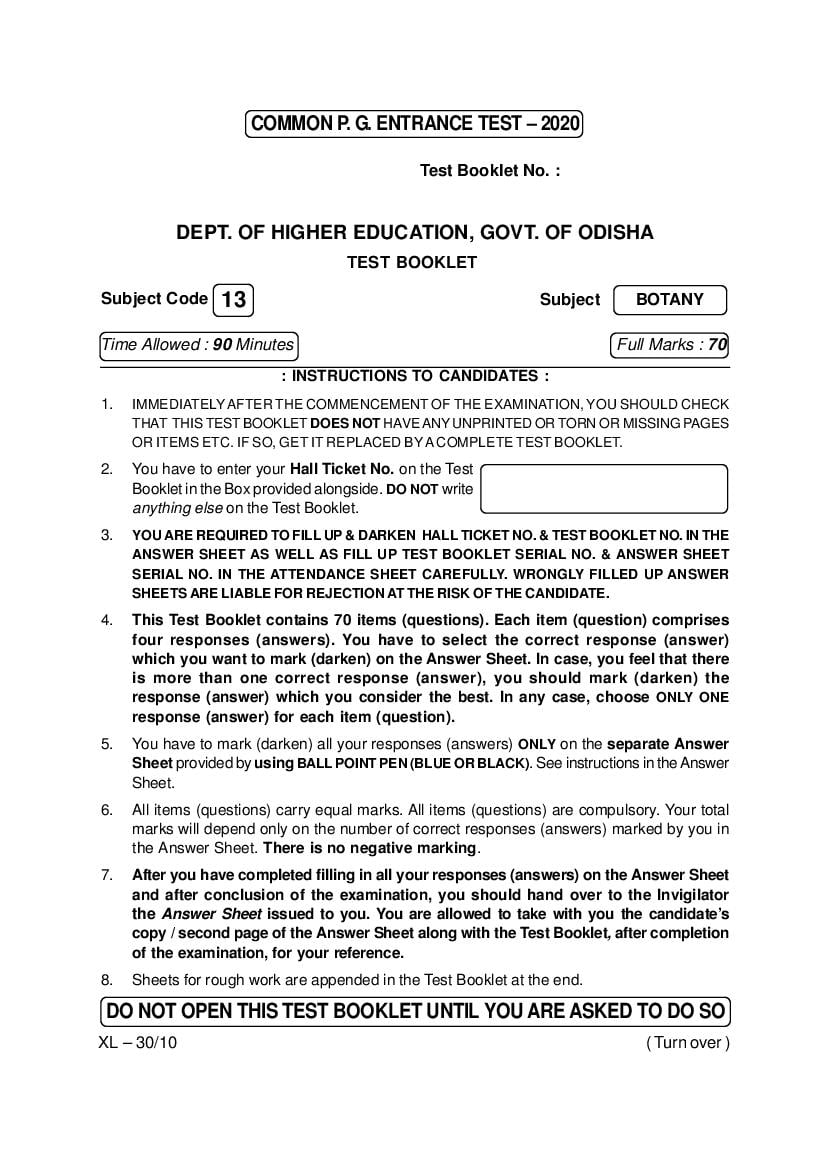
Test Booklet No. :
DEPT. OF HIGHER EDUCATION, GOVT. OF ODISHA
TEST BOOKLET
Subject Code 13 Subject BOTANY
Time Allowed : 90 Minutes Full Marks : 70
: INSTRUCTIONS TO CANDIDATES :
1. IMMEDIATELY AFTER THE COMMENCEMENT OF THE EXAMINATION, YOU SHOULD CHECK
THAT THIS TEST BOOKLET DOES NOT HAVE ANY UNPRINTED OR TORN OR MISSING PAGES
OR ITEMS ETC. IF SO, GET IT REPLACED BY A COMPLETE TEST BOOKLET.
2. You have to enter your Hall Ticket No. on the Test
Booklet in the Box provided alongside. DO NOT write
anything else on the Test Booklet.
3. YOU ARE REQUIRED TO FILL UP & DARKEN HALL TICKET NO. & TEST BOOKLET NO. IN THE
ANSWER SHEET AS WELL AS FILL UP TEST BOOKLET SERIAL NO. & ANSWER SHEET
SERIAL NO. IN THE ATTENDANCE SHEET CAREFULLY. WRONGLY FILLED UP ANSWER
SHEETS ARE LIABLE FOR REJECTION AT THE RISK OF THE CANDIDATE.
4. This Test Booklet contains 70 items (questions). Each item (question) comprises
four responses (answers). You have to select the correct response (answer)
which you want to mark (darken) on the Answer Sheet. In case, you feel that there
is more than one correct response (answer), you should mark (darken) the
response (answer) which you consider the best. In any case, choose ONLY ONE
response (answer) for each item (question).
5. You have to mark (darken) all your responses (answers) ONLY on the separate Answer
Sheet provided by using BALL POINT PEN (BLUE OR BLACK). See instructions in the Answer
Sheet.
6. All items (questions) carry equal marks. All items (questions) are compulsory. Your total
marks will depend only on the number of correct responses (answers) marked by you in
the Answer Sheet. There is no negative marking.
7. After you have completed filling in all your responses (answers) on the Answer Sheet
and after conclusion of the examination, you should hand over to the Invigilator
the Answer Sheet issued to you. You are allowed to take with you the candidate’s
copy / second page of the Answer Sheet along with the Test Booklet, after completion
of the examination, for your reference.
8. Sheets for rough work are appended in the Test Booklet at the end.
DO NOT OPEN THIS TEST BOOKLET UNTIL YOU ARE ASKED TO DO SO
XL – 30/10 ( Turn over )
Page 2
Page 3
microorganisms ?
(A) Gram-positive bacteria
(B) Gram-negative bacteria
(C) Fungi
(D) Algae
2. Which one of the following is not a Cyanobacteria ?
(A) Nostoc
(B) Spirulina
(C) Anabaena
(D) Zygnema
3. Presence of phycobilins is the typical feature of which one of the following ?
(A) Cyanophyceae and Rhodophyceae
(B) Chlorophyceae and Carophyceae
(C) Xanthophyceae and Phaeophyceae
(D) Rhodophyceae only
4. Which one of the following is branched form of starch ?
(A) Amylose
(B) Amylopectin
(C) Maltose
(D) Galactose
5. The bio-membrane exhibiting maximum fluidity is :
(A) Outer membrane of endoplasmic reticulum
(B) Chloroplast envelop
(C) Thylakoid membrane
(D) Outer membrane of mitochondria
XL – 30/10 (3) ( Turn over )
Page 4
(A) Hydrogen bond
(B) Peptide bond
(C) Amide bond
(D) Glycoside bond
7. Read the following statements and choose the appropriate combination :
(i) Passive transport does not require energy and occurs in a down-hill
direction.
(ii) Passive transport does not require energy and occurs in an up-hill
direction.
(iii) Active transport requires energy and occurs in a down-hill direction.
(iv) Active transport requires energy and occurs in an up-hill direction.
(A) Statement (i) is correct, but (ii) , (iii) and (iv) are wrong.
(B) Statement (i) and (ii) are correct, but (iii) and (iv) are wrong.
(C) Statement (i) and (iii) are correct, but (ii) and (iv) are wrong.
(D) Statement (i) and (iv) are correct, but (ii) and (iii) are wrong.
8. Which one of the following is true for Fungi ?
(A) Prokaryotic
(B) Eukaryotic
(C) Prokaryotic and lack chlorophyll
(D) Eukaryotic and lack chlorophyll
9. Rhizopus stolonifer belongs to which one of the following class ?
(A) Acrasiomycetes
(B) Zygomycetes
(C) Ascomycetes
(D) Deuteromycetes
XL – 30/10 (4) ( Continued )
Page 5
vasculature are :
(A) Algae
(B) Fungi
(C) Bryophytes
(D) Pteridophytes
11. Which one of the following is a Pteridophyte ?
(A) Oedogonium
(B) Lycopodium
(C) Riccia
(D) Gnetum
12. Presence of coralloid roots is the typical feature of :
(A) Pinus
(B) Cedrus
(C) Cycas
(D) Gnetum
13. Which one of the following is not a phloem cell ?
(A) Sieve element
(B) Companion cell
(C) Tracheid
(D) Transfer cell
14. The name of the Scientist who coined the term ‘Kranz anatomy’ in C4 plants is coined
by :
(A) Melvin Calvin
(B) Hatch and Slack
(C) G. Haberlandt
(D) Andrew A. Benson
XL – 30/10 (5) ( Turn over )
Page 6
(A) Dracaena
(B) Triticum
(C) Helianthus
(D) Cucurbita
16. Jute is a :
(A) Bast fibre from primary xylem
(B) Bast fibre from secondary xylem
(C) Bast fibre from primary phloem
(D) Bast fibre from secondary phloem
17. Green revolution is :
(A) Revolution in agriculture and crop yield
(B) Preparation of large numbers of green houses
(C) Chipko movement
(D) Revolution in chemical industries
18. Sequence on the DNA molecules that are same on both strands when read in the
same direction (either 5’ → 3’ or 3’ → 5’) are known as :
(A) Restriction Sequence
(B) Pallindrome sequence
(C) Both (A) and (B)
(D) None of the above
19. In case of incomplete dominance, the phenotypic ratio of a monohybrid cross is :
(A) 1:3
(B) 1:2:1
(C) 1 : 3 : 1
(D) 1 : 1 : 2
XL – 30/10 (6) ( Continued )
Page 7
(A) Both divisions are equational
(B) Both divisions are reductional
(C) First division is equational whereas second is reductional
(D) First division is reductional whereas second is equational
21. Which one of the following enzyme is responsible for the joining of Okazari fragment
to from the lagging strand of DNA ?
(A) DNA Polymerase-I
(B) DNA Polymerase-II
(C) DNA ligase
(D) RNAse
22. Which one of the following DNA marker used to determine the paternity of a child ?
(A) RAPD
(B) RFLP
(C) AFLP
(D) All the above
23. Which one of the following is chain initiating codon to code an amino acid during
protein synthesis ?
(A) AUG
(B) AUU
(C) AUC
(D) AGU
24. Crossing over takes place in which one of the following during prophase-I of meiosis ?
(A) Diplotene
(B) Pachytene
(C) Leptotene
(D) Diakinesis
XL – 30/10 (7) ( Turn over )
Page 8
(A) Oxygen cycle
(B) Hydrogen cycle
(C) Nitrogen cycle
(D) Phosphorus cycle
26. Ecosystem is the smallest unit of :
(A) Ionosphere
(B) Lithosphere
(C) Biosphere
(D) Mesosphere
27. Which one of the following is most primitive family among Angiosperms ?
(A) Magnoliaceae
(B) Rubiaceae
(C) Liliaceae
(D) Poaceae
28. Hutchinson system of classification of plants has been published in :
(A) Origin of Flowering plants
(B) Taxonomical classification of Flowering plants
(C) Families of Flowering plants
(D) Flowering plants and their classification
29. Which one of the following statement is incorrect about apomixes ?
(A) Formation of seeds without fertilization
(B) Meiotic division and fertilization of gametes takes place to form a zygote
(C) Apomixis produces genetically identical mother cells
(D) There is no fertilization involved in both apomixis and parthenocarpy
30. Water potential inside the xylem at the top of a tall tree during the hot sunny day time
is :
(A) Always negative
(B) Always positive
(C) Always zero
(D) Sometimes positive and sometimes negative
XL – 30/10 (8) ( Continued )
Page 9
water from the base to the top of a 100m tall tree is approximately :
(A) 0.2 Mega pascals
(B) 2.0 Mega pascals
(C) 20.0 Mega pascals
(D) 200.0 Mega pascals
32. According to Munch’s pressure flow hypothesis, the main driving force for transport
of organic solutes in the phloem tissue from source to sink is :
(A) Concentration gradient
(B) Osmotically generated pressure gradient
(C) Diffusion pressure deficit
(D) Energy through hydrolysis of ATP
33. Which one of the following is a Florigen ?
(A) Flowering Locus Q
(B) Flowering Locus R
(C) Flowering Locus S
(D) Flowering Locus T
34. Inverted stomatal cycle is the characteristic of which group of plants ?
(A) C3 plants
(B) C4 plants
(C) Both C3 and C4 plants
(D) CAM plants
35. The only enzyme in the Kreb’s cycle attached to the inner mitochondrial membrane
is :
(A) Succinate dehydrogenase
(B) Isocitrate dehydrogenase
(C) NADPH dehydrogenase
(D) Malate dehydrogenase
XL – 30/10 (9) ( Turn over )
Page 10
(A) Aerobic cells
(B) Anaerobic cells
(C) Both aerobic and anaerobic cells
(D) Neither aerobic, nor anaerobic cells
37. Which one of the following is the acceptor of CO2 in Calvin cycle ?
(A) RuBP
(B) Glyceral dehyde 3-phosphate
(C) Dihydroxy acetone phosphate
(D) Xylulose 4-phosphate
38. The variation in invitro culture is called :
(A) Mutation
(B) In-vitro variation
(C) Somaclonal variation
(D) All of the above
39. Introduction of DNA into cells by exposing to high voltage electric pulse is called :
(A) Electrofusion
(B) Electrofission
(C) Electrolysis
(D) Electroporation
40. Which one of the following bacterium is considered as ‘natural genetic engineer’ ?
(A) Agrobacterium tumefaciens
(B) Agrobacterium radiobactor
(C) Pseudomonas putida
(D) Thermus aquaticus
41. The chromosome of a typical bacterium is
(A) Circular double-stranded DNA
(B) Circular single-stranded DNA
(C) Double-helix DNA
(D) Linear single stranded DNA
XL – 30/10 ( 10 ) ( Continued )
Page 11
(A) Acrasiomycetes (B) Myxomycetes
(C) Oomycetes (D) Ascomycetes
43. The Tobacco Mosaic Virus (TMV) is approximately ———— in size.
(A) 300 X 18 nm (B) 3000 X 5 nm
(C) 800 X 10 nm (D) 700 X 30 nm
44. Which one of the following can be called a Provirus ?
(A) Free virus (B) Free DNA
(C) Primitive virus (D) Integrated viral genome
45. Fungi that lack partitions (septa) are called :
(A) Ahyphae (B) Coenocytic
(C) Conidia (D) Yeast
46. The stele present in Equisetum is a :
(A) Haplostele (B) Actinostele
(C) Plectostele (D) Siphonostele
47. In Gymnosperms, the term megasporophyll is used for :
(A) Carpels
(B) Stamens
(C) Female cone
(D) Scales
48. The final stable community in ecological succession is known as :
(A) Final community
(B) Seral community
(C) Climax community
(D) Invaded community
49. The species responsible for making the characteristics of the community are called :
(A) Extra-ordinary species
(B) Special species
(C) Dominant species
(D) High-performer species
XL – 30/10 ( 11 ) ( Turn over )
Page 12
(A) India (B) England
(C) Russia (D) Australia
51. Taxon is a :
(A) Highest rank of classification
(B) Species which are advanced in a community
(C) Simple unit of classification
(D) Group of closely related organisms
52. Binomial nomenclature refers to :
(A) Two names of the same plant
(B) One botanical name and the other common name
(C) One scientific name consists of generic name and the other species name
(D) One botanical name associated with the name of the Scientist who identified it
for the first time
53. Which one of the following is correct about a herbarium ?
(A) Herbariums are basically plant specimens that are dried and preserved on
sheets.
(B) Herbarium sheets usually contain the date and place of collection, name, family
and name of the person who collected the specimen etc.
(C) Herbarium may be used as a referral system for taxonomical studies
(D) All of the above
54. Which one of the following is the largest family among Angiosperms ?
(A) Fabaceae (B) Asteraceae
(C) Malvaceae (D) Rubiaceae
55. After fertilization, the seed coat develops from :
(A) Chalaza (B) Ovule
(C) Integuments (D) Fertilized egg cell
XL – 30/10 ( 12 ) ( Continued )
Page 13
(A) Haploid (B) Monoploid
(C) Diploid (D) Triploid
57. The transfer of pollen from the anther to the stigma is called :
(A) Air diffusion (B) Pollination
(C) Fertilization (D) Ovulisation
58. Vascular bundles are scattered in which of the following ?
(A) Dicot root (B) Dicot stem
(C) Pteridophytes (D) Monocot stem
59. Presence of collenchymatous hypodermis is the typical feature of :
(A) Dicot stem (B) Monocot stem
(C) Monocot root (D) None of the above
60. Casparian strips are present in :
(A) Epidermis (B) Cortex
(C) Endodermis (D) Vascular bundles
61. Which one of the following is not the component of water potential ?
(A) Osmotic potential (B) Action potential
(C) Pressure potential (D) Matric potential
62. Which one of the following is not responsible for guttation in grass leaves ?
(A) Root pressure (B) High transpiration
(C) Very low or no transpiration (D) Hydathodes
63. Which one of the following is involved in active transport ?
(A) Pumps (B) Channels
(C) Plasmodesmata (D) Aquaporins
64. Apoplastic phloem loading is basically :
(A) A passive process
(B) An active process
(C) Mediated by open plasmodesmata
(D) None of the above
XL – 30/10 ( 13 ) ( Turn over )
Page 14
(A) Phloem sieve elements are living cells, but xylem tracheary elements are dead
cells.
(B) Phloem sieve elements are dead cells, but xylem tracheary elements are living
cells.
(C) Both phloem sieve elements and xylem tracheary elements are living cells.
(D) Both phloem sieve and xylem tracheary elements are dead cells at functional
maturity.
66. Which one of the following is a gaseous growth retarding hormone ?
(A) IAA (B) Ethylene
(C) ABA (D) Cytokinin
67. Apical dominance in plant is controlled by :
(A) Auxin (B) Gibberellin
(C) Ethylene (D) ABA
68. ‘Km’ value in enzyme kinetics refers to :
(A) Substrate concentration at maximal velocity
(B) Substrate concentration at half maximal velocity
(C) Substrate concentration at the end of enzymatic reaction
(D) None of the above
69. The enzyme ‘Rubisco’ in C3 plants is responsible for :
(A) Carboxylation
(B) Oxygenation
(C) Both carboxylation and oxygenation
(D) Reduction
70. Which one of the following is not involved in light reaction of photosynthesis ?
(A) Chlorophylls (B) Phycobilins
(C) Carotenoids (D) Flavonoids
XL – 30/10 ( 14 ) ( Continued )
Page 15
XL – 30/10 (5,950) ( 15 ) Botany
Document Details
| Board / Org | Odisha Exams |
| Exam | Odisha CPET |
| Type | Question Paper |
| Pages | 15 |
| Updated | 22 Jul 2026 |