AP ECET 2022 Syllabus for Pharmacy Section IV Pharmacology
Finished viewing? Save it for later —
Download AP ECET 2022 Syllabus for Pharmacy Section IV Pharmacology (PDF · 3 pages)About AP ECET 2022 Syllabus for Pharmacy Section IV Pharmacology
AP ECET 2022 Syllabus for Pharmacy Section IV Pharmacology is available here for free download. Published by APSCHE for Andhra Pradesh Engineering Common Entrance Test, this syllabus can be viewed online or downloaded as a PDF (3 pages). Candidates preparing for Andhra Pradesh Engineering Common Entrance Test can use AP ECET 2022 Syllabus for Pharmacy Section IV Pharmacology to understand the exam pattern, the type of questions asked, and the overall difficulty level.
Frequently Asked Questions
How can I download AP ECET 2022 Syllabus for Pharmacy Section IV Pharmacology?
Open this page and click the Download button to save AP ECET 2022 Syllabus for Pharmacy Section IV Pharmacology as a PDF. It is completely free on AglaSem Docs.
Is AP ECET 2022 Syllabus for Pharmacy Section IV Pharmacology free to download?
Yes. AP ECET 2022 Syllabus for Pharmacy Section IV Pharmacology can be viewed online and downloaded as a PDF free of cost on AglaSem Docs.
How many pages does AP ECET 2022 Syllabus for Pharmacy Section IV Pharmacology have?
AP ECET 2022 Syllabus for Pharmacy Section IV Pharmacology contains 3 pages, which you can read online or download together as a single PDF.
Where can I find more Andhra Pradesh Engineering Common Entrance Test study material?
You can find more Andhra Pradesh Engineering Common Entrance Test question papers, sample papers, syllabus, and answer keys on AglaSem Docs.
AP ECET 2022 Syllabus for Pharmacy Section IV Pharmacology – Text
Read the full text of this syllabus below — useful to quickly search, copy and reference the content online without downloading the PDF.
📄 View text version (3 pages)
Page 1
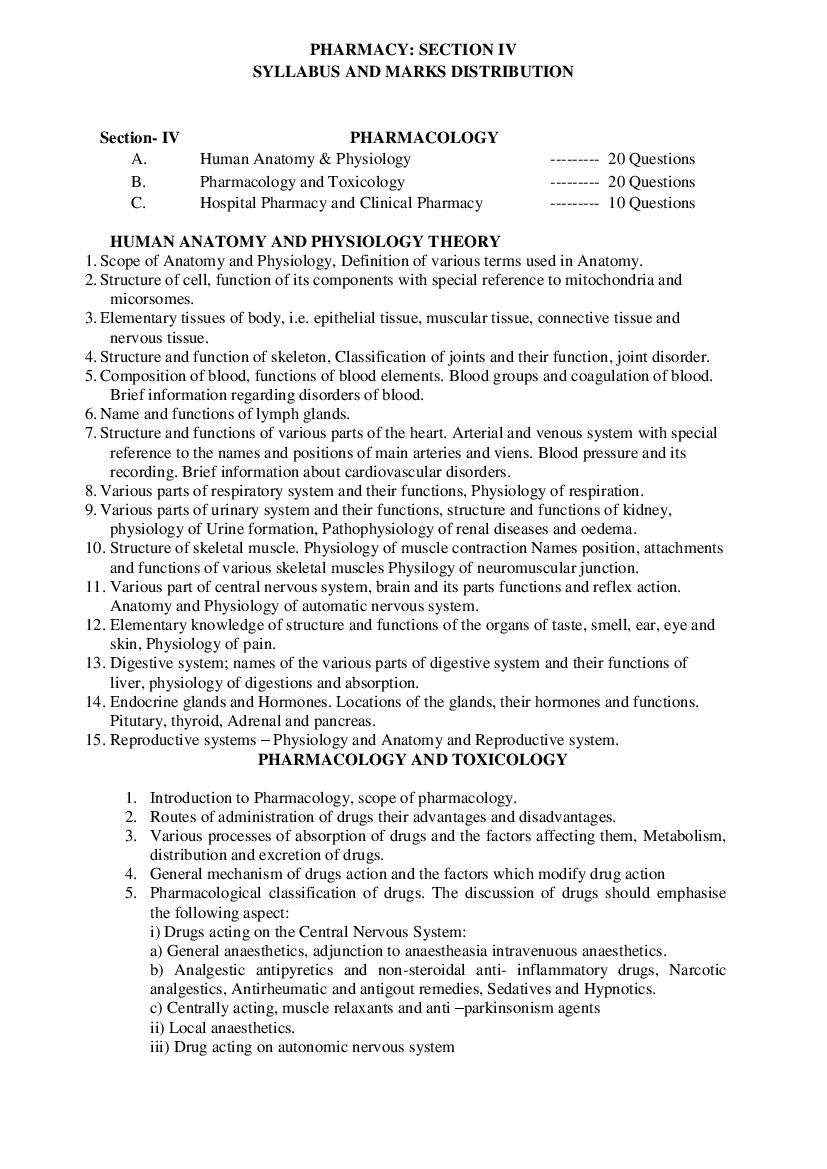
SYLLABUS AND MARKS DISTRIBUTION
Section- IV PHARMACOLOGY
A. Human Anatomy & Physiology --------- 20 Questions
B. Pharmacology and Toxicology --------- 20 Questions
C. Hospital Pharmacy and Clinical Pharmacy --------- 10 Questions
HUMAN ANATOMY AND PHYSIOLOGY THEORY
1. Scope of Anatomy and Physiology, Definition of various terms used in Anatomy.
2. Structure of cell, function of its components with special reference to mitochondria and
micorsomes.
3. Elementary tissues of body, i.e. epithelial tissue, muscular tissue, connective tissue and
nervous tissue.
4. Structure and function of skeleton, Classification of joints and their function, joint disorder.
5. Composition of blood, functions of blood elements. Blood groups and coagulation of blood.
Brief information regarding disorders of blood.
6. Name and functions of lymph glands.
7. Structure and functions of various parts of the heart. Arterial and venous system with special
reference to the names and positions of main arteries and viens. Blood pressure and its
recording. Brief information about cardiovascular disorders.
8. Various parts of respiratory system and their functions, Physiology of respiration.
9. Various parts of urinary system and their functions, structure and functions of kidney,
physiology of Urine formation, Pathophysiology of renal diseases and oedema.
10. Structure of skeletal muscle. Physiology of muscle contraction Names position, attachments
and functions of various skeletal muscles Physilogy of neuromuscular junction.
11. Various part of central nervous system, brain and its parts functions and reflex action.
Anatomy and Physiology of automatic nervous system.
12. Elementary knowledge of structure and functions of the organs of taste, smell, ear, eye and
skin, Physiology of pain.
13. Digestive system; names of the various parts of digestive system and their functions of
liver, physiology of digestions and absorption.
14. Endocrine glands and Hormones. Locations of the glands, their hormones and functions.
Pitutary, thyroid, Adrenal and pancreas.
15. Reproductive systems – Physiology and Anatomy and Reproductive system.
PHARMACOLOGY AND TOXICOLOGY
1. Introduction to Pharmacology, scope of pharmacology.
2. Routes of administration of drugs their advantages and disadvantages.
3. Various processes of absorption of drugs and the factors affecting them, Metabolism,
distribution and excretion of drugs.
4. General mechanism of drugs action and the factors which modify drug action
5. Pharmacological classification of drugs. The discussion of drugs should emphasise
the following aspect:
i) Drugs acting on the Central Nervous System:
a) General anaesthetics, adjunction to anaestheasia intravenuous anaesthetics.
b) Analgestic antipyretics and non-steroidal anti- inflammatory drugs, Narcotic
analgestics, Antirheumatic and antigout remedies, Sedatives and Hypnotics.
c) Centrally acting, muscle relaxants and anti –parkinsonism agents
ii) Local anaesthetics.
iii) Drug acting on autonomic nervous system
Page 2
b) Adrenergic drugs and adrenergic receptor blockers.
c) Neurone blockers and ganglion blockers,
d) Neuromuscular blockers, drugs used in myasthenia gravis.
iv) Drugs acting on eye, mydriatics, drugs used in glaucoma.
v) Drugs acting on respiratory system-Respiratory stimulants Bronchodilators, Nasal
decongestants, Expectorants and Antitussive agents.
vi) Antacids, Physiological role of histamine and serotonin, Histamine and drugs used
in atherosclerosis.
vii) Cardio Vascular drugs, Cardio tonics, Antiarrhyhmic agents, Antianginal agents,
Antihypertensive agents Peripheral Vasodilators and drugs used in atherosclerosis.
viii) Drugs acting on the blood forming organs, Haematinics, Coagulants and anti-
Coagulants, Haemostatics, Blood substitutes and plasma expanders.
ix) Drugs affecting, renal function-Diuretics and antidiuretics.
x) Hormones and hormone antagonists-hypoglycemic agents, Antithyroid durgs, sex
hormones and oral contraceptives and laxatives, Antidiarrhoeals, Emetics,
Antiemetics, Antispasmodics.
6. Chemotherapy of microbial disease: Urinary antiseptics, Sulphonamides. {emocooms.
Streptomycin. Tetracylines and other antibiotics, Antitubercular agents, anti fungal
agents, anti viral drugs, antileprotic drugs.
7. Chemotherapyor protozoal diseases. Anthelmintic drugs
8. Chemotherapy of cancer.
9. Disinfectants and antiseptics
A detailed study of the action of drugs on each organ is not necessary.
HOSPITAL PHARMACY AND CLINICAL PHARMACY
Part –I Hospital pharmacy
1. Hospitals Definitions, Function, Classifications based on various criteria, organization,
Management and Health delivery system in India.
2. Hospital Pharmacy:
a) Definitions
b) Functions and objectives of Hospital Pharmaceutical services.
c) Location, Layout, Flowchart of material and men.
d) Personnel and facilities requirements based on individual and basic needs.
e) Requirements and abilities required for Hospital Pharmacists.
3. Drug Distribution system in Hospitals :
a) Out – Patient service
b) In –Patient services (a) types of services (b) detailed discussion of Unit system. Floor
and ward stock system, Satellite Pharmacy Service, Central services, Bedside
Pharmacy.
4. Manufacturing:
a) Economical considerations, estimation of demand.
b) Sterile manufacture – large and small volume parenterals, facilities, requirements
layout production planning, man-power requirements.
c) Non sterile manufacture-Liquid orals, externals- bulk concentrates.
d) Procurement of stores and testing of raw materials.
5. Nomenclature and used of surgical instruments and Hospital Equipments and health
accessories.
6. P.T.C (Pharmacy Therapeutic Committee), Hospital Formulary System and their
organization, functioning, composition.
7. Drug information service and Drug information Bulletin.
Page 3
pharmacopocial tests of quality. Other hospital supply e.g I.V. Sets B.G. Sets, Ryals
tubes, Catheters, Syringes etc.
Application of computers in maintenance of records, inventory control medication
monitoring, drug information and data storage and retrieval in hospital and retail pharmacy
establishments
Part –II Clinical Pharmacy:
1. Introduction to Clinical Pharmacy Practice - Definition Scope
2. Modern dispensing – Pharmacists and Patient counseling advice for the use of common
drugs, medication history.
3. Common daily terminology used in the practice of medicine.
4. Disease, manifestation and Pathophysiology including salient symptoms to understand
the disease like Tuberculosis, Hepatitis, Rheumatoid Arthritis, Cardiovascular diseases,
Epilepsy. Diabetes, peptic Ulcer, Hyeprtension.
5. Physiological parameters with their significance.
6. Drug interactions:
a) Definition and introduction.
b) Mechanism of Drug Interaction.
c) Drug – drug interaction with reference to analgesics diuretics, cardiovascular drugs.
Gastro – intestinal agents, Vitamins and Hypoglycemic agents.
d) Drug – food interaction
7. Adverse Drug Reaction:
a) Definition and Significance.
b) Drug – induced disease and Teratogencity.
8. Drugs in Clinical Toxicity – introduction, general treatment of poisoning
systemicantidotes Treatment of insecticide poisoning, heavy metal poison Narcotic
drugs Barbiturate, Organophosphours poisons.
9. Drug dependence, Drug abuse, addictive drugs and their treatment complications
10. Bio-availability of drugs, including factors affecting it.
ANNEXURE III
MODEL QUESTIONS FOR PHARMACY
1. Ball mill works on the principle of
1) Impact
2) Attrition
3) Crushing
4) Compaction
2. B.C.G. Vaccine contains
1) Living culture
2) Non-living culture
3) Natural culture
4) Artificial Culture
3. Acacia is not used as
1) Diluent
2) Suspending agent
3) Emulsifying agent
4) Binder
Document Details
| Board / Org | APSCHE |
| Exam | Andhra Pradesh Engineering Common Entrance Test |
| Type | Syllabus |
| Pages | 3 |
| Updated | 22 Jul 2026 |