ISC Class 12 Syllabus 2022 Commerce
Finished viewing? Save it for later —
Download ISC Class 12 Syllabus 2022 Commerce (PDF · 5 pages)About ISC Class 12 Syllabus 2022 Commerce
ISC Class 12 Syllabus 2022 Commerce is available here for free download. Published by CISCE for Class 12, this syllabus can be viewed online or downloaded as a PDF (5 pages). Candidates preparing for Class 12 can use ISC Class 12 Syllabus 2022 Commerce to understand the exam pattern, the type of questions asked, and the overall difficulty level.
Frequently Asked Questions
How can I download ISC Class 12 Syllabus 2022 Commerce?
Open this page and click the Download button to save ISC Class 12 Syllabus 2022 Commerce as a PDF. It is completely free on AglaSem Docs.
Is ISC Class 12 Syllabus 2022 Commerce free to download?
Yes. ISC Class 12 Syllabus 2022 Commerce can be viewed online and downloaded as a PDF free of cost on AglaSem Docs.
How many pages does ISC Class 12 Syllabus 2022 Commerce have?
ISC Class 12 Syllabus 2022 Commerce contains 5 pages, which you can read online or download together as a single PDF.
Where can I find more Class 12 study material?
You can find more Class 12 question papers, sample papers, syllabus, and answer keys on AglaSem Docs.
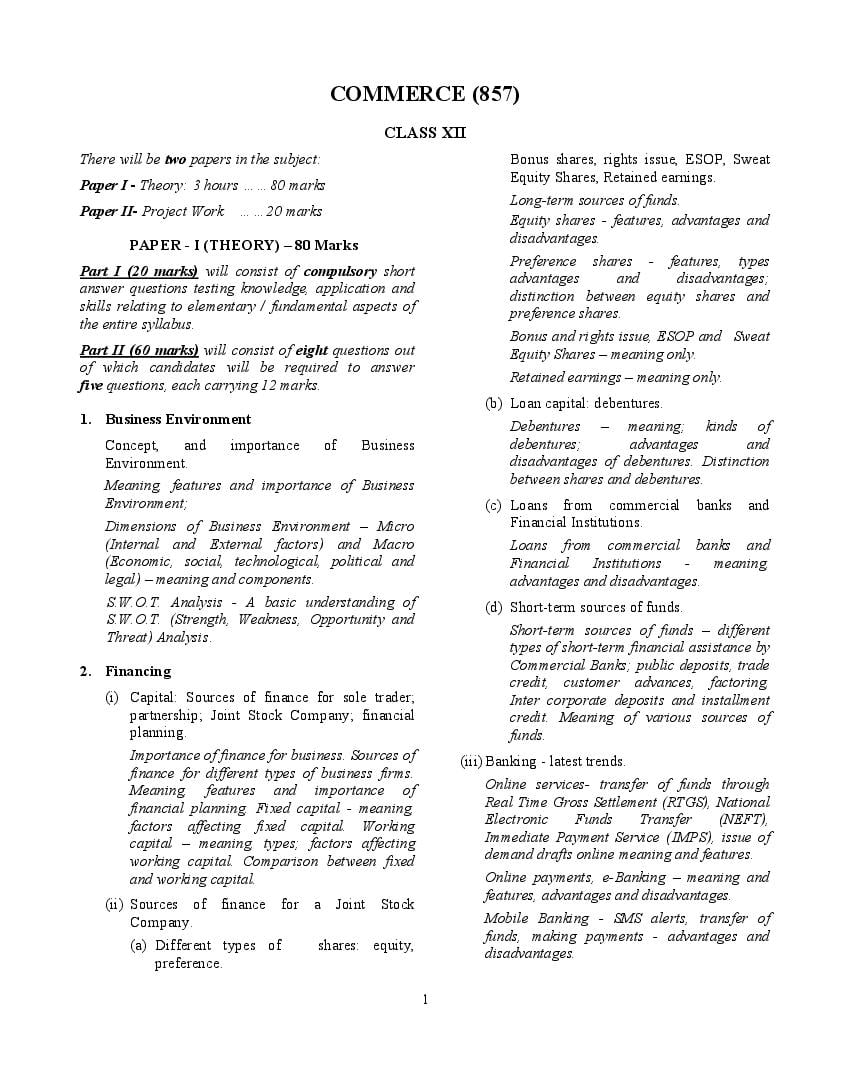
ISC Class 12 Syllabus 2022 Commerce – Text
Read the full text of this syllabus below — useful to quickly search, copy and reference the content online without downloading the PDF.
📄 View text version (5 pages)
Page 1
CLASS XII
There will be two papers in the subject: Bonus shares, rights issue, ESOP, Sweat
Equity Shares, Retained earnings.
Paper I - Theory: 3 hours ……80 marks
Long-term sources of funds.
Paper II- Project Work ……20 marks
Equity shares - features, advantages and
PAPER - I (THEORY) – 80 Marks disadvantages.
Preference shares - features, types
Part I (20 marks) will consist of compulsory short advantages and disadvantages;
answer questions testing knowledge, application and distinction between equity shares and
skills relating to elementary / fundamental aspects of preference shares.
the entire syllabus.
Bonus and rights issue, ESOP and Sweat
Part II (60 marks) will consist of eight questions out Equity Shares – meaning only.
of which candidates will be required to answer
five questions, each carrying 12 marks. Retained earnings – meaning only.
(b) Loan capital: debentures.
1. Business Environment Debentures – meaning; kinds of
Concept, and importance of Business debentures; advantages and
Environment. disadvantages of debentures. Distinction
Meaning, features and importance of Business between shares and debentures.
Environment; (c) Loans from commercial banks and
Dimensions of Business Environment – Micro Financial Institutions.
(Internal and External factors) and Macro Loans from commercial banks and
(Economic, social, technological, political and Financial Institutions - meaning,
legal) – meaning and components. advantages and disadvantages.
S.W.O.T. Analysis - A basic understanding of (d) Short-term sources of funds.
S.W.O.T. (Strength, Weakness, Opportunity and
Threat) Analysis. Short-term sources of funds – different
types of short-term financial assistance by
2. Financing Commercial Banks; public deposits, trade
credit, customer advances, factoring,
(i) Capital: Sources of finance for sole trader; Inter corporate deposits and installment
partnership; Joint Stock Company; financial credit. Meaning of various sources of
planning. funds.
Importance of finance for business. Sources of (iii) Banking - latest trends.
finance for different types of business firms.
Meaning, features and importance of Online services- transfer of funds through
financial planning. Fixed capital - meaning, Real Time Gross Settlement (RTGS), National
factors affecting fixed capital. Working Electronic Funds Transfer (NEFT),
capital – meaning, types; factors affecting Immediate Payment Service (IMPS), issue of
working capital. Comparison between fixed demand drafts online meaning and features.
and working capital. Online payments, e-Banking – meaning and
features, advantages and disadvantages.
(ii) Sources of finance for a Joint Stock
Company. Mobile Banking - SMS alerts, transfer of
funds, making payments - advantages and
(a) Different types of shares: equity,
disadvantages.
preference.
1
Page 2
(Automated Teller Machine) – Meaning; recruitment.
Debit card and credit card: features and
(d) Directing:
differences.
Meaning and importance; Supervision-
3. Management Meaning, functions and span of control;
(i) Management: Meaning, objectives and Motivation - Meaning and Maslow’s
characteristics of management. theory; Leadership- Meaning and
qualities of a good leader;
Meaning of Management: as an activity; as a
group; as a discipline; as a process. Communication - Meaning, objectives
Objectives and characteristics of and process. Barriers to communication
management. and overcoming barriers to
communication.
(ii) Nature of Management – Science, Art and
Profession. (e) Controlling:
Self explanatory. Meaning, steps and importance;
Management by Exception.
(iii) Importance of Management.
(f) Coordination:
Self explanatory.
Meaning of Coordination; Coordination
(iv) Principles of Management: nature of as an essence of Management.
principles; need for principles.
Nature of principles of Management; need for 4. Marketing
principles of management; Taylor’s 5 (i) Marketing: concept and functions.
scientific principles of Management; Fayol’s
14 principles of Management; Relevance of Meaning and types of markets; meaning and
the principles of Management in today’s features of marketing. Comparison between
business scenario. marketing and selling. Objectives and
importance of marketing; functions of
(v) Functions of Management: Planning; marketing – meaning, features of each
Organising; Staffing; Directing; Controlling function of marketing.
and Coordinating.
(ii) Marketing Mix - Meaning and Elements.
(a) Planning:
Product Mix - goods and services - meaning,
Meaning, steps, importance & limitation; features and types of goods; meaning,
Types of plans; Objectives, policy, features of services; difference between
procedures, method, role, budget, product and services. Branding: meaning and
program – meaning only. merits. Labeling: meaning and merits.
(b) Organising: Packaging: meaning and features of good
packaging.
Meaning, importance, steps; Structure of
organization (line, line and staff, Price Mix – meaning, factors determining
functional and divisional; Formal and price.
informal organization) – Meaning and Place Mix – meaning, channel of distribution
features. Meaning and importance of choice of channels of distribution and
delegation of authority. physical distribution.
(c) Staffing: Promotion Mix – Meaning and elements.
Meaning, steps and importance; Elements – Advertising, sales promotion,
Recruitment – Meaning and sources; personal selling and publicity – meaning,
Selection –Meaning and procedure; features, objectives and differences.
Training and development – Meaning,
2
Page 3
methods of consumer protection. to open a savings account.
Need for consumer protection; methods of Find out the details of various Agency & General
consumer protection - self-help, legislative utility services provided by the bank.
measures and consumer associations/NGOs,
Consumer Protection Act, 2019 - Rights of 4. Compare the interest rates offered by five
consumers. different commercial banks on fixed deposits
The Consumer Disputes Redressal under various categories (general and senior
Commissions (National, State and District). citizens) and various time durations.
Difference between Consumer Protection Act, Find out the procedure and formalities for opening
1986 and Consumer Protection Act, 2019. a fixed deposit account.
PAPER II – PROJECT WORK – 20 Marks What is the procedure for closing the account on
maturity and before maturity period?
Candidates will be expected to have completed two
projects from any topic covered in Theory. 5. Select five different companies across varying
The project work will be assessed by the teacher industries such as I.T., textiles, FMCG, Health
and a Visiting Examiner appointed locally and Care, etc., included in the SENSEX. Keeping a
approved by the Council. hypothetical base money of Rupees One Lakh,
invest in the shares of the selected companies. The
Mark allocation for each Project [10 marks]: movement of share prices selected by you should
be monitored over a period of one month on a
Overall format 1 mark
daily basis. A uniform / standard practice of
Content 4 marks either using the opening price or the closing price
on a particular day of the week should be used by
Findings 2 marks
all students in the class.
Viva-voce based on the Project 3 marks
At the end of the month, analyse your investment
in a spread sheet and give reasons for your choice
A list of suggested Projects is given below: of scripts.
1. Compare marketing strategies adopted by two
different companies of the same industry 6. Find out the names of companies under various
(FMCG / Telecommunication / media / education sectors (FMCG, Pharma, automobile, etc)
industry etc.) keeping in mind the following: included in the NIFTY and the SENSEX.
− Product mix Make a chart of the same and track its movements
over a period of one week.
− Price Mix
− Place Mix 7. (a) Study the sources of recruitment and steps
− Promotion Mix involved in the selection procedure adopted
by two companies of the same industry.
2. Collect newspaper/magazine clippings of five (b) Compare and evaluate the sources of
cases filed by consumers in the Consumer Court. recruitment and the selection process adopted
Find out the rights violated, and the redressal by the selected companies.
mechanism used.
What was the outcome of each case?
3
Page 4
business organization. selected business in terms of ownership, capital
and profitability.
Justify your formulated plan.
Make a S.W.O.T. analysis and present it in a
9. Choose two companies of the same industry. tabular form.
Study their organizational structure. Also give
information with regard to:
(i) Hierarchy
(ii) Centralization and delegation of authority
NOTE: No question paper for Project Work will be
(iii) Flow of information (scalar chain)
set by the Council.
(iv) Span of control
(v) Channel of communication.
4
Page 5
S. Unique PROJECT 1 PROJECT 2 TOTAL
No. Identification MARKS
Number A B C D E F G H I J
(Unique ID) Teacher Visiting Average Viva-Voce Total Teacher Visiting Average Viva- Total (E + J)
of the Examiner Marks by Visiting Marks Examiner Marks Voce by Marks
candidate (A + B ÷ 2) Examiner (C + D) (F + G ÷ Visiting (H + I)
2) Examiner
7 Marks* 7 Marks* 7 Marks 3 Marks 10 Marks 7 Marks* 7 Marks* 7 Marks 3 Marks 10 Marks 20 Marks
1
2
3
4
5
6
7
8
9
10
*Breakup of 7 Marks to be awarded separately by
Name of Teacher:
the Teacher and the Visiting Examiner is as
follows:
Signature: Date
Overall Format 1 Mark
Content 4 Marks Name of Visiting Examiner
Findings 2 Marks
Signature: Date
NOTE: VIVA-VOCE (3 Marks) for each Project is to be conducted only by the Visiting Examiner, and should be based on the Project only.
5
Document Details
| Board / Org | CISCE |
| Exam | Class 12 |
| Type | Syllabus |
| Pages | 5 |
| Language | english |
| Updated | 22 Jul 2026 |