TS EAMCET 2023 Syllabus Agriculture
Finished viewing? Save it for later —
Download TS EAMCET 2023 Syllabus Agriculture (PDF · 28 pages)About TS EAMCET 2023 Syllabus Agriculture
TS EAMCET 2023 Syllabus Agriculture is available here for free download. Published by TGCHE for Telangana Engineering, Agriculture and Pharmacy Common Entrance Test, this syllabus can be viewed online or downloaded as a PDF (28 pages). Candidates preparing for Telangana Engineering, Agriculture and Pharmacy Common Entrance Test can use TS EAMCET 2023 Syllabus Agriculture to understand the exam pattern, the type of questions asked, and the overall difficulty level.
Frequently Asked Questions
How can I download TS EAMCET 2023 Syllabus Agriculture?
Open this page and click the Download button to save TS EAMCET 2023 Syllabus Agriculture as a PDF. It is completely free on AglaSem Docs.
Is TS EAMCET 2023 Syllabus Agriculture free to download?
Yes. TS EAMCET 2023 Syllabus Agriculture can be viewed online and downloaded as a PDF free of cost on AglaSem Docs.
How many pages does TS EAMCET 2023 Syllabus Agriculture have?
TS EAMCET 2023 Syllabus Agriculture contains 28 pages, which you can read online or download together as a single PDF.
Where can I find more Telangana Engineering, Agriculture and Pharmacy Common Entrance Test study material?
You can find more Telangana Engineering, Agriculture and Pharmacy Common Entrance Test question papers, sample papers, syllabus, and answer keys on AglaSem Docs.
TS EAMCET 2023 Syllabus Agriculture – Text
Read the full text of this syllabus below — useful to quickly search, copy and reference the content online without downloading the PDF.
📄 View text version (28 pages)
Page 1
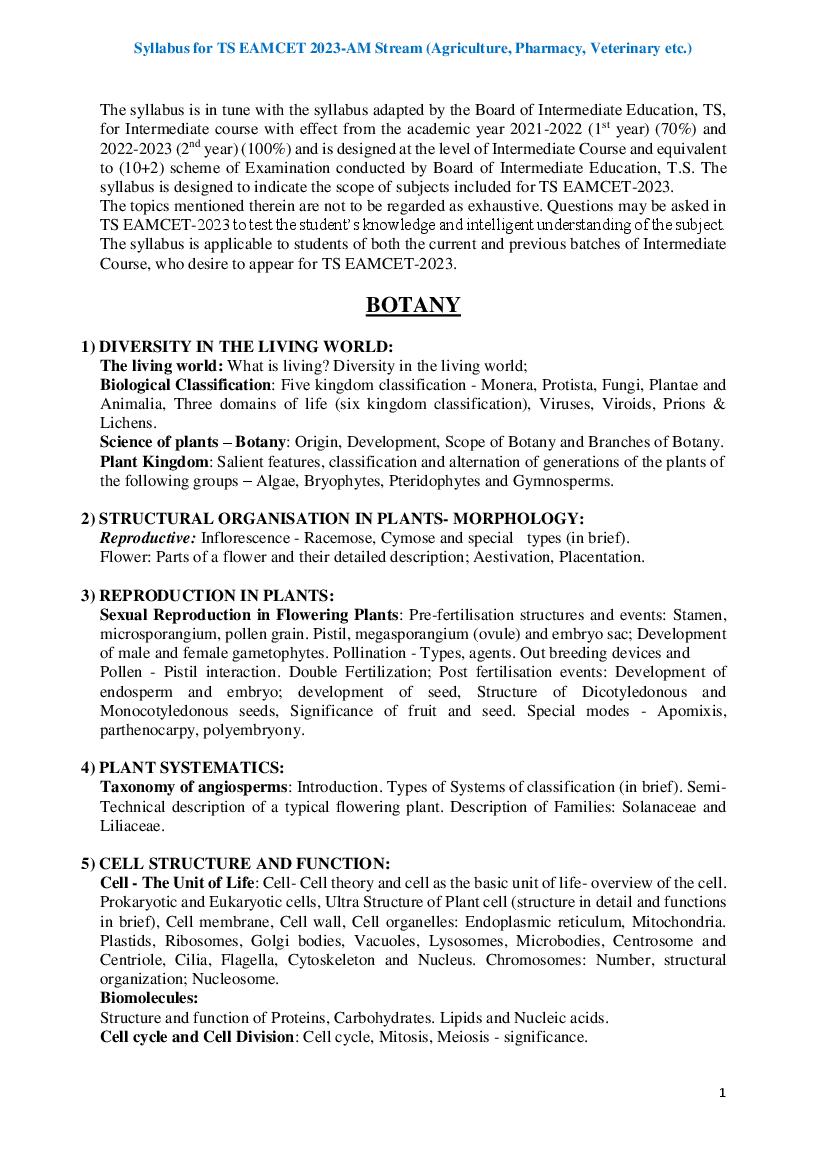
for Intermediate course with effect from the academic year 2021-2022 (1st year) (70%) and
2022-2023 (2nd year) (100%) and is designed at the level of Intermediate Course and equivalent
to (10+2) scheme of Examination conducted by Board of Intermediate Education, T.S. The
syllabus is designed to indicate the scope of subjects included for TS EAMCET-2023.
The topics mentioned therein are not to be regarded as exhaustive. Questions may be asked in
TS EAMCET-2023 to test the student’s knowledge and intelligent understanding of the subject.
The syllabus is applicable to students of both the current and previous batches of Intermediate
Course, who desire to appear for TS EAMCET-2023.
BOTANY
1) DIVERSITY IN THE LIVING WORLD:
The living world: What is living? Diversity in the living world;
Biological Classification: Five kingdom classification - Monera, Protista, Fungi, Plantae and
Animalia, Three domains of life (six kingdom classification), Viruses, Viroids, Prions &
Lichens.
Science of plants – Botany: Origin, Development, Scope of Botany and Branches of Botany.
Plant Kingdom: Salient features, classification and alternation of generations of the plants of
the following groups – Algae, Bryophytes, Pteridophytes and Gymnosperms.
2) STRUCTURAL ORGANISATION IN PLANTS- MORPHOLOGY:
Reproductive: Inflorescence - Racemose, Cymose and special types (in brief).
Flower: Parts of a flower and their detailed description; Aestivation, Placentation.
3) REPRODUCTION IN PLANTS:
Sexual Reproduction in Flowering Plants: Pre-fertilisation structures and events: Stamen,
microsporangium, pollen grain. Pistil, megasporangium (ovule) and embryo sac; Development
of male and female gametophytes. Pollination - Types, agents. Out breeding devices and
Pollen - Pistil interaction. Double Fertilization; Post fertilisation events: Development of
endosperm and embryo; development of seed, Structure of Dicotyledonous and
Monocotyledonous seeds, Significance of fruit and seed. Special modes - Apomixis,
parthenocarpy, polyembryony.
4) PLANT SYSTEMATICS:
Taxonomy of angiosperms: Introduction. Types of Systems of classification (in brief). Semi-
Technical description of a typical flowering plant. Description of Families: Solanaceae and
Liliaceae.
5) CELL STRUCTURE AND FUNCTION:
Cell - The Unit of Life: Cell- Cell theory and cell as the basic unit of life- overview of the cell.
Prokaryotic and Eukaryotic cells, Ultra Structure of Plant cell (structure in detail and functions
in brief), Cell membrane, Cell wall, Cell organelles: Endoplasmic reticulum, Mitochondria.
Plastids, Ribosomes, Golgi bodies, Vacuoles, Lysosomes, Microbodies, Centrosome and
Centriole, Cilia, Flagella, Cytoskeleton and Nucleus. Chromosomes: Number, structural
organization; Nucleosome.
Biomolecules:
Structure and function of Proteins, Carbohydrates. Lipids and Nucleic acids.
Cell cycle and Cell Division: Cell cycle, Mitosis, Meiosis - significance.
1
Page 2
Histology and Anatomy of Flowering Plants: Anatomy of Dicotyledonous and
Monocotyledonous plants - Root, Stem.
7) PLANT ECOLOGY:
Ecological Adaptations, Succession and Ecological Services:
Introduction. Plant communities and Ecological adaptations: Hydrophytes. Mesophytes and
Xerophytes.
8) PLANT PHYSIOLOGY:
Transport in Plants:
Means of Transport- Diffusion, Facilitated Diffusion, Passive symports and antiports, Active
Transport, Comparison of Different Transport Processes; Plant-Water Relations- Water
Potential, Osmosis, Plasmolysis, Imbibition, Long Distance Transport of Water- Water
Movement up a Plant, Root Pressure, Transpiration pull, Transpiration- Opening and Closing
of Stomata, Transpiration and Photosynthesis; Uptake and Transport of Mineral Nutrients-
Uptake of Mineral Ions, Translocation of Mineral Ions, Phloem Transport: Flow from Source
to Sink-The Pressure Flow or Mass Flow Hypothesis
Mineral Nutrition:
Methods to Study the Mineral Requirements of Plants, Essential Mineral Elements-Criteria for
Essentiality, Macronutrients, Micronutrients, Role of Macro- and Micro-nutrients, Deficiency
Symptoms of Essential Elements, Toxicity of Micronutrients, Mechanism of Absorption of
Elements, Translocation of Solutes, Soil as Reservoir of Essential Elements; Metabolism of
Nitrogen-Nitrogen Cycle, Biological Nitrogen Fixation, Symbiotic nitrogen fixation, Nodule
Formation
Enzymes: Chemical Reactions, Enzymatic Conversions, Nature of Enzyme Action, Factors
Affecting Enzyme Activity, Temperature and pH, Concentration of Substrate,
Classification and Nomenclature of Enzymes, Co-factors.
Photosynthesis in Higher Plants: What do we know, Early Experiments, Site of
Photosynthesis, Pigments involved in Photosynthesis, Light Reaction, The Electron Transport-
Splitting of Water, Cyclic and Noncyclic Photo-phosphorylation, Chemiosmotic Hypothesis,
Biosynthetic phase - The Primary Acceptor of CO2, The Calvin Cycle, The C4 Pathway,
Photorespiration, Factors affecting Photosynthesis.
Respiration of Plants: cellular respiration, Glycolysis, Fermentation, Aerobic Respiration -
Tricarboxylic Acid Cycle, Electron Transport System (ETS) and Oxidative Phosphorylation,
The Respiratory Balance Sheet, Amphibolic Pathway, Respiratory Quotient.
Plant Growth and Development:
Growth – Plant Growth, Phases of Growth, Growth Rates, Conditions for Growth,
Differentiation, Dedifferentiation and Redifferentiation, Development, Plant Growth
Regulators - Physiological effects of Plant Growth Regulators, Auxins, Gibberellins,
Cytokinins, Ethylene, Abscisic acid; Seed Dormancy, Photoperiodism, Vernalisation.
9) MICROBIOLOGY
Bacteria: Morphology of Bacteria, Bacterial cell structure, Nutrition, Reproduction- Sexual
Reproduction, Conjugation, Transformation, Transduction, The importance of Bacteria to
Humans.
Viruses: Discovery, Classification of Viruses, structure of Viruses, Multiplication of
Bacteriophages- The Lysogenic Cycle, Viral diseases in Plants, Viral diseases in Humans
2
Page 3
Principles of Inheritance and Variation: Mendel’s Experiments, Inheritance of one
gene (Monohybrid Cross)-Back cross and Test cross, Law of Dominance, Law of
Segregation or Law of purity of gametes, Deviations from Mendelian concept of dominance
- Incomplete Dominance, Co-dominance, Explanation of the concept of dominance,
Inheritance of two genes- (Dihybrid Cross) Law of Independent Assortment, Chromosomal
Theory of Inheritance, Linkage and Recombination, Mutations, Significance of mutations.
11) MOLECULAR BIOLOGY:
Molecular Basis of inheritance: The DNA - Structure of Polynucleotide Chain, Packaging of
DNA Helix, The Search for Genetic Material, Transforming Principle, Biochemical
Characterisation of Transforming Principle, The Genetic Material is DNA, Properties of
Genetic Material (DNA versus RNA), RNA World, Replication - The Experimental Proof,
The Machinery and the Enzymes, Transcription-Transcription Unit, Transcription Unit and the
Gene, Types of RNA and the process of Transcription, Genetic Code-Mutations and Genetic
Code, tRNA - the Adapter Molecule, Translation, Regulation of Gene Expression-The Lac
operon.
12) BIOTECHNOLOGY:
Principles and processes of Biotechnology: Principles of Biotechnology-Construction
of the first artificial recombinant DNA molecule, Tools of Recombinant DNA Technology-
Restriction Enzymes, Cloning Vectors, Competent Host (For Transformation with
Recombinant DNA), Processes of Recombinant DNA Technology - Isolation of the Genetic
Material (DNA), Cutting of DNA at Specific Locations, Separation and isolation of DNA
fragments, Insertion of isolated gene into a suitable vector, Amplification of Gene of Interest
using PCR, Insertion of Recombinant DNA into the Host, Cell/Organism, Selection of
Transformed host cells, Obtaining the Foreign Gene Product, Downstream Processing.
Biotechnology and its applications: Biotechnological Applications in Agriculture - Bt
Cotton, Pest Resistant Plants, Other applications of Biotechnology - Insulin, Gene therapy,
Molecular Diagnosis, ELISA, DNA fingerprinting, Transgenic plants, Bio-safety and Ethical
issues- Biopiracy.
13) PLANTS, MICROBES AND HUMAN WELFARE:
Strategies for enhancement in Food production-
Plant Breeding- What is Plant Breeding? Wheat and Rice, Sugarcane, Millets, Plant Breeding
for Disease Resistance, Methods of breeding for disease resistance, Mutation, Plant Breeding
for Developing Resistance to Insect Pests, Plant Breeding for Improved Food Quality, Single
Cell Protein (SCP), Tissue Culture
Microbes in Human Welfare: Microbes in Household Products, Microbes in Industrial
Products-Fermented Beverages, Antibiotics, Chemicals, Enzymes and other Bioactive
Molecules, Microbes in Sewage Treatment, Primary treatment, Secondary treatment or
Biological treatment, Microbes in Production of Biogas, Microbes as Biocontrol Agents,
Biological control of pests and diseases, Microbes as Biofertilisers, Challenges posed by
Microbes.
*****
3
Page 4
1) ZOOLOGY - DIVERSITY OF LIVING WORLD:
What is life? Nature, Scope & meaning of zoology; Branches of Zoology.
Levels or Hierarchy of classification; Nomenclature - Binomial & Trinominal; Species
concept; Kingdom Animalia.
Biodiversity - Meaning and distribution, Genetic diversity, Species diversity, Ecosystem
diversity (alpha, beta and gama), other attributes of biodiversity, role of biodiversity, threats
to biodiversity, methods of conservation, IUCN Red data books, Conservation of wild life
in India -Legislation, Preservation, Organizations, Threatened species.
2) STRUCTURAL ORGANIZATION IN ANIMALS:
Levels of organization, Multicellularity: Diploblastic & Triploblastic conditions,
Importance of Symmetry: Asymmetry, Symmetry: Radial symmetry, and Bilateral
symmetry.
Coelem: Acoelomates, Pseudocoelomates and Eucoelomates: Schizo & Entero coelomates
(Brief account of formation of coelom).
Tissues: Epithelial, Connective, Muscular and Nervous tissues.
3) ANIMAL DIVERSITY-I : INVERTEBRATE PHYLA:
General Characters –Classification up to Classes. Porifera; Cnidaria; Ctenophora.
Platyhelminthes; Nematoda; Annelida; (Include Earthworm as a type study).
Arthropoda; Mollusca; Echinodermata; Hemichordata.
4) ANIMAL DIVERSITY-II: PHYLUM : CHORDATA
General Characters –Classification up to Classes. Phylum: Chordata; Sub phylum:
Urochordata; Sub phylum: Cephalochordata.
Sub phylum: Vertebrata; Super class: Agnatha, Class Cyclostomata; Super class:
Gnathostomata, Super class pisces, Class: Chondrichthyes; Class: Osteichthyes.
Tetrapoda Class: Amphibia (Including the brief type study of Frog) Class: Reptilia, Class:
Aves, Class: Mammalia.
5) BIOLOGY & HUMAN WELFARE:
Parasitism and parasitic adaptation.
Health and disease: introduction Life cycle, Pathogenicity, Treatment & Prevention (Brief
account only) 1. Entamoeba histolytica 2. Plasmodium vivax 3. Ascaris lumbricoides
4. Wuchereria bancrofti.
Brief account of pathogenicity, treatment & prevention of Bacterial, viral, fungal
diseases (Typhoid, Pneumonia, Common cold, & Ring worm).
Tobacco, Drugs and Alcohol abuse. (TDA Abuse).
6) ECOLOGY & ENVIRONMENT:
What is Ecology, Importance of Ecology, Organisms and Environment: Ecology,
population, communities, habitat, niche, biome and ecosphere. Ecosystem: Elementary
aspects only, Abiotic factors- Light, Temperature & Water (Biological effects only);
Ecological adaptations.
Population interactions; Food chains, Food web, Nutrient cycling - Nitrogen cycle (Brief
account); Population attributes: Growth, Natality and Mortality, Age distribution, Population
regulation.
4
Page 5
Digestion and absorption:
Digestive System: Alimentary canal, Digestive glands, Physiology of digestion, Peristalsis,
Absorption of digested food, Gastro intestinal hormones, Calorific values of carbohydrates,
proteins and fats, Disorders of the digestive system
Breathing and Respiration: Respiratory organs in animals; Respiratory system in
humans; Mechanism of breathing and its regulation in humans.
Exchange of gases, transport of gases and regulation of respiratory movements,
Respiratory volumes; Respiratory disorders: Asthma, Emphysema, Bronchitis, Pneumonia,
Occupational respiratory disorders - Asbestosis, Silicosis, Siderosis, Black Lung Disease in
coal mine workers.
8) HUMAN ANATOMY AND PHYSIOLOGY-II:
Body Fluids and Circulation: Lymphatic system; Clotting of blood.
Human circulatory system - structure of human heart and blood vessels; Cardiac cycle,
cardiac output, double circulation, circulatory pathways, Portal circulation and coronary
circulation; regulation of cardiac activity; Disorders of circulatory system: Hypertension,
coronary artery disease, angina pectoris, heart failure.
Excretory products and their elimination: Modes of excretion - Ammonotelism,
Ureotelism, Uricotelism, Excretory organs; Human excretory system - structure of kidney
and nephron.
Urine formation, osmoregulation; Regulation of kidney function - Renin-Angiotensin -
Aldosterone system, Atrial Natriuretic Factor, ADH and diabetes insipidus; Role of other
organs in excretion; Disorders: Uremia, renal failure, renal calculi, glomerular nephritis,
dialysis using artificial kidney, and kidney transplantation.
9) HUMAN ANATOMY AND PHYSIOLOGY-III:
Muscular and Skeletal system: The muscle - ultra structure; Contractile proteins &
Mechanism of muscle contraction, muscle fatigue, cori cycle, Types of muscle fibres.
The Skeleton - Axial skeleton, Appendicular skeleton Joints - Types of joints, Structure of
synovial joint. Disorders of the muscular and skeletal system: myasthenia gravis, tetany,
muscular dystrophy, arthritis, osteoporosis, gout.
Neural control and co-ordination:
Nervous system in human beings - Central nervous system, Peripheral nervous system and
Somatic and autonomic neural system-Sympathetic and Parasympathetic neural system.
Generation and conduction of nerve impulse. Synaptic transmission. Reflex action and reflex
arc; Sensory reception and processing: The Eye, The mechanism of vision, The Ear, The
mechanism of hearing
10) HUMAN ANATOMY AND PHYSIOLOGY-IV:
Endocrine system and chemical co-ordination: Endocrine glands and hormones; Human
endocrine system - Hypothalamus, Pituitary, Pineal, Thyroid, Parathyroid,
Thymus gland, Adrenal, Pancreas, Gonads.
Mechanism of hormone action (Elementary idea only), hormones of kidney, heart and
gastrointestinal tract, Role of hormones as messengers and regulators; Hypo and Hyper activity
and related disorders: Common disorders - Dwarfism, acromegaly, cretinism, goiter,
exophthalmic goiter, diabetes, Addison’s disease, Cushing’s syndrome. (Diseases & disorders
to be dealt in brief).
5
Page 6
Acquired Immunity, Active and Passive Immunity.
Cell mediated Immunity and Humoral Immunity, Cells of immune system, organs of
immune system, soluble mediators of immunity, vaccination or immunization and
immunological disorders.
11) HUMAN REPRODUCTION:
Human Reproductive System: Male and female reproductive systems; Microscopic
anatomy of testis & ovary; Gametogenesis (Spermatogenesis & Oogenesis) Menstrual
cycle; Fertilization and Development, Gastrulation, Extraembryonic Membranes,
Formation of placenta, Parturition, Lactation (elementary idea).
Reproductive Health: Need for reproductive health and prevention of sexually transmitted
diseases (STD); Birth control - Need and methods, contraception and medical termination
of pregnancy (MTP); Amniocentesis; infertility and assisted reproductive technologies
- IVF-ET, ZIFT, GIFT, ICSI, AI, Surrogacy (elementary idea for general awareness).
12) GENETICS:
Heredity and variation: Mendel’s laws of inheritance with reference to Drosophila.
(Drosophila melanogaster Grey, Black body colour; Long, Vestigial wings),
Pleiotropy; Multiple alleles: Inheritance of blood groups and Rh-factor; Codominance
(Blood groups as example); Elementary idea of polygenic inheritance; Skin colour in
humans. Sex determination – in humans, birds, Fumea moth, genic balance theory of sex
determination in Drosophila melanogaster and honey bees; Sex linked inheritance –
Haemophilia, Colour blindness. Mendelian disorders in humans: Thalassemia,
Haemophilia, Sickle cell anaemia, cystic fibrosis PKU, Alkaptonuria; Chromosomal
disorders –Down’s syndrome, Edwards syndrome, Turner’s syndrome and Klinefelter
syndrome; Cri-du-chat Syndrome, Chronic Myelogenous Leukemia, Human Genome
Project and DNA Finger Printing.
13) ORGANIC EVOLUTION
Origin of Life, Biological evolution, Evidences for biological evolution (palaeontological,
embryological comparative anatomical, and molecular evidences); Theories of evolution:
Lamarckism (in brief), Darwin’s theory of Evolution-Natural Selection with example Mutation
Theory of Hugo De Vries; Modern synthetic theory of Evolution, Mechanism of evolution-
Hardy Weinberg law, Evolutionary forces, Types of Natural Selection; Gene flow and genetic
drift; Human evolution; Speciation - Allopatric, sympatric; Reproductive isolation, A brief
account of evolution, Origin and evolution of man.
14) APPLIED BIOLOGY:
Animal Husbandry, Poultry Farm management, Beekeeping, Fishery management,
Biotechnological applications in medicine: Vaccines, Molecular diagnosis, Gene Therapy,
Transgenic animals, Cancer biology, stem cells, Bio-medical Technology: Diagnostic
Imaging X-ray, CT scan, MRI, ECG, EEG; ELISA;
******
6
Page 7
1) PHYSICAL WORLD: What is physics? Fundamental forces in nature.
2) UNITS AND MEASUREMENTS: Introduction, The international system of units,
Measurement of Length, Measurement of Large Distances, Estimation of Very Small
Distances: Size of a Molecule, Range of Lengths, Measurement of Mass, Range of Masses,
Measurement of time, Accuracy, precision of instruments and errors in measurement,
Systematic errors, random errors, least count error, Absolute Error, Relative Error and
Percentage Error, Combination of Errors, Significant figures, Rules for Arithmetic
Operations with Significant Figures, Rounding off the Uncertain Digits, Rules for
Determining the Uncertainty in the Results of Arithmetic Calculations, Dimensions of
Physical Quantities, Dimensional Formulae and dimensional equations, Dimensional
Analysis and its Applications, Checking the Dimensional Consistency of Equations,
Deducing Relation among the Physical Quantities.
3) MOTION IN A STRAIGHT LINE: Introduction, Position, path length and displacement,
Average velocity and average speed, Instantaneous velocity and speed, Acceleration.
Kinematic equations for uniformly accelerated motion, Relative velocity.
4) MOTION IN A PLANE: Introduction, Scalars and vectors, Position and Displacement
Vectors, Equality of Vectors, Multiplication of vectors by real numbers, Addition and
subtraction of vectors - graphical method, Resolution of vectors, Vector addition -
analytical method, Motion in a plane, Position Vector and Displacement, Velocity,
Acceleration, Motion in a plane with constant acceleration, Relative velocity in two
dimensions. Projectile motion, Equation of path of a projectile, Time of Maximum height,
Maximum height of a projectile, Horizontal range of projectile, Uniform circular motion.
5) LAWS OF MOTION: Introduction, Conservation of momentum, Equilibrium of a particle,
Common forces in mechanics, friction, Circular motion, Motion of a car on a level road,
Motion of a car on a Banked Road, Solving problems in mechanics.
6) WORK, ENERGY AND POWER: Introduction, The Scalar Product, Notions of work and
kinetic energy : The work-energy theorem, Work, Kinetic energy, Work done by a variable
force, The work-energy theorem for a variable force, The concept of Potential Energy, The
conservation of Mechanical Energy, The Potential Energy of a spring, Various forms of
energy: the law of conservation of energy, Heat, Chemical Energy, Electrical Energy, The
Equivalence of Mass and Energy, Nuclear Energy. The Principle of Conservation of Energy,
Power, Collisions, Elastic and Inelastic Collisions, Collisions in one dimension, Coefficient
of Restitution and its determination, Collisions in Two Dimensions.
7) SYSTEMS OF PARTICLES AND ROTATIONAL MOTION: Introduction, What kind
of motion can a rigid body have?, Centre of mass, Centre of Gravity, Motion of centre of
mass, Linear momentum of a system of particles, Vector product of two vectors, Angular
velocity and its relation with linear velocity, Angular acceleration, Kinematics of rotational
motion about a fixed axis, Torque and angular momentum, Moment of force (Torque),
Angular momentum of particle, Torque and angular momentum for a system of a particles,
conservation of angular momentum, Equilibrium of a rigid body, Principle of moments,
Moment of inertia, Dynamics of rotational motion about a fixed axis, Angular momentum
7
Page 8
Kinetic Energy of Rolling Motion.
8) OSCILLATIONS: Introduction, Periodic and oscillatory motions, Period and frequency,
Displacement, Simple harmonic motion (S.H.M.), Simple harmonic motion and uniform
circular motion, Velocity and acceleration in simple harmonic motion, Force law for Simple
harmonic Motion, Energy in simple harmonic motion, Some systems executing Simple
Harmonic Motion, Oscillations due to a spring, The Simple Pendulum, Damped simple
harmonic motion, Forced oscillations and resonance.
9) GRAVITATION: Introduction, Universal law of gravitation, Acceleration due to gravity
below and above the surface of earth, Gravitational potential energy, Escape speed, Earth
satellite, Energy of an orbiting satellite, Geostationary and polar satellites, Weightlessness.
10) MECHANICAL PROPERTIES OF SOLIDS: Introduction, Elastic behaviour of solids,
Stress and strain, Hooke’s law, Stress-strain curve, Elastic moduli, Young’s Modulus, Bulk
Modulus.
11) MECHANICAL PROPERTIES OF FLUIDS: Introduction, Pressure, Pascal’s Law,
Variation of Pressure with Depth, Atmosphere Pressure and Gauge Pressure, Hydraulic
Machines, Streamline flow, Bernoulli’s principle, Speed of Efflux: Torricelli’s Law,
Venturi-meter, Blood Flow and Heart Attack, Dynamic Lift. Viscosity, Variation of
Viscosity of fluids with temperature, Stokes’ Law, Reynolds number, critical velocity,
Surface tension, Surface Energy, Surface Energy and Surface Tension, Angle of Contact,
Drops and Bubbles, Capillary Rise, Detergents and Surface Tension.
12) THERMAL PROPERTIES OF MATTER: Introduction, Temperature and heat,
Measurement of temperature, Ideal-gas equation and absolute temperature, Thermal
expansion. Specific heat capacity, Calorimetry, Change of state, Regelation, Latent Heat,
Black body Radiation, Greenhouse Effect, Newton’s law of cooling.
13)THERMODYNAMICS: Introduction, Thermal equilibrium, Zeroth law of
thermodynamics, Heat, Internal Energy and work, First law of thermodynamics, Specific
heat capacity. Thermodynamic state variables and equation of State, Thermodynamic
process, Quasi-static process, Isothermal Process, Adiabatic Process, Isochoric Process,
Isobaric process, Cyclic process, Second law of thermodynamics, Reversible and irreversible
processes.
14) KINETIC THEORY: Introduction, Molecular nature of matter, Behavior of gases, Boyle’s
Law, Charles’ Law, Kinetic theory of an ideal gas, Pressure of an Ideal Gas, kinetic
interpretation of temperature, Law of equipartition of energy, Specific heat capacity,
Monatomic Gases, Diatomic Gases, Polyatomic Gases, Specific Heat Capacity of Solids,
Specific Heat Capacity of Water, Mean free path.
15) WAVES: Introduction, Transverse and longitudinal waves, Displacement relation in a
progressive wave, The speed of a travelling wave, The principle of superposition of waves,
Reflection of waves, Beats, Doppler Effect.
16) RAY OPTICS AND OPTICAL INSTRUMENTS: Introduction, Reflection of light by
Spherical Mirrors, Refraction, Total Internal Reflection, Refraction at Spherical Surfaces and
8
Page 9
to Sunlight, The Rainbow, Scattering of light, Optical Instruments.
17) WAVE OPTICS: Introduction, Huygens Principle, Refraction and reflection of plane waves
using Huygens Principle, Coherent and Incoherent Addition of Waves, Interference of Light
Waves and Young’s Experiment, Diffraction, The single slit, seeing the single slit diffraction
pattern, Resolving power of optical instruments, The validity of ray optics, Polarization.
18) ELECTRIC CHARGES AND FIELDS: Introduction, Electric Charges, Conductors and
Insulators, Charging by Induction, Basic Properties of Electric Charge, Coulomb’s Law, Forces
between Multiple Charges, Electric Field, Electric Field Lines, Electric Flux, Electric Dipole,
Dipole in a Uniform External Field, Continuous Charge Distribution, Gauss’s Law,
Application of Gauss’s Law, Field due to an infinitely long straight uniformly charged wire,
Field due to a uniformly charged infinite plane sheet, Field due to a uniformly charged thin
spherical shell.
19) ELECTROSTATIC POTENTIAL AND CAPACITANCE: Introduction, Electrostatic
Potential, Potential due to a Point Charge, Potential due to an Electric Dipole, Potential due to
a System of Charges, Equipotential Surfaces, Potential Energy of a System of Charges,
Potential Energy in an External Field, Electrostatics of Conductors, Dielectrics and
Polarisation, Capacitors and Capacitance, The Parallel Plate Capacitor, Effect of Dielectric on
Capacitance, Combination of Capacitors, Energy Stored in a Capacitor, Van de Graaf generator
20) CURRENT ELECTRICITY: Introduction, Electric Current, Electric Currents in Conductors,
Ohm’s law, Drift of Electrons and the Origin of Resistivity, Limitations of Ohm’s Law,
Resistivity of various Materials, Temperature Dependence of Resistivity, Electrical Energy,
Power, Combination of resistors-series and parallel, Cells, emf, Internal Resistance, Cells in
Series and in Parallel, Kirchhoff’s rules, Wheatstone Bridge, Meter Bridge, Potentiometer.
21) MOVING CHARGES AND MAGNETISM: Introduction, Magnetic Force, Motion in a
Magnetic Field, Motion in combined electric and magnetic fields, Magnetic Field due to a
Current Element, Biot-Savart Law, Magnetic Field on the Axis of a Circular Current Loop,
Ampere’s Circuital Law, The Solenoid and the Toroid, Force between Two Parallel Currents,
the Ampere, Torque on Current Loop, Magnetic Dipole, The Moving Coil Galvanometer.
22) MAGNETISM AND MATTER: Introduction, The Bar Magnet, The magnetic field lines, Bar
Magnet as a equivalent solenoid, The dipole in a uniform magnetic field, The Electrostatic
analog, Magnetism and Gauss’s Law, The Earth’s Magnetism, Magnetisation and Magnetic
Intensity, Magnetic properties of materials, Permanent magnets and electromagnets.
23) ELECTROMAGNETIC INDUCTION: Introduction, The Experiments of Faraday and
Henry, Magnetic Flux, Faraday’s Law of Induction, Lenz’s Law and Conservation of Energy,
Motional Electromotive Force, Energy Consideration: A Quantitative Study, Eddy Currents,
Inductance, AC Generator.
24) ALTERNATING CURRENT: Introduction, AC Voltage Applied to a Resistor,
Representation of AC Current and Voltage by Rotating Vectors — Phasors, AC Voltage
Applied to an Inductor, AC Voltage Applied to a Capacitor, AC Voltage Applied to a Series
LCR Circuit, Power in AC Circuit: The Power Factor, LC Oscillations, Transformers.
9
Page 10
Waves, Electromagnetic Spectrum.
26) DUAL NATURE OF RADIATION AND MATTER: Introduction, Electron Emission,
Photoelectric Effect, Experimental Study of Photoelectric Effect, Photoelectric Effect and
Wave Theory of Light, Einstein’s Photoelectric Equation, Energy Quantum of Radiation,
Particle Nature of Light: The Photon, Wave Nature of Matter, Davisson and Germer
Experiment.
27) ATOMS: Introduction, Alpha-particle Scattering and Rutherford’s Nuclear Model of Atom,
Atomic Spectra, Bohr Model of the Hydrogen Atom, The Line Spectra of the Hydrogen Atom,
DE Broglie’s Explanation of Bohr’s Second Postulate of Quantisation.
28) NUCLEI: Introduction, Atomic Masses and Composition of Nucleus, Size of the Nucleus,
Mass-Energy and Nuclear Binding energy, Nuclear Force, Radioactivity, Nuclear Energy.
29) SEMICONDUCTOR ELECTRONICS: MATERIALS, DEVICES AND SIMPLE
CIRCUITS: Introduction, Classification of Materials: Metals, Semiconductors and Insulators,
Intrinsic Semiconductor, Extrinsic Semiconductor, p-n Junction, Semiconductor diode,
Application of Junction Diode as a Rectifier, Special Purpose p-n Junction Diodes, Zener
diode, optoelectronic junction devices, Junction Transistor, transistor structure and action,
basic transistor circuit configurations and transistor characteristics, Transistor as a device,
Transistor as an amplifier (CE configuration), Feedback amplifier and transistor oscillator
Digital Electronics and Logic Gates, Integrated Circuits.
30) COMMUNICATION SYSTEMS: Introduction, Elements of a Communication System,
Basic Terminology Used in Electronic Communication Systems, Bandwidth of Signals,
Bandwidth of Transmission Medium, Propagation of Electromagnetic Waves, Modulation
and its Necessity, Amplitude Modulation, Production of Amplitude Modulated Wave,
Detection of Amplitude Modulated Wave.
*****
10
Page 11
1) ATOMIC STRUCTURE:
Developments leading to the Bohr’s model of atom; Wave nature of electromagnetic radiation;
Particle nature of electromagnetic radiation- Planck’s quantum theory; Dual behaviour of
matter; Bohr’s model for Hydrogen atom; Explanation of line spectrum of hydrogen;
Limitations of Bohr’s model; Quantum mechanical considerations of sub atomic particles;
Heisenberg’s uncertainty principle; Quantum numbers; Energies of orbitals; Filling of orbitals
in atoms. Aufbau Principle, Pauli’s exclusion Principle and Hund’s rule of maximum
multiplicity; Electronic configurations of atoms; Stability of half-filled and completely filled
orbitals.
2) CLASSIFICATION OF ELEMENTS AND PERIODICITY IN PROPERTIES:
Modern periodic law and present form of the periodic table; Nomenclature of elements with
atomic number greater than 100; Electronic configuration of elements and the periodic table;
Electronic configuration and types of elements s, p, d and f blocks; Trends in physical
properties: (a) Atomic radius, (b) Ionic radius (c) Ionization enthalpy, (d) Electron gain
enthalpy, (e) Electronegativity; Periodic trends in chemical properties: (a) Periodicity of
valence or Oxidation states, (b) Anomalous properties of second period elements - diagonal
relationship; Periodic trends and chemical reactivity.
3) CHEMICAL BONDING AND MOLECULAR STRUCTURE:
Kossel - Lewis approach to chemical bonding, Octet rule, covalent bond-Lewis representation
of simple molecules, formal charges, limitations of octet rule; Ionic or electrovalent bond -
Crystal structure of sodium chloride, Lattice enthalpy; General properties of ionic compounds;
Bond Parameters - bond length, bond angle, bond enthalpy, bond order, resonance - Polarity
of bonds - dipole moment; Fajan’s rules; Valence Shell Electron Pair Repulsion (VSEPR)
theory; Predicting the geometry of simple molecules; Valence bond theory-Orbital overlap
concept-Directional properties of bonds-overlapping of atomic orbitals, strength of sigma and
pi bonds-Factors favouring the formation of covalent bonds; Hybridisation- different types of
hybridization involving s, p and d orbitals- shapes of simple covalent molecules; Coordinate
bond -definition with examples; Molecular orbital theory - Formation of molecular orbitals,
Linear combination of atomic orbitals (LCAO)-conditions for combination of atomic orbitals
- Energy level diagrams for molecular orbitals -Bonding in some homo nuclear diatomic
molecules- H2, He2, Li2, B2, C2, N2 and O2; Hydrogen bonding-cause of formation of hydrogen
bond - Types of hydrogen bonds-inter and intra molecular-General properties of hydrogen
bonds.
4) STATES OF MATTER: GASES AND LIQUIDS:
Intermolecular forces; Thermal Energy; Intermolecular forces vs Thermal interactions; The
Gaseous State; The Gas Laws; Ideal gas equation; Graham’s law of diffusion; Dalton’s Law of
partial pressures; Kinetic molecular theory of gases; Kinetic gas equation of an ideal gas (No
derivation) deduction of gas laws from Kinetic gas equation; Behaviour of real gases -
Deviation from Ideal gas behaviour - Compressibility factor vs Pressure diagrams of real gases.
5) STOICHIOMETRY:
Importance of chemistry-some basic concepts - Properties of matter - uncertainty in
measurement-significant figures, dimensional analysis; Atomic and molecular masses- mole
concept and molar mass. Concept of equivalent weight; Percentage composition of compounds
and calculations of empirical and molecular formulae of compounds; Stoichiometry and
11
Page 12
reduction reactions-redox reactions in terms of electron transfer; Oxidation number concept;
Types of Redox reactions-combination, decomposition, displacement and disproportionation
reactions; Balancing of redox reactions - oxidation number method, Half reaction (ion-
electron) method.
6) THERMODYNAMICS:
Thermodynamic Terms; The system and the surroundings; Types of systems and surroundings;
The state of the system; The Internal Energy as a State Function. (a) Work (b) Heat (c) The
general case, the first law of Thermodynamics; Applications-Work; Enthalpy- a useful new
state function; Extensive and intensive properties; Measurement of U and H: Calorimetry;
Enthalpy change, rH of reactions - reaction Enthalpy (a) Standard enthalpy of reactions, (b)
Enthalpy changes during phase transformations, (c) Standard enthalpy of formation, (d)
Thermo chemical equations (e) Hess’s law of constant heat summation; Enthalpies for different
types of reactions. (a) Standard enthalpy of combustion (∆cH), (b) Enthalpy of atomization
(∆aH), phase transition, sublimation and ionization, (c) Bond Enthalpy (∆bondH ), (d) Enthalpy
of solution (∆solH) and dilution; Lattice enthalpy Spontaneity. (a) Is decrease in enthalpy a
criterion for spontaneity (b) Entropy and spontaneity, the second law of thermodynamics, (c)
Gibbs Energy and spontaneity; Absolute entropy and the third law of thermodynamics.
7) CHEMICAL EQUILIBRIUM AND ACIDS-BASES:
Equilibrium in Physical processes; Equilibrium in chemical processes - Dynamic Equilibrium;
Law of chemical Equilibrium - Law of mass action and Equilibrium constant; Homogeneous
Equilibria, Equilibrium constant in gaseous systems. Relationship between KP and Kc;
Heterogeneous Equilibria; Applications of Equilibrium constant; Factors affecting Equilibria -
Le Chatelier’s principle - application to industrial synthesis of Ammonia and Sulphur trioxide;
Ionic Equilibrium in solutions; Acids, bases and salts- Arrhenius, Bronsted-Lowry and Lewis
concepts of acids and bases; Buffer solutions-designing of buffer solution-Preparation of
Acidic buffer; Solubility Equilibria of sparingly soluble salts. Solubility product constant,
Common ion effect on solubility of ionic salts.
8) HYDROGEN AND ITS COMPOUNDS:
Position of hydrogen in the periodic table; Dihydrogen-Occurrence and Isotopes; Hydrides:
Ionic, covalent, and non-stoichiometric hydrides; Water: Physical properties; structure of
water, ice. Chemical properties of water; hard and soft water, temporary and permanent
hardness of water; Heavy Water; Hydrogen as a fuel.
9) s - BLOCK ELEMENTS (ALKALI AND ALKALINE EARTH METALS)
Group 1 Elements: Alkali metals; Electronic configurations; Atomic and Ionic radii;
Ionization enthalpy; Hydration enthalpy; Physical properties; Chemical properties; Uses;
General characteristics of the compounds of the alkali metals: Oxides; Halides; Salts of oxo
acids; Anomalous properties of Lithium: Differences and similarities with other alkali metals,
Diagonal relationship; similarities between Lithium and Magnesium;
Group 2 Elements: Alkaline earth elements; Electronic configuration; Ionization enthalpy;
Hydration enthalpy; Physical properties, Chemical properties; Uses; General characteristics of
compounds of the Alkaline Earth Metals: Oxides, hydroxides, halides, salts of oxoacids
(Carbonates; Sulphates and Nitrates); Anomalous behavior of Beryllium; its diagonal
relationship with Aluminium.
12
Page 13
General introduction - Electronic configuration, Atomic radii, Ionization enthalpy, Electro
negativity; Physical & Chemical properties; Important trends and anomalous properties of
boron.
11) p-BLOCK ELEMENTS - GROUP 14 (CARBON FAMILY):
General introduction - Electronic configuration, Atomic radii, Ionization enthalpy, Electro
negativity; Physical & Chemical properties; Important trends and anomalous properties of
carbon; Allotropes of carbon; Uses of carbon.
12) ORGANIC CHEMISTRY-SOME BASIC PRINCIPLES, TECHNIQUES AND
HYDROCARBONS
SOME BASIC PRINCIPLES AND TECHNIQUES
General introduction; Tetravalency of Carbon: shapes of organic compounds; Structural
representations of organic compounds; Classification of organic compounds; Nomenclature of
organic compounds; Isomerism; Fundamental concepts in organic reaction mechanisms;
Fission of covalent bond; Nucleophiles and electrophiles; Electron movements in organic
reactions; Electron displacement effects in covalent bonds: inductive effect, resonance,
resonance effect, electromeric effect, hyperconjugation; Types of Organic reactions.
HYDROCARBONS
Classification of Hydrocarbons; Alkanes - Nomenclature, isomerism (structural and
conformations of ethane only); Preparation of alkanes; Properties - Physical properties and
chemical reactivity, Controlled Oxidation, Isomerization, Aromatization, reaction with steam;
Alkenes - Nomenclature, structure of ethene, Isomerism (structural and geometrical); Methods
of preparation; Properties- Physical and chemical reactions: Addition of hydrogen, halogen,
water, sulphuric acid, hydrogen halides (Mechanism- ionic and peroxide effect,
Markovnikov’s, anti Markovnikov’s or Kharasch effect). Oxidation, Ozonolysis and
Polymerization.
Alkynes - Nomenclature and isomerism, structure of acetylene. Methods of preparation of
acetylene; Physical properties, Chemical reactions- acidic character of acetylene, addition
reactions- of hydrogen, Halogen, Hydrogen halides and water. Polymerization.
Aromatic Hydrocarbons: Nomenclature and isomerism, Structure of benzene, Resonance and
aromaticity; Preparation of benzene. Physical properties. Chemical properties: Mechanism of
electrophilic substitution. Electrophilic substitution reactions - Nitration, Sulphonation,
Halogenation, Friedel-Crafts alkylation and acylation; Directive influence of functional groups
in mono substituted benzene; Carcinogenicity and toxicity.
13) SOLID STATE:
General characteristics of solid state; Amorphous and crystalline solids; Classification of
crystalline solids based on different binding forces (molecular, ionic, metallic and covalent
solids); Probing the structure of solids: X-ray crystallography; Crystal lattices and unit cells.
Number of atoms in a unit cell (primitive, body centred and face centred cubic unit cell);
Close packed structures: Close packing in one dimension, in two dimensions and in three
dimensions- tetrahedral and octahedral voids- formula of a compound and number of voids
filled - locating tetrahedral and octahedral voids; Packing efficiency in simple cubic, bcc,
hcp, ccp lattice; Calculations involving unit cell dimensions-density of the unit cell;
Imperfections in solids-types of point defects-stoichiometric and non-stoichiometric defects.
Electrical properties, Magnetic properties (Band theory of metals, conductors, semiconductors
and insulators and n and p type semiconductors)
13
Page 14
Types of solutions; Expressing concentration of solutions - mass percentage, volume
percentage, mass by volume percentage, parts per million, mole fraction, molarity and molality;
Solubility: Solubility of a solid in a liquid, solubility of a gas in a liquid, Henry’s law; Vapour
pressure of liquid solutions: vapour pressure of liquid- liquid solutions. Raoult’s law as a
special case of Henry’s law - vapour pressure of solutions of solids in liquids; Ideal and non-
ideal solutions; Colligative properties and determination of molar mass-relative lowering of
vapour pressure-elevation of boiling point-depression of freezing point-osmosis and osmotic
pressure-reverse osmosis and water purification; Abnormal molar masses-van’t Hoff
factor.
15) ELECTROCHEMISTRY AND CHEMICAL KINETICS:
ELECTROCHEMISTRY:
Electrochemical cells, Galvanic cells; Nernst equation-equilibrium constant from Nernst
equation- electro chemical cell and Gibbs energy of the cell reaction; Conductance of
electrolytic solutions- measurement of the conductivity of ionic solutions-variation of
conductivity and molar conductivity with concentration-strong electrolytes and weak
electrolytes-applications of Kohlrausch law; Electrolytic cells; Electrolysis: Faraday’s laws
of electrolysis-products of electrolysis; Batteries: primary and secondary batteries, Fuel cells,
Corrosion of metals-Hydrogen economy
CHEMICAL KINETICS: Rate of a chemical reaction; Factors influencing rate of a reaction:
dependance of rate on concentration- rate expression and rate constant- order of a reaction,
molecularity of a reaction; Integrated rate equations-zero order reactions-first order
reactions- half-life of a reaction; Pseudo first order reaction; Temperature dependence of the
rate of a reaction. Effect of catalyst, Collision theory of chemical reaction rates.
16) SURFACE CHEMISTRY:
Adsorption and absorption: Distinction between adsorption and absorption-mechanism of
adsorption; types of adsorption; characteristics of physisorption; characteristics of
chemisorption; adsorption isotherms; adsorption from solution phase; applications of
adsorption
Catalysis: catalysis, homogeneous and heterogeneous, Adsorption theory of heterogeneous
catalysis, activity and selectivity of solid catalysis, Shape - selective catalysis by zeolites,
Enzyme catalysis, Catalysis in industry.
Colloids; Classification of colloids: Classification based on physical state of dispersed phase
and dispersion medium- classification based on nature of interaction between dispersed phase
and dispersion medium- classification based on type of particles of the dispersed phase- multi
molecular, macromolecular and associated colloids- cleansing action of soaps-preparation of
colloids-purification of colloidal solutions- properties of colloidal solutions: Tyndall effect,
colour, Brownian movement-charge on colloidal particles, electrophoresis. Coagulation or
precipitation, Coagulation of lyophilic sols, protection of colloids, Colloids around us -
applications of colloids.
Emulsions – types of emulsions
17) GENERAL PRINCIPLES OF METALLURGY:
Occurance of metals, Concentration of ores - levigation, magnetic separation, froth floatation,
leaching, Extraction of crude metal from concentrated ore-conversion to oxide, reduction of
oxide to the metal, Thermodynamic principles of metallurgy-Ellingham diagram-limitations-
applications-extraction of iron, copper and zinc from their oxides; Electrochemical principles
14
Page 15
electrolysis, zone refining and vapour phase refining; Uses of aluminium, copper, zinc and iron
18) p-BLOCK ELEMENTS:
GROUP-15 ELEMENTS: Introduction - Occurrence- electronic configuration, atomic and
ionic radii, ionisation enthalpy, electronegativity, physical and chemical properties;
Dinitrogen-preparation, properties and uses; Compounds of nitrogen-preparation, properties
and uses of ammonia; Oxides of nitrogen; preparation, properties and uses of nitric acid;
Phosphorous-allotropic forms, Phosphine-preparation, properties and uses, Phosphorous
halides, Oxoacids of phosphorous.
GROUP-16 ELEMENTS: Introduction - Occurrence- electronic configuration, atomic and
ionic radii, ionisation enthalpy, electron gain enthalpy, electronegativity, physical and
chemical properties; Dioxygen-preparation, properties and uses; Simple oxides: Ozone -
preparation, properties, structure and uses; Sulphur allotropic forms; Sulphur dioxide-
preparation, properties and uses; Oxoacids of sulphur; Sulphuric acid-Properties and uses only,
Sulphuric acid-manufacture.
GROUP-17 ELEMENTS: Introduction - Occurrence, electronic configuration, atomic and
ionic radii, ionisation enthalpy, electron gain enthalpy, electronegativity, physical and chemical
properties; Chlorine- preparation, properties and uses; Hydrogen chloride- preparation,
properties and uses; Oxoacids of halogens; Interhalogen compounds.
GROUP-18 ELEMENTS: Introduction - Occurrence, electronic configuration, ionization
enthalpy, atomic radii, electron gain enthalpy, physical and chemical properties (a) Xenon-
fluorine compounds- XeF2, XeF4 and XeF6 -preparation, hydrolysis and formation of fluoro
anions-structures of XeF2, XeF4 and XeF6 (b) Xenon-oxygen compounds XeO3 and XeOF4 -
their formation, structures and uses.
19) d AND f BLOCK ELEMENTS & COORDINATION COMPOUNDS:
d AND f BLOCK ELEMENTS: Position in the periodic table; Electronic configuration of
the d-block elements; General properties of the transition elements (d-block) - physical
properties, variation in atomic and ionic sizes of transition series, ionisation enthalpies,
oxidation states, trends in the M²+/M and M³+/M²+ standard electrode potentials, trends
in stability of higher oxidation states, chemical reactivity and Eθ values, magnetic properties,
formation of coloured ions, formation of complex compounds, catalytic properties, formation
of interstitial compounds, alloy formation; Some important compounds of transition elements;
Inner transition elements, Actinoids; Some applications of d and f block elements.
COORDINATION COMPOUNDS: Werner’s theory of coordination compounds;
Definitions of some terms used in coordination compounds; Nomenclature of
coordination compounds-IUPAC nomenclature; Isomerism in coordination compounds -
(a)Stereo isomerism-Geometrical and optical isomerism (b)Structural isomerism-linkage,
coordination, ionisation and hydrate isomerism; Bonding in coordination compounds.
(a)Valence bond theory - magnetic properties of coordination compounds-limitations of
valence bond theory (b) Crystal field theory (i) Crystal field splitting in octahedral and
tetrahedral coordination entities (ii) Colour in coordination compounds-limitations of crystal
field theory; Bonding in metal carbonyls; Stability of coordination compounds; Importance and
applications of coordination compounds.
15
Page 16
Classification of Polymers -Classification based on source, structure, mode of polymerization,
molecular forces and growth polymerization
Types of polymerization reactions-addition polymerization or chain growth polymerization-
ionic polymerization, free radical mechanism-preparation of addition polymers-polythene,
teflon and poly acrylonitrile; condensation polymerization or step growth polymerization-
polyamides-preparation of Nylon 6,6 and nylon 6-poly esters-terylene-bakelite, melamine,
formaldehyde polymer-copolymerization-Rubber-natural rubber-vulcanisation of rubber-
Synthetic rubbers-preparation of neoprene and buna-N
Molecular mass of polymers-number average and weight average molecular masses- poly
dispersity index (PDI)
Biodegradable polymers-PHBV, Nylon 2-nylon 6
Polymers of commercial importance-poly propene, poly styrene, poly vinyl chloride (PVC),
urea-formaldehyde resin, glyptal, bakelite- their monomers, structures and uses
21) BIOMOLECULES:
Carbohydrates - Classification of carbohydrates-Monosaccharides: preparation of glucose
from sucrose and starch- Properties and structure of glucose- D, L and (+), (-) configurations
of glucose - Structure of fructose; Disaccharides (sucrose, lactose, maltose), polysaccharides
(starch, cellulose, glycogen); importance of carbohydrates.
Amino acids: Natural amino acids-classification of amino acids - structures and D and L
forms-Zwitterions.
Proteins: Structures, classification, fibrous and globular- primary, secondary, tertiary and
quaternary structures of proteins- Denaturation of proteins.
Nucleic acids: Chemical composition of nucleic acids, structures of nucleic acids, DNA
finger printing, biological functions of nucleic acids.
Enzymes: Enzymes, mechanism of enzyme action.
Vitamins and Hormones.
22) CHEMISTRY IN EVERYDAY LIFE:
Drugs and their classification: (a) Classification of drugs on the basis of pharmacological
effect (b) Classification of drugs on the basis of drug action (c) Classification of drugs on the
basis of chemical structure (d) Classification of drugs on the basis of molecular targets.
Drug-Target interaction-Enzymes as drug targets (a) Catalytic action of enzymes (b) Drug-
enzyme interaction; Receptors as drug targets.
Therapeutic action of different classes of drugs: antacids, antihistamines, neurologically
active drugs: tranquilizers, non-narcotic analgesics, narcotic analgesics, antimicrobials-
antibiotics, antiseptics and disinfectants- antifertility drugs.
Chemicals in food: Artificial sweetening agents, food preservatives, antioxidants in food.
Cleansing agents-soaps and synthetic detergents.
23) HALOALKANES AND HALOARENES:
Classification and nomenclature; Nature of C-X bond; Methods of preparation: Alkyl halides
and aryl halides-from alcohols, from hydrocarbons (a) by free radical halogenation (b) by
electrophilic substitution (c) by replacement of diazonium group (Sandmeyer reaction) (d)
by the addition of hydrogen halides and halogens to alkenes-by halogen exchange
(Finkelstein reaction); Physical properties-melting and boiling points, density and solubility;
Chemical reactions: Reactions of haloalkanes (i) Nucleophilic substitution reactions (a) SN²
mechanism (b) SN¹ mechanism (c) stereochemical aspects of nucleophilic substitution
16
Page 17
halo arenes: (i) Nucleophilic substitution (ii) Electrophilic substitution and (iii) Reaction with
metals. Polyhalogen compounds.
24) ORGANIC COMPOUNDS CONTAINING C, H AND O (Alcohols, Phenols, Ethers,
Aldehydes, Ketones and Carboxylic acids):
ALCOHOLS, PHENOLS AND ETHERS
Alcohols, phenols and ethers - classification; Nomenclature: (a) alcohols, (b) phenols and (c)
ethers; Structures of hydroxy and ether functional groups; Methods of preparation:
Alcohols from alkenes and carbonyl compounds (reduction and reaction with Grignard
reagents).
Phenols from haloarenes, benzene sulphonic acid, diazonium salts, cumene;
Physical properties of alcohols and phenols; Chemical reactions of alcohols and phenols
(i) Reactions involving cleavage of O-H bond-Acidity of alcohols and phenols, esterification
(ii) Reactions involving cleavage of C-O bond- reactions with HX, PX3, dehydration and
oxidation (iii) Reactions of phenols- electrophilic aromatic substitution, Kolbe’s reaction,
Reimer - Tiemann reaction, reaction with zinc dust, oxidation.
Ethers-Methods of preparation: By dehydration of alcohols, Williamson synthesis-
Physical properties-Chemical reactions: Cleavage of C-O bond and electrophilic substitution
of aromatic ethers, Some Commercially important alcohols (uses with special reference to
methanol and ethanol) .
ALDEHYDES AND KETONES
Nomenclature and structure of carbonyl group; Preparation of aldehydes and ketones-
(1) by oxidation of alcohols (2) by dehydrogenation of alcohols (3) from hydrocarbons -
Preparation of aldehydes (1) from acyl chlorides (2) from nitriles and esters (3) from
hydrocarbons-Preparation of ketones (1) from acyl chlorides (2)from nitriles (3)from benzene
or substituted benzenes; Physical properties of aldehydes and ketones; Chemical reactions of
aldehydes and ketones-nucleophilic addition, reduction, oxidation, reactions due to alpha
hydrogen and other reactions (Cannizzaro reaction, electrophilic substitution reaction); Uses
of aldehydes and ketones.
CARBOXYLIC ACIDS
Nomenclature and structure of carboxyl group; Methods of preparation of carboxylic
acids (1) from primary alcohols and aldehydes (2) from alkyl benzenes (3)from nitriles
and amides (4) from Grignard reagents (5) from acyl halides and anhydrides (6) from esters;
Physical properties; Chemical reactions: (i) Reactions involving cleavage of O-H bond-acidity,
reactions with metals and alkalies (ii) Reactions involving cleavage of C-OH bond-formation
of anhydride, reactions with PCl5, PCl3, SOCl2, esterification and reaction with ammonia (iii)
Reactions involving-COOH group-reduction, decarboxylation (iv) Substitution reactions
in the hydrocarbon part - halogenation and ring substitution; Uses of carboxylic acid.
25) ORGANIC COMPOUNDS CONTAINING NITROGEN:
AMINES
Structure of amines; Classification; Nomenclature; Preparation of amines: reduction of nitro
compounds, ammonolysis of alkyl halides, reduction of nitriles, reduction of amides, Gabriel
phthalimide synthesis and Hoffmann bromamide degradation reaction; Physical properties;
Chemical reactions: basic character of amines, alkylation, acylation, carbyl amine reaction,
reaction with nitrous acid, reaction with aryl sulphonyl chloride, electrophilic substitution
of aromatic amines-bromination, nitration and sulphonation.
17
Page 18
Methods of preparation of diazonium salts, Physical properties, Chemical reactions.
Importance of diazonium salts in synthesis of aromatic compounds.
CYANIDES AND ISOCYANIDES
Structure and nomenclature of cyanides and isocyanides, Preparation, physical properties and
chemical reactions of cyanides and isocyanides.
*****
18
Page 19
1. Assertion (A): The energy requirement for the formation of one hexose molecule is
more in chlorella than in sugarcane
Reason (R): The formation of phosphoenol pyruvic acid from pyruvic acid requires
two ATP molecules.
The correct one is
1) Both (A) and (R) are true and (R) is the correct explanation of (A).
2) Both (A) and (R are true but (R) is not the correct explanation of (A).
3) (A) is true, (R) is false.
4) (A) is false, (R) is true.
2. Which of the following statements related to protein synthesis are true?
(I) Transcribed hnRNA and mRNA of gene are similar in size.
(II) The 3’CCA and of tRNA acts as amino acid binding site
(III) f-met tRNA binds on to the ‘P’ site in ribosome.
(IV) The protein factor called RF3 helps in recognizing the termination codon.
1) (I), (III) 2) (II), (III) 3) (II), (IV) 4) (I), (IV)
3. Inflorescence found in Asteraceae members:
. 1) Spadix 2) Cyathium 3) Head 4) Umbel
4. Match the following
LIST A LIST B
A. Syncarpous I. Lotus
B. Bicarpellary II. Tomato
C. Tricarpellary III. Datura
D. Apocarpous IV. Onion
Identify the correct match between List-A and List-B
1) A B C D
II IV I III
2) A B C D
II III IV I
3) A B C D
III II I IV
4) A B C D
IV III II I
5. Naked ovules are the characteristic feature of
1) Bryophytes 2) Angiosperms 3) Gymnosperms 4) Pteridophytes
19
Page 20
1. A chronic disorder in which alveolar walls are damaged due to which respiratory surface
is decreased. Identify it?
1) Bronchitis 2) Asthma 3) Emphysema 4) Pneumonia
2. Epididymis lined with
1) Stratified cuboidal epithelium 2) Pseudo stratified ciliated epithelium
3) Pseudo stratified non ciliated epithelium 4) Ciliated columnar epithelium
3. Match the following
List-A List-B
A) Basophils I) Large Cytoplasmic
B) Acidophils II) Peripheral Cytoplasm
C) Neutrophils III) Phagocytes
D) Lymphocytes IV) Small cytoplasmic
E) Monocytes V) Irregular Cytoplasmic
Identify the correct match between List-A and List-B
1) A B C D E
V I II IV III
2) A B C D E
I V IV II III
3) A B C D E
V I III IV II
4) A B C D E
V I IV II III
4. Large ecosystem is called
1) Biome 2) Ecotone 3) Community 4) Ecosphere
5. Statement(I)- Red muscle can also be called aerobic muscle.
Statement(II)-These muscle contain plenty of mitochondria which can utilize the large
amount of oxygen stored in them for the production of ATP.
1) Both Statement I and Statement II are correct.
2) Both Statement I and Statement II are incorrect.
3) Statement I is correct but Statement II is incorrect
4) Statement I is incorrect but Statement II is correct
******
20
Page 21
1. A particle performs simple harmonic motion with amplitude A and time period T. The mean
velocity of the particle over the time interval during which it travels a distance of A/2
starting from extreme position.
1) A/T 2) 2A/T 3) 3A/T 4) A/2T
2. When a battery connected across a resistor of 16 Ω ,the voltage across the resistor is
12V.When same battery is connected across a resistor of 10 Ω voltage across it is 11V.The
internal resistance of the battery
1) 10/7Ω 2) 20/7Ω 3) 25/7Ω 4) 30/7Ω
3.Assertion (A): A rocket works on the principle of conservation of linear momentum.
Reason (R): When ever there is change in momentum of one body, the same change occurs
in the momentum of the second body of the same system but in the opposite
direction.
1) A is true & R is true and correct explanation
2) A is true & R is true and not correct explanation
3) A is true & R is false
4) A is false & R is true
4. Statement(A): A particle can have zero displacement and non zero average velocity.
Statement (B): A particle can have zero acceleration and non zero velocity
Statement (C): A particle can have zero velocity and non-zero acceleration.
1) A,B,C True 2) A, B True, C False 3) B,C True, A False 4) A,B,C False.
5. Match the following
In the experimental study of photoelectric effect:
Column-I Column-II
A. Intensity of incident light changes I. Maximum K.E of photoelectrons changes
B. Frequency of incident light changes II. Stopping potential changes
C. Target material changes III. Saturation current changes.
1. A-III B-I,II C-I,II
2. A-II B-I,III C-I,II
3. A-III B-III,II C-I,II
4. A-I B-I,II C-I,II
******
21
Page 22
1. Half life of a first order reaction is 15min. The time required for completion of 87.5%
of the reaction is
(1) 15 min (2) 30 min (3) 60 min (4) 45 min
2. Arrange the following in increasing order of their basic strength.
I) C2H5NH2 II) C6H5NH2 III) C6H5CH2NH2 IV) (C2H5 )2NH
(1) I < II < IV < III (2) II < III < I < IV
(3) I < IV < III < II (4) IV < I < III < II
3. Which of the following has least electron gain enthalpy?
(1) Sulphur (2) Chlorine (3) Flourine (4) Oxygen
4. Assertion (A): H2O is liquid and H2S is gas at room temperature
Reason (R) : Molecules of H2O are highly associated through hydrogen bonding
The correct answer is:
(1) Both (A) and (R) are true and (R) is the correct explanation of (A)
(2) Both (A) and (R) are true and (R) is not the correct explanation of (A)
(3) (A) is true but (R) is not true
(4) (A) is not true but (R) is true
5. Match the following:
LIST I (Crystal System) LIST II (Axial Angle)
(A) Cubic (I) α = β = 90; = 120
(B) Hexagonal (II) α ≠ β ≠ ≠ 90
(C) Monoclinic (III) α = β = ≠ 90
(D) Triclinic (IV) α = = 90; β ≠ 90
(V) α = β = = 90
The correct match is:
(1) A B C D
V I III IV
(2) A B C D
IV II V I
(3) A B C D
V I IV II
(4) A B C D
IV II V III
22
Page 23
are deleted. The same syllabus is deleted for TS EAMCET-2023.
30% deleted topics in the First-Year Intermediate Botany syllabus
Unit I - DIVERSITY IN THE LIVING WORLD:
Chapter 1: The living world:
1.3 Taxonomic categories
1.4 Taxonomical aids
Chapter 4: Plant Kingdom:
4.5 Angiosperms
Unit II - STRUCTURAL ORGANISATION IN PLANTS- MORPHOLOGY:
Chapter 5: Morphology of flowering Plants
5.1 Root
5.2 Stem
5.3 Leaf
5.6 Fruits
5.7 Seeds
Unit III - REPRODUCTION IN PLANTS:
Chapter 6: Modes of Reproduction:
6.1 Reproduction and its types
6.2 ASexual reproduction
6.3 Sexual reproduction
Unit IV - PLANT SYSTEMATICS:
Chapter 8: Taxonomy of angiosperms:
8.3.1 Fabaceae family
Unit VI - INTERNAL ORGANISATION OF PLANTS:
Chapter 12: Histology and Anatomy of Flowering Plants:
12.1 The Tissues
12.2 Tissue systems
12.3 Anatomy
12.3.5 Dorsiventral leaf
12.3.6 Isobilateral leaf
12.4 Secondary growth
Unit VII - PLANT ECOLOGY:
Chapter 13: Ecological Adaptations, Succession and Ecological Services:
13.3 Plant succession.
13.4 Ecological services
******
23
Page 24
are deleted. The same syllabus is deleted for TS EAMCET-2023.
30% deleted topics in the First-Year Intermediate Zoology Syllabus
Unit I- ZOOLOGY - DIVERSITY OF LIVING WORLD:
1.4 Need for classification- Zoos as tools for classification; Museums
1.5 Biological system of classification- (Phylogenetic classification only);
Unit V: LOCOMOTION & REPRODUCTION IN PROTOZOA:
5.1 Locomotion: Definition, types of locomotor structures pseudopodia (basic
idea of pseudopodia without going into different types), flagella & cilia (Brief
account giving two examples each)
5.2 Flagellar & Ciliary movement - Effective & Recovery strokes in Euglena,
Synchronal & Metachronal movements in Paramecium
5.3 Asexual Reproduction: Transverse binary fission in Paramecium &
Longitudinal binary fission in Euglena. Multiple fission,
5.4 Sexual Reproduction.
Unit VII: TYPE STUDY OF PERIPLANETA AMERICANA:
7.1 Habitat and habits
7.2 External features
7.3 Locomotion
7.4 Digestive system
7.5 Circulatory system
7.6 Respiratory system
7.7 Excretory system
7.8 Nervous system - sense organs, structure of ommatidium
7.9 Reproductive system.
Unit VIII: ECOLOGY & ENVIRONMENT:
8.4 Ecosystems and their components
8.4.1 The Natural Ecosystems
8.4.2 Aquatic Ecosystems
8.4.3 Lake Ecosystems
8.4.4 Terrestrial Ecosystems
8.5.3 Energy flow in Ecosystem,
8.5.4 Productivity
8.5.5 Ecological pyramids - Pyramids of numbers, biomass and energy
8.6 Nutrient cycling- Carbon & Phosphorous cycles (Brief account)
8.8 Environmental issues.
*****
24
Page 25
are deleted. The same syllabus is deleted for TS EAMCET-2023.
30% Deleted Topics in the First-Year Intermediate Physics Syllabus.
CHAPTER–1 : PHYSICAL WORLD
1.2 Scope and excitement of Physics.
1.3 Physics, technology and society.
1.5 Nature of physical laws.
CHAPTER–5: LAWS OF MOTION
5.2 Aristotle’s fallacy.
5.3 The law of inertia.
5.4 Newton’s first law of motion.
5.5 Newton’s second law of motion.
5.6 Newton’s third law of motion,
(These topics are deleted, however they must be recapitulated as a pre-requisite to deal with
the remaining topics of the chapter.)
CHAPTER–7 : SYSTEMS OF PARTICLES AND ROTATIONAL MOTION
7.10 Theorems of perpendicular and parallel axes.
CHAPTER–9: GRAVITATION
9.2 Kepler’s laws.
9.4 The gravitational constant. (despite the topic is deleted, the value of G should be
mentioned to the student)
9.5 Acceleration due to gravity of the earth.
CHAPTER–10: MECHANICAL PROPERTIES OF SOLIDS:
10.6.2 Determination of Young’s Modulus of the Material of a Wire.
10.6.3 Shear Modulus.
10.6.5 Poisson’s Ratio.
10.6.6 Elastic potential energy in a stretched wire.
10.7 Applications of elastic behaviour of materials
25
Page 26
12.9 Heat transfer.
12.9.1 Conduction.
12.9.2 Convection.
12.9.3 Radiation.
(These topics are deleted, however they must be recapitulated as a pre-requisite to deal with
the remaining topics of the chapter.)
CHAPTER–13: THERMODYNAMICS:
13.9 Heat engines.
13.10 Refrigerators and heat pumps.
13.13 Carnot engine
******
26
Page 27
22 are deleted. The same syllabus is deleted for TS EAMCET-2023.
30% deleted topics in the First-Year Intermediate Chemistry Syllabus
Chapter 1: ATOMIC STRUCTURE:
1.1 Sub - atomic particles
1.2 Atomic models – Thomson’s Model; Rutherford’s Nuclear model of
atom, Drawbacks
1.6 Quantum mechanical model of an atom. Important features of Quantum
mechanical model of atom
1.6.2 Shapes of atomic orbitals
Chapter 2: CLASSIFICATION OF ELEMENTS AND PERIODICITY IN
PROPERTIES:
2.1 Need to classify elements
2.2 Genesis of periodic classification
Chapter 4: STATES OF MATTER: GASES AND LIQUIDS:
4.10 Distribution of molecular speeds - rms, average and most probable
speeds-Kinetic energy of gas molecules
4.12 Liquefaction of gases
4.13 Liquid State - Properties of Liquids in terms of Inter molecular
interactions - Vapour pressure, Viscosity and Surface tension
(Qualitative idea only. No mathematical derivation).
Chapter 5: STOICHIOMETRY:
5.2 Laws of Chemical Combinations - Law of Conservation of Mass, Law
of Definite Proportions, Law of Multiple Proportions, Gay Lussac’s
Law of Gaseous Volumes, Dalton’s Atomic Theory, Avogadro’s Law
5.6 Methods of expressing concentrations of solutions-mass percent, mole
fraction, molarity, molality and normality;
5.11 Redox reactions in Titrimetry.
Chapter 6: THERMODYNAMICS:
6.2.4 Heat capacity
6.2.5 The relationship between Cp and Cv
6.2.7 Gibbs Energy change and equilibrium
Chapter 7: CHEMICAL EQUILIBRIUM AND ACIDS-BASES:
7.7 Relationship between Equilibrium constant K, reaction quotient Q and
Gibbs energy G;
7.11 Ionisation of Acids and Bases -Ionisation constant of water and its ionic
product- pH scale-ionisation constants of weak acids-ionisation of weak
bases-relation between Ka and Kb-Di and poly basic acids and di and
poly acidic Bases-Factors affecting acid strength-Common ion effect in
the ionization of acids and bases-Hydrolysis of salts and pH of their
solutions.
7.12 Henderson equation derivation
27
Page 28
8.3 Preparation of Dihydrogen
8.4 properties of Dihydrogen
8.7 Hydrogen peroxide: Preparation; Physical properties; structure and
chemical properties; storage and uses
Chapter 9: s - BLOCK ELEMENTS (ALKALI AND ALKALINE EARTH
METALS)
9.4 Some important compounds of Sodium: Sodium Carbonate; Sodium
Chloride; Sodium Hydroxide; Sodium hydrogen carbonate
9.5 Biological importance of Sodium and Potassium.
9.9 Some important compounds of calcium: Preparation and uses of
Calcium Oxide; Calcium Hydroxide; Calcium Carbonate; Plaster of
Paris; Cement
9.10 Biological importance of Calcium and Magnesium.
Chapter 10: p- BLOCK ELEMENTS GROUP 13 (BORON FAMILY):
10.3 Some important compounds of boron - Borax, Ortho boric acid,
diborane
10.4 Uses of boron, aluminium and their compounds.
Chapter 11: p-BLOCK ELEMENTS - GROUP 14 (CARBON FAMILY):
11.4 Some important compounds of carbon and silicon – carbon monoxide,
carbon dioxide, Silica, silicones, silicates and zeolites.
Chapter 12: ENVIRONMENTAL CHEMISTRY: (ENTIRE CHAPTER)
Definition of terms: Air, Water and Soil Pollutions; Environmental Pollution;
Atmospheric pollution; Tropospheric Pollution; Gaseous Air Pollutants (Oxides
of Sulphur; Oxides of Nitrogen; Hydrocarbons; Oxides of Carbon (CO, CO2)).
Global warming and Green house effect; Acid rain - Particulate Pollutants -
Smog; Stratospheric Pollution: Formation and breakdown of Ozone- Ozone
hole- effects of depletion of the Ozone Layer; Water Pollution: Causes of Water
Pollution; International standards for drinking water; Soil Pollution: Pesticides,
Industrial Wastes; Strategies to control environmental pollution - waste
Management - collection and disposal; Green Chemistry: Green chemistry in
day-to-day life; Dry cleaning of clothes; Bleaching of paper; Synthesis of
chemicals
Chapter 13: ORGANIC CHEMISTRY-SOME BASIC PRINCIPLES, TECHNIQUES
AND HYDROCARBONS
13.8 Methods of purification of organic compounds;
13.9 Qualitative elemental analysis of organic compounds;
13.10 Quantitative elemental analysis of organic compounds.
13.12.2 Alkanes properties
1. Free radical mechanism of halogenations,
2. Combustion
7. Pyrolysis
******
28
Document Details
| Board / Org | TGCHE |
| Exam | Telangana Engineering, Agriculture and Pharmacy Common Entrance Test |
| Type | Syllabus |
| Pages | 28 |
| Updated | 22 Jul 2026 |