TS EAMCET 2024 Syllabus Engineering
Finished viewing? Save it for later —
Download TS EAMCET 2024 Syllabus Engineering (PDF · 24 pages)About TS EAMCET 2024 Syllabus Engineering
TS EAMCET 2024 Syllabus Engineering is available here for free download. Published by TGCHE for Telangana Engineering, Agriculture and Pharmacy Common Entrance Test, this syllabus can be viewed online or downloaded as a PDF (24 pages). Candidates preparing for Telangana Engineering, Agriculture and Pharmacy Common Entrance Test can use TS EAMCET 2024 Syllabus Engineering to understand the exam pattern, the type of questions asked, and the overall difficulty level.
Frequently Asked Questions
How can I download TS EAMCET 2024 Syllabus Engineering?
Open this page and click the Download button to save TS EAMCET 2024 Syllabus Engineering as a PDF. It is completely free on AglaSem Docs.
Is TS EAMCET 2024 Syllabus Engineering free to download?
Yes. TS EAMCET 2024 Syllabus Engineering can be viewed online and downloaded as a PDF free of cost on AglaSem Docs.
How many pages does TS EAMCET 2024 Syllabus Engineering have?
TS EAMCET 2024 Syllabus Engineering contains 24 pages, which you can read online or download together as a single PDF.
Where can I find more Telangana Engineering, Agriculture and Pharmacy Common Entrance Test study material?
You can find more Telangana Engineering, Agriculture and Pharmacy Common Entrance Test question papers, sample papers, syllabus, and answer keys on AglaSem Docs.
TS EAMCET 2024 Syllabus Engineering – Text
Read the full text of this syllabus below — useful to quickly search, copy and reference the content online without downloading the PDF.
📄 View text version (24 pages)
Page 1
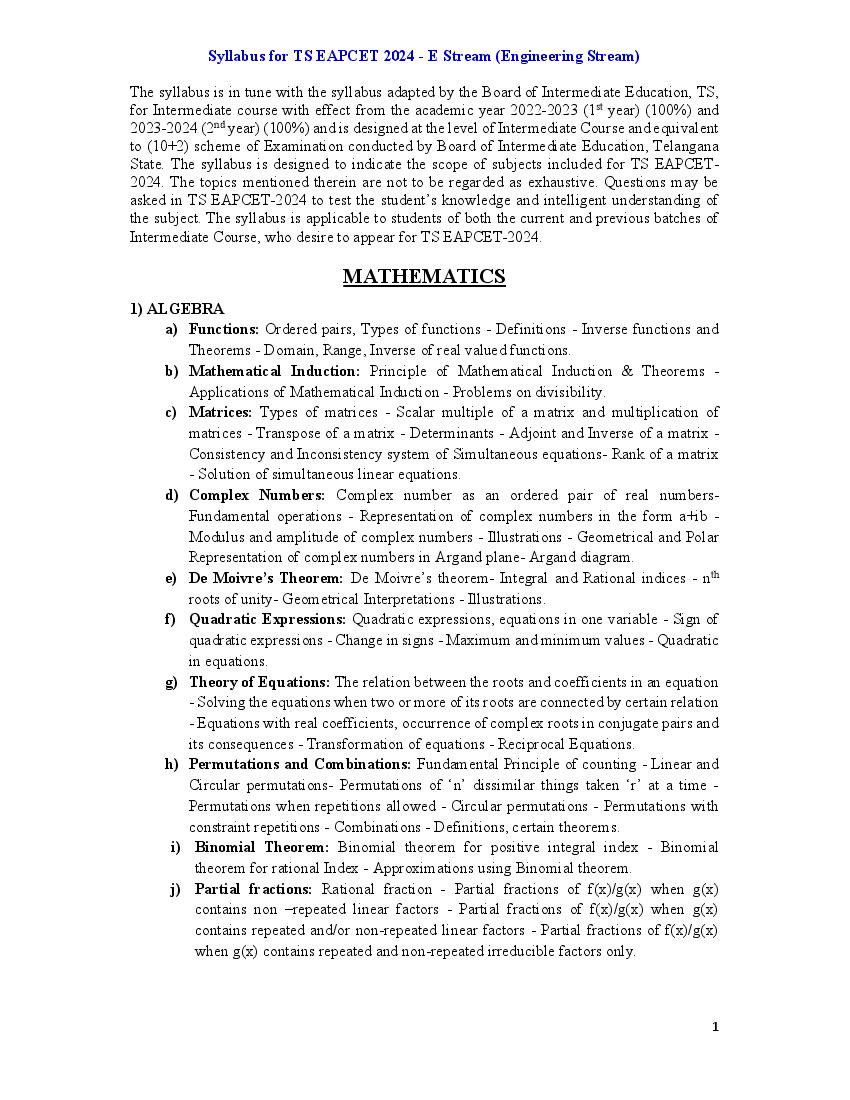
for Intermediate course with effect from the academic year 2022-2023 (1st year) (100%) and
2023-2024 (2nd year) (100%) and is designed at the level of Intermediate Course and equivalent
to (10+2) scheme of Examination conducted by Board of Intermediate Education, Telangana
State. The syllabus is designed to indicate the scope of subjects included for TS EAPCET-
2024. The topics mentioned therein are not to be regarded as exhaustive. Questions may be
asked in TS EAPCET-2024 to test the student’s knowledge and intelligent understanding of
the subject. The syllabus is applicable to students of both the current and previous batches of
Intermediate Course, who desire to appear for TS EAPCET-2024.
MATHEMATICS
1) ALGEBRA
a) Functions: Ordered pairs, Types of functions - Definitions - Inverse functions and
Theorems - Domain, Range, Inverse of real valued functions.
b) Mathematical Induction: Principle of Mathematical Induction & Theorems -
Applications of Mathematical Induction - Problems on divisibility.
c) Matrices: Types of matrices - Scalar multiple of a matrix and multiplication of
matrices - Transpose of a matrix - Determinants - Adjoint and Inverse of a matrix -
Consistency and Inconsistency system of Simultaneous equations- Rank of a matrix
- Solution of simultaneous linear equations.
d) Complex Numbers: Complex number as an ordered pair of real numbers-
Fundamental operations - Representation of complex numbers in the form a+ib -
Modulus and amplitude of complex numbers - Illustrations - Geometrical and Polar
Representation of complex numbers in Argand plane- Argand diagram.
e) De Moivre’s Theorem: De Moivre’s theorem- Integral and Rational indices - nth
roots of unity- Geometrical Interpretations - Illustrations.
f) Quadratic Expressions: Quadratic expressions, equations in one variable - Sign of
quadratic expressions - Change in signs - Maximum and minimum values - Quadratic
in equations.
g) Theory of Equations: The relation between the roots and coefficients in an equation
- Solving the equations when two or more of its roots are connected by certain relation
- Equations with real coefficients, occurrence of complex roots in conjugate pairs and
its consequences - Transformation of equations - Reciprocal Equations.
h) Permutations and Combinations: Fundamental Principle of counting - Linear and
Circular permutations- Permutations of ‘n’ dissimilar things taken ‘r’ at a time -
Permutations when repetitions allowed - Circular permutations - Permutations with
constraint repetitions - Combinations - Definitions, certain theorems.
i) Binomial Theorem: Binomial theorem for positive integral index - Binomial
theorem for rational Index - Approximations using Binomial theorem.
j) Partial fractions: Rational fraction - Partial fractions of f(x)/g(x) when g(x)
contains non –repeated linear factors - Partial fractions of f(x)/g(x) when g(x)
contains repeated and/or non-repeated linear factors - Partial fractions of f(x)/g(x)
when g(x) contains repeated and non-repeated irreducible factors only.
1
Page 2
a) Trigonometric Ratios upto Transformations: Trigonometric ratios - variation - Graph
and Periodicity - Trigonometric ratios of Compound angles - Trigonometric ratios of
multiple and sub-multiple angles - Sum and Product of transformations.
b) Trigonometric Equations: General Solution of Trigonometric Equations - Simple
Trigonometric Equations - Solutions.
c) Inverse Trigonometric Functions: To reduce a Trigonometric Function into a bijective
function - Graphs of Inverse Trigonometric Functions - Properties of Inverse
Trigonometric Functions.
d) Hyperbolic Functions: Definition of Hyperbolic Function - Graphs - Definition of
Inverse Hyperbolic Functions - Graphs - Addition formulae of Hyperbolic Functions.
e) Properties of Triangles: Relation between sides and angles of a Triangle - Sine, Cosine,
Tangent and Projection rules - Half angle formulae and areas of a triangle - Incircle and
Excircle of a Triangle.
3) VECTOR ALGEBRA:
a) Addition of Vectors: Vectors as a triad of real numbers, some basic concepts -
Classification (Types) of vectors - Addition of vectors - scalar multiplication of a vector
- Angle between two non-zero vectors. Linear combination of vectors - Component of a
vector in three dimensions - Vector equations of line and plane.
b) Product of Vectors: Scalar or dot Product of two vectors - Geometrical Interpretations
- Orthogonal projections - Properties of dot product - Expression for scalar (dot) product
in i, j, k system - Angle between two vectors - Geometrical Vector methods - Vector
equations of plane in normal form - Angle between two planes-Vector product (cross
product) of two vectors and properties - Vector product in i, j, k system - Vector Areas
- scalar Triple Product-Vector equations of plane in different forms, skew lines, shortest
distance- condition for coplanarity etc., - Vector Triple Product - Results.
4) PROBABILITY:
a) Measures of Dispersion - Range - Mean deviation - Variance and standard deviation
of ungrouped/grouped data - Coefficient of variation and analysis of frequency
distribution with equal means but different variances.
b) Probability: Random experiments and events - Classical definition of probability,
Axiomatic approach and addition theorem of probability.
Independent and dependent events - conditional probability- Multiplication theorem
and Baye’s theorem.
c) Random Variables and Probability Distributions: Random Variables - Theoretical
discrete distributions - Binomial and Poisson Distributions.
5) COORDINATE GEOMETRY:
a) Locus: Definition of locus - Illustrations - Equations of locus - Problems connected to it.
b) Transformation of Axes: Transformation of axes - Rules, Derivations and Illustrations
- Rotation of axes - Derivations - Illustrations.
2
Page 3
Illustrations - Straight line - Symmetric form - Straight line - Reduction into various
forms - Intersection of two Straight Lines - Family of straight lines - Concurrent lines -
Condition for Concurrent lines - Angle between two lines - Length of perpendicular
from a point to a Line - Distance between two parallel lines - Concurrent lines -
properties related to a triangle.
d) Pair of Straight lines: Equations of pair of lines passing through origin - angle between
a pair of lines - Condition for perpendicular and coincident lines, bisectors of angles -
Pair of bisectors of angles - Pair of lines - second degree general equation - Conditions
for parallel lines - Distance between them, Point of intersection of pair of lines -
Homogenizing a second degree equation with a first degree equation in x and y.
e) Circle: Equation of circle -standard form-centre and radius Position of a point in the
plane of a circle - Definition of tangent. Position of a straight line in the plane of a circle
conditions for a line to be tangent - chord of contact and polar. Relative positions of
two circles.
f) System of circles: Angle between two intersecting circles - Radical axis of two circles
g) Parabola: Conic sections - Equations of tangent and normal at a point on the parabola
h) Ellipse: Equation of ellipse in standard form- Parametric equations - Equation of
tangent and normal at a point on the ellipse.
i) Hyperbola: Equation of hyperbola in standard form - Parametric equations - Equations
of tangent and normal at a point on the Hyperbola.
j) Three Dimensional Coordinates: Coordinates - Section formulae.
k) Direction Cosines and Direction Ratios: Direction Cosines - Direction Ratios.
l) Plane: Cartesian equation of Plane - Simple Illustrations.
6) CALCULUS:
a) Limits and Continuity: Intervals and neighbourhoods - Limits - Standard Limits -
Continuity.
b) Differentiation: Derivative of a function - Elementary Properties - Trigonometric,
Inverse Trigonometric, Hyperbolic, Inverse Hyperbolic Function.
c) Derivatives - Methods of Differentiation - Second Order Derivatives.
d) Applications of Derivatives: Errors and approximations - Geometrical Interpretation
of a derivative - Equations of tangents and normals - Lengths of tangent, normal, sub
tangent and sub normal. Angles between two curves and condition for orthogonality of
curves - Derivative as Rate of change - Rolle’s Theorem and Lagrange’s Mean value
theorem. Increasing and decreasing functions - Maxima and Minima.
e) Integration: Integration as the inverse process of differentiation- Standard forms -
properties of integrals - Method of substitution. Integration of Algebraic, exponential,
logarithmic, trigonometric and inverse trigonometric functions. Integration by parts,
Integration by the method of substitution - Integration of algebraic and trigonometric
functions, Integration by parts- Integration of exponential, logarithmic and inverse
trigonometric functions, Integration-partial fractions method, reduction formulae.
3
Page 4
Integral as an area - Fundamental theorem of Integral Calculus - Properties - Reduction
formulae. Application of Definite integral to areas.
g) Differential equations: Formation of differential equation - Degree and order of an
ordinary differential equation. Solving differential equation by Variables separable
method, Homogeneous differential equation, non-homogeneous differential equation,
Linear differential equations.
*****
4
Page 5
1) PHYSICAL WORLD:
What is physics? Scope and excitement of Physics, Physics, technology and society,
Fundamental forces in nature, Gravitational Force, Electromagnetic Force, Strong
Nuclear Force, Weak Nuclear Force, Towards Unification of Forces, Nature of physical
laws.
2) UNITS AND MEASUREMENTS:
Introduction, The international system of units, Measurement of Length, Measurement
of Large Distances, Estimation of Very Small Distances: Size of a Molecule, Range of
Lengths, Measurement of Mass, Range of Masses, Measurement of time , Accuracy,
precision of instruments and errors in measurement, Systematic errors, random errors,
least count error, Absolute Error, Relative Error and Percentage Error, Combination of
Errors, Significant figures, Rules for Arithmetic Operations with Significant Figures,
Rounding off the Uncertain Digits, Rules for Determining the Uncertainty in the Results
of Arithmetic Calculations, Dimensions of Physical Quantities, Dimensional Formulae
and dimensional equations, Dimensional Analysis and its Applications, Checking the
Dimensional Consistency of Equations, Deducing Relation among the Physical
Quantities.
3) MOTION IN A STRAIGHT LINE:
Introduction, Position, path length and displacement, Average velocity and average
speed, Instantaneous velocity and speed, Acceleration, Kinematic equations for
uniformly accelerated motion, Relative velocity.
4) MOTION IN A PLANE:
Introduction, Scalars and vectors, Position and Displacement Vectors, Equality of
Vectors, Multiplication of vectors by real numbers, Addition and subtraction of vectors
- graphical method, Resolution of vectors, Vector addition - analytical method, Motion
in a plane, Position Vector and Displacement, Velocity, Acceleration, Motion in a plane
with constant acceleration, Relative velocity in two dimensions. Projectile motion,
Equation of path of a projectile, Time of Maximum height, Maximum height of a
projectile, Horizontal range of projectile, Uniform circular motion.
5) LAWS OF MOTION:
Introduction, Aristotle’s fallacy, The law of inertia, Newton’s first law of motion,
Newton’s second law of motion, Momentum Impulse Newton’s third law of motion,
Conservation of momentum, Equilibrium of a particle, Common forces in mechanics,
friction, rolling friction, Circular motion, Motion of a car on a level road, Motion of a
car on a Banked road, Solving problems in mechanics.
6) WORK, ENERGY AND POWER:
Introduction, The Scalar Product, Notions of work and kinetic energy : The work-
energy theorem, Work, Kinetic energy, Work done by a variable force, The work-
5
Page 6
of Mechanical Energy, The Potential Energy of a spring, Various forms of energy: the
law of conservation of energy, Heat, Chemical Energy, Electrical Energy, The
Equivalence of Mass and Energy, Nuclear Energy, The Principle of Conservation of
Energy, Power, Collisions, Elastic and Inelastic Collisions, Collisions in one
dimension, Coefficient of Restitution and its determination, Collisions in Two
Dimensions.
7) SYSTEMS OF PARTICLES AND ROTATIONAL MOTION:
Introduction, What kind of motion can a rigid body have?, Centre of mass, Centre of
Gravity, Motion of centre of mass, Linear momentum of a system of particles, Vector
product of two vectors, Angular velocity and its relation with linear velocity, Angular
acceleration, Kinematics of rotational motion about a fixed axis, Torque and angular
momentum, Moment of force (Torque), Angular momentum of particle, Torque and
angular momentum for a system of a particles, conservation of angular momentum,
Equilibrium of a rigid body, Principle of moments, Moment of inertia, Theorems of
perpendicular and parallel axes, Theorem of perpendicular axes, Theorem of parallel
axes, Dynamics of rotational motion about a fixed axis, Angular momentum in case of
rotations about a fixed axis, Conservation of Angular Momentum, Rolling motion,
Kinetic Energy of Rolling Motion.
8) OSCILLATIONS:
Introduction, Periodic and oscillatory motions, Period and frequency, Displacement,
Simple harmonic motion (S.H.M.), Simple harmonic motion and uniform circular
motion, Velocity and acceleration in simple harmonic motion, Force law for Simple
harmonic Motion, Energy in simple harmonic motion, Some systems executing Simple
Harmonic Motion, Oscillations due to a spring, The Simple Pendulum, Damped simple
harmonic motion, Forced oscillations and resonance.
9) GRAVITATION:
Introduction, Kepler’s laws, Universal law of gravitation, The gravitational constant,
Acceleration due to gravity of the earth, Acceleration due to gravity below and above
the surface of earth, Gravitational potential energy, Escape speed, Earth satellite,
Energy of an orbiting satellite, Geostationary and polar satellites, Weightlessness.
10) MECHANICAL PROPERTIES OF SOLIDS:
Introduction, Elastic behaviour of solids, Stress and strain, Hooke’s law, Stress-strain
curve, Elastic moduli, Young’s Modulus, Determination of Young’s Modulus of the
Material of a Wire, Shear Modulus, Bulk Modulus, Poisson’s Ratio, Elastic Potential
Energy in a Stretched Wire, Applications of elastic behaviour of materials.
11) MECHANICAL PROPERTIES OF FLUIDS:
Introduction, Pressure, Pascal’s Law, Variation of Pressure with Depth, Atmospheric
Pressure and Gauge Pressure, Hydraulic Machines, Streamline flow, Bernoulli’s
6
Page 7
Attack, Dynamic Lift, Viscosity, Variation of Viscosity of fluids with temperature,
Stokes’ Law, Reynolds number, critical velocity, Surface tension, Surface Energy,
Surface Energy and Surface Tension, Angle of Contact, Drops and Bubbles, Capillary
Rise, Detergents and Surface Tension.
12) THERMAL PROPERTIES OF MATTER:
Introduction, Temperature and heat, Measurement of temperature, Ideal-gas equation
and absolute temperature, Thermal expansion, Specific heat capacity, Calorimetry,
Change of state, Regelation, Latent Heat, Heat transfer, Conduction, thermal
conductivity, Convection, Radiation, Black body Radiation, Greenhouse Effect,
Newton’s law of cooling.
13) THERMODYNAMICS:
Introduction, Thermal equilibrium, Zeroth law of thermodynamics, Heat, Internal
Energy and work, First law of thermodynamics, Specific heat capacity, Specific heat
capacity of water, Thermodynamic state variables and equation of State,
Thermodynamic process, Quasistatic process, Isothermal Process, Adiabatic Process,
Isochoric Process, Isobaric process, Cyclic process, Heat engines, Refrigerators and
heat pumps, Second law of thermodynamics, Reversible and irreversible processes,
Carnot engine, Carnot’s theorem.
14) KINETIC THEORY:
Introduction, Molecular nature of matter, Behaviour of gases, Boyle’s Law, Charles’
Law, Kinetic theory of an ideal gas, Pressure of an Ideal Gas, Kinetic interpretation of
temperature, Law of equipartition of energy, Specific heat capacity, Monatomic Gases,
Diatomic Gases, Polyatomic Gases, Specific Heat Capacity of Solids, Specific Heat
Capacity of Water, Mean free path.
15) WAVES:
Introduction, Transverse and longitudinal waves, Displacement relation in a
progressive wave, amplitude and phase, wavelength and angular wave number, time
period, angular frequency and frequency, The speed of a travelling wave, speed of
transverse wave on stretched string, speed of a longitudinal wave (speed of sound), The
principle of superposition of waves, Reflection of waves, standing waves and normal
modes, Beats, Doppler effect.
16) RAY OPTICS AND OPTICAL INSTRUMENTS:
Introduction, Reflection of Light by Spherical Mirrors, sign convention, focal length of
Spherical Mirrors, mirror equation, Refraction, Total Internal Reflection, Total
Internal Reflection in nature and its technological applications, Refraction at Spherical
Surfaces and by Lenses, power of a lens, combination of thin lenses in contact,
Refraction through a Prism, Dispersion by a Prism, Some Natural Phenomena due to
7
Page 8
telescope.
17) WAVE OPTICS:
Introduction, Huygens Principle, Refraction and reflection of plane waves using
Huygens Principle, refraction of a plane wave, refraction in a rarer medium (at the
denser medium boundary), reflection of a plane wave by a plane surface, the Doppler
effect, Coherent and Incoherent Addition of Waves, Interference of Light, Waves and
Young’s Experiment, Diffraction, the single slit, resolving power of optical
instruments, the validity of ray optics, Polarisation, polarisation by scattering,
polarisation of reflection.
18) ELECTRIC CHARGES AND FIELDS:
Introduction, Electric Charges, Conductors and Insulators, Charging by Induction,
Basic Properties of Electric Charge, Coulomb’s Law, Forces between Multiple
Charges, Electric Field, Electric Field due to a system of charges, physical significance
of Electric field, Electric Field Lines, Electric Flux, Electric Dipole, the field of an
Electric Dipole, physical significance of dipoles, Dipole in a Uniform External Field,
Continuous Charge Distribution, Gauss’s Law, Application of Gauss’s Law, field due
to a an infinitely long straight uniformly charged wire, field due to a uniformly charged
infinite plane sheet, field due to uniformly charged thin spherical shell.
19) ELECTROSTATIC POTENTIAL AND CAPACITANCE:
Introduction, Electrostatic Potential, Potential due to a Point Charge, Potential due to
an Electric Dipole, Potential due to a System of Charges, Equipotential Surfaces,
relation between field and potential, Potential Energy of a System of Charges, Potential
Energy in an External Field, potential energy of a single charge, potential energy of a
system of two charges in an external field, potential energy of a dipole in an external
field, Electrostatics of Conductors, Dielectrics and Polarisation, Capacitors and
Capacitance, The Parallel Plate Capacitor, Effect of Dielectric on Capacitance,
Combination of Capacitors – series and parallel, Energy Stored in a Capacitor, Van de
Graaff Generator.
20) CURRENT ELECTRICITY:
Introduction, Electric Current, Electric Currents in Conductors, Ohm’s law, Drift of
Electrons and the Origin of Resistivity, mobility, Limitations of Ohm’s Law, Resistivity
of various Materials, Temperature Dependence of Resistivity, Electrical Energy,
Power, Combination of Resistors — Series and Parallel, Cells, emf, Internal Resistance,
Cells in Series and in Parallel, Kirchhoff’s Laws, Wheatstone Bridge, Meter Bridge,
Potentiometer.
21) MOVING CHARGES AND MAGNETISM:
Introduction, Magnetic Force, sources and fields, magnetic field Lorentz force, Motion
in a Magnetic Field, Motion in Combined Electric and Magnetic Fields, velocity
8
Page 9
Magnetic Field on the Axis of a Circular Current Loop, Ampere’s Circuital Law, The
Solenoid and the Toroid, Force between Two Parallel Current carrying conductors, the
Ampere (unit), Torque on Current Loop (rectangular current loop), circular current loop
as a Magnetic Dipole, the magnetic dipole moment of a revolving electron, The
Moving Coil Galvanometer.
22) MAGNETISM AND MATTER:
Introduction, The Bar Magnet, the magnetic field lines, bar magnet as an equivalent
solenoid, the dipole in a uniform magnetic field, the electrostatic, analog, Magnetism
and Gauss’s Law, The Earth’s Magnetism, magnetic declination and dip, Magnetisation
and Magnetic Intensity, Magnetic Properties of Materials (diamagnetism, para
magnetism, ferromagnetism), Permanent Magnets and Electromagnets.
23) ELECTROMAGNETIC INDUCTION:
Introduction, The Experiments of Faraday and Henry, Magnetic Flux, Faraday’s Law
of Induction, Lenz’s Law and Conservation of Energy, Motional Electromotive Force,
Energy Consideration: A Quantitative Study, Eddy Currents, Inductance, mutual
Inductance, self-Inductance, AC Generator.
24) ALTERNATING CURRENT:
Introduction, AC Voltage Applied to a Resistor, Representation of AC Current and
Voltage by Rotating Vectors — Phasors, AC Voltage Applied to an Inductor, AC
Voltage Applied to a Capacitor, AC Voltage Applied to a Series LCR Circuit, phasor –
diagram solution, analytical solution, resonance, sharpness of resonance, Power in AC
Circuit: The Power Factor, LC Oscillations, Transformers.
25) ELECTROMAGNETIC WAVES:
Introduction, Displacement Current, Electromagnetic Waves, sources of
Electromagnetic Waves, nature of Electromagnetic Waves, Electromagnetic Spectrum.
26) DUAL NATURE OF RADIATION AND MATTER:
Introduction, Electron Emission, Photoelectric Effect, Hertz’s observations,
HallWachs and Lenard’s observations, Experimental Study of Photoelectric Effect,
Photoelectric Effect and Wave Theory of Light, Einstein’s Photoelectric Equation:
Energy Quantum of Radiation, Particle Nature of Light: The Photon, Wave Nature of
Matter, Davisson and Germer Experiment.
27) ATOMS:
Introduction, Alpha-particle Scattering and Rutherford’s Nuclear Model of Atom, alpha
Particle trajectory, electron orbits, Atomic Spectra, spectral series, Bohr Model of the
Hydrogen Atom, energy levels, The Line Spectra of the Hydrogen Atom, De Broglie’s
Explanation of Bohr’s Second Postulate of Quantisation.
9
Page 10
Introduction, Atomic Masses and Composition of Nucleus, Size of the Nucleus, Mass-
Energy and Nuclear Binding Energy, Nuclear Force, Radioactivity, law of radioactive
decay, alpha decay, beta decay, gamma decay, Nuclear Energy, fission, nuclear reactor,
nuclear fusion – energy generation in stars, controlled thermonuclear fusion.
29) SEMICONDUCTOR ELECTRONICS: MATERIALS, DEVICES AND SIMPLE
CIRCUITS:
Introduction, Classification of Materials: Metals, Semiconductors and Insulators (on
the basis of conductivity, on the basis of energy bands) Intrinsic Semiconductor,
Extrinsic Semiconductor, p-n Junction, p-n Junction formation, Semiconductor diode,
p-n Junction diode under forward bias, p-n Junction diode under reverse bias,
Application of Junction Diode as a Rectifier, Special Purpose p-n Junction Diodes,
zener diode, optoelectronic junction devices (photo diode, light emitting diode, solar
cell), Junction Transistor, transistor: structure and action, basic transistor circuit
configurations and Transistor characteristics (common emitter Transistor
characteristics), Transistor as a device (switch, amplifier), Transistor as an amplifier
(CE-configuration), feedback amplifier and Transistor oscillator, Digital Electronics
and Logic Gates, Logic Gates (NOT gate, OR gate, AND gate, NAND gate, NOR
gate), Integrated Circuits.
30) COMMUNICATION SYSTEMS:
Introduction, Elements of a Communication System, Basic Terminology Used in
Electronic Communication Systems, Bandwidth of Signals, Bandwidth of
Transmission Medium, Propagation of Electromagnetic Waves (ground wave, sky
waves, space waves), Modulation and its Necessity, Amplitude Modulation, Production
of Amplitude Modulated Wave, Detection of Amplitude Modulated Wave.
*****
10
Page 11
1) ATOMIC STRUCTURE:
Introduction; Sub- atomic particles; Atomic models – Thomson’s Model; Rutherford’s
Nuclear model of atom, Drawbacks; Developments to the Bohr’s model of atom; Nature
of electromagnetic radiation; Particle nature of electromagnetic radiation- Planck’s
quantum theory; Bohr’s model for Hydrogen atom; Explanation of line spectrum of
hydrogen; Limitations of Bohr’s model; Quantum mechanical considerations of sub
atomic particles; Dual behaviour of matter; Heisenberg’s uncertainty principle; Quantum
mechanical model of an atom. Important features of Quantum mechanical model of atom;
Orbitals and quantum numbers; Shapes of atomic orbitals; Energies of orbitals; Filling of
orbitals in atoms. Aufbau Principle, Pauli’s exclusion Principle and Hund’s rule of
maximum multiplicity; Electronic configurations of atoms; Stability of half filled and
completely filled orbitals.
2) CLASSIFICATION OF ELEMENTS AND PERIODICITY IN PROPERTIES:
Need to classify elements; Genesis of periodic classification; Modern periodic law and
present form of the periodic table; Nomenclature of elements with atomic number greater
than 100; Electronic configuration of elements and the periodic table; Electronic
configuration and types of elements - s,p,d.and f blocks; Trends in physical properties:
(a) Atomic radius, (b) Ionic radius (c)Variation of size in inner transition elements,
(d) Ionization enthalpy, (e) Electron gain enthalpy, (f) Electronegativity;
Periodic trends in chemical properties: (a) Valence or Oxidation states, (b) Anomalous
properties of second period elements - diagonal relationship; Periodic trends and chemical
reactivity.
3) CHEMICAL BONDING AND MOLECULAR STRUCTURE:
Kossel - Lewis approach to chemical bonding, Octet rule, Representation of simple
molecules, formal charges, limitations of octet rule; Ionic or electrovalent bond - Factors
favourable for the formation of ionic compounds-Crystal structure of sodium chloride,
Lattice enthalpy; General properties of ionic compounds; Bond Parameters - bond length,
bond angle, and bond enthalpy, bond order, resonance-Polarity of bonds dipole moment;
Valence Shell Electron Pair Repulsion (VSEPR) theories; Predicting the geometry of
simple molecules; Valence bond theory-Orbital overlap concept-Directional properties of
bonds-overlapping of atomic orbitals strength of sigma and pi bonds-Factors favouring
the formation of covalent bonds; Hybridisation- different types of hybridization involving
s, p and d orbitals- shapes of simple covalent molecules; Coordinate bond –definition with
examples; Molecular orbital theory - Formation of molecular orbitals, Linear combination
of atomic orbitals (LCAO)-conditions for combination of atomic orbitals - Energy level
diagrams for molecular orbitals -Bonding in some homo nuclear diatomic molecules- H 2,
He2, Li2, B2, C2, N2 and O2; Hydrogen bonding-cause of formation of hydrogen bond -
Types of hydrogen bonds-inter and intra molecular-General properties of hydrogen bonds.
11
Page 12
Intermolecular forces; Thermal Energy; Intermolecular forces vs Thermal interactions;
The Gaseous State; The Gas Laws; Ideal gas equation; Graham’s law of diffusion -
Dalton’s Law of partial pressures; Kinetic molecular theory of gases; Kinetic gas equation
of an ideal gas (no derivation) deduction of gas laws from Kinetic gas equation;
Distribution of molecular speeds - rms, average and most probable speeds-Kinetic energy
of gas molecules; Behaviour of real gases - Deviation from Ideal gas behaviour -
Compressibility factor vs Pressure diagrams of real gases; Liquefaction of gases; Liquid
State - Properties of Liquids in terms of Inter molecular interactions - Vapour pressure,
Viscosity and Surface tension (Qualitative idea only. No mathematical derivation).
5) STOICHIOMETRY:
Some basic concepts - Properties of matter - uncertainty in measurement-significant
figures, dimensional analysis; Laws of Chemical Combinations – Law of Conservation of
Mass, Law of Definite Proportions, Law of Multiple Proportions, Gay Lussac’s Law of
Gaseous Volumes, Dalton’s Atomic Theory, Avogadro’s Law, Atomic and molecular
masses- mole concept and molar mass. Concept of equivalent weight; Percentage
composition of compounds and calculations of empirical and molecular formulae of
compounds; Stoichiometry and stoichiometric calculations; Methods of expressing
concentrations of solutions-mass percent, mole fraction, molarity, molality and normality;
Redox reactions classical idea of redox reactions, oxidation and reduction reactions-redox
reactions in terms of electron transfer; Oxidation number concept; Types of Redox
reactions-combination, decomposition, displacement and disproportionation reactions;
Balancing of redox reactions - oxidation number method, Half reaction (ion-electron)
method; Redox reactions in Titrimetry.
6) THERMODYNAMICS:
Thermodynamic Terms; The system and the surroundings; Types of systems and
surroundings; The state of the system; The Internal Energy as a State Function. (a) Work
(b) Heat (c) The general case, the first law of Thermodynamics; Applications; Work;
Enthalpy, H- a useful new state function; Extensive and intensive properties; Heat
capacity; The relationship between Cp and Cv; Measurement of ΔU and ΔH: Calorimetry;
Enthalpy change, ΔrH of reactions - reaction Enthalpy (a) Standard enthalpy of reactions,
(b) Enthalpy changes during transformations, (c) Standard enthalpy of formation, (d)
Thermo chemical equations (e) Hess’s law of constant heat summation; Enthalpies for
different types of reactions. (a) Standard enthalpy of combustion (ΔcHθ), (b) Enthalpy of
atomization (ΔaHθ), phase transition, sublimation and ionization, (c) Bond Enthalpy
(ΔbondHθ ), (d) Enthalpy of solution (ΔsolHθ) and dilution; Spontaneity. (a) Is decrease in
enthalpy a criterion for spontaneity? (b) Entropy and spontaneity, the second law of
thermodynamics, (c) Gibbs Energy and spontaneity; Gibbs Energy change and
equilibrium; Absolute entropy and the third law of thermodynamics.
12
Page 13
CHEMICAL EQUILIBRIUM: Equilibrium in Physical process; Equilibrium in
chemical process - Dynamic Equilibrium; Law of chemical Equilibrium - Law of mass
action and Equilibrium constant; Homogeneous; Equilibria, Equilibrium constant in
gaseous systems. Relationship between KP and Kc; Heterogeneous Equilibria;
Applications of Equilibrium constant; Relationship between Equilibrium constant K,
reaction quotient Q and Gibbs energy G; Factors affecting Equilibria.-Le-chatlier principle
application to industrial synthesis of Ammonia and Sulphur trioxide; Ionic Equilibrium in
solutions
ACIDS,BASES AND SALTS:Acids, bases and salts- Arrhenius, Bronsted-Lowry and
Lewis concepts of acids and bases; Ionisation of Acids and Bases -Ionisation constant of
water and its ionic product- pH scale-ionisation constants of weak acids-ionisation of weak
bases-relation between Ka and Kb-Di and poly basic acids and di and poly acidic Bases-
Factors affecting acid strength-Common ion effect in the ionization of acids and bases-
Hydrolysis of salts and pH of their solutions; Buffer solutions-designing of buffer solution-
Preparation of Acidic buffer; Solubility Equilibria of sparingly soluble salts. Solubility
product, Common ion effect on solubility of salts.
8) HYDROGEN AND ITS COMPOUNDS:
Position of hydrogen in the periodic table; Dihydrogen-Occurence and Isotopes;
Preparation and properties of Dihydrogen; Hydrides: Ionic, covalent and non-
stiochiometric hydrides; Water: Physical properties; structure of water, ice. Chemical
properties of water; hard and soft water, Temporary and permanent hardness of water;
Hydrogen peroxide: Preparation; Physical properties; structure and chemical properties;
storage and uses; Heavy Water; Hydrogen as a fuel.
9) s - BLOCK ELEMENTS (ALKALI AND ALKALINE EARTH METALS)
Group 1 Elements : Alkali metals; Electronic configurations; Atomic and Ionic radii;
Ionization enthalpy; Hydration enthalpy; Physical properties; Chemical properties; Uses;
General characteristics of the compounds of the alkali metals: Oxides; Halides; Salts of
oxo Acids; Anomalous properties of Lithium: Differences and similarities with other alkali
metals, Diagonal relationship; similarities between Lithium and Magnesium; Some
important compounds of Sodium: Sodium Carbonate; Sodium Chloride; Sodium
Hydroxide; Sodium hydrogen carbonate; Biological importance of Sodium and Potassium.
Group 2 Elements: Alkaline earth elements; Electronic configuration; Ionization
enthalpy; Hydration enthalpy; Physical properties, Chemical properties; Uses; General
characteristics of compounds of the Alkaline Earth Metals: Oxides, hydroxides, halides,
salts of oxoacids (Carbonates; Sulphates and Nitrates); Anomalous behavior of Beryllium;
its diagonal relationship with Aluminium; Some important compounds of calcium:
Preparation and uses of Calcium Oxide; Calcium Hydroxide; Calcium Carbonate; Plaster
of Paris; Cement; Biological importance of Calcium and Magnesium.
13
Page 14
General introduction - Electronic configuration, Atomic radii, Ionization enthalpy, Electro
negativity; Physical & Chemical properties; Important trends and anomalous properties of
boron; Some important compounds of boron - Borax, Ortho boric acid, diborane; Uses of
boron, aluminium and their compounds.
11) p-BLOCK ELEMENTS - GROUP 14 (CARBON FAMILY):
General introduction - Electronic configuration, Atomic radii, Ionization enthalpy, Electro
negativity; Physical & Chemical properties; Important trends and anomalous properties of
carbon; Allotropes of carbon; Uses of carbon; Some important compounds of carbon and
silicon – carbon monoxide, carbon dioxide, Silica, silicones, silicates and zeolites.
12) ENVIRONMENTAL CHEMISTRY:
Definition of terms: Air, Water and Soil Pollutions; Environmental Pollution; Atmospheric
pollution; Tropospheric Pollution; Gaseous Air Pollutants (Oxides of Sulphur; Oxides of
Nitrogen; Hydrocarbons; Oxides of Carbon (CO, CO2). Global warming and Greenhouse
effect; Acid rain- Particulate Pollutants- Smog; Stratospheric Pollution: Formation and
breakdown of Ozone- Ozone hole- effects of depletion of the Ozone Layer; Water
Pollution: Causes of Water Pollution; International standards for drinking water; Soil
Pollution: Pesticides, Industrial Wastes; Strategies to control environmental pollution-
waste management- collection and disposal; Green Chemistry: Green chemistry in day-to-
day life; Dry cleaning of clothes; Bleaching of paper; Synthesis of chemicals.
13) ORGANIC CHEMISTRY-SOME BASIC PRINCIPLES, TECHNIQUES AND
HYDROCARBONS
SOME BASIC PRINCIPLES AND TECHNIQUES
General introduction; Tetravalency of Carbon: shapes of organic compounds; Structural
representations of organic compounds; Classification of organic compounds;
Nomenclature of organic compounds; Isomerism; Fundamental concepts in organic
reaction mechanisms; Fission of covalent bond; Nucleophiles and electrophiles; Electron
movements in organic reactions; Electron displacement effects in covalent bonds:
inductive effect, resonance, resonance effect, electromeric effect, hyperconjugation; Types
of Organic reactions; Methods of purification of organic compounds; Qualitative
elemental analysis of organic compounds; Quantitative elemental analysis of organic
compounds.
HYDROCARBONS:
Classification of Hydrocarbons; Alkanes - Nomenclature, isomerism (structural and
conformations of ethane only); Preparation of alkanes; Properties - Physical properties and
chemical Reactivity, Substitution reactions - Halogenation (free radical mechanism),
Combustion, Controlled Oxidation, Isomerisation, Aromatization, reaction with steam and
Pyrolysis; Alkenes- Nomenclature, structure of ethene, Isomerism (structural and
geometrical); Methods of preparation; Properties- Physical and chemical reactions:
Addition of Hydrogen, halogen, water, sulphuric acid, Hydrogen halides (Mechanism-
ionic and peroxide effect, Markovnikov’s, anti Markovnikov’s or Kharasch effect).
14
Page 15
structure of acetylene. Methods of preparation of acetylene; Physical properties, Chemical
reactions- acidic character of acetylene, addition reactions- of Hydrogen, Halogen,
Hydrogen halides and Water. Polymerization.
AROMATIC HYDROCARBONS: Nomenclature and isomerism, Structure of benzene,
Resonance and aromaticity; Preparation of benzene. Physical properties. Chemical
properties: Mechanism of electrophilic substitution. Electrophilic substitution reactions-
Nitration, Sulphonation, Halogenation, Friedel-Crafts alkylation and acylation; Directive
influence of functional groups in mono substituted benzene, Carcinogenicity and toxicity.
14) SOLID STATE:
General characteristics of solid state; Amorphous and crystalline solids; Classification of
crystalline solids based on different binding forces (molecular, ionic, metallic and covalent
solids); Probing the structure of solids: X-ray crystallography; Crystal lattices and unit
cells. Bravais lattices primitive and centred unit cells; Number of atoms in a unit cell
(primitive, body centred and face centred cubic unit cell); Close packed structures: Close
packing in one dimension, in two dimensions and in three dimensions- tetrahedral and
octahedral voids formula of a compound and number of voids filled- locating tetrahedral
and octahedral voids; Packing efficiency in simple cubic, bcc and in hcp, ccp lattice;
Calculations involving unit cell dimensions-density of the unit cell; Imperfections in
solids-types of point defects stoichiometric and non-stoichiometric defects; Electrical
properties-conduction of electricity in metals, semiconductors and insulators- band theory
of metals; Magnetic properties.
15) SOLUTIONS:
Types of solutions; Expressing concentration of solutions - mass percentage, volume
percentage, mass by volume percentage, parts per million, mole fraction, molarity and
molality; Solubility: Solubility of a solid in a liquid, solubility of a gas in a liquid, Henry’s
law; Vapour pressure of liquid solutions: vapour pressure of liquid- liquid solutions.
Raoult’s law as a special case of Henry’s law -vapour pressure of solutions of solids in
liquids; Ideal and non-ideal solutions.
COLLIGATIVE PROPERTIES: Colligative properties and determination of molar
mass relative lowering of vapour pressure-elevation of boiling point-depression of freezing
point - osmosis and osmotic pressure-reverse osmosis and water purification; Abnormal
molar masses - van’t Hoff factor.
16) ELECTROCHEMISTRY AND CHEMICAL KINETICS:
ELECTROCHEMISTRY: Electrochemical cells; Galvanic cells: measurement of
electrode potentials; Nernst equation-equilibrium constant from Nernst equation-
electrochemical cell and Gibbs energy of the cell reaction; Conductance of electrolytic
solutions- measurement of the conductivity of ionic solutions-variation of conductivity and
molar conductivity with concentration-strong electrolytes and weak electrolytes-
applications of Kohlrausch’s law; Electrolytic cells and electrolysis: Faraday’s laws of
15
Page 16
Fuel cells; Corrosion of metals-Hydrogen economy.
CHEMICAL KINETICS: Rate of a chemical reaction; Factors influencing rate of a
reaction: dependence of rate on concentration- rate expression and rate constant- order of
a reaction, molecularity of a reaction; Integrated rate equations-zero order reactions-first
order reactions- half-life of a reaction; Pseudo first order reaction; Temperature
dependence of the rate of a reaction -effect of catalyst; Collision theory of chemical
reaction rates.
17) SURFACE CHEMISTRY:
Adsorption and absorption: Distinction between adsorption and absorption-mechanism of
adsorption-types of adsorption-characteristics of physisorption characteristics of
chemisorptions-adsorption isotherms-adsorption from solution phase - applications of
adsorption; Catalysis: Catalysts, promoters and poisons-auto catalysis - homogeneous and
heterogeneous catalysis-adsorption theory of heterogeneous catalysis; important features
of solid catalysts: (a)activity (b)selectivity-shape-selective catalysis by zeolites-enzyme
catalysis-characteristics and mechanism- catalysts in industry; Colloids: Classification of
colloids; Classification based on physical state of dispersed phase and dispersion medium-
classification based on nature of interaction between dispersed phase and dispersion
medium- classification based on type of particles of the dispersed phase- multi molecular,
macromolecular and associated colloids- cleansing action of soaps-preparation of colloids-
purification of colloidal solutions- properties of colloidal solutions: Tyndal effect, colour,
Brownian movement-charge on colloidal particles, electrophoresis; Emulsions; Colloids
around us- application of colloids.
18) GENERAL PRINCIPLES OF METALLURGY:
Occurrence of metals; Concentration of ores-levigation, magnetic separation, froth
floatation, leaching; Extraction of crude metal from concentrated ore-conversion to oxide,
reduction of oxide to the metal; Thermodynamic principles of metallurgy – Ellingham
diagram-limitations-applications-extraction of aluminium, iron, copper and zinc from their
oxides; Electrochemical principles of metallurgy; Oxidation and reduction; Refining of
crude metal-distillation, liquation poling, electrolysis, zone refining and vapour phase
refining; Uses of aluminium, copper, zinc and iron.
19) p-BLOCK ELEMENTS:
GROUP-15 ELEMENTS: Occurrence- electronic configuration, atomic and ionic radii,
ionisation enthalpy, electronegativity, physical and chemical properties; Dinitrogen
preparation, properties and uses; Compounds of nitrogen-preparation and properties of
ammonia; Oxides of nitrogen; Preparation and properties of nitric acid; Phosphorous-
allotropic forms; Phosphine-preparation and properties; Phosphorous halides; Oxoacids of
phosphorous
GROUP-16 ELEMENTS: Occurrence- electronic configuration, atomic and ionic radii,
ionisation enthalpy, electron gain enthalpy, electronegativity, physical and chemical
properties; Dioxygen-preparation, properties and uses; Simple oxides; Ozone-preparation,
16
Page 17
properties and uses; Oxoacids of sulphur; Sulphuric acid-industrial process of
manufacture, properties and uses.
GROUP-17 ELEMENTS: Occurrence, electronic configuration, atomic and ionic radii,
ionisation enthalpy, electron gain enthalpy, electronegativity, physical and chemical
properties; Chlorine- preparation, properties and uses; Hydrogen chloride- preparation,
properties and uses; Oxoacids of halogens; Interhalogen compounds.
GROUP-18 ELEMENTS: Occurrence, electronic configuration, ionization enthalpy,
atomic radii, electron gain enthalpy, physical and chemical properties(a) Xenon-fluorine
compounds- XeF2, XeF4 and XeF6 -preparation, hydrolysis and formation of fluoro anions
structures of XeF2, XeF4 and XeF6 (b) Xenon-oxygen compounds: XeO3 and XeOF4 –
their formation and structures.
20) d AND f BLOCK ELEMENTS & COORDINATION COMPOUNDS:
d AND f BLOCK ELEMENTS: Position in the periodic table; Electronic configuration
of the d block elements; General properties of the transition elements (d-block) -physical
properties, variation in atomic and ionic sizes of transition series, ionisation enthalpies,
oxidation states, trends in the M2+/M and M3+/M2+ standard electrode potentials, trends
in stability of higher oxidation states, chemical reactivity and Eθ values, magnetic
properties, formation of coloured ions, formation of complex compounds, catalytic
properties, formation of interstitial compounds, alloy formation; Some important
compounds of transition elements oxides and oxoanions of metals-preparation and
properties of potassium dichromate and potassium permanganate-structures of chromate,
dichromate, manganate and permanganate ions; Inner transition elements (f-block)-
lanthanoids- electronic configuration-atomic and ionic sizes oxidation states- general
characteristics; actinoids-electronic configuration atomic and ionic sizes, oxidation states,
general characteristics and comparison with lanthanoids; Some applications of d and f
block elements.
COORDINATION COMPOUNDS: Werner’s theory of coordination compounds;
Definitions of some terms used in coordination compounds; Nomenclature of coordination
compounds-IUPAC nomenclature; Isomerism in coordination compounds-
(a) Stereo isomerism-Geometrical and optical isomerism (b) Structural isomerism-linkage,
coordination, ionisation and hydrate isomerism; Bonding in coordination compounds.
(a) Valence bond theory - magnetic properties of coordination compounds-limitations of
valence bond theory (b) Crystal field theory (i) Crystal field splitting in octahedral and
tetrahedral coordination entities (ii) Colour in coordination compounds-limitations of
crystal field theory; Bonding in metal carbonyls; Stability of coordination compounds;
Importance and applications of coordination compounds.
21) POLYMERS:
Introduction; Classification of Polymers -Classification based on source, structure, mode
of polymerization, molecular forces and growth polymerization; Types of polymerization
reactions-addition polymerization or chain growth polymerization-ionic polymerization,
free radical mechanism-preparation of addition polymers-polythene, Teflon and
17
Page 18
preparation of Nylon 6,6 and Nylon 6, -poly esters-terylene, bakelite,
melamineformaldehyde polymers; copolymerization, Rubber-natural rubber-vulcanisation
of rubber-Synthetic rubbers-preparation of neoprene and buna-N; Molecular mass of
polymers-number average and weight average molecular masses- poly dispersity index
(PDI); Biodegradable polymers-PHBV, Nylon 2 Nylon 6; Polymers of commercial
importance - polypropene, polystyrene, polyvinylchloride (PVC), urea-formaldehyde
resin, Glyptal and Bakelite – their monomers, structures and uses.
22) BIOMOLECULES:
Carbohydrates –
Classification of carbohydrates- Monosaccharides: preparation of glucose from sucrose
and starch- Properties and structure of glucose- D,L and (+), (-) configurations of glucose-
Structure of fructose; Disaccharides: Sucrose- preparation, structure; Invert sugar-
Structures of maltose and lactose- Polysaccharides: Structures of starch, cellulose;
glycogen- Importance of carbohydrates; Aminoacids: Natural aminoacids-classification
of aminoacids - structures and D and L forms-Zwitter ions; Proteins: Structures,
classification, fibrous and globular- primary, secondary, tertiary and quarternary structures
of proteins- Denaturation of proteins; Enzymes: Enzymes, mechanism of enzyme action;
Vitamins: Explanation, names, classification of vitamins - sources of vitamins-deficiency
diseases of different types of vitamins; Nucleic acids: chemical composition of nucleic
acids, structures of nucleic acids, DNA finger printing, biological functions of nucleic
acids; Hormones: Definition, different types of hormones, their production, biological
activity, diseases due to their abnormal activities.
23) CHEMISTRY IN EVERYDAY LIFE:
Drugs and their classification: (a) Classification of drugs on the basis of pharmocological
effect (b) Classification of drugs on the basis of drug action (c) Classification of drugs on
the basis of chemical structure (d) Classification of drugs on the basis of molecular targets;
Drug-Target interaction-Enzymes as drug targets (a) Catalytic action of enzymes (b) Drug-
enzyme interaction,receptors as drug targets; Therapeutic action of different classes of
drugs: antacids, antihistamines, neurologically active drugs: tranquilizers, analgesics-non-
narcotic, narcotic analgesics, antimicrobials-antibiotics, antiseptics and disinfectants- anti
fertility drugs; Chemicals in food-artificial sweetening agents, food preservatives,
antioxidants in food; Cleansing agents-soaps and synthetic detergents – types and
examples.
24) HALOALKANES AND HALOARENES:
Classification and nomenclature; Nature of C-X bond; Methods of preparation: Alkyl
halides and aryl halides-from alcohols, from hydrocarbons (a) by free radical halogenation
(b) by electrophilic substitution (c) by replacement of diazonium group (Sandmeyer
reaction) (d) by the addition of hydrogen halides and halogens to alkenes - by halogen
exchange (Finkelstein reaction); Physical properties-melting and boiling points, density
and solubility; Chemical reactions: Reactions of haloalkanes (i) Nucleophilic substitution
18
Page 19
nucleophilic substitution reactions-optical activity (ii) Elimination reactions (iii) Reaction
with metals-Reactions of haloarenes: (i) Nucleophilic substitution (ii) Electrophilic
substitution and (iii) Reaction with metals; Polyhalogen compounds: Uses and
environmental effects of dichloro methane, trichloromethane, triiodomethane, tetrachloro
methane, freons and DDT.
25) ORGANIC COMPOUNDS CONTAINING C, H AND O (Alcohols, Phenols, Ethers,
Aldehydes, Ketones and Carboxylic acids):
ALCOHOLS, PHENOLS AND ETHERS: Alcohols, phenols and ethers -classification;
Nomenclature: (a)Alcohols, (b)phenols and (c) ethers; Structures of hydroxy and ether
functional groups; Methods of preparation: Alcohols from alkenes and carbonyl
compounds (reduction and reaction with Grignard reagents); Phenols from haloarenes,
benzene sulphonic acid, diazonium salts, cumene; Physical propertics of alcohols and
phenols; Chemical reactions of alcohols and phenols (i) Reactions involving cleavage of
O-H bond-Acidity of alcohols and phenols, esterification (ii) Reactions involving cleavage
of C-O bond- reactions with HX, PX3, dehydration and oxidation (iii) Reactions of
phenols- electrophilic aromatic substitution, Kolbe’s reaction, Reimer - Tiemann reaction,
reaction with zinc dust, oxidation; Commercially important alcohols (methanol,ethanol).
ETHERS-Methods of preparation: By dehydration of alcohols, Williamson synthesis-
Physical properties-Chemical reactions: Cleavage of C-O bond and electrophilic
substitution of aromatic ethers.
ALDEHYDES AND KETONES: Nomenclature and structure of carbonyl group;
Preparation of aldehydes and ketones-(1) by oxidation of alcohols (2) by dehydrogenation
of alcohols (3) from hydrocarbons - Preparation of aldehydes: (1) from acyl chlorides (2)
from nitriles and esters (3) from hydrocarbons-Preparation of ketones: (1) from acyl
chlorides
(2) from nitriles (3) from benzene or substituted benzenes; Physical properties of
aldehydes and ketones; Chemical reactions of aldehydes and ketones-nucleophilic
addition, reduction, oxidation, reactions due to alpha hydrogen (aldol condensation) and
other reactions (Cannizzaro reaction, electrophilic substitution reaction); Uses of
aldehydes and ketones.
CARBOXYLIC ACIDS: Nomenclature and structure of carboxyl group; Methods of
preparation of carboxylic acids (1) from primary alcohols and aldehydes (2) from
alkylbenzenes (3) from nitriles and amides (4) from Grignard reagents (5) from acyl
halides and anhydrides (6) from esters; Physical properties; Chemical reactions: (i)
Reactions involving cleavage of O-H bond-acidity, reactions with metals and alkalies (ii)
Reactions involving cleavage of C-OH bond-formation of anhydride, reactions with PCl 5,
PCl3, SOCl2, esterification and reaction with ammonia (iii) Reactions involving-COOH
group-reduction, decarboxylation (iv) Substitution reactions in the hydrocarbon part -
halogenation and ring substitution; Uses of carboxylic acids.
19
Page 20
AMINES: Structure of amines; Classification; Nomenclature; Preparation of amines:
reduction of nitro compounds, ammonolysis of alkyl halides, reduction of nitriles,
reduction of amides, Gabriel phthalimide synthesis and Hoffmann bromamide degradation
reaction; Physical properties; Chemical reactions: basic character of amines, alkylation,
acylation, carbyl amine reaction, reaction with nitrous acid, reaction with aryl sulphonyl
chloride, electrophilic substitution of aromatic amines-bromination, nitration and
sulphonation.
DIAZONIUM SALTS: Methods of preparation of diazonium salts (by diazotization)
Physical properties; Chemical reactions: Reactions involving displacement of Nitrogen;
Sandmeyer reaction, Gatterman reaction, replacement by i) iodiode and fluoride ions ii)
hydrogen, hydroxyl and Nitro groups; reactions involving retention of diazo group;
coupling reactions; Importance of diazonium salts in synthesis of aromatic compounds.
CYANIDES AND ISOCYANIDES: Structure and nomenclature of cyanides and
isocyanides; Preparation, physical properties and chemical reactions of cyanides and
isocyanides.
*****
20
Page 21
1) I) The coefficient of 𝑥 in (1 − 𝑥 − 𝑥 + 𝑥 ) is 20.
II) If p and q are the coefficients of 𝑥 in (1 + 𝑥) and (1 + 𝑥) respectively then
2p=q.
Which of the above statements is (are) true.
1) only I 2) Only II 3) Both I and II 4) Neither I nor II
2). Assertion (A): If A+B=45 then (1+TanA)(1+TanB)=2.
Reason(R): Tan 22 ½ = √2 − 1.
1) Both A & R are True and R is the correct explanation of A.
2) Both A & R are True and R is not correct explanation of A.
3) A is True but R is False.
4) R is True but A is False.
3) Arrange the following statements in ascending order of their results
/
A) The order of + =𝑎
/ /
B) The degree of + =𝑎
/
C) The degree of 𝑦 = 1 +
D) The order of 𝑥 + + 2𝑥 − 3𝑦 = 𝑥
1) D,C,B,A 2) D,C,A,B 3) C,D,B,A 4) C,D,A,B
4) A and B are two independent events of a sample space such that P(A)=0.2, P(B)=0.5.
List I List II
A) P(B/A) I) 0.2
B) P(A/B) II) 0.1
C) P(A ∩ B) III) 0.3
D) P(A ∪ B) IV) 0.6
V) 0.5
The correct match is
1) A-IV, B-V, C-III, D-I
2) A-V, B-I, C-II, D-IV
3) A-III, B-I, C-II, D- IV
4) A-II, B-I, C-IV, D-V
5) The line𝑎𝑥 + 𝑏𝑦 + 𝑐 = 0 is a normal to the circle 𝑥 + 𝑦 + 4𝑥 + 6𝑦 + 8 = 0 if and
only if
(1) 2𝑎 + 3𝑏 = 𝑐 (2) 3𝑎 + 2𝑏 = 𝑐 (3)2𝑎 + 3𝑏 + 𝑐 = 0 (4)3𝑎 + 2𝑏 + 𝑐 = 0
21
Page 22
6) 𝑙 𝑚 𝑛 = ∆ and 𝑙 𝑚 𝑛 = ∆ then
1 1 1 𝑚𝑛 𝑙𝑛 𝑙𝑚
(1)∆ = ∆ (2) ∆ = 2∆ (3) 2∆ = ∆ (4) ∆ + ∆ = 0
7) If 𝑎 is a non-zero vector and 𝑏, 𝑐̅ are two vectors such that 𝑎 X 𝑏 = 𝑎 X 𝑐̅ and
𝑎 . 𝑏 = 𝑎 . 𝑐̅ then
1) 𝑏 − 𝑐̅ is collinear with 𝑎 2) 𝑏 − 𝑐̅ is perpendicular with 𝑎
3) 𝑏 = 𝑐̅ 4) 𝑏 ≠ 𝑐̅
8) If L1 :2𝑥 + 3𝑦 − 20 = 0, L2 :2𝑥 + 3𝑦 − 14 = 0,
then the straight line represented by 𝑎(2𝑥 + 3𝑦 − 20) + 𝑏( 2𝑥 + 3𝑦 − 14) = 0 is
1) Parallel to L1 =0 and L2 =0.
2) Perpendicular to L1 =0 and parallel to L2 =0
3) Perpendicular to L1 =0 and L2 =0
4) Parallel to L1 =0 and Perpendicular to L2 =0
9) If 𝑓(𝑥) = 𝑙𝑜𝑔 , then 𝑥 =
( ) ( ) ( ) ( )
1) ( ) 2) ( ) 3) ( ) 4) ( )
10) If 𝑡𝑎𝑛𝜃 = then 𝑎 𝑐𝑜𝑠2𝜃 − 𝑏𝑠𝑖𝑛2𝜃 =
1) 𝑎 2) 𝑏 3) 2𝑎 4) 2𝑏
*****
22
Page 23
1. A particle performs simple harmonic motion with amplitude A and time period T. The mean
velocity of the particle over the time interval during which it travels a distance of A/2
starting from extreme position.
1) A/T 2) 2A/T 3) 3A/T 4) A/2T
2. When a battery connected across a resistor of 16 Ω, the voltage across the resistor is
12V.When same battery is connected across a resistor of 10 Ω voltage across it is 11V.The
internal resistance of the battery
1) 10/7Ω 2) 20/7Ω 3) 25/7Ω 4) 30/7Ω
3.Assertion (A): A rocket works on the principle of conservation of linear momentum.
Reason (R): Whenever there is change in momentum of one body, the same change occurs
in the momentum of the second body of the same system but in the opposite
direction.
1) A is true & R is true and correct explanation
2) A is true & R is true and not correct explanation
3) A is true & R is false
4) A is false & R is true
4. Statement(A): A particle can have zero displacement and non zero average velocity.
Statement (B): A particle can have zero acceleration and non zero velocity
Statement (C): A particle can have zero velocity and non-zero acceleration.
1) A,B,C True 2) A, B True, C False 3) B,C True, A False 4) A,B,C False.
5. Match the following
In the experimental study of photoelectric effect:
Column-I Column-II
A. Intensity of incident light changes I. Maximum K.E of photoelectrons changes
B. Frequency of incident light changes II. Stopping potential changes
C. Target material changes III. Saturation current changes.
1. A-III B-I,II C-I,II
2. A-II B-I,III C-I,II
3. A-III B-III,II C-I,II
4. A-I B-I,II C-I,II
*****
23
Page 24
1. Half life of a first order reaction is 15min. The time required for completion of 87.5%
of the reaction is
(1) 15 min (2) 30 min (3) 60 min (4) 45 min
2. Arrange the following in increasing order of their basic strength.
I) C2H5NH2 II) C6H5NH2 III) C6H5CH2NH2 IV) (C2H5 )2NH
(1) I < II < IV < III (2) II < III < I < IV
(3) I < IV < III < II (4) IV < I < III < II
3. Which of the following has least electron gain enthalpy?
(1) Sulphur (2) Chlorine (3) Flourine (4) Oxygen
4. Assertion (A): H2O is liquid and H2S is gas at room temperature
Reason (R) : Molecules of H2O are highly associated through hydrogen bonding
The correct answer is:
(1) Both (A) and (R) are true and (R) is the correct explanation of (A)
(2) Both (A) and (R) are true and (R) is not the correct explanation of (A)
(3) (A) is true but (R) is not true
(4) (A) is not true but (R) is true
5. Match the following:
LIST I (Crystal System) LIST II (Axial Angle)
(A) Cubic (I) α = β = 90; = 120
(B) Hexagonal (II) α ≠ β ≠ ≠ 90
(C) Monoclinic (III) α = β = ≠ 90
(D) Triclinic (IV) α = = 90; β ≠ 90
(V) α = β = = 90
The correct match is:
(1) A-V, B-I, C-III, D-IV
(2) A-IV, B-II, C-V, D-I
(3) A-V, B-I, C-IV, D-II
(4) A-IV, B-II, C-V, D-III
*****
24
Document Details
| Board / Org | TGCHE |
| Exam | Telangana Engineering, Agriculture and Pharmacy Common Entrance Test |
| Type | Syllabus |
| Pages | 24 |
| Updated | 09 Jun 2026 |