TS CPGET 2022 Syllabus M.Sc Biochemistry, Environmental Science, Forensic Science, Genetics, Microbiology
Finished viewing? Save it for later —
Download TS CPGET 2022 Syllabus M.Sc Biochemistry, Environmental Science, Forensic Science, Genetics, Microbiology (PDF · 14 pages)About TS CPGET 2022 Syllabus M.Sc Biochemistry, Environmental Science, Forensic Science, Genetics, Microbiology
TS CPGET 2022 Syllabus M.Sc Biochemistry, Environmental Science, Forensic Science, Genetics, Microbiology is available here for free download. Published by TGCHE for Telangana Common Post Graduate Entrance Test, this syllabus can be viewed online or downloaded as a PDF (14 pages). Candidates preparing for Telangana Common Post Graduate Entrance Test can use TS CPGET 2022 Syllabus M.Sc Biochemistry, Environmental Science, Forensic Science, Genetics, Microbiology to understand the exam pattern, the type of questions asked, and the overall difficulty level.
Frequently Asked Questions
How can I download TS CPGET 2022 Syllabus M.Sc Biochemistry, Environmental Science, Forensic Science, Genetics, Microbiology?
Open this page and click the Download button to save TS CPGET 2022 Syllabus M.Sc Biochemistry, Environmental Science, Forensic Science, Genetics, Microbiology as a PDF. It is completely free on AglaSem Docs.
Is TS CPGET 2022 Syllabus M.Sc Biochemistry, Environmental Science, Forensic Science, Genetics, Microbiology free to download?
Yes. TS CPGET 2022 Syllabus M.Sc Biochemistry, Environmental Science, Forensic Science, Genetics, Microbiology can be viewed online and downloaded as a PDF free of cost on AglaSem Docs.
How many pages does TS CPGET 2022 Syllabus M.Sc Biochemistry, Environmental Science, Forensic Science, Genetics, Microbiology have?
TS CPGET 2022 Syllabus M.Sc Biochemistry, Environmental Science, Forensic Science, Genetics, Microbiology contains 14 pages, which you can read online or download together as a single PDF.
Where can I find more Telangana Common Post Graduate Entrance Test study material?
You can find more Telangana Common Post Graduate Entrance Test question papers, sample papers, syllabus, and answer keys on AglaSem Docs.
TS CPGET 2022 Syllabus M.Sc Biochemistry, Environmental Science, Forensic Science, Genetics, Microbiology – Text
Read the full text of this syllabus below — useful to quickly search, copy and reference the content online without downloading the PDF.
📄 View text version (14 pages)
Page 1
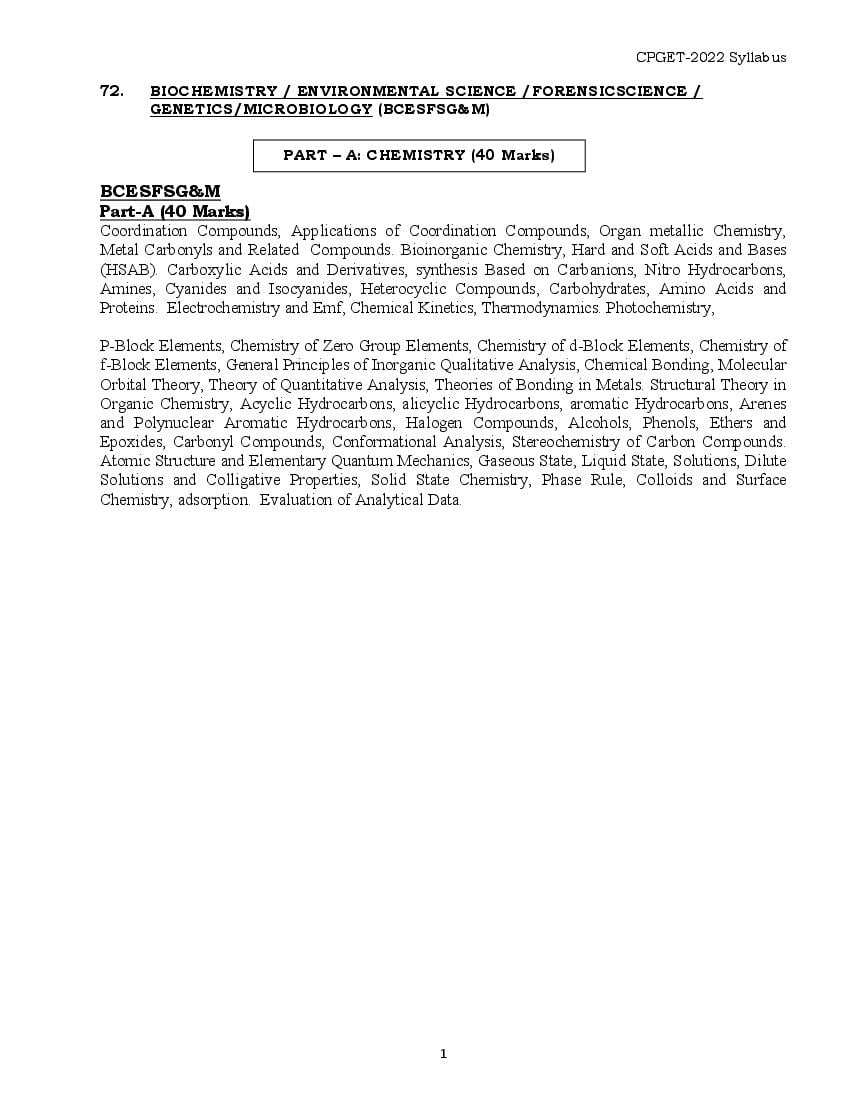
GENETICS/MICROBIOLOGY (BCESFSG&M)
PART – A: CHEMISTRY (40 Marks)
BCESFSG&M
Part-A (40 Marks)
Coordination Compounds, Applications of Coordination Compounds, Organ metallic Chemistry,
Metal Carbonyls and Related Compounds. Bioinorganic Chemistry, Hard and Soft Acids and Bases
(HSAB). Carboxylic Acids and Derivatives, synthesis Based on Carbanions, Nitro Hydrocarbons,
Amines, Cyanides and Isocyanides, Heterocyclic Compounds, Carbohydrates, Amino Acids and
Proteins. Electrochemistry and Emf, Chemical Kinetics, Thermodynamics. Photochemistry,
P-Block Elements, Chemistry of Zero Group Elements, Chemistry of d-Block Elements, Chemistry of
f-Block Elements, General Principles of Inorganic Qualitative Analysis, Chemical Bonding, Molecular
Orbital Theory, Theory of Quantitative Analysis, Theories of Bonding in Metals. Structural Theory in
Organic Chemistry, Acyclic Hydrocarbons, alicyclic Hydrocarbons, aromatic Hydrocarbons, Arenes
and Polynuclear Aromatic Hydrocarbons, Halogen Compounds, Alcohols, Phenols, Ethers and
Epoxides, Carbonyl Compounds, Conformational Analysis, Stereochemistry of Carbon Compounds.
Atomic Structure and Elementary Quantum Mechanics, Gaseous State, Liquid State, Solutions, Dilute
Solutions and Colligative Properties, Solid State Chemistry, Phase Rule, Colloids and Surface
Chemistry, adsorption. Evaluation of Analytical Data.
1
Page 2
GENETICS/MICROBIOLOGY (BCESFSG&M)
PART – B (60 Marks)
SECTION – I: PHYSICS
Mechanics
1. Vector Analysis: Scalar and vector fields, gradient of a scalar field and its
physical significance. Divergence and curl of a vector field and related problems. Vector
integration, line, surface and volume integrals. Stokes, Gauss and Greens theorems- simple
applications:
2. Mechanics of Particles: Laws of motion, motion of variable mass system, motion of a
rocket, multi-stage rocket, conservation of energy and momentum. Collisions in two and
three dimensions, concept of impact parameter, scattering cross-section,
3. Mechanics of rigid bodies: Definition of Rigid body, rotational kinematic relations,
equation of motion for a rotating body, angular momentum and inertial tensor. Euler’s
equation, precession of a top, Gyroscope,
4. Central Forces: Central forces – definition and examples, conservative nature of central
forces, conservative force as a negative gradient of potential energy, equation of motion
under a central force, gravitational potential and gravitational field, motion under inverse
square law, derivation of Kepler’s laws, Coriolis force and its expressions.
5. Special theory of relativity: Galilean relativity, absolute frames, Michelson-Morley
experiment, Postulates of special theory of relativity. Lorentz transformation, time dilation,
length contraction, addition of velocities, mass-energy relation. Concept of four vector
formalism.
Waves and Oscillations
1. Fundamentals of vibrations: Simple harmonic oscillator, and solution of the differential
equation– Physical characteristics of SHM, torsion pendulum, - measurements of
rigidity modulus, compound pendulum, measurement of ‘g’, combination of two mutually
perpendicular simple harmonic vibrations of same frequency and different frequencies,
Lissajous figures
2. Damped and forced oscillations: Damped harmonic oscillator, solution of the
differential equation of damped oscillator. Energy considerations, comparison with
undamped harmonic oscillator, logarithmic decrement, relaxation time, quality factor,
differential equation of forced oscillator and its solution, amplitude resonance, velocity
resonance. Coupled Oscillators.
3. Vibrating Strings: Transverse wave propagation along a stretched string, general
solution of wave equation and its significance, modes of vibration of stretched string
clamped at ends, overtones, energy transport, transverse impedance
4. Vibrations of bars: Longitudinal vibrations in bars- wave equation and its general
solution. Special cases (i) bar fixed at both ends ii) bar fixed at the mid point iii) bar free at
both ends iv) bar fixed at one end. Transverse vibrations in a bar- wave equation and its
general solution. Boundary conditions, clamped free bar, free-free bar, bar supported at
both ends, Tuning fork.
Thermodynamics
1. Kinetic theory of gases: Introduction-Deduction of Maxwell‟s law of distribution of
molecular speeds, Transport Phenomena-Viscosity of gases-thermal conductivity-diffusion
of gases.
2
Page 3
Thermodynamic scale of temperature – Entropy, physical significance – Change in
entropy in reversible and irreversible processes – Entropy and disorder – Entropy of
universe – Temperature- Entropy (T-S) diagram – Change of entropy of a perfect gas-
change of entropy when ice changes into steam.
3. Thermodynamic potentials and Maxwell’s equations: hermodynamic potentials-
Derivation of Maxwell‟s thermodynamic relations-Clausius-Clayperon‟s equation-
Derivation for ratio of specific heats – Derivation for difference of two specific heats for
perfect gas.Joule Kelvin effect – expression for Joule Kelvin coefficient for perfect and
Vanderwaal‟s gas.
4. Low temperature Physics: Joule Kelvin effect – liquefaction of gas using porous plug
experiment. Joule expansion – Distinction between adiabatic and Joule Thomson
expansion – Expression for Joule Thomson cooling – Liquefaction of helium, Kapitza‟s
method – Adiabatic demagnetization – Production of low temperatures – Principle of
refrigeration, vapour compression type.
5. Quantum theory of radiation: Black body-Ferry‟s black body – distribution of energy
in the spectrum of Black body – Wein‟s displacement law, Wein‟s law, Rayleigh-Jean‟s
law – Quantum theory of radiation - Planck‟s law – deduction of Wein‟s distribution
law, Rayleigh-Jeans law, Stefan‟s law from Planck‟s law. Measurement of radiation using
pyrometers – Disappearing filament optical pyrometer – experimental determination –
Angstrom pyroheliometer - determination of solar constant, effective temperature of sun.
6. Statistical Mechanics: Introduction, postulates of statistical mechanics. Phase space,
concept of ensembles and some known ensembles ,classical and quantum statistics and
their differences, concept of probability, Maxwell-Boltzmann‟s distribution law -Molecular
energies in an ideal gas- Maxwell-Boltzmann‟s velocity distribution law, Bose-Einstein
Distribution law, Fermi- Dirac Distribution law, comparison of three distribution laws,
Application of B-E distribution to Photons-planks radiation formula, Application of Fermi-
Dirac statistics to white dwarfs and Neutron stars.
OPTICS
1 Interference: Principle of superposition – coherence – temporal coherence and
spatial coherence – conditions for Interference of light
Interference by division of wave front: Fresnel‟s biprism – determination of wave
length of light. Determination of thickness of a transparent material using Biprism –
change of phase on reflection – Lloyd‟s mirror experiment.
Interference by division of amplitude: Oblique incidence of a plane wave on a thin film
due to reflected and transmitted light (Cosine law) – Colours of thin films – Non
reflecting films – interference by a plane parallel film illuminated by a point source –
Interference by a film with two non-parallel reflecting surfaces (Wedge shaped film) –
Determination of diameter of wire-Newton‟s rings in reflected light with and without
contact between lens and glass plate, Newton‟s rings in transmitted light (Haidinger
Fringes) – Determination of wave length of monochromatic light – Michelson
Interferometer – types of fringes – Determination of wavelength of monochromatic light,
Difference in wavelength of sodium D 1,D2 lines and thickness of a thin transparent plate.
2 Diffraction: Introduction – Distinction between Fresnel and Fraunhoffer diffraction
Fraunhoffer diffraction:- Diffraction due to single slit and circular aperture – Limit of
resolution – Fraunhoffer diffraction due to double slit – Fraunhoffer diffraction pattern with
N slits (diffraction grating) Resolving Power of grating – Determination of wave length of
light in normal and oblique incidence methods using diffraction grating. Fresnel
diffraction-Fresnel‟s half period zones – area of the half period zones –zone plate –
3
Page 4
straight edge – difference between interference and diffraction.
3 Polarization: Polarized light : Methods of Polarization, Polarization by reflection,
refraction, Double refraction, selective absorption , scattering of light – Brewsters law –
Malus law – Nicol prism polarizer and analyzer – Refraction of plane wave incident on
negative and positive crystals (Huygen‟s explanation) – Quarter wave plate, Half wave
plate – Babinet‟s compensator – Optical activity, analysis of light by Laurent‟s half
shade polarimeter.
4 Aberrations and Fiber Optics: Introduction – Monochromatic aberrations, spherical
aberration, methods of minimizing spherical aberration, coma, astigmatism and curvature
of field, distortion. Chromatic aberration – the achromatic doublet – Removal of chromatic
aberration of a separated doublet. Fiber Optics : Introduction – Optical fibers – Principles
of fiber communication – Step and graded index fibers – Rays and modes in an optical
fiber – Fiber material – Types of optical fibers and advantages of fiber communication.
Electromagnetism, Electrostatics:
Electric Field:- Concept of electric field lines and electric flux, Gauss‟s law (Integral
and differential forms), application to linear, plane and spherical charge distributions.
Conservative nature of electric field E, irrotational field. Electric Potential:- Concept of
electric potential, relation between electric potential and electric field, potential energy of a
system of charges. Energy density in an electric field. Calculation of potential from electric
field for a spherical charge distribution.
Magnetostatics
Concept of magnetic field B and magnetic flux, Biot-Savart‟s law, B due to a straight
current carrying conductor. Force on a point charge in a magnetic field. Properties of B,
curl and divergence of B, solenoidal field. Integral form of Ampere‟s law, applications of
Ampere‟s law: field due to straight, circular and solenoidal currents. Energy stored in
magnetic field. Magnetic energy in terms of current and inductance. Magnetic force
between two current carrying conductors. Magnetic field intensity. Ballistic
Galvanometer:- Torque on a current loop in a uniform magnetic field, working
principle of B.G., current and charge sensitivity, electromagnetic damping, critical
damping resistance.
Electromagnetic Induction
Faraday‟s laws of induction (differential and integral form), Lenz‟s law, self and
mutual Induction. Continuity equation, modification of Ampere‟s law, displacement
current, Maxwellequations
Electromagnetic waves
Maxwell‟s equations in vacuum and dielectric medium, boundary conditions, plane
wave equation: transverse nature of EM waves, velocity of light in vacuum and in medium,
polarization, reflection and transmission. Polarization of EM waves, Brewster‟s
angle, description of linear, circular and elliptical polarization.
MODERN PHYSICS
Atomic Spectra and Models Inadequacy of classical
physics:
Brief Review of Black body Radiation , Photoelectric effect, Compton effect, dual nature
of radiation, wave nature of particles. Atomic spectra, Line spectra of hydrogen atom, Ritz
Rydberg combination principle. Alpha Particle Scattering, Rutherford Scattering
Formula, Rutherford Model of atom and its limitations, Bohr‟s model of H atom,
explanation of atomic spectra, correction for finite mass of the nucleus, Bohr
correspondence principle, limitations of Bohr model, discrete energy exchange by atom,
4
Page 5
Broglie hypothesis, Experimental confirmation of matter wave, Davisson Germer
Experiment, velocity of de Broglie wave, wave particle duality, Complementarity.
Superposition of two waves, phase velocity and group velocity , wave packets ,Gaussian
Wave Packet , spatial distribution of wave packet, Localization of wave packet in time.
Time development of a wave Packet; Wave Particle Duality, Complementarity.
Heisenberg Uncertainty Principle, Illustration of the Principle through Experiments of
Gamma ray microscope and electron diffraction through a slit. Time independent and
time dependent Schrodinger wave equation. Estimation of ground state energy of harmonic
oscillator and hydrogen atom, non-existence of electron in the nucleus. Uncertainty
and Complementarities. Nuclear Physics Size and structure of atomic nucleus and its
relation with atomic weight; Impossibility of an electron being in the nucleus as a
consequence of the uncertainty principle. Nature of nuclear force, NZ graph, Liquid
Drop model: semi-empirical mass formula and binding energy, Nuclear Shell Model and
magic numbers. Radioactivity: stability of the nucleus; Law of radioactive decay; Mean life
and half-life; Alpha decay; Beta decay- energy released, spectrum and Pauli's prediction of
neutrino; Gamma ray emission, energy-momentum conservation: electron-positron pair
creation by gamma photons in the vicinity of a nucleus. Fission and fusion- mass deficit,
relativity and generation of energy; Fission - nature of fragments and emission of
neutrons. Nuclear reactor: slow neutrons interacting with Uranium 235; Fusion and
thermonuclear reactions driving stellar energy (brief qualitative discussions), Classification
of Elementary Particles.
5
Page 6
GENETICS/MICROBIOLOGY (BCESFSG&M)
SECTION – II: BOTANY
Microbial Diversity :
Bacteria: Structure, nutrition, reproduction and economic importance. An outline of plant diseases
of important crop plants caused by bacteria and their control with reference to Angular leaf spot of
cotton and Bacterial blight of Rice. Brief account of Archaebacteria, Actinomycetes. General account
of Mycoplasma with reference to Little leaf of brinjal and Papaya leaf curl.
Viruses: Structure, replication and transmission; plant diseases caused by viruses and their control
with reference to Tobacco Mosaic and Rice Tungro.
Algae
Algae: General characters, structure, reproduction and classification of algae (Fritsch).
Cyanobacteria: General characters, cell structure, thallus organisation and their significance as
biofertilizers with special reference to Oscillatoria, Nostoc and Anabaena.
Structure and reproduction of the following:
Chlorphyceae-Volvox, Oedogonium, Chara.
Phaeophyceae-Ectocarpus.
Rhodophyceae-Polysiphonia.
Fungi
Fungi: General characters and classification of fungi (Ainsworth). Structure and reproduction of the
following:
Mastigomycotina-Albugo
Zygomycotina-Mucor
Ascomycotina-Saccharomyces, Penicillium
Basidiomycotina- Puccinia
Deuteromucotina-Cercospora.
Lichens: Structure and reproduction; ecological and economic importance.
Bryophytes, Pteridophytes, Gymnosperms and Paleobotany:
Bryophytes: Structure, reproduction, life cycle and systematic position of Marchantia, Anthoceros
and Polytrichum. Evolution of Sporophyte in Bryophytes. Pteridophytes: Structure, reproduction,
life cycle and systematic position of Rhynia, Lycopodium, Equisetum and Marsilea. Stelar evolution,
heterospory and seed habit in Pteridophytes. Gymnosperms: General characters, structure,
reproduction and classification (Sporne’s). Distribution and economic importance of Gymnosperms.
Morphology of vegetative and reproductive parts, systematic position and life cycle of Pinus and
Gnetum. Palaeobotany: Introduction, Fossils, types of fossils and fossilization, Importance of
fossils. Geological time scale.
Taxonomy of Angiosperms:
Principles of plant systematics, Types of classification: Artificial, Natural and Phylogenetic;
Systems of classification: Salient features and comparative account of Bentham & Hooker and
Engler & Prantle. An introduction to Angiosperm Phylogeny Group (APG). Current concepts in
Angiosperm Taxonomy: Embryology in relation to taxonomy, Cytotaxonomy, Chemotaxonomy and
Numerical Taxonomy. Nomenclature and Taxonomic resources: An introduction to ICN, Shenzen
code - a brief account. Herbarium: Concept, techniques and applications. Systematic study and
economic importance of plants belonging to the families; Annonaceae, Capparidaceae, Rutaceae,
Fabaceae (Faboideae/papilionoideae, Caesalpinioideae, Mimosoideae), Cucurbitaceae, Apiaceae,
Asteraceae, Asclepiadaceae, Lamiaceae, Amaranthaceae, Euphorbiaceae, Monocotyledons:
Orchidaceae and Poaceae, Zinziberaceae.
6
Page 7
Component of eco system, energy flow, food chain and food webs. Plants and environment,
ecological adaptations of plants, Hydrophytes, Xerophytes and Mesophytes. Plant Succession serial
stages, modification of environment, climax formation with reference to Hydrosere and Xerosere.
Generalaccount of adaptations in xerophytes and hydrophytes.
Plant Anatomy
Meristems: Types, histological organization of shoot and root apices and theories. Tissues and Tissue
Systems: Simple, complex and special tissues. Leaf: Ontogeny, diversity of internal structure;
stomata and epidermal outgrowths. Stem and root anatomy: Vascular cambium - Formation and
function. Anomalous secondary growth of Stem - Achyranthes, Boerhaavia, Bignonia, Dracaena;
Root– Beta vulgaris. Wood structure: General account. Study of local timbers – Teak, Rosewood, Red
sanders, Nallamaddi and Neem.
Embryology
History and importance of Embryology. Anther structure, Microsporogenesis and development of
male gametophyte. Ovule structure and types; Megasporogenesis; types and development of female
gametophyte. Pollen morphology, pollination and fertilization, Pollination – Types, Pollen - pistil
interaction, double fertilization. Seed structure appendages and dispersal mechanisms. Endosperm -
Development and types. Embryo - development and type, Polyembryony and Apomixis - an outline.
Cell Biology
Plant cell envelops: Ultra structure of cell wall, Models of membrane structure, structure and
functions of Semi permeable Plasma membrane. Cell Organelles: Structure and semiautonomous
nature of Mitochondria and Chloroplast. Nucleus: Ultra structure, types and functions of DNA &
RNA. Mitochondrial DNA & Plastid DNA and Plasmids. Chromosomes: Morphology, organization of
DNA in a chromosome, Euchromatin and Heterochromatin, Karyotype. Special types of
chromosomes: Lampbrush and Polytene chromosomes. Cell division: Cell and its regulation;
mitosis, meiosis and their significance
Genetics
Mendelism: History, Principles of inheritance, Chromosome theory of inheritance, Autosomes
and sex chromosomes, Incomplete dominance and Co-dominance. Multiple alleles, Lethal alleles,
Epistasis, Recessive and Dominant traits, Polygenic inheritance. Linkage and crossing over,
Recombination frequency, two factor and three factor crosses; Interference and coincidence.
Numericals based on gene mapping; Sex Linkage.Variation in chromosome number and structure:
Deletion, Duplication, Inversion, Translocation, Position effect, Euploidy and Aneuploidy. Gene
mutations: Types of mutations; Molecular basis of Mutations; Mutagens-physical and chemical (Base
analogs, deaminating, alkylating and intercalating agents).
Plant Physiology
Plant -water Relations: Water potential, osmosis, osmotic and pressure potential, absorption and
transport of water. Mineral Nutrition: Essential micro & macro nutrients and symptoms of mineral
deficiency. Transpiration: Stomatal structure and movement. Mechanism of phloem transport.
Enzymes: Nomenclature, properties, Classification and factors regulating enzyme activity.
Photosynthesis: Photosynthetic pigments, Cyclic and Non-cyclic Photophosphorylation.
Carbon assimilation pathways: C3, C4 and CAM. Respiration: Aerobic and Anaerobic; Glycolysis,
Krebs cycle and oxidative phosphorylation. Nitrogen Metabolism: Biological nitrogen fixation.
Physiological role of Phytohormones: Auxins, gibberellins, cytokinins, ABA, ethylene and
Brassinosteroids.
7
Page 8
GENETICS/MICROBIOLOGY (BCESFSG&M)
SECTION – III: ZOOLOGY
Physiology and Biochemistry:
Digestion Digestion definition and extra and intracellular digestion. Digestion of Carbohydrates,
Proteins, Lipids and Cellulose. Absorption and Assimilation of digested food; role of Gastrointestinal
hormones in digestion Respiration Definition of Respiration and Respiratory mechanisms-External,
Internal and cellular. Respiratory Pigments; Transport of oxygen, Oxygen dissociation curves. Bohr’s
effect. Transport of CO2 – Chloride shift; Regulation of respiration – nervous and chemical Circulation
Types of circulation - Open and Closed circulation Structure of Mammalian Heart, Types of hearts –
Neurogenic and Myogenic; Heart function -Conduction and regulation of heart beat. Regulation of
Heart rate – Tachycardia and Bradycardia; Blood Clotting mechanism. Excretion Classification of
Animals on the basis of excretory products- Ammonotelic, Uricotelic, Ureotelic, Structure and
function of Nephron. Urine formation, Counter current mechanism.
Physiology
Muscle Contraction: Types of Muscles, Ultra structure of skeletal muscle fibre, Sliding Filament
theory, muscle contraction mechanism and energetics. Nerve Impulse Structure of Neuron, Nerve
impulse - Resting potential and Action potential and Conduction of Nerve impulse, Synapse, types of
synapses and Synaptic transmission. Endocrine System Endocrine glands - Structure, secretions and
functions of Pituitary, Thyroid, Parathyroid, Adrenal glands and Pancreas, Hormone action and
concept of Secondary messengers, Male and Female Hormones, Hormonal control of Menstrual cycle
in humans.
Physiology and Biochemistry:
Homeostasis and Enzymes Concept of Homeostasis. Mechanism of Homeostasis. Osmoregulation -
Water and ionic regulation by freshwater, brackish water and marine animals, Enzymes: Definition,
Classification, Inhibition and Regulation. Biomolecules and Metabolism Carbohydrates:
Classification and function of Carbohydrates, Carbohydrate metabolism - Glycolysis, Krebs cycle,
Electron transport and oxidative phosphorylation. Proteins: Classification of proteins based on
functions and Chemical nature, Protein Metabolism - Transamination, Deamination and Urea Cycle,
Lipids: Classification of Lipids, Lipid Metabolism - Fatty acid synthesis and Fatty acid oxidation.
Immunology and Animal Biotechnology:
Immunology – Basic concepts; antigens and antibodies Basic concepts of immunology. Cells of
immune system, Primary and secondary Organs of immune system, Types of Immunity – Innate and
acquired, Basic properties of antigens, Structure, function and types of an antibody. B and T cell
epitopes, haptens, adjuvants. Antigen-antibody reactions, T-Cell and B-Cell activation, Monoclonal
antibodies and their production. Working of an Immune system; Immune system in health and
disease Structure and functions of major histocompatibility complex. Basic properties and functions
of Cytokines, Interferons and complement proteins, Humoral and Cell mediated immunity. Types of
hyper sensitivity. Concepts of autoimmunity and immunodeficiency. Introduction to Vaccines and
types of Vaccines. Animal Biotechnology and Genetically modified organisms Concept and Scope of
Animal Biotechnology. Cloning vectors - Plasmids, Cosmids, Lambda bacteriophage, YAC Cloning-
Cloning methods (Cell, Animal and Gene cloning) Animal Cell culture - Equipment and materials for
8
Page 9
applications, Transgenesis – Methods of Transgenesis. Production of Transgenic animals and
Application of Transgenic animals in Biotechnology. Stem cells –types and their applications.
Animal Diversity – Invertebrates
Brief history of Invertebrates: Kingdom Animalia, Brief history of Invertebrates. Protozoa General
characters Classification up to classes with examples, Type study – Elphidium, Life cycle of
Plasmodium. Locomotion, Reproduction and Diseases. Porifera General characters, Classification of
Porifera up to classes with examples, Type study – Sycon, Canal system in sponges and Spicules.
Cnidaria General characters, Classification of Cnidaria up to classes with examples, Type study –
Obelia, Polymorphism in hydrozoa, Corals and coral reef formation. Platyhelminthes General
characters Classification of Platyhelminthes up to classes with examples, Type study-Schistosoma.
Nemathelminthes General characters Classification of Nemathelminthes up to classes with examples
Type study-Dracunculus, Parasitic Adaptations in Helminthes.
Annelida General characters, Classification of Annelida up to classes with examples Type study -
Hirudinaria granulosa. Evolutionary significance of Coelome and Coelomoducts and metamerism.
Arthropoda General characters, Classification of Arthropoda up to classes with examples, Type study
– Prawn, Crustacean larvae, Insect metamorphosis, Peripatus - Structure and affinities. Mollusca
General characters, Classification of Mollusca up to classes with examples, Type study – Pila, Pearl
formation, Torsion and detorsion in gastropods. Echinodermata General characters, Classification of
Echinodermata up to classes with examples, Water vascular system in star fish, Echinoderm larvae
and their significance. Hemichordata General characters, Classification of Hemichordata up to classes
with examples, Balanoglossus - Structure and affinities.
Ecology, Zoogeography and Animal Behavior:
Ecology-I: Ecosystem structure and functions. Types of Ecosystems –Aquatic and Terrestrial.
Biogeochemical cycles - Nitrogen, Carbon, Phosphorus and Water. Energy flow in ecosystem. Food
chain, food web and ecological pyramids. Animal Associations - Mutualism, commensalism,
parasitism, competition, predation.
Ecology – II: Concept of Species, Population dynamics and Growth curves. Community Structure and
dynamics and Ecological Succession. Ecological Adaptations. Environmental Pollution – Sources,
Effect and Control measures of Air, Water, Soil and Noise Pollution. Wildlife conservation - National
parks and Sanctuaries of India, Endangered species. Biodiversity and hotspots of Biodiversity in India.
Zoogeography: Zoogeographical regions – Palaearctic, Nearctic, Neotropical, Oriental, Australian and
Ethiopian regions - their Climatic and faunal peculiarities, Wallace line, Discontinuous distribution
Continental Drift. Animal Behaviour Types of Behaviour- Innate and Acquired, Instinctive and
Motivated behavior, Taxes, Reflexes, Tropisms, Biological rhythms and types of rhythms, trial and error
learning, Imprinting, habituation, Classical conditioning, Instrumental conditioning, Social behavior,
Communication, Pheromones, Biological rhythms, Biological clocks, Circadian rhythms.
Animal Diversity- Vertebrates and Developmental Biology:
Urochordata, Cephalochordata, Cyclostomata: Salient features of Urochordata, Retrogressive,
metamorphosis and its significance in Urochordata, Salient features and affinities of Cephalochordata
General characters of Cyclostomata, Comparison of the Petromyzon and Myxine, General characters
and classification of Chordata upto orders with examples. Pisces General characters of Fishes,
9
Page 10
Nervous system. Types of Scales and types of Fins
Amphibia General characters of Amphibians, Classification of Amphibians up to orders with
examples. Rana tigrina-Respiratory, Circulatory and Nervous system. Parental care in amphibian;
neoteny and paedogenesis.
Reptilia: General characters of Reptilia, Classification of Reptilia up to orders with examples, Calotes
– Respiratory system, Circulatory and Nervous system. Temporal fossae in reptiles and its
evolutionary importance, Distinguished characters of Poisonous and Non poisonous snakes.
Rhynchocephalia. Aves General characters of Aves, Classification of Aves up to orders with
examples. Columba livia -, Digestive system, Circulatory systems, Respiratory system and Nervous,
system. Migration in Birds, Flight adaptation in Birds, Mammalia General characters of Mammalia,
Classification of Mammalia up to orders with examples Rabbit –Digestive, Respiratory, Circulatory
and Nervous system. Dentition in mammals. Aquatic adaptations in Mammals. Developmental
Biology and Embryology Gametogenesis (Spermatogenesis and Oogenesis) Fertilization, Types of
eggs, Types of cleavages, Development of Frog up to formation of primary germ layers Formation of
Foetal membrane in chick embryo and their functions, Types and functions of Placenta in mammals,
Regeneration in Turbellaria and Lizards.
Cell Biology, Genetics & Evolution:
1. Cell Biology Ultrastructure of animal cell, Structure and functions of plasma membrane
proteins. Structure and functions of cell organelles –Endoplasmic reticulum, Golgi body,
Ribosomes, Lysosomes, centrosomes, Mitochondria and Nucleus Chromosomes – Structure,
types, giant chromosomes, Cell Division - Mitosis, Meiosis. 2. Molecular Biology DNA
(Deoxyribo Nucleic Acid) – Structure, RNA (Ribo Nucleic Acid) - Structure, types, DNA
Replication, Protein Synthesis – Transcription and Translation, Gene Expression – Genetic
Code; operon concept, Molecular Biology Techniques- Polymerase Chain Reaction,
Electrophoresis 3. Genetics Mendals laws of Inheritance and Non-Medelian Inheritance,
Linkage and Crossing over, Sex determination and sex-linked inheritance, Chromosomal
Mutations- Deletion, Duplication, Inversion, Translocation, Aneuploidy and Polyploidy. Gene
mutations- Induced versus Spontaneous mutations. Inborn errors of metabolism. 4.
Evolution Theories of evolution – Lamarckism and Neo-Lamarckism, Darwinism and Neo-
Darwinism, Modern synthetic theory. Evidences of Evolution and Hardy Weinberg Law.
Forces of Evolution – mutation, gene flow, genetic drift, and natural selection. Isolation – Pre-
mating and post mating isolating mechanisms, Speciation: Methods of speciation-Allopatric
and sympatric.
10
Page 11
GENETICS/MICROBIOLOGY (BCESFSG&M)
SECTION – IV: BIOCHEMISTRY
Elementary aspects of cell structure–function, tissues and body fluids. 2. Chemistry, physiological
role and metabolism of biomolecules like carbohydrates, amino-acids, proteins, Lipids & nucleic
acids. 3. Basic aspects of nutrition, endocrinology & Physiology, clinical biochemistry, enzymology,
biological oxidations, photosynthesis. 4. Physiological role of vitamins and minerals. 5. Basic
aspects of immunology. 6. Replication, transcription and protein synthesis. 7. Fundamental aspects
of microbiology. 8. Elementary aspects of r-DNA technology and genetic engineering. 9. Principles,
methodology and applications of various biochemical techniques used in biochemistry.
11
Page 12
GENETICS/MICROBIOLOGY (BCESFSG&M)
SECTION – V: GENETICS
CLASSICAL GENETICS
Mendelian Inheritance & extensions: Terminology and definitions –phenotypes, genotype, locus,
allele, homozygotes, heterozygotes, Johanssen’s pure line concept, filial generations, reciprocal cross,
back cross, test cross; Law of segregation- Law of Independent Assortment, Extension to mendelian
segregation patterns: Co-dominance, Incomplete dominance, Lethals, gene interaction-Epistasis-
paramutation-Environmental effects on gene expression-Penetrance-Expressivity, Multiple alleles,
and Pseudoalleles; Features of Quantitative Inheritance, Multifactorial inheritance,
Extrachromosomal inheritance, Sex linked inheritance: X—linked and Y-linked traits, Sex
chromosome inactivation –dosage compensation, Gynandromorph; Linkage and gene mapping:
Cytological proof of crossing over, Phases of linkage, test cross, recombination frequency,
gene mapping, determination of map distances based on two and three point test crosses,
coincidence, interference, Tetrad analysis –Neurospora, Mitotic crossing over-Drosophila; Organellar
inheritance: Non-Mendelian inheritance, Chloroplast and Mitochondrial inheritance, Chloroplast
and Mitochondrial genomes
CYTOGENETICS
Eukaryotic Cell cycle -Phases of cell cycle G0, G1,S, G2, Genes that determine the cell cycle –
cyclins, CDK proteins, role of p53 in cell cycle, Mitosis –stages, significance of mitosis, Meiosis I &
II- Stages, formation of synaptonemal complex, crossing over, chiasma formation, significance of
meiosis; Chromosome structure, chromatin organization and variation: Chromosome
morphology-size and shape; Euchromatin and Heterochromatin-constitutive and facultative
heterochromatin, Components of chromatin, histones & non-histones, Packing of DNA into
chromatin –Nucleosome and higher order organization, Specialized Chromosomes –Lampbrush
chromosomes, Polytene Chromosomes, Super numerary chromosomes, Chromosome Variation-
Structural and Numerical aberrations; Cell communication and signaling: Basics of cell signaling –
paracrine, endocrine, autocrine, tight junctions and gap junctions, Secondary messengers -cAMP,
phosphotidyl inositol, Ca+2and IP3, G-protein coupled receptors and Tyrosine Kinase receptors;
Dysregulation of Cell cycle: Necrosis, senescence, programmed cell death (apoptosis- intrinsic and
extrinsic factors), Cancer
MOLECULAR GENETICS
Nucleic acids: DNA as the genetic material and experimental evidences, RNA as genetic material,
Chemistry of Nucleic acids, Forms of DNA and types of RNA, Models and methods of DNA
replication, Mechanism of DNA replication and enzymes involved; Gene expression and regulation
in prokaryotes and eukaryotes: Structure of prokaryotic and eukaryotic gene, Transcription and
Translation mechanisms, Genetic code and properties, Operon concept- lac operon & glucose effect,
tryptophan operon, Post-transcriptional and Post-translational modifications in eukaryotes;
Mutations and repair mechanisms: Mutations-spontaneous and induced mutations, Types of
mutations, DNA damage & repair mechanisms, Diseases caused due to mutation-sickle cell anaemia
and cystic fibrosis
MICROBIAL GENETICS & GENETIC ENGINEERING
Bacterial recombination and mapping: Bacteria- structure, Transformation and gene mapping,
Conjugation and gene mapping High frequency recombination, interrupted mating experiment;
Genetics of bacteriophages: Structure and classification of bacteriophages, Lytic cycle, Lysogeny,
Generalized and specialized transductions; Enzymes used in molecular cloning, Vectors used in
cloning, Genomic and cDNA libraries, Blotting techniques and PCR, Screening for detection of
cloned genes, Applications of genetic engineering- Gene products in medicine, DNA based
vaccines, Subunit vaccines, Attenuated vaccines, genetically engineered microorganisms for
bioremediation, phytoremediation, Transgenic plants, Transgenic animals, Molecular pharming,
Industrial products
12
Page 13
Measures of central tendency and measures of dispersion, Grouped data and graphical methods,
Probability, Binomial, Poisson and Normal distributions, t-test, z-test, chi-square test; Computer
and Internet Basics, Biological databases, DNA Sequence and Protein sequence databases, Sequence
retrieval from Genbank, ENA, Swissprot
POPULATION GENETICS & EVOLUTION
Allele frequencies and genotype frequencies at a locus, Hardy-Weinberg Law, Linkage
disequilibrium, Snyder’s ratios; Selection–fitness, patterns of natural selection, general selection
equation, equilibrium under selection, Selection favoring heterozygote, selection against
heterozygote, complete elimination of recessive gene; Mutation–mutation models, influence of
mutation on allele frequency & autozygosity, balance between forward & backward mutation,
interaction of mutation with selection; Genetic load, Gene flow, Wahlund effect, Inbreeding,
construction of pedigrees inbreeding coefficient and inbreeding depression; Genetic Drift -Bottle neck
effect, Founder effect, effective population size, consequences of a decreasing population size; Origins
of genomes - Acquisition of new genes by gene duplication and from other species, Origin of non-
coding DNA, transposable elements and introns, Molecular phylogenetics, Molecular Evolution,
Molecular clock
13
Page 14
GENETICS/MICROBIOLOGY (BCESFSG&M)
SECTION – VI: MICROBIOLOGY
Scope and importance of Microbiology. Spontaneous generation-biogenesis theory; Germ theory of
diseases; Recent developments of Microbiology. Principles of microscopy. Principles of staining.
Culture media. Sterilization methods. Isolation of pure cultures, maintenance and preservation of
microbial cultures. Morphology and ultra structure of typical eubacterial cell. Bacterial classification.
Discovery and nature of viruses. TMV, HIV, T4 and lambda phages. Cultivation and assay of phages,
plant and animal viruses. Nutritional types of bacteria. Bacterial growth. Respiration. Fermentation.
Antibiotics. DNA and RNA structures and their role as genetic materials. Transcription and
translation. Lac operon. Bacterial plasmids and transposons. DNA damage and repair mechanisms.
Mutations. Gene transfer mechanisms in bacteria. Recombinant DNA technology. Types of
immunity. Organs of immune system. Cells of immune system. Antigens. Antibodies. Antigen-
antibody reactions. Normal flora of human body. Infection, Disease, Defense mechanisms. Bacterial
toxins, virulence and attenuation. Airborne diseases, Food water borne diseases and Blood borne
diseases. General principles of diagnostic microbiology. Elements of chemotherapy-therapeutic
drugs. Drug resistance. Microorganisms in relation to plant growth. Biological nitrogen fixation,
Biofertilizers. Microorganisms of the environment (soil, water and air). Microbial interactions.
Microbiology of potable and polluted waters. Microorganisms of food spoilage and their sources.
General account of food .preservation. Microorganisms as food – SCP, edible mushrooms. Screening
and isolation of industrially useful microbes, strain improvement and fermentation. Fermentor.
Immobiolization Industrial production of Alcohols, Glutamic acid, Citric acid, vitamin B12, Enzymes,
and Antibiotics. Biomolecules: Carbohydrates, aminoacids, proteins, Biochemical techniques.
14
Document Details
| Board / Org | TGCHE |
| Exam | Telangana Common Post Graduate Entrance Test |
| Type | Syllabus |
| Pages | 14 |
| Updated | 30 Apr 2026 |