Odisha CPET 2020 Question Paper Education
Finished viewing? Save it for later —
Download Odisha CPET 2020 Question Paper Education (PDF · 15 pages)About Odisha CPET 2020 Question Paper Education
Odisha CPET 2020 Question Paper Education is available here for free download. Published by Odisha Exams for Odisha CPET, this question paper can be viewed online or downloaded as a PDF (15 pages). Candidates preparing for Odisha CPET can use Odisha CPET 2020 Question Paper Education to understand the exam pattern, the type of questions asked, and the overall difficulty level.
Frequently Asked Questions
How can I download Odisha CPET 2020 Question Paper Education?
Open this page and click the Download button to save Odisha CPET 2020 Question Paper Education as a PDF. It is completely free on AglaSem Docs.
Is Odisha CPET 2020 Question Paper Education free to download?
Yes. Odisha CPET 2020 Question Paper Education can be viewed online and downloaded as a PDF free of cost on AglaSem Docs.
How many pages does Odisha CPET 2020 Question Paper Education have?
Odisha CPET 2020 Question Paper Education contains 15 pages, which you can read online or download together as a single PDF.
Where can I find more Odisha CPET study material?
You can find more Odisha CPET question papers, sample papers, syllabus, and answer keys on AglaSem Docs.
Odisha CPET 2020 Question Paper Education – Text
Read the full text of this question paper below — useful to quickly search, copy and reference the content online without downloading the PDF.
📄 View text version (15 pages)
Page 1
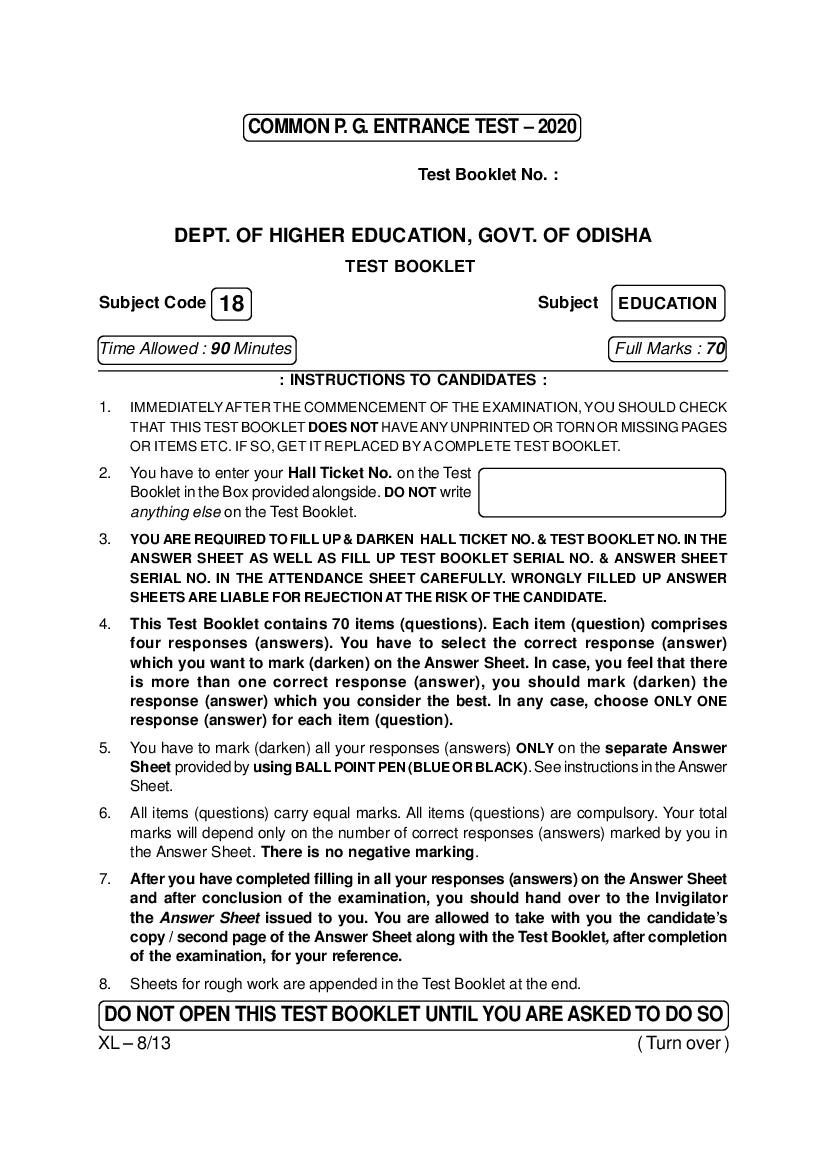
Test Booklet No. :
DEPT. OF HIGHER EDUCATION, GOVT. OF ODISHA
TEST BOOKLET
Subject Code 18 Subject EDUCATION
Time Allowed : 90 Minutes Full Marks : 70
: INSTRUCTIONS TO CANDIDATES :
1. IMMEDIATELY AFTER THE COMMENCEMENT OF THE EXAMINATION, YOU SHOULD CHECK
THAT THIS TEST BOOKLET DOES NOT HAVE ANY UNPRINTED OR TORN OR MISSING PAGES
OR ITEMS ETC. IF SO, GET IT REPLACED BY A COMPLETE TEST BOOKLET.
2. You have to enter your Hall Ticket No. on the Test
Booklet in the Box provided alongside. DO NOT write
anything else on the Test Booklet.
3. YOU ARE REQUIRED TO FILL UP & DARKEN HALL TICKET NO. & TEST BOOKLET NO. IN THE
ANSWER SHEET AS WELL AS FILL UP TEST BOOKLET SERIAL NO. & ANSWER SHEET
SERIAL NO. IN THE ATTENDANCE SHEET CAREFULLY. WRONGLY FILLED UP ANSWER
SHEETS ARE LIABLE FOR REJECTION AT THE RISK OF THE CANDIDATE.
4. This Test Booklet contains 70 items (questions). Each item (question) comprises
four responses (answers). You have to select the correct response (answer)
which you want to mark (darken) on the Answer Sheet. In case, you feel that there
is more than one correct response (answer), you should mark (darken) the
response (answer) which you consider the best. In any case, choose ONLY ONE
response (answer) for each item (question).
5. You have to mark (darken) all your responses (answers) ONLY on the separate Answer
Sheet provided by using BALL POINT PEN (BLUE OR BLACK). See instructions in the Answer
Sheet.
6. All items (questions) carry equal marks. All items (questions) are compulsory. Your total
marks will depend only on the number of correct responses (answers) marked by you in
the Answer Sheet. There is no negative marking.
7. After you have completed filling in all your responses (answers) on the Answer Sheet
and after conclusion of the examination, you should hand over to the Invigilator
the Answer Sheet issued to you. You are allowed to take with you the candidate’s
copy / second page of the Answer Sheet along with the Test Booklet, after completion
of the examination, for your reference.
8. Sheets for rough work are appended in the Test Booklet at the end.
DO NOT OPEN THIS TEST BOOKLET UNTIL YOU ARE ASKED TO DO SO
XL – 8/13 ( Turn over )
Page 2
Page 3
(A) Logic
(B) Axiology
(C) Metaphysics
(D) Epistemology
2. Which school of philosophy allows maximum freedom for the learners ?
(A) Idealism
(B) Naturalism
(C) Pragmatism
(D) Both Naturalism and Pragmatism
3. Which is the last step of human evolution according to Sri Aurovindo ?
(A) Vital
(B) Mental
(C) Spiritual
(D) Psychic
4. Montessori who worked in the field of early childhood care and education was from :
(A) England
(B) Germany
(C) Italy
(D) America
5. Who has created the Kindergarten ?
(A) Montessori
(B) Pestalozzi
(C) Rousseau
(D) Froebel
6. Who is the founder of pragmatism ?
(A) James
(B) Mead
(C) Peirce
(D) Dewey
XL – 8/13 (3) ( Turn over )
Page 4
(A) Naturalism
(B) Idealism
(C) Pragmatism
(D) Existentialism
8. Who has said that ‘eating without doing any work is as good as stealing’ ?
(A) Tagore
(B) Vivekananda
(C) Gandhi
(D) Aurovindo
9. The idea of self-supporting education was advocated by :
(A) Tagore
(B) Gandhi
(C) Krishnamurthy
(D) Aurovindo
10. The concept of Gnostic being was introduced by :
(A) Tagore
(B) Gandhi
(C) Krishnamurthy
(D) Aurovindo
11. Who among the following observed that ‘Nature is the manuscript of God’ ?
(A) Tagore
(B) Gandhi
(C) Krishnamurthy
(D) Aurovindo
12. The scientific analysis of the social processes and patterns involved in the educational
system is called as :
(A) Educational sociology
(B) Sociology of education
(C) Social foundation of education
(D) Educational foundation of society
XL – 8/13 (4) ( Continued )
Page 5
(A) Culture is abstract
(B) Culture is shared by members of a society
(C) Culture is a way of Life
(D) Culture is hereditary
14. At which stage of Piaget’s Cognitive Development the learner is able to do a
systematic checking of all possible alternative solutions to a Problem ?
(A) Preoperational
(B) Concrete operational
(C) Formal operational
(D) Sensorimotor
15. Which is not a characteristic of childhood emotion ?
(A) Children’s emotions are intense
(B) Children’s emotions appear at times
(C) Children’s emotions change with growth and development
(D) Behavioural characteristics of children reveal their emotion
16. The concept of Mental age was first developed by :
(A) Binet
(B) Cattell
(C) Stern
(D) Simon
17. Which is the highest level in the hierarchy theory of learning ?
(A) Concept Learning
(B) Problem Solving
(C) Multiple Discrimination
(D) Principle Learning
18. At which age the child starts walking alone ?
(A) 12 months
(B) 13 months
(C) 14 months
(D) 15 months
XL – 8/13 (5) ( Turn over )
Page 6
(A) Life
(B) Excitement
(C) Joy
(D) Motion
20. What type of intelligence is possessed by Tendulkar ?
(A) Logical mathematical
(B) Spatial
(C) Bodily-kinesthetic
(D) Naturalistic
21. The child learns to open a lock through a number of attempts. This is due to learning
by :
(A) Classical conditioning
(B) Trial and Error
(C) Operant conditioning
(D) Insightful learning
22. A teacher asked a child of 3-6 years old, what would happen if you got wings. The
purpose of the teacher is to promote :
(A) Cognitive thinking
(B) Creative thinking
(C) Aesthetic appreciation
(D) Emotional wellbeing
23. Which psychologist integrated social psychology with aspects of individual and
cognitive psychology ?
(A) Piaget
(B) Vygotsky
(C) Ausubel
(D) Mc Millan
24. Who has advocated Concept attainment Model ?
(A) Bruner
(B) Ausubel
(C) Glaser
(D) Bloom
XL – 8/13 (6) ( Continued )
Page 7
(A) Syntax
(B) Social system
(C) Support system
(D) Application
26. When the sender in the communication process encodes the message through a
medium, what does the receiver do ? Indicate the incorrect answer from the following :
(A) Transmits
(B) Decodes
(C) Interprets
(D) Transfers
27. The value that describes the characteristics of a sample is known as :
(A) Statistic
(B) Central tendency
(C) Parameter
(D) Variability
28. Which statistical measure is to be used when the data are given in the form of an
incomplete distribution ?
(A) Mean
(B) Median
(C) Mode
(D) Range
29. Which two measures of central tendency are the same for the following scores ?
9, 15, 4, 11, 6, 15
(A) Mean and Mode
(B) Mode and Median
(C) Mean and Median
(D) Median and Range
XL – 8/13 (7) ( Turn over )
Page 8
(A) 34.13
(B) 68.26
(C) 60
(D) 50
31. The characteristic that the tails of the normal probability curve approach the base
line but never touch it, is known as :
(A) Meso-Kurtic
(B) Lepto- kurtic
(C) Platy-kurtic
(D) Asymptotic
32. Which of the following is the right combination of components of curriculum ?
(A) Context, input, process, product
(B) Input, process, content, outcome
(C) Objective, content, method, evaluation
(D) Objective, content, learning experience, evaluation
33. The subject centred curriculum is recommended by :
(A) Naturalist
(B) Idealist
(C) Pragmatist
(D) Both Naturalist and Idealist
34. Which document envisages nurturing the identity of each learner within democratic
framework ?
(A) NPE-1986
(B) POA-1992
(C) NCF-2005
(D) NCFTE-2009
XL – 8/13 (8) ( Continued )
Page 9
Evaluation ?
(A) Formative
(B) Summative
(C) Diagnostic
(D) Remedial
36. The arranging of 20 essays from the highest to the lowest represents which scale of
measurement ?
(A) Ratio
(B) Nominal
(C) Ordinal
(D) Interval
37. When students are asked to compare between the principles of Jainism and
Buddhism, which objective under cognitive domain is covered ?
(A) Understanding
(B) Analysing
(C) Applying
(D) Creating
38. In which step of test construction Item analysis is done ?
(A) Planning
(B) Preparing
(C) Evaluation
(D) Tryout
39. Which two of the following are synonymous ?
(a) Research Proposal
(b) Research abstract
(c) Synopsis
(d) Research plan
(A) (a), (b)
(B) (b), (c)
(C) (c), (d)
(D) (a), (d)
XL – 8/13 (9) ( Turn over )
Page 10
(A) Pure research
(B) Applied research
(C) Action research
(D) Basic research
41. Which is not correct about the nature of science ?
(A) Scientific knowledge is empirical
(B) Scientific knowledge is rational
(C) Scientific knowledge is speculative
(D) Scientific knowledge is self-corrective
42. Monasteries were the centres of learning during :
(A) Vedic period
(B) Upanishadic period
(C) Buddhist period
(D) Medieval period
43. Which document recommended for introduction of teacher training in India ?
(A) Adam’s Report
(B) Macaulay’s Minute
(C) Wood’s Despatch
(D) Hunter Commission Report
44. Which commission recommended for introduction of Education as a subject of study
at the Intermediate and Degree level ?
(A) Calcutta University Commission
(B) University Education Commission
(C) Secondary Education Commission
(D) Education Commission
45. Which of the following value has not been enlisted as a core component in NPE-
1986 ?
(A) Freedom Movement in India
(B) Scientific temperament
(C) Gandhian values of Truth and Ahimsa
(D) Gender equality
XL – 8/13 ( 10 ) ( Continued )
Page 11
(A) UK (B) USA
(C) China (D) Japan
47. Which country exhibits both tradition and modernity in its education system ?
(A) UK (B) USA
(C) China (D) Japan
48. OER stands for :
(A) Open Education Resource
(B) Open Edutech Resource
(C) Open Educational Resource
(D) Online Educational Resource
49. On Teacher’s Day, 2017, which portal providing National digital infrastructure for
teachers was launched ?
(A) DIKSHA (B) SHIKSHA
(C) GYAN (D) SHAKTI
50. Which technique is used for Educating the Gifted and Creative Children ?
(A) Group techniques
(B) Remedial Techniques
(C) Brain Storming
(D) Multi-sensory technique
51. Reading difficulties on the part of the children is termed as :
(A) Dyscalculia (B) Dyslexia
(C) Disphoria (D) Dyspraxia
52. Appropriate arrangement of the shifting models of disability in historical progression
is :
(A) The Charity model, Bio-centric model, Functional model, Human rights model
(B) Bio-centric model, The Charity model, Human rights model, Functional model
(C) The Charity model, Bio-centric model, Human rights model, Functional model
(D) The Charity model, Human rights model, Bio-centric model, Functional model
XL – 8/13 ( 11 ) ( Turn over )
Page 12
List – 1 List – 2
(a) Epilepsy (I) tri-cycle
(b) Walking difficulty (II) protective head gear
(c) Speech-difficulty (III) headphone
(d) Hearing impairment (IV) communication board
(V) wheel chair
Codes :
(a) (b) (c) (d)
(A) (II), (I), (IV), (III)
(B) (II), (IV), (I), (III)
(C) (II), (I), (V), (IV)
(D) (III), (I), (IV), (II)
54. Which is not correct about District Primary Education Programme ?
(A) The programme covered the age group 6-11
(B) The programme meant for students from class-I to V
(C) The programme based on decentralised educational planning
(D) The programme covered all backward districts
55. In which class a child of 10 years old who has not been exposed to any Education will
take admission as per RCFCE Act, 2009 ?
(A) Class-II (B) Class-III
(C) Class-IV (D) Class-I
56. Which of the following has been very challenging in the implementation of Choice
Based Credit System ?
(A) Provision of infrastructure
(B) Provision of teachers
(C) Provision of course material
(D) Provision of credit Transfer
57. Which article of the Indian Constitution provides education through mother tongue ?
(A) Article 350 A (B) Article 350 B
(C) Article 21 A (D) Article 21 B
XL – 8/13 ( 12 ) ( Continued )
Page 13
(A) National Policy on Education
(B) National Curriculum Framework, 2005
(C) Education Commission, 1964-66
(D) National Curriculum Framework for Teacher Education, 2009
59. Which does not come under the scope of life skill education ?
(A) Coping with stress
(B) Communication
(C) Problem solving and critical thinking
(D) Digital literacy
60. Who is the Head of the Educational Administration in the Districts of Odisha ?
(A) Principal, DIET
(B) District Education Officer
(C) Director of Secondary Education
(D) District Project Coordinator
61. Which is not true for distance education ?
(A) Materials are provided to all learners
(B) ICT support is extended to learners
(C) Compulsory counselling classes are held
(D) Evaluation is done through assignment, projects and summative tests
62. In a village there are 120 children in the age group 6-11. 96 children have taken
admission in the village school in class I to V. Calculate the Net Enrolment Ratio :
(A) 70 (B) 80
(C) 60 (D) 90
63. Who has given the observation that ‘cities are the graves of human species’ ?
(A) Comenius (B) Spencer
(C) Darwin (D) Rousseau
64. In which phase of teaching a teacher needs to reflect on his practice ?
(A) Pre-active (B) Interactive
(C) Post-active (D) Evaluation
XL – 8/13 ( 13 ) ( Turn over )
Page 14
themes in the text several ways ?
(A) Cognitive apprenticeship
(B) Interpretation construction
(C) Multiple manifestation
(D) Multiple interpretation
66. The term scaffolding is related with :
(A) Problem solving method
(B) Analytic –synthetic method
(C) Constructivist method
(D) Inductive-deductive method
67. Which is not correct about Early Childhood care and Education ?
(A) It is a programme for three to six year children
(B) It is a child-centred programme
(C) It is a programme to prepare children for the primary grades
(D) It is a syllabus bound programme
68. What is the full form of ICDS ?
(A) Integrated Child Development Scheme
(B) Integrated Child Development Service
(C) Integrated Child Development Study
(D) Integrated Child Development Services
69. When is National Education Day observed ?
(A) November, 5 (B) November, 7
(C) November, 11 (D) September, 11
70. Which is the last but one step under 5-E model ?
(A) Engage (B) Explore
(C) Evaluation (D) Elaborate
XL – 8/13 ( 14 ) ( Continued )
Page 15
XL – 8/13 (3,790) ( 15 ) Education
Document Details
| Board / Org | Odisha Exams |
| Exam | Odisha CPET |
| Type | Question Paper |
| Pages | 15 |
| Updated | 22 Jul 2026 |