AP ECET 2022 Syllabus for Analytical Ability
Finished viewing? Save it for later —
Download AP ECET 2022 Syllabus for Analytical Ability (PDF · 3 pages)About AP ECET 2022 Syllabus for Analytical Ability
AP ECET 2022 Syllabus for Analytical Ability is available here for free download. Published by APSCHE for Andhra Pradesh Engineering Common Entrance Test, this syllabus can be viewed online or downloaded as a PDF (3 pages). Candidates preparing for Andhra Pradesh Engineering Common Entrance Test can use AP ECET 2022 Syllabus for Analytical Ability to understand the exam pattern, the type of questions asked, and the overall difficulty level.
Frequently Asked Questions
How can I download AP ECET 2022 Syllabus for Analytical Ability?
Open this page and click the Download button to save AP ECET 2022 Syllabus for Analytical Ability as a PDF. It is completely free on AglaSem Docs.
Is AP ECET 2022 Syllabus for Analytical Ability free to download?
Yes. AP ECET 2022 Syllabus for Analytical Ability can be viewed online and downloaded as a PDF free of cost on AglaSem Docs.
How many pages does AP ECET 2022 Syllabus for Analytical Ability have?
AP ECET 2022 Syllabus for Analytical Ability contains 3 pages, which you can read online or download together as a single PDF.
Where can I find more Andhra Pradesh Engineering Common Entrance Test study material?
You can find more Andhra Pradesh Engineering Common Entrance Test question papers, sample papers, syllabus, and answer keys on AglaSem Docs.
AP ECET 2022 Syllabus for Analytical Ability – Text
Read the full text of this syllabus below — useful to quickly search, copy and reference the content online without downloading the PDF.
📄 View text version (3 pages)
Page 1
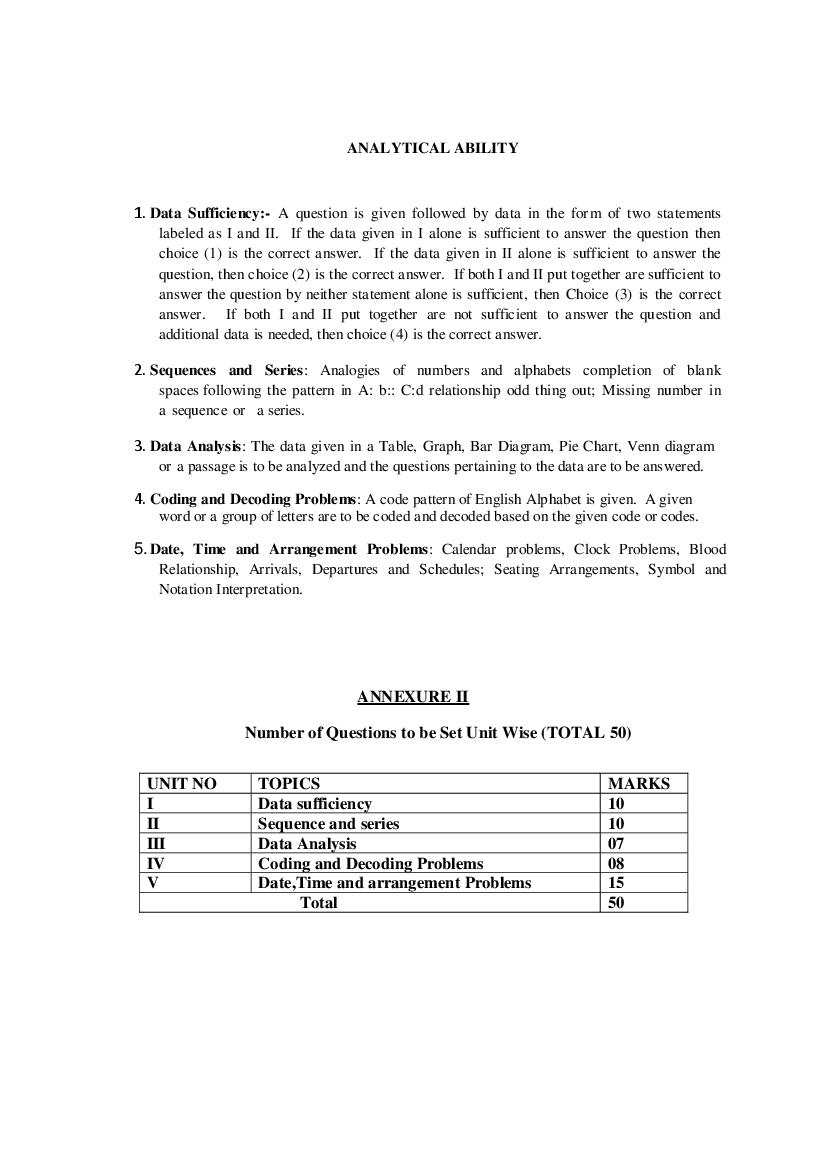
1. Data Sufficiency:- A question is given followed by data in the form of two statements
labeled as I and II. If the data given in I alone is sufficient to answer the question then
choice (1) is the correct answer. If the data given in II alone is sufficient to answer the
question, then choice (2) is the correct answer. If both I and II put together are sufficient to
answer the question by neither statement alone is sufficient, then Choice (3) is the correct
answer. If both I and II put together are not sufficient to answer the question and
additional data is needed, then choice (4) is the correct answer.
2. Sequences and Series: Analogies of numbers and alphabets completion of blank
spaces following the pattern in A: b:: C:d relationship odd thing out; Missing number in
a sequence or a series.
3. Data Analysis: The data given in a Table, Graph, Bar Diagram, Pie Chart, Venn diagram
or a passage is to be analyzed and the questions pertaining to the data are to be answered.
4. Coding and Decoding Problems: A code pattern of English Alphabet is given. A given
word or a group of letters are to be coded and decoded based on the given code or codes.
5. Date, Time and Arrangement Problems: Calendar problems, Clock Problems, Blood
Relationship, Arrivals, Departures and Schedules; Seating Arrangements, Symbol and
Notation Interpretation.
ANNEXURE II
Number of Questions to be Set Unit Wise (TOTAL 50)
UNIT NO TOPICS MARKS
I Data sufficiency 10
II Sequence and series 10
III Data Analysis 07
IV Coding and Decoding Problems 08
V Date,Time and arrangement Problems 15
Total 50
Page 2
MODEL QUESTIONS FOR ANALYTICAL ABILITY
I. Data Sufficiency
In questions 1-2 the choices are same as given below
(1) If the data I alone is sufficient to answer the question, then (1) is the correct answer.
(2) If the data II alone is sufficient to answer the question, then (2) is the correct answer.
(3) If the data I & II both are sufficient to answer the question, then (3) is the correct answer.
(4) If the data I & II both are not sufficient to answer the question, then (4) is the correct answer.
1. How far is town A from Town C?
I: Town A is 160 kms from town B. II: Town B is 155 kms from town C
2. If M and N are points on segment RS. What is the length of the segment MN? I: The
length of segment RM is 10 II: The length of segment NS is 8
II.
a) Sequence and Series:
3. RTV, OQS, LNP, IKM,
(1) FHJ
(2) GIK
(3) GHJ
(4) GIJ
4. Find the missing term in the series 1,9,17,33,49,73, ______
(1) 97
(2) 98
(3) 99
(4) 100
b) Data Analysis:-
Note:- Answer questions 5 and 6 after reading the table
Food Items Jan Feb March April May June
Rice 250 230 210 260 240 220
Wheat 320 340 280 290 300 360
Sugar 240 210 200 210 160 150
Pulses 360 300 320 245 235 250
Vegetables 380 390 385 375 355 370
Misc. 460 485 440 460 475 480
Page 3
used in April.
(1) 21%
(2) 18%
(3) 11%
(4) 25%
6. What is the respective ratio of the total quality of food items used in the month of March to the
quantity of food items used in the month of April?
(1) 366: 367
(2) 361: 365
(3) 248:245
(4) 367:368
c) Coding and Decoding Problems:
7. If BELIEF is written as AFKKDI, then the code for SELDOM is
(1) TFKENP
(2) RFKFNP
(3) RFKENN
(4) RDKCNL
8. In a row of six persons D and C are immediate neighbours of E. B is a neighbour of A only. If A is the
forth from F who are on the two end points?
(1) F,B
(2) F,C
(3) B,D
(4) C,A
Document Details
| Board / Org | APSCHE |
| Exam | Andhra Pradesh Engineering Common Entrance Test |
| Type | Syllabus |
| Pages | 3 |
| Updated | 22 Jul 2026 |