TS CPGET 2022 Syllabus M.Sc Physics
Finished viewing? Save it for later —
Download TS CPGET 2022 Syllabus M.Sc Physics (PDF · 3 pages)About TS CPGET 2022 Syllabus M.Sc Physics
TS CPGET 2022 Syllabus M.Sc Physics is available here for free download. Published by TGCHE for Telangana Common Post Graduate Entrance Test, this syllabus can be viewed online or downloaded as a PDF (3 pages). Candidates preparing for Telangana Common Post Graduate Entrance Test can use TS CPGET 2022 Syllabus M.Sc Physics to understand the exam pattern, the type of questions asked, and the overall difficulty level.
Frequently Asked Questions
How can I download TS CPGET 2022 Syllabus M.Sc Physics?
Open this page and click the Download button to save TS CPGET 2022 Syllabus M.Sc Physics as a PDF. It is completely free on AglaSem Docs.
Is TS CPGET 2022 Syllabus M.Sc Physics free to download?
Yes. TS CPGET 2022 Syllabus M.Sc Physics can be viewed online and downloaded as a PDF free of cost on AglaSem Docs.
How many pages does TS CPGET 2022 Syllabus M.Sc Physics have?
TS CPGET 2022 Syllabus M.Sc Physics contains 3 pages, which you can read online or download together as a single PDF.
Where can I find more Telangana Common Post Graduate Entrance Test study material?
You can find more Telangana Common Post Graduate Entrance Test question papers, sample papers, syllabus, and answer keys on AglaSem Docs.
TS CPGET 2022 Syllabus M.Sc Physics – Text
Read the full text of this syllabus below — useful to quickly search, copy and reference the content online without downloading the PDF.
📄 View text version (3 pages)
Page 1
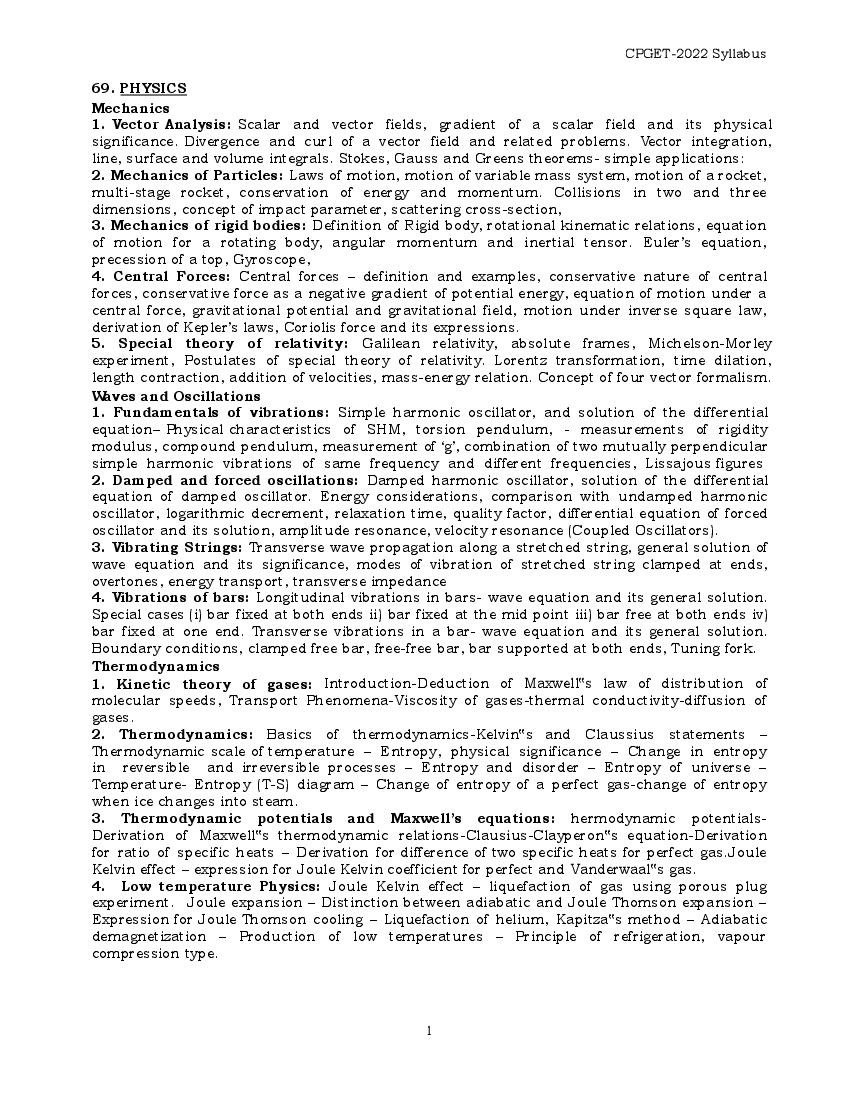
Mechanics
1. Vector Analysis: Scalar and vector fields, gradient of a scalar field and its physical
significance. Divergence and curl of a vector field and related problems. Vector integration,
line, surface and volume integrals. Stokes, Gauss and Greens theorems- simple applications:
2. Mechanics of Particles: Laws of motion, motion of variable mass system, motion of a rocket,
multi-stage rocket, conservation of energy and momentum. Collisions in two and three
dimensions, concept of impact parameter, scattering cross-section,
3. Mechanics of rigid bodies: Definition of Rigid body, rotational kinematic relations, equation
of motion for a rotating body, angular momentum and inertial tensor. Euler’s equation,
precession of a top, Gyroscope,
4. Central Forces: Central forces – definition and examples, conservative nature of central
forces, conservative force as a negative gradient of potential energy, equation of motion under a
central force, gravitational potential and gravitational field, motion under inverse square law,
derivation of Kepler’s laws, Coriolis force and its expressions.
5. Special theory of relativity: Galilean relativity, absolute frames, Michelson-Morley
experiment, Postulates of special theory of relativity. Lorentz transformation, time dilation,
length contraction, addition of velocities, mass-energy relation. Concept of four vector formalism.
Waves and Oscillations
1. Fundamentals of vibrations: Simple harmonic oscillator, and solution of the differential
equation– Physical characteristics of SHM, torsion pendulum, - measurements of rigidity
modulus, compound pendulum, measurement of ‘g’, combination of two mutually perpendicular
simple harmonic vibrations of same frequency and different frequencies, Lissajous figures
2. Damped and forced oscillations: Damped harmonic oscillator, solution of the differential
equation of damped oscillator. Energy considerations, comparison with undamped harmonic
oscillator, logarithmic decrement, relaxation time, quality factor, differential equation of forced
oscillator and its solution, amplitude resonance, velocity resonance (Coupled Oscillators).
3. Vibrating Strings: Transverse wave propagation along a stretched string, general solution of
wave equation and its significance, modes of vibration of stretched string clamped at ends,
overtones, energy transport, transverse impedance
4. Vibrations of bars: Longitudinal vibrations in bars- wave equation and its general solution.
Special cases (i) bar fixed at both ends ii) bar fixed at the mid point iii) bar free at both ends iv)
bar fixed at one end. Transverse vibrations in a bar- wave equation and its general solution.
Boundary conditions, clamped free bar, free-free bar, bar supported at both ends, Tuning fork.
Thermodynamics
1. Kinetic theory of gases: Introduction-Deduction of Maxwell‟s law of distribution of
molecular speeds, Transport Phenomena-Viscosity of gases-thermal conductivity-diffusion of
gases.
2. Thermodynamics: Basics of thermodynamics-Kelvin‟s and Claussius statements –
Thermodynamic scale of temperature – Entropy, physical significance – Change in entropy
in reversible and irreversible processes – Entropy and disorder – Entropy of universe –
Temperature- Entropy (T-S) diagram – Change of entropy of a perfect gas-change of entropy
when ice changes into steam.
3. Thermodynamic potentials and Maxwell’s equations: hermodynamic potentials-
Derivation of Maxwell‟s thermodynamic relations-Clausius-Clayperon‟s equation-Derivation
for ratio of specific heats – Derivation for difference of two specific heats for perfect gas.Joule
Kelvin effect – expression for Joule Kelvin coefficient for perfect and Vanderwaal‟s gas.
4. Low temperature Physics: Joule Kelvin effect – liquefaction of gas using porous plug
experiment. Joule expansion – Distinction between adiabatic and Joule Thomson expansion –
Expression for Joule Thomson cooling – Liquefaction of helium, Kapitza‟s method – Adiabatic
demagnetization – Production of low temperatures – Principle of refrigeration, vapour
compression type.
1
Page 2
the spectrum of Black body – Wein‟s displacement law, Wein‟s law, Rayleigh-Jean‟s law –
Quantum theory of radiation - Planck‟s law – deduction of Wein‟s distribution law,
Rayleigh-Jeans law, Stefan‟s law from Planck‟s law. Measurement of radiation using
pyrometers – Disappearing filament optical pyrometer – experimental determination – Angstrom
pyroheliometer - determination of solar constant, effective temperature of sun.
6. Statistical Mechanics: Introduction, postulates of statistical mechanics. Phase space,
concept of ensembles and some known ensembles ,classical and quantum statistics and their
differences, concept of probability, Maxwell-Boltzmann‟s distribution law -Molecular energies
in an ideal gas- Maxwell-Boltzmann‟s velocity distribution law, Bose-Einstein Distribution
law, Fermi- Dirac Distribution law, comparison of three distribution laws, Application of B-E
distribution to Photons-planks radiation formula, Application of Fermi-Dirac statistics to white
dwarfs and Neutron stars.
OPTICS
1 Interference: Principle of superposition – coherence – temporal coherence and spatial
coherence – conditions for Interference of light
Interference by division of wave front: Fresnel‟s biprism – determination of wave
length of light. Determination of thickness of a transparent material using Biprism – change of
phase on reflection – Lloyd‟s mirror experiment.
Interference by division of amplitude: Oblique incidence of a plane wave on a thin film due
to reflected and transmitted light (Cosine law) – Colours of thin films – Non reflecting
films – interference by a plane parallel film illuminated by a point source – Interference by a
film with two non-parallel reflecting surfaces (Wedge shaped film) – Determination of diameter
of wire-Newton‟s rings in reflected light with and without contact between lens and glass
plate, Newton‟s rings in transmitted light (Haidinger Fringes) – Determination of wave
length of monochromatic light – Michelson Interferometer – types of fringes – Determination of
wavelength of monochromatic light, Difference in wavelength of sodium D 1,D2 lines and
thickness of a thin transparent plate.
2 Diffraction: Introduction – Distinction between Fresnel and Fraunhoffer diffraction
Fraunhoffer diffraction:- Diffraction due to single slit and circular aperture – Limit of resolution
– Fraunhoffer diffraction due to double slit – Fraunhoffer diffraction pattern with N slits
(diffraction grating) Resolving Power of grating – Determination of wave length of light in
normal and oblique incidence methods using diffraction grating. Fresnel diffraction-Fresnel‟s
half period zones – area of the half period zones –zone plate – Comparison of zone plate with
convex lens – Phase reversal zone plate – diffraction at a straight edge – difference between
interference and diffraction.
3 Polarization: Polarized light : Methods of Polarization, Polarization by reflection, refraction,
Double refraction, selective absorption , scattering of light – Brewsters law – Malus law – Nicol
prism polarizer and analyzer – Refraction of plane wave incident on negative and
positive crystals (Huygen‟s explanation) – Quarter wave plate, Half wave plate –
Babinet‟s compensator – Optical activity, analysis of light by Laurent‟s half shade
polarimeter.
4 Aberrations and Fiber Optics: Introduction – Monochromatic aberrations, spherical
aberration, methods of minimizing spherical aberration, coma, astigmatism and curvature of
field, distortion. Chromatic aberration – the achromatic doublet – Removal of chromatic
aberration of a separated doublet. Fiber Optics : Introduction – Optical fibers – Principles of
fiber communication – Step and graded index fibers – Rays and modes in an optical fiber –
Fiber material – Types of optical fibers and advantages of fiber communication.
Electromagnetism, Electrostatics:
Electric Field:- Concept of electric field lines and electric flux, Gauss‟s law (Integral
and differential forms), application to linear, plane and spherical charge distributions.
Conservative nature of electric field E, irrotational field. Electric Potential:- Concept of electric
potential, relation between electric potential and electric field, potential energy of a system of
2
Page 3
spherical charge distribution.
Magnetostatics
Concept of magnetic field B and magnetic flux, Biot-Savart‟s law, B due to a straight
current carrying conductor. Force on a point charge in a magnetic field. Properties of B, curl
and divergence of B, solenoidal field. Integral form of Ampere‟s law, applications of Ampere‟s
law: field due to straight, circular and solenoidal currents. Energy stored in magnetic field.
Magnetic energy in terms of current and inductance. Magnetic force between two current
carrying conductors. Magnetic field intensity. Ballistic Galvanometer:- Torque on a current
loop in a uniform magnetic field, working principle of B.G., current and charge
sensitivity, electromagnetic damping, critical damping resistance.
Electromagnetic Induction
Faraday‟s laws of induction (differential and integral form), Lenz‟s law, self and
mutual Induction. Continuity equation, modification of Ampere‟s law, displacement current,
Maxwellequations
Electromagnetic waves
Maxwell‟s equations in vacuum and dielectric medium, boundary conditions, plane
wave equation: transverse nature of EM waves, velocity of light in vacuum and in medium,
polarization, reflection and transmission. Polarization of EM waves, Brewster‟s
angle, description of linear, circular and elliptical polarization.
MODERN PHYSICS
Atomic Spectra and Models Inadequacy of classical physics:
Brief Review of Black body Radiation , Photoelectric effect, Compton effect, dual nature of
radiation, wave nature of particles. Atomic spectra, Line spectra of hydrogen atom, Ritz
Rydberg combination principle. Alpha Particle Scattering, Rutherford Scattering Formula,
Rutherford Model of atom and its limitations, Bohr‟s model of H atom, explanation of
atomic spectra, correction for finite mass of the nucleus, Bohr correspondence principle,
limitations of Bohr model, discrete energy exchange by atom, Frank Hertz Expt. Sommerfeld's
Modification of Bohr‟s Theory. Wave Particle Duality de Broglie hypothesis, Experimental
confirmation of matter wave, Davisson Germer Experiment, velocity of de Broglie wave, wave
particle duality, Complementarity. Superposition of two waves, phase velocity and group
velocity , wave packets ,Gaussian Wave Packet , spatial distribution of wave packet,
Localization of wave packet in time. Time development of a wave Packet; Wave Particle
Duality, Complementarity . Heisenberg Uncertainty Principle, Illustration of the Principle
through Experiments of Gamma ray microscope and electron diffraction through a slit.
Time independent and time dependent Schrodinger wave equation. Estimation of ground
state energy of harmonic oscillator and hydrogen atom, non-existence of electron in the
nucleus. Uncertainty and Complementarities. Nuclear Physics Size and structure of
atomic nucleus and its relation with atomic weight; Impossibility of an electron being in
the nucleus as a consequence of the uncertainty principle. Nature of nuclear force, NZ
graph, Liquid Drop model: semi-empirical mass formula and binding energy, Nuclear
Shell Model and magic numbers. Radioactivity: stability of the nucleus; Law of radioactive
decay; Mean life and half-life; Alpha decay; Beta decay- energy released, spectrum and Pauli's
prediction of neutrino; Gamma ray emission, energy-momentum conservation: electron-
positron pair creation by gamma photons in the vicinity of a nucleus. Fission and fusion-
mass deficit, relativity and generation of energy; Fission - nature of fragments and
emission of neutrons. Nuclear reactor: slow neutrons interacting with Uranium 235;
Fusion and thermonuclear reactions driving stellar energy (brief qualitative discussions),
Classification of Elementary Particles.
3
Document Details
| Board / Org | TGCHE |
| Exam | Telangana Common Post Graduate Entrance Test |
| Type | Syllabus |
| Pages | 3 |
| Updated | 09 Jun 2026 |