Odisha CPET 2020 Question Paper Environmental Science
Finished viewing? Save it for later —
Download Odisha CPET 2020 Question Paper Environmental Science (PDF · 15 pages)About Odisha CPET 2020 Question Paper Environmental Science
Odisha CPET 2020 Question Paper Environmental Science is available here for free download. Published by Odisha Exams for Odisha CPET, this question paper can be viewed online or downloaded as a PDF (15 pages). Candidates preparing for Odisha CPET can use Odisha CPET 2020 Question Paper Environmental Science to understand the exam pattern, the type of questions asked, and the overall difficulty level.
Frequently Asked Questions
How can I download Odisha CPET 2020 Question Paper Environmental Science?
Open this page and click the Download button to save Odisha CPET 2020 Question Paper Environmental Science as a PDF. It is completely free on AglaSem Docs.
Is Odisha CPET 2020 Question Paper Environmental Science free to download?
Yes. Odisha CPET 2020 Question Paper Environmental Science can be viewed online and downloaded as a PDF free of cost on AglaSem Docs.
How many pages does Odisha CPET 2020 Question Paper Environmental Science have?
Odisha CPET 2020 Question Paper Environmental Science contains 15 pages, which you can read online or download together as a single PDF.
Where can I find more Odisha CPET study material?
You can find more Odisha CPET question papers, sample papers, syllabus, and answer keys on AglaSem Docs.
Odisha CPET 2020 Question Paper Environmental Science – Text
Read the full text of this question paper below — useful to quickly search, copy and reference the content online without downloading the PDF.
📄 View text version (15 pages)
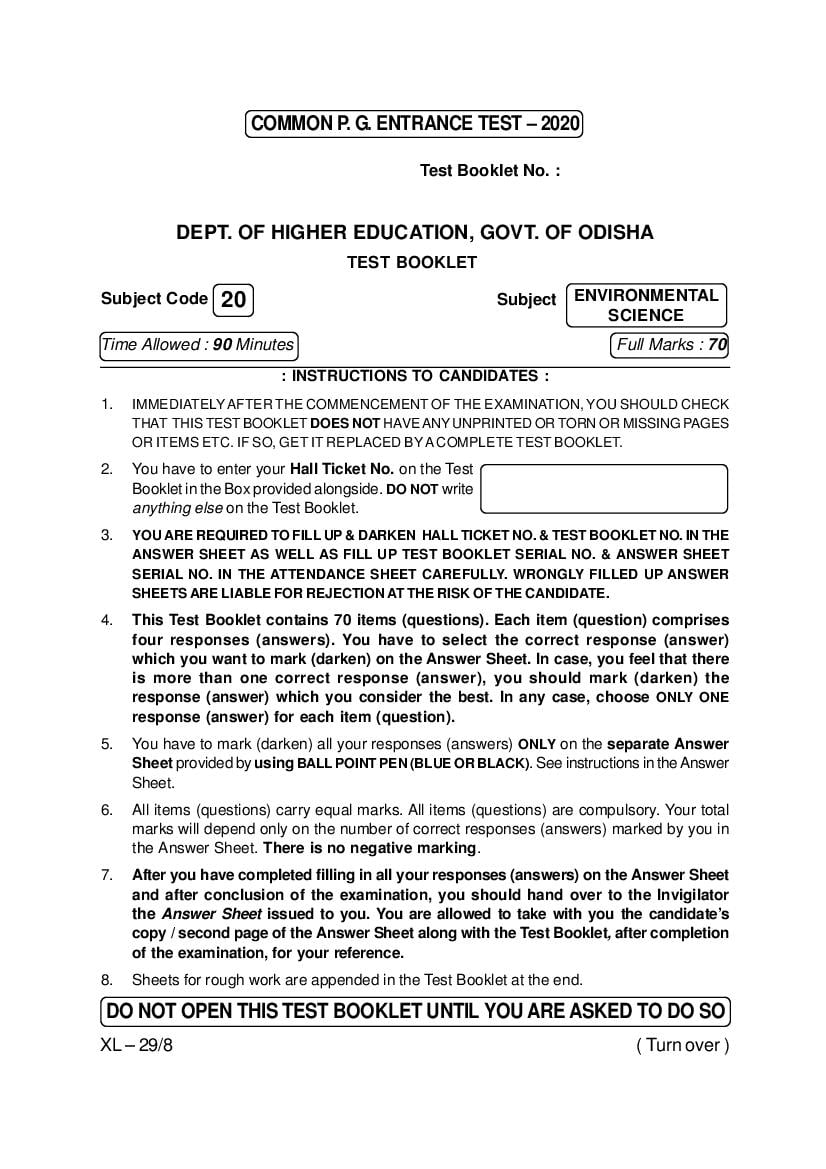
Page 1
Test Booklet No. :
DEPT. OF HIGHER EDUCATION, GOVT. OF ODISHA
TEST BOOKLET
Subject Code 20 Subject ENVIRONMENTAL
SCIENCE
Time Allowed : 90 Minutes Full Marks : 70
: INSTRUCTIONS TO CANDIDATES :
1. IMMEDIATELY AFTER THE COMMENCEMENT OF THE EXAMINATION, YOU SHOULD CHECK
THAT THIS TEST BOOKLET DOES NOT HAVE ANY UNPRINTED OR TORN OR MISSING PAGES
OR ITEMS ETC. IF SO, GET IT REPLACED BY A COMPLETE TEST BOOKLET.
2. You have to enter your Hall Ticket No. on the Test
Booklet in the Box provided alongside. DO NOT write
anything else on the Test Booklet.
3. YOU ARE REQUIRED TO FILL UP & DARKEN HALL TICKET NO. & TEST BOOKLET NO. IN THE
ANSWER SHEET AS WELL AS FILL UP TEST BOOKLET SERIAL NO. & ANSWER SHEET
SERIAL NO. IN THE ATTENDANCE SHEET CAREFULLY. WRONGLY FILLED UP ANSWER
SHEETS ARE LIABLE FOR REJECTION AT THE RISK OF THE CANDIDATE.
4. This Test Booklet contains 70 items (questions). Each item (question) comprises
four responses (answers). You have to select the correct response (answer)
which you want to mark (darken) on the Answer Sheet. In case, you feel that there
is more than one correct response (answer), you should mark (darken) the
response (answer) which you consider the best. In any case, choose ONLY ONE
response (answer) for each item (question).
5. You have to mark (darken) all your responses (answers) ONLY on the separate Answer
Sheet provided by using BALL POINT PEN (BLUE OR BLACK). See instructions in the Answer
Sheet.
6. All items (questions) carry equal marks. All items (questions) are compulsory. Your total
marks will depend only on the number of correct responses (answers) marked by you in
the Answer Sheet. There is no negative marking.
7. After you have completed filling in all your responses (answers) on the Answer Sheet
and after conclusion of the examination, you should hand over to the Invigilator
the Answer Sheet issued to you. You are allowed to take with you the candidate’s
copy / second page of the Answer Sheet along with the Test Booklet, after completion
of the examination, for your reference.
8. Sheets for rough work are appended in the Test Booklet at the end.
DO NOT OPEN THIS TEST BOOKLET UNTIL YOU ARE ASKED TO DO SO
XL – 29/8 ( Turn over )
Page 2
Page 3
(A) CH4
(B) N2O
(C) CO2
(D) CFCs
2. The four major layers (from ground surface upwar(d) of Atmosphere are :
(A) Stratosphere, thermosphere, mesosphere and troposphere
(B) Mesosphere ,troposphere ,stratosphere and thermosphere
(C) Thermosphere, mesosphere, stratosphere and troposphere
(D) Troposphere, stratosphere, mesosphere and thermosphere
3. Functional unit of ecology is :
(A) Organism
(B) Biosphere
(C) Ecosystem
(D) Population
4. Electromagnetic radiation with maximum wave length is :
(A) Ultraviolet
(B) Radio wave
(C) X-ray
(D) Infrared
5. Planktons in water bodies belongs to which group ?
(A) Plants
(B) Animals
(C) Both Plants and Animals
(D) None of the above
XL – 29/8 (3) ( Turn over )
Page 4
Hydrogen Ion Concentration of B is more than A ?
(A) 3
(B) 10
(C) 100
(D) 1000
7. Which of the following chemical is used to disinfect water ?
(A) Alum
(B) Chlorine
(C) Benzene
(D) Ammonia
8. World Earth Day is celebrated every year on :
(A) 22nd April
(B) 5th June
(C) 10th June
(D) 24th October
9. Organisms that mineralizes organic matter in an ecosystem are called :
(A) Producers
(B) Consumers
(C) Decomposers
(D) Carnivores
10. Which pair of gases are primary pollutants ?
(A) Nitric Oxide and Hydrocarbons
(B) Ozone and CO
(C) Nitric acid and SO2
(D) Methane and Ozone
XL – 29/8 (4) ( Continued )
Page 5
(A) 3.186 (B) 4.184
(C) 5.184 (D) 6.186
12. Symbiotic nitrogen fixation is associated with the bacteria :
(A) Pseudomonas (B) Rhizobium
(C) Nitrosomonas (D) Nitrobacter
13. The first law of thermodynamics is correctly represented by the
equation ————————.
(A) ∆Q = E – W (B) ∆W = Q – E
(C) ∆E = Q – W (D) ∆E = Q + W
14. Radioactive substance emits :
(A) Only α-rays
(B) Only β-rays
(C) α and β rays
(D) α , β and γ-rays
15. A biological community is :
(A) Collection of species
(B) Collection of animals
(C) Collection of plants
(D) Collection of families
16. Energy in the Sun is generated mainly by :
(A) Fusion of hydrogen atoms
(B) Fission of helium atoms
(C) Fusion of radio active material
(D) Chemical reactions
XL – 29/8 (5) ( Turn over )
Page 6
(A) Ozone (B) Nitric oxide
(C) Peroxyacetyl nitrate (D) Sulphur dioxide
18. Isotopes of an element have the same :
(A) Number of protons in the nucleus
(B) Number of nucleons
(C) Number of neutrons
(D) Atomic weights
19. The nitrogen from the atmosphere is absorbed by plants in the form of :
(A) Nitrates (B) Nitrogen gas
(C) Nitrites (D) Urea
20. Acidity in rain water is due to :
(A) HCl and H2SO4
(B) H2SO4 and HNO3
(C) H2SO4 and H3CO3
(D) H2SO4, HNO3 and H3CO3
21. In the explosion of atom bomb, energy is released due to :
(A) Conversion of mass into energy
(B) Conversion of momentum into energy
(C) Conversion of velocity into energy
(D) Conversion of molecules into atoms
22. Noise pollution is measured in :
(A) Ohm (B) Mho
(C) Joule (D) Decibel
23. Which one of the following is a major pollutant in aluminum smelter plants ?
(A) Mercury (B) Chloride
(C) Lead (D) Fluoride
XL – 29/8 (6) ( Continued )
Page 7
(A) Potential energy of water
(B) Chemical energy of water
(C) Heat energy of water
(D) Magnetic energy of water
25. One example of metamorphic rock is :
(A) Granite
(B) Shale
(C) Marble
(D) Feldspar
26. Major source of water used by the plants is :
(A) Capillary water
(B) Hygroscopic water
(C) Gravitational water
(D) Combined water
27. In centrifugation the migration of a compound away from the centre of axis depends
on :
(A) Molecular size
(B) Effective radius of the rotor head
(C) Angular velocity
(D) All of the above
28. The direct change from solid to gaseous state is referred to as :
(A) Evaporation (B) Vaporization
(C) Sublimation (D) Condensation
29. Plants that grow in saline soils are called :
(A) Epiphytes
(B) Hydrophytes
(C) Mesophytes
(D) Halophytes
XL – 29/8 (7) ( Turn over )
Page 8
(A) Finely divided solid particles of microscopic size
(B) Finely divided liquid particles of microscopic size
(C) Finely divided solid and liquid particles of microscopic size
(D) None of the above
31. The book authored by Rachel Carson is :
(A) Silent Spring
(B) Hot Spring
(C) Wings of the Fire
(D) Ignited Mind
32. An ore is composed of :
(A) Ore minerals
(B) Metallic minerals
(C) Ore minerals and gangue minerals
(D) Economic minerals
33. Remote sensing can be performed in :
(A) Active mode
(B) Passive mode
(C) Both active and passive mode
(D) None of the above
34. Of a frequency distribution, the median is 21 and arithmetic mean is 22. What is the
value of mode ?
(A) 20 (B) 19
(C) 18 (D) 17
35. A climax community is associated with :
(A) High net production (B) Low stability
(C) High diversity index (D) None of the above
XL – 29/8 (8) ( Continued )
Page 9
(A) Food Chain
(B) Oversimplified version of the reality of feeding relationship
(C) Pictorial representation of the feeding relationship between organisms in an
ecosystem
(D) Annual energy flow passes
37. Which of the following species is extinct ?
(A) Pygmy hog
(B) White rhinos
(C) Ganges Shark
(D) Dodo
38. Gram molecular weight is the weight of :
(A) One molecule of a substance
(B) 6.02 x 10²³ atoms of the element
(C) 100 molecules of a substance
(D) 6.02 x 10²³ molecules of a substance
39. The green house gas which is responsible for causing about 60% of the green house
effect in Earth System is :
(A) Carbon monoxide
(B) Methane
(C) NOx
(D) Carbon dioxide
40. What is the value of Mean Deviation of the data : 1, 2, 3, 4, 8, 10, 12, 18, 20, 22 ?
(A) 5 (B) 6.4
(C) 5.4 (D) 6
XL – 29/8 (9) ( Turn over )
Page 10
remains constant ?
(A) Angular Momentum
(B) Linear Velocity
(C) Angular Displacement
(D) Linear Displacement
42. A radioactive element has half-life period 1600 years. After 6400 years what amount
of the element will remain ?
(A) 1/2 (B) 1/8
(C) 1/16 (D) D.1/4
43. If N is the population density, t is time, r is intrinsic rate then the formula for exponential
growth curve is :
(A) dN x rN = dt
(B) dN/dt = rN
(C) rN/DN = dt
(D) dt/dN = rN
44. Eagles predating Fish that eat algae belongs to :
(A) Trophic level I
(B) Trophic level II
(C) Trophic level III
(D) Trophic level IV
45. The basal zone of an Ocean is known as the :
(A) Littoral zone
(B) Neritic zone
(C) Bathyal zone
(D) Abyssal zone
46. The magnitude of an earthquake is measured in units of :
(A) Joules (B) Ergs
(C) Richter (D) Decibel
XL – 29/8 ( 10 ) ( Continued )
Page 11
(A) 20% (B) 25%
(C) 33% (D) 40%
48. A molar solution is prepared by :
(A) Dissolving 1g of a substance in 100cc of water
(B) Dissolving 1mole of a substance in 100ml of water
(C) Dissolving 1mole of a substance in 1000ml of water
(D) Dissolving 1g of a substance in 100ml of water
49. Which one of the following is a sedimentary cycle ?
(A) Carbon
(B) Hydrogen
(C) Nitrogen
(D) Phosphorous
50. Bacteria that derive both energy and material from soil are called :
(A) Archaebacteria
(B) Photoautotrophs
(C) Chemolithotrophs
(D) Photolithotrophs
51. National Environmental Engineering Research Institute in India is situated at :
(A) Nagpur (B) Dehradun
(C) Delhi (D) Kolkata
52. GIS stands for :
(A) Geological Information System
(B) Geographical Information System
(C) Geographical Information Science
(D) All of the the above
XL – 29/8 ( 11 ) ( Turn over )
Page 12
(A) Anthracite
(B) Bituminous
(C) Sub-bituminous
(D) Lignite
54. Bhopal Gas tragedy was due to :
(A) Ethyl Isocyanate
(B) Methyl Isocyanate
(C) Methyl Cyanate
(D) Methyl Carbide
55. An example of in- situ conservation is :
(A) Captive breeding (B) Zoos
(C) Sanctuaries (D) Seed Bank
56. A body spends 20 Joule of energy in 5 seconds. What is its power ?
(A) 100 w (B) 2w
(C) 5 w (D) 4 w
57. Conversion of nitrate into ammonium salts is called :
(A) Nitrification (B) Denitrification
(C) Ammonification (D) None of the above
58. The Stockholm Conference on Human Environment was held in the year :
(A) 1972 (B) 1962
(C) 1982 (D) 1992
59. According to which theory the human population will out run food supply :
(A) Elton theory
(B) Malthusian theory
(C) Altrosian theory
(D) Gausian theory
XL – 29/8 ( 12 ) ( Continued )
Page 13
(A) Wullar lake
(B) Stenothermal
(C) Oligothermal
(D) Eurythermal
61. Association of organisms where one is benefitted and the other one is neither
benefitted nor harmed is called :
(A) Proto-Co-operation
(B) Mutualism
(C) Commensalism
(D) Competition
62. Cause of Rainbow formation is :
(A) Refraction, Reflection and Dispersion
(B) Refraction and Dispersion only
(C) Refraction and Scattering
(D) Diffraction and Reflection
63. Kanchanjunga biosphere reserve is situated in the state of ————————.
(A) Arunachal Pradesh (B) Sikkim
(C) Mizoram (D) Himachal Pradesh
64. Maximum carbon in the world is found in :
(A) Oceans (B) Coal mines
(C) Antarctica (D) Forests
65. The most important reason for decrease in biodiversity is :
(A) Habitat destruction
(B) Introduction of exotic species
(C) Over exploitation
(D) Habitat pollution
XL – 29/8 ( 13 ) ( Turn over )
Page 14
(A) Sunderbans
(B) Western Ghats
(C) Eastern Ghats
(D) Gangetic Plains
67. Why Ramsar Convention is famous for ?
(A) Wetland Conservation
(B) Forest Conservation
(C) Desert Conservation
(D) Biodiversity Conservation
68. The one- horned rhinoceros is specific to which of the following sanctuary ?
(A) Bandipur
(B) Corbett Park
(C) Kaziranga
(D) Simlipal
69. Growing grass to check soil erosion is known as :
(A) Agrobiology
(B) Agrostology
(C) Agronomy
(D) Agrosilvipasture
70. Population growth of a country depends on :
(A) Birth rate
(B) Death rate
(C) Net Migration rate
(D) All of the above
XL – 29/8 ( 14 ) ( Continued )
Page 15
XL – 29/8 (1,460) ( 15 ) Environmental Science
Document Details
| Board / Org | Odisha Exams |
| Exam | Odisha CPET |
| Type | Question Paper |
| Pages | 15 |
| Updated | 22 Jul 2026 |