Odisha CPET 2020 Question Paper Geology
Finished viewing? Save it for later —
Download Odisha CPET 2020 Question Paper Geology (PDF · 15 pages)About Odisha CPET 2020 Question Paper Geology
Odisha CPET 2020 Question Paper Geology is available here for free download. Published by Odisha Exams for Odisha CPET, this question paper can be viewed online or downloaded as a PDF (15 pages). Candidates preparing for Odisha CPET can use Odisha CPET 2020 Question Paper Geology to understand the exam pattern, the type of questions asked, and the overall difficulty level.
Frequently Asked Questions
How can I download Odisha CPET 2020 Question Paper Geology?
Open this page and click the Download button to save Odisha CPET 2020 Question Paper Geology as a PDF. It is completely free on AglaSem Docs.
Is Odisha CPET 2020 Question Paper Geology free to download?
Yes. Odisha CPET 2020 Question Paper Geology can be viewed online and downloaded as a PDF free of cost on AglaSem Docs.
How many pages does Odisha CPET 2020 Question Paper Geology have?
Odisha CPET 2020 Question Paper Geology contains 15 pages, which you can read online or download together as a single PDF.
Where can I find more Odisha CPET study material?
You can find more Odisha CPET question papers, sample papers, syllabus, and answer keys on AglaSem Docs.
Odisha CPET 2020 Question Paper Geology – Text
Read the full text of this question paper below — useful to quickly search, copy and reference the content online without downloading the PDF.
📄 View text version (15 pages)
Page 1
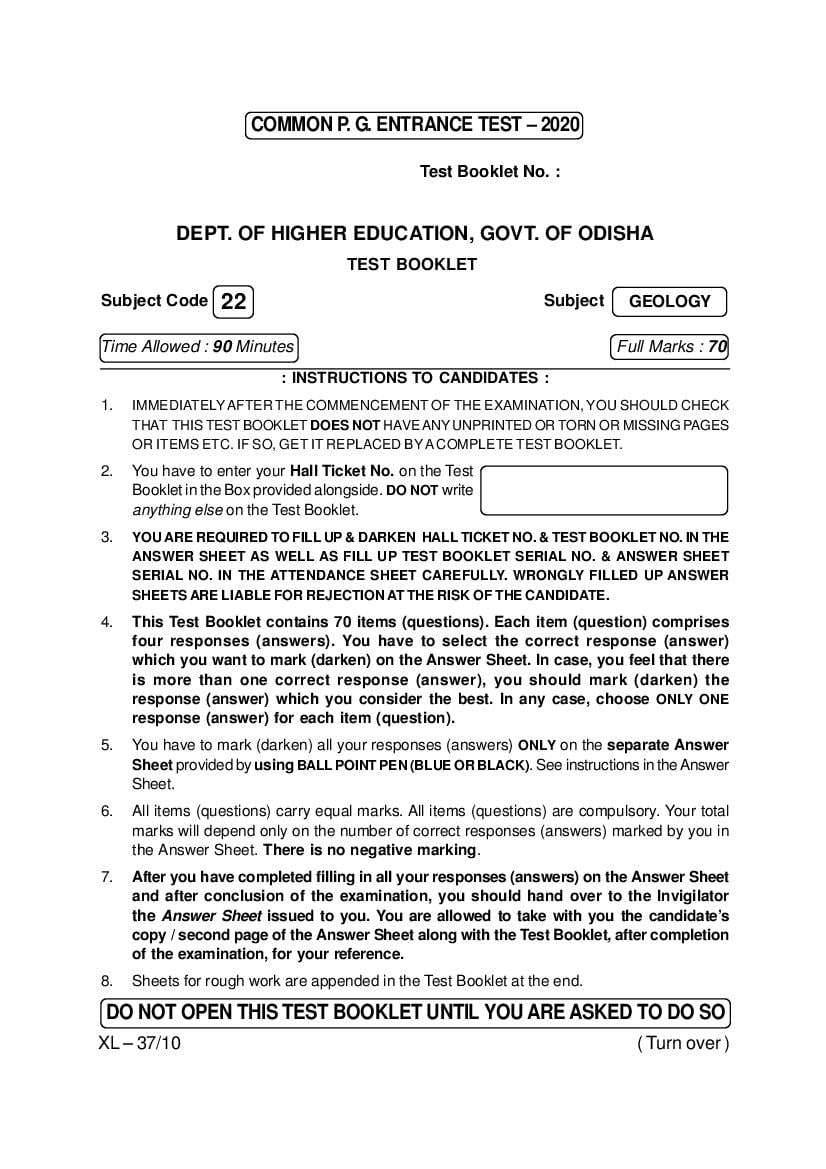
Test Booklet No. :
DEPT. OF HIGHER EDUCATION, GOVT. OF ODISHA
TEST BOOKLET
Subject Code 22 Subject GEOLOGY
Time Allowed : 90 Minutes Full Marks : 70
: INSTRUCTIONS TO CANDIDATES :
1. IMMEDIATELY AFTER THE COMMENCEMENT OF THE EXAMINATION, YOU SHOULD CHECK
THAT THIS TEST BOOKLET DOES NOT HAVE ANY UNPRINTED OR TORN OR MISSING PAGES
OR ITEMS ETC. IF SO, GET IT REPLACED BY A COMPLETE TEST BOOKLET.
2. You have to enter your Hall Ticket No. on the Test
Booklet in the Box provided alongside. DO NOT write
anything else on the Test Booklet.
3. YOU ARE REQUIRED TO FILL UP & DARKEN HALL TICKET NO. & TEST BOOKLET NO. IN THE
ANSWER SHEET AS WELL AS FILL UP TEST BOOKLET SERIAL NO. & ANSWER SHEET
SERIAL NO. IN THE ATTENDANCE SHEET CAREFULLY. WRONGLY FILLED UP ANSWER
SHEETS ARE LIABLE FOR REJECTION AT THE RISK OF THE CANDIDATE.
4. This Test Booklet contains 70 items (questions). Each item (question) comprises
four responses (answers). You have to select the correct response (answer)
which you want to mark (darken) on the Answer Sheet. In case, you feel that there
is more than one correct response (answer), you should mark (darken) the
response (answer) which you consider the best. In any case, choose ONLY ONE
response (answer) for each item (question).
5. You have to mark (darken) all your responses (answers) ONLY on the separate Answer
Sheet provided by using BALL POINT PEN (BLUE OR BLACK). See instructions in the Answer
Sheet.
6. All items (questions) carry equal marks. All items (questions) are compulsory. Your total
marks will depend only on the number of correct responses (answers) marked by you in
the Answer Sheet. There is no negative marking.
7. After you have completed filling in all your responses (answers) on the Answer Sheet
and after conclusion of the examination, you should hand over to the Invigilator
the Answer Sheet issued to you. You are allowed to take with you the candidate’s
copy / second page of the Answer Sheet along with the Test Booklet, after completion
of the examination, for your reference.
8. Sheets for rough work are appended in the Test Booklet at the end.
DO NOT OPEN THIS TEST BOOKLET UNTIL YOU ARE ASKED TO DO SO
XL – 37/10 ( Turn over )
Page 2
Page 3
Reverse is known as —————.
(A) Gauss Normal
(B) Brunhes Normal
(C) Hutton Normal
(D) Gilbert Normal
2. Which supercontinent of the following existed during the Late Palaeozoic Era ?
(A) Rodinia
(B) Gondwana
(C) Panthalassa
(D) Pangea
3. Compared to Delhi, Earth’s normal gravity field at Colombo is —————.
(A) Smaller as Sri Lanka is surrounded by water
(B) Larger as the Oceanic crust below Sri Lanka is shallower
(C) Smaller because of Colombo’s geographic location
(D) Larger as Sri Lanka is isostatically compensated
4. Guyots are formed in —————.
(A) Oceans
(B) Mountains
(C) Deserts
(D) Riverbeds
5. The East- African rift valley is a good example of —————.
(A) Oceanic- oceanic convergent boundary
(B) Oceanic- continental convergent boundary
(C) Continent- continent divergent boundary
(D) Continent- continent transform boundary
6. Which of the following is the gem variety of olivine ?
(A) Amethyst
(B) Sapphire
(C) Aquamarine
(D) Peridot
XL – 37/10 (3) ( Turn over )
Page 4
class of the isometric system is ——————. .
(A) 40
(B) 43
(C) 48
(D) 20
8. Two minerals P and Q were studied under the microscope. Mineral P is characterised
by two orthogonal cleavages. Mineral Q has more than one set of cleavage, but not
at right angles. Q also changes relief on the rotation of the stage. Identify P and Q
from the following alternatives :
(A) P- diopside, Q- calcite
(B) P- diopside, Q- hornblende
(C) P- hornblende, Q- calcite
(D) P- calcite, Q- diopside
9. Which is sodium rich mica ?
(A) Biotite
(B) Muscovite
(C) Paragonite
(D) Lepidolite
10. Dodecahedron and trapezohedron are the common forms of —————.
(A) Feldspar group
(B) Garnet group
(C) Mica group
(D) Amphibole group
11. Chemical composition of Earth’s core is similar to that of —————.
(A) Chondritic meteorite
(B) Achondritic meteorites
(C) Stony meteorite
(D) Iron meteorites
XL – 37/10 (4) ( Continued )
Page 5
(A) Aluminium
(B) Oxygen
(C) Iron
(D) Carbon
13. Which phenomenon is responsible for the production of about 80% of the Earth’s
internal heat ?
(A) Radioactive decay
(B) Magnetic decay
(C) Friction between tectonic plates
(D) The accelerated spin of the inner core
14. What is the third most abundant element (after H and He) in the solar system ?
(A) O
(B) Fe
(C) Si
(D) Ni
15. What is the average geothermal gradient in the top 15 km of a continental crust ?
(A) 30C/km
(B) 300C/km
(C) 500C/km
(D) 1000C/km
16. An ore body is dipping 30 degree towards west on a flat topography. At what distance
in metres should a bore hole be placed so that it intersects the ore body perpendicularly
at a vertical depth of 70 metre ?
(A) 121.2
(B) 161.63
(C) 140.4
(D) 70.63
17. An outcrop in which younger rocks surround older rocks is known as —————.
(A) Overlap
(B) Offlap
(C) Outlier
(D) Inlier
XL – 37/10 (5) ( Turn over )
Page 6
(A) High angle fault
(B) Low angle fault
(C) Horizontal fault
(D) Vertical fault
19. Structure contours of a bedding plane at 150m interval are spaced in such a
manner that the horizontal equivalent is also 150m. The dip of the bedding plane is
—————.
(A) 300
(B) 450
(C) 600
(D) 900
20. A ‘culmination’ may be described as a combination of —————.
(A) Two anticlines of different sets of folding
(B) Two synclines of different sets of folding
(C) An anticline and a syncline of same set of folding
(D) An anticline and a syncline of different sets of folding
21. Quartz is a diagnostic mineral in —————.
(A) Oversaturated rock
(B) Saturated rock
(C) Under saturated rock
(D) Unsaturated rock
22. The degree of freedom on the liquidus curve of a binary system is —————.
(A) 0
(B) 1
(C) 2
(D) 3
23. Which one of the following igneous rocks has the composition of granite and a
predominance of large mineral crystal ?
(A) Basalt
(B) Rhyolite
(C) Gabbro
(D) Pegmatite
XL – 37/10 (6) ( Continued )
Page 7
composition in granodiorite is —————.
(A) More or less similar to that in anorthosite
(B) More potassic
(C) More calcic
(D) More sodic
25. The igneous rock comprising mainly of olivine and orthopyroxene is called as
—————.
(A) Wherlite
(B) Gabbro
(C) Harzburgite
(D) Websterite
26. In a flow regime, the bedforms formed with increasing current velocity are
—————.
(A) Dunes - ripples - plane beds - antidunes
(B) Ripples - plane beds - dunes - antidunes
(C) Antidunes - dunes - ripples - plane beds
(D) Plane beds - ripples - dunes - antidunes
27. A turbidite deposit contains the following in a sequence of —————.
(a) Massive beds
(b) Upper parallel lamination
(c) Lower parallel lamination
(d) Structureless mud
(e) Ripple cross lamination
(A) a–e–b–c–d
(B) b–a–e–d–c
(C) a – c – e – b – d
(D) d – c – e – b – a
28. In rock records, extreme floods and rainfall events are likely to be represented by
thick bedded units of —————.
(A) Poorly sorted sediments
(B) Large scale cross beds
(C) Parallel laminated fine sand
(D) Imbricated gravels
XL – 37/10 (7) ( Turn over )
Page 8
—————.
(A) Packstone
(B) Wackestone
(C) Grainstone
(D) Mudstone
30. Which of the following structures are developed in upper flow regime (F > 1) ?
(A) Ripples
(B) Dunes
(C) Antidunes
(D) All of these
31. In ACF diagram, “F” stands for —————.
(A) F = FeO
(B) F = FeO + MgO + (Na2O + K2O)
(C) F = FeO + MgO + MnO
(D) F= FeO – (MgO + MnO)
32. Which pair of rock types best describes the products of metamorphism in the contact
aureole ?
(A) Slate and schist
(B) Schist and hornfels
(C) Schist and skarn
(D) Hornfels and skarn
33. The metamorphic facies diagnostic of subduction zone is —————.
(A) Hornblende facies
(B) Pyroxene hornfels
(C) Blue schist
(D) Granulite
34. A metamorphic rock consisting of pyroxene, plagioclase and quartz and exhibiting
hornfelsic texture has undergone ————— metamorphism.
(A) Regional
(B) Contact
(C) Cataclastic
(D) Impact
XL – 37/10 (8) ( Continued )
Page 9
original mineral assemblage by —————.
(A) Quartz + calcite
(B) Muscovite + chlorite
(C) Quartz + chlorite
(D) Quartz + muscovite
36. Venus belongs to phylum —————.
(A) Brachiopoda
(B) Pelecypoda
(C) Gastropoda
(D) Cephalopoda
37. Which one of the following plant fossils indicates Triassic age of the sediments ?
(A) Ptillophylum
(B) Trizygia
(C) Dicroidium
(D) Cordaites
38. Suture line with rounded saddles and angular lobes is called as —————.
(A) Orthoceratite type
(B) Ceratite type
(C) Goniatite type
(D) Nautiloid type
39. Which one among the following is a phosphatic micro-fossil ?
(A) Foraminifera
(B) Cocolithophore
(C) Radiolaria
(D) Conodont
40. “Ediacaran fossils” have significance in determining the —————.
(A) Archean / Proterozoic boundary
(B) Cretaceous / Tertiary boundary
(C) Precambrian / Cambrian boundary
(D) Permian / Triassic boundary
XL – 37/10 (9) ( Turn over )
Page 10
(A) Precambrian
(B) Mesozoic
(C) Palaeozoic
(D) Cenozoic
42. Kaladgi Group belongs to —————.
(A) Archaean
(B) Proterozoic
(C) Palaeozoic
(D) Mesozoic
43. Dhokpathan Formation is overlain by —————.
(A) Pinjor Formation
(B) Tatrot Formation
(C) Nagri Formation
(D) Chinji Formation
44. Deccan flood basalts are considered to be related to —————.
(A) Hawaii hotspot
(B) Iceland hotspot
(C) Reunion hotspot
(D) Easter hotspot
45. Which among the following microscopic bands of coal is the brightest ?
(A) Vitrain
(B) Clarain
(C) Durain
(D) Fusain
46. The volume of water that an aquifer releases from or takes into storage per unit
surface area of aquifer per unit drop of water table or piezometric surface is called
—————.
(A) Storage coefficient or storativity
(B) Transmissivity
(C) Specific yield
(D) Safe yield
XL – 37/10 ( 10 ) ( Continued )
Page 11
(A) Vadose zone
(B) Capillary zone
(C) Phreatic zone
(D) Aeration zone
48. When an artesian condition is developed ?
(A) Piezometric surface falls below the bottom of upper confining bed
(B) Water table is perched
(C) Aquifer is unconfined
(D) Piezometric surface is above the groundwater table
49. Maximum porosity is seen in which soil —————.
(A) Sandy soil
(B) Silty soil
(C) Clayey soil
(D) Loam soil
50. A unit which is semi-permeable and does not yield any significant quantity of
groundwater is called —————.
(A) Aquiclude
(B) Aquifer
(C) Aquitard
(D) Artesian aquifer
51. Chalk Hill of Salem, Tamil Nadu is famous for —————.
(A) Limestone
(B) Barite
(C) China clay
(D) Magnesite
52. Commercial magnesite deposit can be hosted in —————.
(A) Serpentinite
(B) Potassic granite
(C) Gabbro
(D) Nepheline syenite
XL – 37/10 ( 11 ) ( Turn over )
Page 12
Group – I Group – II
(a) Lead (i) Magmatic
(b) Aluminium (ii) Pegmatitic
(c) Chromite (iii) Residual
(d) Muscovite (iv) Hydrothermal
(A) (a)-(iv), (b)-(ii), (c)-(iii), (d)-(i)
(B) (a)-(iv), (b)-(iii), (c)-(i), (d)-(ii)
(C) (a)-(iii), (b)-(ii), (c)-(iv), (d)-(i)
(D) (a)-(i), (b)-(ii), (c)-(iii), (d)-(iv)
54. ‘Comb structure’ with ‘symmetrical banding’ is formed by —————.
(A) Early magmatic process
(B) Hydrothermal process
(C) Chemical sedimentary process
(D) Residual concentration process
55. Blue asbestos is another name of —————.
(A) Amosite
(B) Tremolite
(C) Actinolite
(D) Crocidolite
56. If a stream maintains the same course after upliftment in an area, it is known
as —————.
(A) Consequent (B) Subsequent
(C) Resequent (D) Antecedent
57. Which of the following is a wind-blown deposit ?
(A) Till (B) Bajada
(C) Varve (D) Loess
58. Point bar deposit is associated with —————.
(A) Braided river (B) Estuary
(C) Meandering river (D) Beach
XL – 37/10 ( 12 ) ( Continued )
Page 13
(A) Wind erosion (B) River erosion
(C) Wind deposition (D) Glacial erosion
60. Which glacial feature can not be used to predict the glacial movements ?
(A) Eskers (B) Crescentic gouges
(C) Horn (D) Drumlin
61. Brazilian test is used for the —————.
(A) Determination of tensile strength of rocks
(B) Determination of indirect compressive strength of rocks
(C) Determination of coefficient of compressibility of soils
(D) Determination of in situ stress
62. Match the following :
Group – I Group – II
(a) Creep (i) Tongue- shaped mass movement
(b) Earth flow (ii) Curved tree trunks
(c) Slump (iii) Scree formation at the base
(iv) Curved surface of rupture
(A) (a)-(ii), (b)-(i), (c)-(iv)
(B) (a)-(i), (b)-(ii), (c)-(iii)
(C) (a)-(ii), (b)-(iv), (c)-(i)
(D) (a)-(iv), (b)-(ii), (c)-(iii)
63. The most sluggish process of mass wasting is —————.
(A) Creep (B) Flow
(C) Slide (D) Fall
64. An adit is an underground excavation, which is —————.
(A) A horizontal opening giving access to main tunnel
(B) A horizontal opening used for transporting water to powerhouse
(C) A vertical opening used for multipurpose
(D) An inclined opening providing access to main tunnel
XL – 37/10 ( 13 ) ( Turn over )
Page 14
of a gravity dam ?
(A) Strata dipping downstream in narrow valley
(B) Strata dipping upstream in wide valley
(C) Strata dipping downstream in wide valley
(D) Strata dipping towards abetment in narrow valley
66. How a large city generally appears on a 1 : 25000 scale map ?
(A) As a single point
(B) As a cluster of points, lines and polygons
(C) As a polygon
(D) As a cluster of points
67. The RF of the geological map prepared on a scale of 5cm = 1km is —————.
(A) 1 : 20000 (B) 1 : 2000
(C) 1 : 10000 (D) 1 : 1000
68. In a truly vertical aerial photograph, ———————————————.
(A) The principal point and nadir point only coincide
(B) The principal point and isocentre only coincide
(C) The nadir point and isocentre only coincide
(D) The principal point, nadir point and isocentre must all coincide
69. During refination of bauxite the waste generated is —————.
(A) Red mud (B) Fly ash
(C) Bottom ash (D) Char
70. A flash flood is a flood that —————.
(A) Occurs in rural areas for a longer duration due to drizzle
(B) Occurs in urban areas
(C) Occurs suddenly and unexpectedly for a short duration
(D) Is caused by drying of drains
XL – 37/10 ( 14 ) ( Continued )
Page 15
XL – 37/10 (1,310) ( 15 ) Geology
Document Details
| Board / Org | Odisha Exams |
| Exam | Odisha CPET |
| Type | Question Paper |
| Pages | 15 |
| Updated | 22 Jul 2026 |