TS CPGET 2022 Syllabus M.Sc Zoology
Finished viewing? Save it for later —
Download TS CPGET 2022 Syllabus M.Sc Zoology (PDF · 3 pages)About TS CPGET 2022 Syllabus M.Sc Zoology
TS CPGET 2022 Syllabus M.Sc Zoology is available here for free download. Published by TGCHE for Telangana Common Post Graduate Entrance Test, this syllabus can be viewed online or downloaded as a PDF (3 pages). Candidates preparing for Telangana Common Post Graduate Entrance Test can use TS CPGET 2022 Syllabus M.Sc Zoology to understand the exam pattern, the type of questions asked, and the overall difficulty level.
Frequently Asked Questions
How can I download TS CPGET 2022 Syllabus M.Sc Zoology?
Open this page and click the Download button to save TS CPGET 2022 Syllabus M.Sc Zoology as a PDF. It is completely free on AglaSem Docs.
Is TS CPGET 2022 Syllabus M.Sc Zoology free to download?
Yes. TS CPGET 2022 Syllabus M.Sc Zoology can be viewed online and downloaded as a PDF free of cost on AglaSem Docs.
How many pages does TS CPGET 2022 Syllabus M.Sc Zoology have?
TS CPGET 2022 Syllabus M.Sc Zoology contains 3 pages, which you can read online or download together as a single PDF.
Where can I find more Telangana Common Post Graduate Entrance Test study material?
You can find more Telangana Common Post Graduate Entrance Test question papers, sample papers, syllabus, and answer keys on AglaSem Docs.
TS CPGET 2022 Syllabus M.Sc Zoology – Text
Read the full text of this syllabus below — useful to quickly search, copy and reference the content online without downloading the PDF.
📄 View text version (3 pages)
Page 1
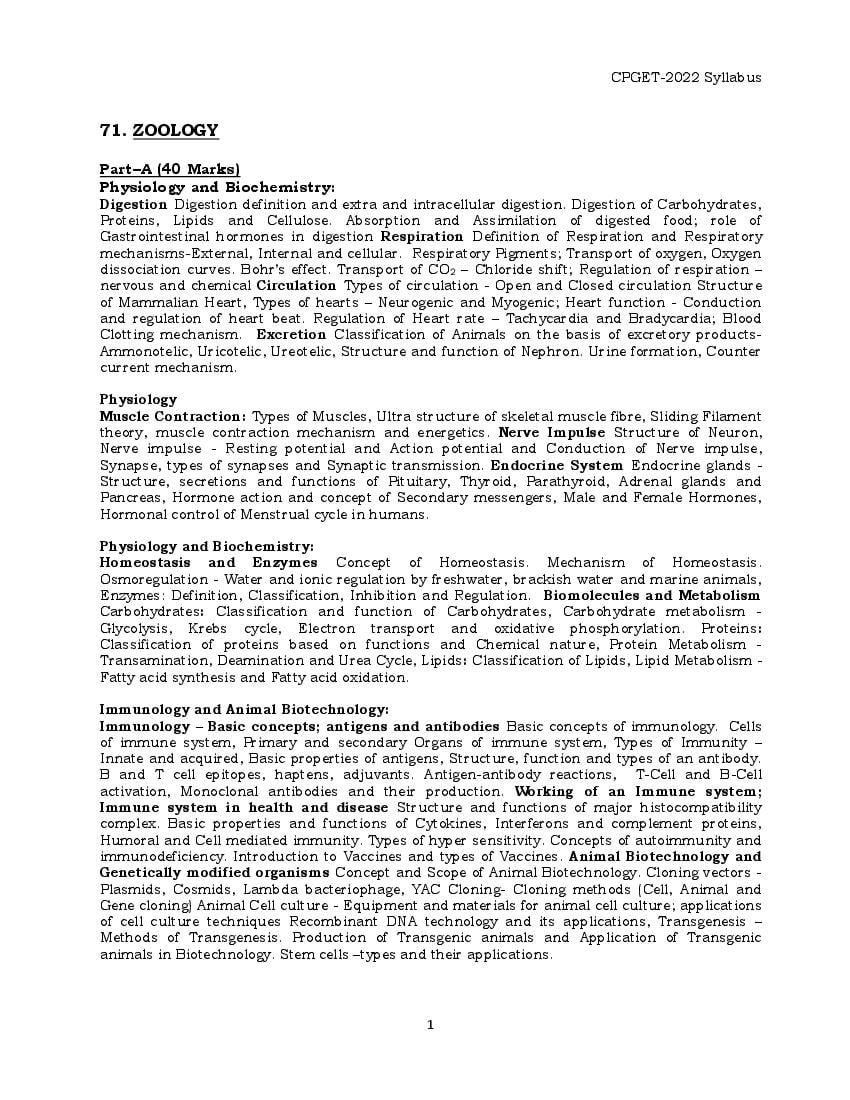
Part–A (40 Marks)
Physiology and Biochemistry:
Digestion Digestion definition and extra and intracellular digestion. Digestion of Carbohydrates,
Proteins, Lipids and Cellulose. Absorption and Assimilation of digested food; role of
Gastrointestinal hormones in digestion Respiration Definition of Respiration and Respiratory
mechanisms-External, Internal and cellular. Respiratory Pigments; Transport of oxygen, Oxygen
dissociation curves. Bohr’s effect. Transport of CO2 – Chloride shift; Regulation of respiration –
nervous and chemical Circulation Types of circulation - Open and Closed circulation Structure
of Mammalian Heart, Types of hearts – Neurogenic and Myogenic; Heart function - Conduction
and regulation of heart beat. Regulation of Heart rate – Tachycardia and Bradycardia; Blood
Clotting mechanism. Excretion Classification of Animals on the basis of excretory products-
Ammonotelic, Uricotelic, Ureotelic, Structure and function of Nephron. Urine formation, Counter
current mechanism.
Physiology
Muscle Contraction: Types of Muscles, Ultra structure of skeletal muscle fibre, Sliding Filament
theory, muscle contraction mechanism and energetics. Nerve Impulse Structure of Neuron,
Nerve impulse - Resting potential and Action potential and Conduction of Nerve impulse,
Synapse, types of synapses and Synaptic transmission. Endocrine System Endocrine glands -
Structure, secretions and functions of Pituitary, Thyroid, Parathyroid, Adrenal glands and
Pancreas, Hormone action and concept of Secondary messengers, Male and Female Hormones,
Hormonal control of Menstrual cycle in humans.
Physiology and Biochemistry:
Homeostasis and Enzymes Concept of Homeostasis. Mechanism of Homeostasis.
Osmoregulation - Water and ionic regulation by freshwater, brackish water and marine animals,
Enzymes: Definition, Classification, Inhibition and Regulation. Biomolecules and Metabolism
Carbohydrates: Classification and function of Carbohydrates, Carbohydrate metabolism -
Glycolysis, Krebs cycle, Electron transport and oxidative phosphorylation. Proteins:
Classification of proteins based on functions and Chemical nature, Protein Metabolism -
Transamination, Deamination and Urea Cycle, Lipids: Classification of Lipids, Lipid Metabolism -
Fatty acid synthesis and Fatty acid oxidation.
Immunology and Animal Biotechnology:
Immunology – Basic concepts; antigens and antibodies Basic concepts of immunology. Cells
of immune system, Primary and secondary Organs of immune system, Types of Immunity –
Innate and acquired, Basic properties of antigens, Structure, function and types of an antibody.
B and T cell epitopes, haptens, adjuvants. Antigen-antibody reactions, T-Cell and B-Cell
activation, Monoclonal antibodies and their production. Working of an Immune system;
Immune system in health and disease Structure and functions of major histocompatibility
complex. Basic properties and functions of Cytokines, Interferons and complement proteins,
Humoral and Cell mediated immunity. Types of hyper sensitivity. Concepts of autoimmunity and
immunodeficiency. Introduction to Vaccines and types of Vaccines. Animal Biotechnology and
Genetically modified organisms Concept and Scope of Animal Biotechnology. Cloning vectors -
Plasmids, Cosmids, Lambda bacteriophage, YAC Cloning- Cloning methods (Cell, Animal and
Gene cloning) Animal Cell culture - Equipment and materials for animal cell culture; applications
of cell culture techniques Recombinant DNA technology and its applications, Transgenesis –
Methods of Transgenesis. Production of Transgenic animals and Application of Transgenic
animals in Biotechnology. Stem cells –types and their applications.
1
Page 2
Animal Diversity – Invertebrates
Brief history of Invertebrates: Kingdom Animalia, Brief history of Invertebrates. Protozoa
General characters Classification up to classes with examples, Type study – Elphidium, Life cycle
of Plasmodium. Locomotion, Reproduction and Diseases. Porifera General characters,
Classification of Porifera up to classes with examples, Type study – Sycon, Canal system in
sponges and Spicules. Cnidaria General characters, Classification of Cnidaria up to classes with
examples, Type study – Obelia, Polymorphism in hydrozoa, Corals and coral reef formation.
Platyhelminthes General characters Classification of Platyhelminthes up to classes with
examples, Type study-Schistosoma. Nemathelminthes General characters Classification of
Nemathelminthes up to classes with examples Type study-Dracunculus, Parasitic Adaptations in
Helminthes.
Annelida General characters, Classification of Annelida up to classes with examples Type study -
Hirudinaria granulosa. Evolutionary significance of Coelome and Coelomoducts and metamerism.
Arthropoda General characters, Classification of Arthropoda up to classes with examples, Type
study – Prawn, Crustacean larvae, Insect metamorphosis, Peripatus - Structure and affinities.
Mollusca General characters, Classification of Mollusca up to classes with examples, Type study
– Pila, Pearl formation, Torsion and detorsion in gastropods. Echinodermata General
characters, Classification of Echinodermata up to classes with examples, Water vascular system
in star fish, Echinoderm larvae and their significance. Hemichordata General characters,
Classification of Hemichordata up to classes with examples, Balanoglossus - Structure and
affinities.
Ecology, Zoogeography and Animal Behavior:
Ecology-I: Ecosystem structure and functions. Types of Ecosystems –Aquatic and Terrestrial.
Biogeochemical cycles - Nitrogen, Carbon, Phosphorus and Water. Energy flow in ecosystem.
Food chain, food web and ecological pyramids. Animal Associations - Mutualism, commensalism,
parasitism, competition, predation.
Ecology–II: Concept of Species, Population dynamics and Growth curves. Community Structure
and dynamics and Ecological Succession. Ecological Adaptations. Environmental Pollution –
Sources, Effect and Control measures of Air, Water, Soil and Noise Pollution. Wildlife
conservation-National parks and Sanctuaries of India, Endangered species. Biodiversity and
hotspots of Biodiversity in India.
Zoogeography: Zoogeographical regions – Palaearctic, Nearctic, Neotropical, Oriental, Australian
and Ethiopian regions - their Climatic and faunal peculiarities, Wallace line, Discontinuous
distribution Continental Drift. Animal Behaviour Types of Behaviour- Innate and Acquired,
Instinctive and Motivated behavior, Taxes, Reflexes, Tropisms, Biological rhythms and types of
rhythms, trial and error learning, Imprinting, habituation, Classical conditioning, Instrumental
conditioning, Social behavior, Communication, Pheromones, Biological rhythms, Biological
clocks, Circadian rhythms.
Animal Diversity- Vertebrates and Developmental Biology:
Urochordata, Cephalochordata, Cyclostomata: Salient features of Urochordata, Retrogressive,
metamorphosis and its significance in Urochordata, Salient features and affinities of
Cephalochordata General characters of Cyclostomata, Comparison of the Petromyzon and
Myxine, General characters and classification of Chordata upto orders with examples. Pisces
General characters of Fishes, Classification of fishes up to order level with examples, Scoliodon –
Respiratory, Circulatory and Nervous system. Types of Scales and types of Fins
2
Page 3
examples. Rana tigrina-Respiratory, Circulatory and Nervous system. Parental care in
amphibian; neoteny and paedogenesis.
Reptilia: General characters of Reptilia, Classification of Reptilia up to orders with examples,
Calotes – Respiratory system, Circulatory and Nervous system. Temporal fosse in reptiles and its
evolutionary importance, Distinguished characters of Poisonous and Non poisonous snakes.
Rhynchocephalia. Aves General characters of Aves, Classification of Aves up to orders with
examples. Columba livia -, Digestive system, Circulatory systems, Respiratory system and
Nervous, system. Migration in Birds, Flight adaptation in Birds, Mammalia General characters of
Mammalia, Classification of Mammalia up to orders with examples Rabbit–Digestive, Respiratory,
Circulatory and Nervous system. Dentition in mammals. Aquatic adaptations in Mammals.
Developmental Biology and Embryology Gametogenesis (Spermatogenesis and Oogenesis)
Fertilization, Types of eggs, Types of cleavages, Development of Frog up to formation of primary
germ layers Formation of Foetal membrane in chick embryo and their functions, Types and
functions of Placenta in mammals, Regeneration in Turbellaria and Lizards.
Cell Biology, Genetics & Evolution:
1. Cell Biology Ultrastructure of animal cell, Structure and functions of plasma membrane
proteins. Structure and functions of cell organelles –Endoplasmic reticulum, Golgi body,
Ribosomes, Lysosomes, centrosomes, Mitochondria and Nucleus Chromosomes – Structure,
types, giant chromosomes, Cell Division - Mitosis, Meiosis. 2. Molecular Biology DNA (Deoxyribo
Nucleic Acid) – Structure, RNA (Ribo Nucleic Acid) - Structure, types, DNA Replication, Protein
Synthesis – Transcription and Translation, Gene Expression – Genetic Code; operon concept,
Molecular Biology Techniques- Polymerase Chain Reaction, Electrophoresis 3. Genetics Mendals
laws of Inheritance and Non-Medelian Inheritance, Linkage and Crossing over, Sex determination
and sex-linked inheritance, Chromosomal Mutations- Deletion, Duplication, Inversion,
Translocation, Aneuploidy and Polyploidy. Gene mutations- Induced versus Spontaneous
mutations. Inborn errors of metabolism. 4. Evolution Theories of evolution – Lamarckism and
Neo-Lamarckism, Darwinism and Neo-Darwinism, Modern synthetic theory. Evidences of
Evolution and Hardy Weinberg Law. Forces of Evolution – mutation, gene flow, genetic drift, and
natural selection. Isolation – Pre-mating and post mating isolating mechanisms, Speciation:
Methods of speciation-Allopatric and sympatric.
3
Document Details
| Board / Org | TGCHE |
| Exam | Telangana Common Post Graduate Entrance Test |
| Type | Syllabus |
| Pages | 3 |
| Updated | 09 Jun 2026 |