Page 1
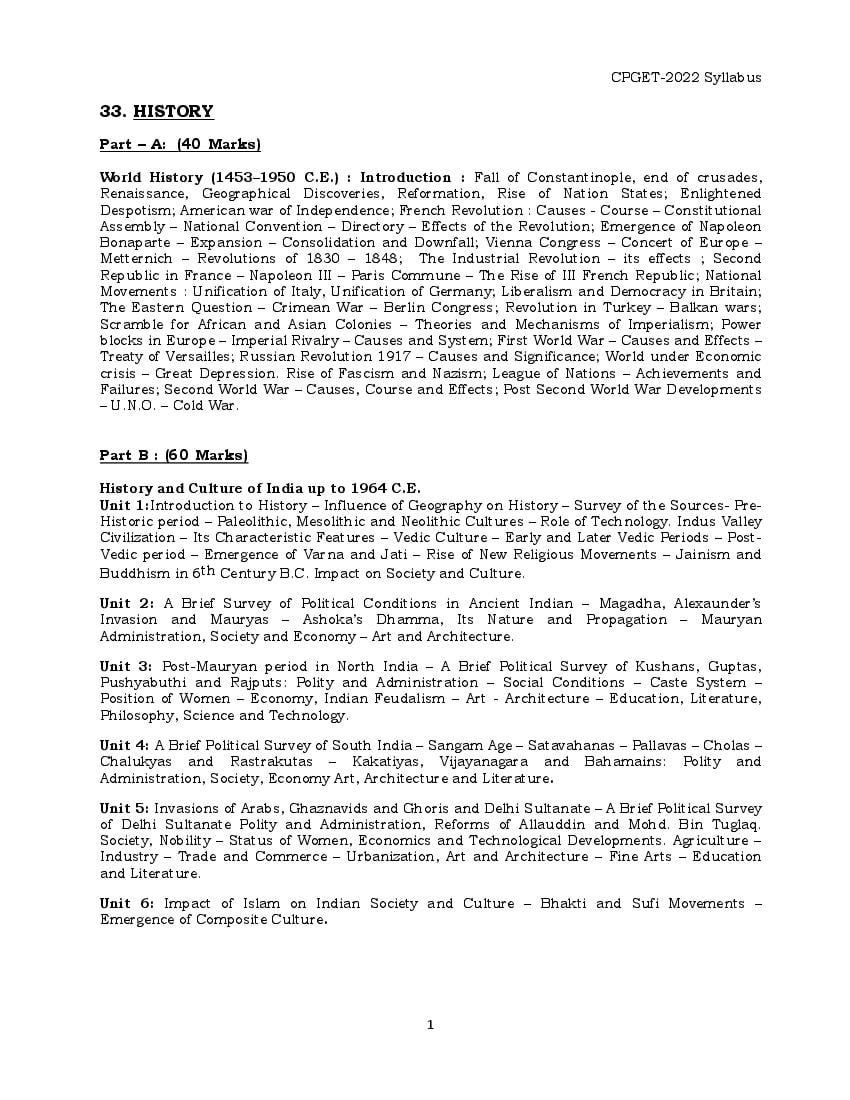
CPGET-2022 Syllabus 33. HISTORY Part – A: (40 Marks) World History (1453–1950 C.E.) : Introduction : Fall of Constantinople, end of crusades, Renaissance, Geographical Discoveries, Reformation, Rise of Nation States; Enlightened Despotism; American war of Independence; French Revolution : Causes - Course – Constitutional Assembly – National Convention – Directory – Effects of the Revolution; Emergence of Napoleon Bonaparte – Expansion – Consolidation and Downfall; Vienna Congress – Concert of Europe – Metternich – Revolutions of 1830 – 1848; The Industrial Revolution – its effects ; Second Republic in France – Napoleon III – Paris Commune – The Rise of III French Republic; National Movements : Unification of Italy, Unification of Germany; Liberalism and Democracy in Britain; The Eastern Question – Crimean War – Berlin Congress; Revolution in Turkey – Balkan wars; Scramble for African and Asian Colonies – Theories and Mechanisms of Imperialism; Power blocks in Europe – Imperial Rivalry – Causes and System; First World War – Causes and Effects – Treaty of Versailles; Russian Revolution 1917 – Causes and Significance; World under Economic crisis – Great Depression. Rise of Fascism and Nazism; League of Nations – Achievements and Failures; Second World War – Causes, Course and Effects; Post Second World War Developments – U.N.O. – Cold War. Part B : (60 Marks) History and Culture of India up to 1964 C.E. Unit 1:Introduction to History – Influence of Geography on History – Survey of the Sources- Pre- Historic period – Paleolithic, Mesolithic and Neolithic Cultures – Role of Technology. Indus Valley Civilization – Its Characteristic Features – Vedic Culture – Early and Later Vedic Periods – Post- Vedic period – Emergence of Varna and Jati – Rise of New Religious Movements – Jainism and Buddhism in 6th Century B.C. Impact on Society and Culture. Unit 2: A Brief Survey of Political Conditions in Ancient Indian – Magadha, Alexaunder’s Invasion and Mauryas – Ashoka’s Dhamma, Its Nature and Propagation – Mauryan Administration, Society and Economy – Art and Architecture. Unit 3: Post-Mauryan period in North India – A Brief Political Survey of Kushans, Guptas, Pushyabuthi and Rajputs: Polity and Administration – Social Conditions – Caste System – Position of Women – Economy, Indian Feudalism – Art - Architecture – Education, Literature, Philosophy, Science and Technology. Unit 4: A Brief Political Survey of South India – Sangam Age – Satavahanas – Pallavas – Cholas – Chalukyas and Rastrakutas – Kakatiyas, Vijayanagara and Bahamains: Polity and Administration, Society, Economy Art, Architecture and Literature. Unit 5: Invasions of Arabs, Ghaznavids and Ghoris and Delhi Sultanate – A Brief Political Survey of Delhi Sultanate Polity and Administration, Reforms of Allauddin and Mohd. Bin Tuglaq. Society, Nobility – Status of Women, Economics and Technological Developments. Agriculture – Industry – Trade and Commerce – Urbanization, Art and Architecture – Fine Arts – Education and Literature. Unit 6: Impact of Islam on Indian Society and Culture – Bhakti and Sufi Movements – Emergence of Composite Culture. 1
Page 2
CPGET-2022 Syllabus Unit 7: Survey of Sources – Establishment of Mughal Empire – Shershah Sur – Brief Survey of Political History up to A.D. 1707 – Polity and Administration – Society – Social Composition – Ulema – Nobility – Peasantry – Artisans – Slaves – Status of Women – Economy: Agriculture Industries, Trade and Commerce – Economic and Technological Developments. Religion – Hindu- Muslim Relations – Composite Culture. Education, Literature, Art, Architecture and Fine Arts. Decline and Disintegration of Mughal Empire – Rise of Regional Powers – Marathas and Sikhs. Unit 8: Advent of European Powers – Portugese, Dutch, English and French Expansion and Consolidation of British Empire – Wars – Diplomacy – Policies Pursued – Subsidiary Alliance – Doctrine of Lapse; Economics Policies and Changes – Mercantilism and Free Trade Policies – Land Revenue Settlements – permanent – Ryotwari – Mahlawari Systems – Irrigation – Commercialization of Agriculture – Condition of Peasants – Famines – Decline of Cottage Industries. Unit 9: Anti-colonial Upsurge – Peasant and Tribal Revolts, Revolt of 1857 – Causes – Nature and Results. Unit 10: Factors for Social Change – Christian Missionaries – Western Education – Emergence of New Middle Classes – Growth of Press – Socio-Religious Reforms Movements – Brahma Samaj – Arya Samaj – Theosophical Society – Ramakrishna Mission – Aligarh Movement – Jyotiba Phule – Narayana Guru, Periyar’s Self-Respect Movement – Dr.B.R Ambedkar. Unit 11: National Movement – Factors for the Growth of Nationalism – Indian National Congress – Three Phases of Freedom Struggle – Revolutionary Movements – Left Wing Movements – Peasant and Workers Movements. Unit 12: Emergence of Communal Trends – Partition of India – Integration of Princely states into Indian Union – Formation of Indian Republic. Jawaharlal Nehru as first Prime Minister and his Policies. 2