Karnataka SSLC Model Question Paper 2027 for Mathematics (Paper 3, English Medium) Key Answers
Finished viewing? Save it for later —
Download Karnataka SSLC Model Question Paper 2027 for Mathematics (Paper 3, English Medium) Key Answers (PDF · 33 pages)About Karnataka SSLC Model Question Paper 2027 for Mathematics (Paper 3, English Medium) Key Answers
Karnataka SSLC Model Question Paper 2027 for Mathematics (Paper 3, English Medium) Key Answers is available here for free download. Published by Karnataka Board for Class 10, this answer key can be viewed online or downloaded as a PDF (33 pages). Candidates preparing for Class 10 can use Karnataka SSLC Model Question Paper 2027 for Mathematics (Paper 3, English Medium) Key Answers to understand the exam pattern, the type of questions asked, and the overall difficulty level.
Frequently Asked Questions
How can I download Karnataka SSLC Model Question Paper 2027 for Mathematics (Paper 3, English Medium) Key Answers?
Open this page and click the Download button to save Karnataka SSLC Model Question Paper 2027 for Mathematics (Paper 3, English Medium) Key Answers as a PDF. It is completely free on AglaSem Docs.
Is Karnataka SSLC Model Question Paper 2027 for Mathematics (Paper 3, English Medium) Key Answers free to download?
Yes. Karnataka SSLC Model Question Paper 2027 for Mathematics (Paper 3, English Medium) Key Answers can be viewed online and downloaded as a PDF free of cost on AglaSem Docs.
How many pages does Karnataka SSLC Model Question Paper 2027 for Mathematics (Paper 3, English Medium) Key Answers have?
Karnataka SSLC Model Question Paper 2027 for Mathematics (Paper 3, English Medium) Key Answers contains 33 pages, which you can read online or download together as a single PDF.
Where can I find more Class 10 study material?
You can find more Class 10 question papers, sample papers, syllabus, and answer keys on AglaSem Docs.
Karnataka SSLC Model Question Paper 2027 for Mathematics (Paper 3, English Medium) Key Answers – Text
Read the full text of this answer key below — useful to quickly search, copy and reference the content online without downloading the PDF.
📄 View text version (34 pages)
Page 1
Karnataka SSLC Model
Question Paper 2027 for
Mathematics (Paper 3, English
Medium) Key Answers
EXAM YEAR TYPE SUBJECT
Karnataka Class 10 2027 Answer Key Maths
Notes · Sample Papers · Previous Year Papers · Mock Tests
Page 2
.co s e m
s em l a
a ag
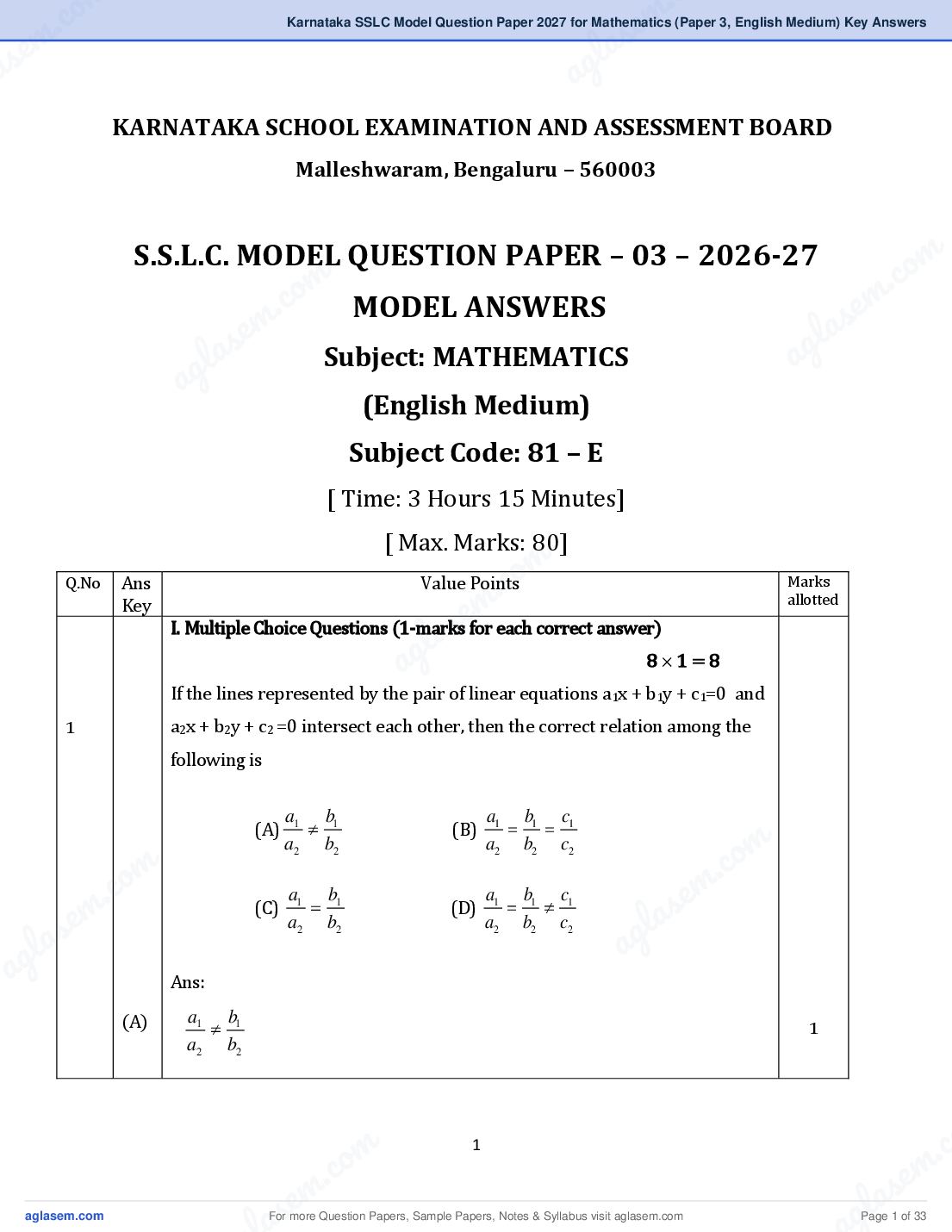
KARNATAKA SCHOOL EXAMINATION AND ASSESSMENT BOARD
Malleshwaram, Bengaluru – 560003
S.S.L.C. MODEL QUESTION PAPER – 03 – 2026-27 m
om . co
. c e m
e m MODEL ANSWERS
l as
l as Subject: MATHEMATICS ag
ag
(English Medium)
Subject Code: 81 – E
[ Time: 3 Hours 15 Minutes]
[ Max. Marks: 80]
m
Q.No Ans Value Points
m .co Marks
e
Key allotted
l as
I. Multiple Choice Questions (1-marks for each correct answer)
ag 8 1=8
If the lines represented by the pair of linear equations a1x + b1y + c1=0 and
1 a2x + b2y + c2 =0 intersect each other, then the correct relation among the
following is
a1 b1 a1 b1 c1
m
(A) (B)
.co
a2 b2 a2 b2 c2
m
m .co a1 b1 a1 b1 c1
s e m
la
s e (C)
a2 b2
(D)
a2 b2 c2
g
g la a
a Ans:
(A) a1 b1
1
a2 b2
om
1
. c
. c e m
m as
se
For more Question Papers, Sample Papers, Notes & Syllabus visit
gl
Page 1 of 33
Page 3
Key allotted
2 If α and β are the zeroes of the polynomial p(x) = ax2 + then the
value of α + β is
–
(A) (B)
–
(C) (D)
Ans:
– 1
(B)
3 The formula to find the sum of all terms of the arithmetic progression with
first term ‘a’ and last term ‘l’ is
(A) sn= (B) sn =
(C) sn = (a (D) sn = (a
Ans:
sn= 1
(A)
4 The value of cosec 600 + sec 300 is
√ √
(A) (B)
(C) (D)
√ √
Ans:
(C) 1
√
5 The formula to find the total surface area of cube of edge ‘a’ unit is
(A) 4a2 Sq. units (B) 6a2 Sq. units
(C) 4a3 Sq. units (D) 6a3 Sq. units
Ans:
(B) 1
6a2 Sq. units
2
For more Question Papers, Sample Papers, Notes & Syllabus visit Page 2 of 33
Page 4
.co s e m
s em l a
a ag
Q.No Ans Value Points Marks
Key allotted
6 Which measure of central tendency is calculated by finding Cumulative
frequency?
(A) Mean (B) Median
m
om . co
(C) Mode
. c
(D) Deviation
e m
Ans:
e m as
s g1l
(B) Median
l a a
If pgand q are co-primes, then the H.C.F of
7
a and is
(A) pq (B) 1
(C) p + q (D) p2q2
Ans:
(B) 1
o m
c
. is equal to 1
8
e
In the figure, if EF∥CA and FG ∥AB, thenm
l as
ag
m
m .co
.co
(A) (B)
e m
e m las
las (C) (D)
ag
ag
Ans:
1
(A)
om
3
. c
. c e m
m as
se
For more Question Papers, Sample Papers, Notes & Syllabus visit
gl
Page 3 of 33
Page 5
II. Answer the following questions: 8
9 Write the zeroes of the polynomial y=p(x) in the given graph.
Ans: 1 and 4 1
10 Find the roots of the quadratic equation
Ans:
1
11 Write the coordinates of the point P which divides the line segment joining the
points and B ( internally in the ratio 1:1.
Ans: =( )
1
12 When a die is rolled once, find the probability of getting the number 6 on the top.
Ans: S={1,2,3,4,5,6} n(S) = 6
Getting number 6 on top , A={6} n(A) = 1
P(A) = ½
½ 1
4
For more Question Papers, Sample Papers, Notes & Syllabus visit Page 4 of 33
Page 6
.co s e m
s em l a
a ag
Q. No allotted
How many solutions does the pair of linear equations and
13
have?
m
om . co
Ans:
. c e m
e m l as
l
a1 b1 c1
as ag
ag
a2 b2 c2
½
They have infinitely many solutions ½ 1
If the nth term of an arithmetic progression is an then find its 4th term.
14
Ans: an
om
a4 – ½
. c
a4 –
e m
a4
l as ½
g
1
a and height is 10cm, then find the volume
If the area of base of a cylinder is 22cm 2
15
the cylinder.
Ans: V= ½
V= 22 10
om
V=220 cm3 ½ 1
om . c
16 .c
In ΔLMN, ∠L = 50° and ∠N = 60°. If ΔLMN ~ ΔPQR, then find the measure of ∠Q .
e m
em Ans: Since ΔLMN ~ ΔPQR, las
las ag
ag ∠L = ∠P = 50° and ∠N= ∠R = 60°
∠Q = 1800 ( 500 + 600)
1
∠Q = 700
om
5
. c
. c e m
m as
se
For more Question Papers, Sample Papers, Notes & Syllabus visit
gl
Page 5 of 33
Page 7
III. Answer the following questions: 8 x 2 = 16
17 Prove that 4 + √ is an irrational number
Ans:
Let us assume that 4 + √ is rational number.
Then we can find coprime a and b (b 0) such that
4+√ = ½
Rearranging the equation, we get
√ = –4 ½
√ =
√ =
Since a and b are integers,
we get is rational, and so √ is rational.
But this contradicts the fact that √ is irrational.
This contradiction has arisen because of our incorrect assumption that 4 + √ is
rational. ½ 2
So, we conclude that 4 + √ is an irrational. ½
18 Solve the given pair of linear equations by elimination method.
2x y = 8
x+y=7
Ans:
2x y ………. i)
x+y ………. ii
------------------------
½
3x=15
x=5 ½
Substitute value of x in equation (ii)
x+y=7
5+y = 7 ½
y=7 5 2
y=2 ½
6
For more Question Papers, Sample Papers, Notes & Syllabus visit Page 6 of 33
Page 8
.co s e m
s em l a
a ag
Q. No allotted
19 Express (2x+3) x = x2+1 in the standard form of quadratic equation.
OR
For what value of ‘k’ the roots of the equation are equal?
m
Ans: (2x + 3) x = x2 + 1
om . co
. c e m
s
1
m
2x2 +3x = x2 + 1
s e g l a
g a
2x2 +3x – x2 – 1 = 0
l– 1 = 0 1 a
2
a
x +3x
2
OR
a= k , b = 6 , c = 1
b2 – 4ac = 0
om
½
(6)2 – 4×k×1= 0
. c ½
36 4k = 0
e m
4k = 36
l as ½
k =g
a
2
k=9 ½
20 Find how many numbers between 201 and 401 are divisible by 6 using formula.
OR
Find the sum of first 20 terms of the arithmetic progression 2, 5, 8, 11,.......
m
.co
using formula.
omThe numbers divisible by 6 between 201 and 400 are 204, 210,216,..........396
c. Ans: e m
em l s
a ½
s
a= 204; a =396; d=6: n=?
g
n
la a = a+(n-1)d
n
a
ag 396 = 204+(n 1)6
396 = 204+6n 6
½
396 = 6n+198
6n = 198 ½
n= 33 ½ 2
om
7
. c
. c e m
m as
se
For more Question Papers, Sample Papers, Notes & Syllabus visit
gl
Page 7 of 33
Page 9
OR
a=2; d=3; n=20; s20=?
Sn= [2a+(n-1)d] ½
S20 = [2x2+(20-1)3] ½
= 10 [4+19x3]
= 10 [4+57] ½
= 10 x 61
2
S20 = 610 ½
21
If then find the value of tan A
Ans: In ABC , ∠B = 900
AC2 = AB2 + BC2
52 = AB2 + 32
25 = AB2 + 9
AB2 = 25 – 9
AB2 = 16
AB = 4 1
t ½
2
t ½
8
For more Question Papers, Sample Papers, Notes & Syllabus visit Page 8 of 33
Page 10
.co s e m
s em l a
a ag
Q. No allotted
22 Find the H.C.F and L.C.M of 68 and 72 by the method of prime factorization and
verify that L.C.M X H.C. F = The product of numbers.
m
om . co
Ans:
. c e m
e m l as
l as 2 68
2 72 ag
ag 2 34
17
2 36
2 18
3 9
3
68 = 22 × 171 72 = 23 × 32 ½
om
L.C.M = 23 × 32 × 171 = 1224 ½
c
m.
H.C.F = 22 = 4 ½
A×B=L×H
s e
g l a
a
68 × 72 = 1224 × 4
4896 = 4896 ½ 2
23 AD and BC are tangents to the circles with centre M and N and they intersect at
point P as shown in the figure. If ∠ , AP = 4 cm and ,
then find the measure of ∠ and length of BC.
m
m .co
m .co s e m
s e g la
g la a
a
om
9
. c
. c e m
m as
se
For more Question Papers, Sample Papers, Notes & Syllabus visit
gl
Page 9 of 33
Page 11
AP = 4cm ( Given)
AP = BP = 4cm [ Tangents drawn from an external point P to the same circle]
AP : PD = 1 : 2 [Given]
PD = 2 AP = 2 X 4 = 8cm ½
PD = PC = 8cm [Tangents drawn from an external point P to the same circle]
BC = BP + PC = 4 + 8
BC = 12cm ½
∠AMP = 60° [Given], ∠MPA = 90°[ Angle at the point of contact] ½
∠NPD = 180° (60°+90°)
= 1800 - 1500
∠NPD = 30° ½ 2
24 The centre of a circle is ‘P’ whose coordinates are P(6, 7). In this circle AB is a
chord and the coordinates of its end points are A (3, 4) and B (9, 4). Find the
perpendicular distance to the chord from the centre of the circle using formula.
P(6,7)
Q(x,y)
10
For more Question Papers, Sample Papers, Notes & Syllabus visit Page 10 of 33
Page 12
.co s e m
s em l a
a ag
Q. No allotted
Ans: AB is a chord and PQ ⊥ AB
m
co
Therefore, AQ = BQ
m .
c. oof AB
⇒ Q is the Midpoint
s e m
s em g l a
g la a
a Q =( ) ½
=( )
=( )
= ½
m
.co
PQ = √ ½
PQ = √
e m
l as
ag
PQ = √
PQ = √ 2
PQ = 3 units ½
m
m
IV .Answer the following questions: 9 x 3 = 27
.co
.co s e m
s em Find the zeroes of the quadratic polynomial p(x) = x + 6x + 8 andgverify
l a the
la
2
g a
a relationship between the zeroes and the coefficients.
OR
Write the quadratic polynomial whose sum of the zeroes is 3 and product of
the zeroes is 10. And also find the zeroes of this polynomial.
om
11
. c
. c e m
m as
se
For more Question Papers, Sample Papers, Notes & Syllabus visit
gl
Page 11 of 33
Page 13
25 Ans: p(x) = x2+ 6x + 8
p(x) = x2+6x +8
p(x) = x2 + 4x + 2x + 8 ½
p(x) = x (x + 4)+2 ( x + 4)
(x + 4)(x + 2) =0
x + 4= 0 or x + 2 =
x = 4 or x = 2 ½
zeros of polynomials α = 4 and β = 2
sum of the zeros of polynomials = α + β= ( 4) +( 2)= 6 ½
= = ½
product of the zeros of polynomials= α x β =8 ½
= = ½ 3
OR
Given α + β = 3 , α x β = 10
Required quadratic polynomial P(x) = x2 – (α + β) x + αβ ½
P(x) = x2 – 3x – 10 ½
P(x) = x2 – 3x – 10
P(x) = x2 5x + 2x 10 ½
P(x) = x (x 5)+ 2 ( x 5 ) ½
(x 5)(x + 2) =0
x 5= 0 or x + 2 = ½
x = 5 or x = 2 ½
zeroes of the polynomial are 5 and 2
3
12
For more Question Papers, Sample Papers, Notes & Syllabus visit Page 12 of 33
Page 14
.co s e m
s em l a
a ag
Q. No allotted
26 Prove th t “the le gth of tangents drawn to a circle from an external point are
equ l”.
m
om . co
. c e m
em l as
l as ag
ag
Given : PQ and PR are the two tangents drawn from the external point P to
m
a circle of center O.
To Prove : PQ = PR
m .co
s e
Construction : Join OP, OQ, OR
g l a
Proof :
a
In △ OQP and △ORP
OQ = OR (∵ Radii of same circle)
OP = OP (∵Common side )
∠OQP =∠ORP =900 ( Theorem 10.1)
m
.co
OQP ≅ △ORP ( RHS congruence rule)
m
m .co PQ = PR (CPCT)
s em
s e la
Datag, Figure: 1 mark
g la a
a To prove, construction : ½ marks
3
Proof : 1 ½ marks
om
13
. c
. c e m
m as
se
For more Question Papers, Sample Papers, Notes & Syllabus visit
gl
Page 13 of 33
Page 15
27 Find the coordinates of the point which divides the line segment joining the
points ( and (8, 5) internally in the ratio .
Ans: ) A (4, -3) = (x1, y1), B(8, 5) = (x2, y2), m1 : m2 = 3 : 1, P (x, y) = ?
P(x, y) = * + ½
P(x, y) = * + 1
=* + ½
=* + ½
P(x, y) = [ 7, 3] ½ 3
28 In the figure, and PST = PRQ. Prove that PQR is an isosceles
triangle.
Ans: ST || QR ( Converse of Thales theorem ) ½
PST = PQR (Corresponding angles) ½
PST = PRQ (data) ½
⟹PRQ = PQR ½
PQ = PR ½
3
PQR is an isosceles triangle ½
14
For more Question Papers, Sample Papers, Notes & Syllabus visit Page 14 of 33
Page 16
.co s e m
s em l a
a ag
Q. No allotted
29 Prove that cosec A (1 – cos A) (cosec A + cot A) = 1
OR
m
co
Prove that
. c om e m .
em A (1 – cos A)(cosec A + cot A)
LHS = cosec
l as
las ag
a g . (cosec A +cot A) ½
=( . )(cosec A +cot A) ½
= (cosec A – cot A) (cosec A +cot A) ½
= cosec2 A– cot2 A ½
m
.co
= 1 + cot2 A –cot2 A ½
e m 3
=1 = RHS
l as ½
ag OR
LHS
= 1
=
m
m .1co
m .co s e m
s e g la
g la a
a
1
= = . = RHS 3
om
15
. c
. c e m
m as
se
For more Question Papers, Sample Papers, Notes & Syllabus visit
gl
Page 15 of 33
Page 17
30 A bag contains 26 cards numbered from 5 to 30. A card is drawn at random from
the bag. Find the probability that the card drawn is
(i) a multiple of both 2 and 3
(ii) a square number
(iii) a multiple of 3
OR
There are 3 red balls, 5 white balls and 8 blue balls in a bag. A ball is drawn at
random from the bag. Find the probability that the ball drawn is
(i) a red ball
(ii) not a white ball
(iii) a green ball
Ans: S {5 ……… } S
i) A={6,12,18,24,30} n(A)=5
P(A)= = 1
ii) B= {9,16,25 } n(B) = 3
⸫ P(B)= = 1 3
iii) C={6,9,12,15,18,21,24,27,30} n(C) =9 ⸫
P(C)= = 1
OR
16
For more Question Papers, Sample Papers, Notes & Syllabus visit Page 16 of 33
Page 18
.co s e m
s em l a
a ag
Q. No allotted
n(S)= 3+5+8=16
(i) A= Getting a red ball n(A) =3
m
om . co
c. P(A)= = 1
e m
em l as
l as (ii) B= Not getting a white ball n(B)=11 ag
ag P(B)= = 1
(iii) C= getting a green ball n(C) = 0
3
P(C)= = =0 1
31
m
A farmer wishes to grow a 100 m2 rectangular vegetable garden. Since he has
.co
only 30m barbed wire, he fences the sides of the rectangular garden letting his
m
s e
a
house compound wall act as the fourth side fence. Find the dimensions of the
l
garden.
ag
Ans: Let the length of the rectangular garden be ‘l’ m and breadth be ‘ ’ m
(given) ½
– m
.½co
----------(1)
m
.co m
=100
m s e
e la
(30 2b)b =100 (from 1)
las 30b – 2b2 – 100 = 0
ag
ag 2b2 – 30b + 100 = 0
b2 15b + 50 = 0 ½
b2 5b – 10b + 50 = 0
b(b – 5) 10(b – 5) = 0
om
17
. c
. c e m
m as
se
For more Question Papers, Sample Papers, Notes & Syllabus visit
gl
Page 17 of 33
Page 19
(b – 5)(b – 10) = 0
b = 5 or b = 10 ½
if b= 5 , = 30 – 2× 5 or if b= 10, = 30 – 2× 10
= 30 – 10 = 30 – 20
= 20 = 10 ½
here, if = 10 m the garden shape would be a square , but it is of
rectangular shape
= 20 and b = 5
3
The length of the garden is 20m and its breadth is 5m ½
32
In the given figure, area of the sector OAC is cm2. If OR = RA and ∠AOC = 600
then, find the area of the segment ABC and length of the arc PQR.
Ans: Area of the sector OAC =
½
r=7 cm ½
18
For more Question Papers, Sample Papers, Notes & Syllabus visit Page 18 of 33
Page 20
.co s e m
s em l a
a ag
Q. No allotted
√
Area of
√
m
co
=
√
. c om e m .
=
e m l as
as
l = ag
ag √
cm2 ½
Are o the seg e t A Are o the se tor OA Are o
√
Are o the seg e t A ) cm2 ½
Length of arc PQR = ½
m
=
m .co
s e
l a
=
ag 3
= 18.33cm ½
33. Find the Median for the given data
Class interval frequency
5 6
9
m
.co
20
m
.co m
10
m s e
la
5
s e g
la
OR
g a
a Find the Mode for the following frequency distribution table
Class interval 10 -20 20 -30 30 -40 40 -50
frequency 6 4 12 3
om
19
. c
. c e m
m as
se
For more Question Papers, Sample Papers, Notes & Syllabus visit
gl
Page 19 of 33
Page 21
Ans:
I.C f cf
50-60 6 6
60-70 9 15
70-80 20 35
80-90 10 45
90-100 5 50
N=50
for table 1mark
=70
15
h =10
f=20
5 ½
Me i ( ) h ½
( ) ½
( )
5
75 ½ 3
OR
20
For more Question Papers, Sample Papers, Notes & Syllabus visit Page 20 of 33
Page 22
.co s e m
s em l a
a ag
Q. No allotted
Here class interval of the mode is 30 – 40
1
m
co
30, 4, 12, 3, h = 10
. c ]om e m .
e
[
m l as
as ag
* gl
a + 1
[ ]
.
m
c. o
1 3
Mode =34.7
e m
V. Answer the following questions: gl
as
a
4 x 4 = 16
th
In an arithmetic progression the first term is 22, n term is 11 and the sum of
34
the first ‘n’ terms is 66. Find the number of terms of the progression , common
difference and the 7th term.
OR
o m
om than thrice of its 5 term. The 10 term of the progression is 31.em c
An arithmetic progression contains 30 terms. 17 th term of the progression is 4
. the
c. more th th Find
e m last three terms of the progression and also find the progression. las
l as a g
ag Ans:
Data
a = 22, an = 11, Sn = 66
n =?, d=? and 7th term=?
om
21
. c
. c e m
m as
se
For more Question Papers, Sample Papers, Notes & Syllabus visit
gl
Page 21 of 33
Page 23
S ½
½
Number of terms =12 ½
½
½
½
a7 = a+6d
a7 = 22 +6( 3)
a7 = 22 18
4
a7 = 4 ½
OR
a10 = 31
a+9d=31 ----------(1) ½
a17 = 3a5 + 4
a + 16d = 3 ( a + 4d) + 4
a + 16d = 3a + 12d +4
a – 3a + 16d – 12d = 4
22
For more Question Papers, Sample Papers, Notes & Syllabus visit Page 22 of 33
Page 24
.co s e m
s em l a
a ag
Q. No allotted
-2a + 4d = 4 ( Divide by 2 ) ½
- ……..
m
-a +2d = 2
om . co
. c e m
s
a +9d = 31
em l a
a s
l 33 ag
11dg=
ad =
d=3 ½
substitute v lue o “ ” i equ tio
a + 9d = 31
a + 9(3) = 31
m
a + 27 = 31
m .co
a = 31 – 27
s e
a=4
g l a ½
The last three terms of an A.P are a a, a , a30 29 28
a30 = a + 29d a29=a+ 28d a28= a+ 27d
a30 =4 + 29(3) a29 =4 + 28 (3) a28 =4 + 27 (3)
a30 =4 + 87 a29 =4 + 84 a28 = 4 + 81
a30 =91 a29 =88 a28 =85 1
m
om eti Progressio
c. Arith m.co
m …… s e
s e g la
g la ……
a
a …………. 1 4
om
23
. c
. c e m
m as
se
For more Question Papers, Sample Papers, Notes & Syllabus visit
gl
Page 23 of 33
Page 25
35 Solve the given pair of linear equations by graphical method.
Scale : x axis and Y axis: 1 cm = 1unit.
For two tables 1+1 : 2marks
Drawing 2 lines : 1 mark 4
Finding values of x and y : 1 mark
24
For more Question Papers, Sample Papers, Notes & Syllabus visit Page 24 of 33
Page 26
.co s e m
s em l a
a ag
m
om . co
. c e m
em l as
l as ag
ag
Q. No allotted
36. Prove th t “I i two tri gles si es o o e tri gle re proportio l to i.e. i the
o m
same ratio of) the sides of the other triangle, then their corresponding angles are
equ l he e the two tri gles re si il r.” . c
ORse
m
g la
a
Prove that “I o e gle o tri gle is equ l to o e gle o the other tri gle
and the sides including these angles are proportional, then the two triangles are
si il r”.
Ans :
Data : In ABC and DEF
m
m
c. o = m.co
m
= ----- (1)
s e
s e g la
g la a
a To prove : A = D, B = E and C= F and ΔABC ≅ ΔDEF
Construction : Mark Points P and Q on DE and DF so that AB = DP and
AC = DQ then join PQ
om
25
. c
. c e m
m as
se
For more Question Papers, Sample Papers, Notes & Syllabus visit
gl
Page 25 of 33
Page 27
⟹ = ( Inverse ratios)
⟹
⟹ =
⟹ =
⟹ = ( inverse ratios)
PQ ||EF ( Thales theorem )
P = E and Q =F
DPQ = DEF ( AA similarity criteria)
There fore = ------ (2)
If AB = DP, AC = DQ
= ------- (3)
From (2)and (3)
BC = PQ
In ABC and DPQ
BC = PQ
AB = DP
AC = DQ
ABC ≅ DPQ
A = D, B = P, & C = Q,
4
26
For more Question Papers, Sample Papers, Notes & Syllabus visit Page 26 of 33
Page 28
.co s e m
s em l a
a ag
⟹ A = D, B = E, & C = F
& ABC DE F
m
om . co
. c em
s
OR
em l a
l as ag
ag
Data :In ABC and DEF
m
.co
A = D, and =
e m
To prove : ABC DEF
l as
Construction: Mark Points P and a
g
Q on DE and DF so that AB = DP and
AC = DQ then join PQ
Proof : In ABC and DPQ
AB = DP (construction)
AC = DQ (construction)
m
m A = D, (data)
.co
m .co ABC ≅ DPQ ( SAS)
s em
s e B = P,
g la
g la C = Q, (corresponding angles of similaratriangles) -----(1)
a
= (data)
= ( AB = DP & AC = DQ)
PQ || EF (converse of Thales theorem)
om
27
. c
. c e m
m as
se
For more Question Papers, Sample Papers, Notes & Syllabus visit
gl
Page 27 of 33
Page 29
F = Q, --------(2)
From (1)and (2)
B = E , C= F , and A = D ,
ABC DEF 4
Data : ½ mark
Figure : ½ mark
To Prove : ½ mark
Construction: ½ mark
Proof : 2 marks
Q. No allotted
37 A ladder ‘AB’ is used to climb the terrace of a room (APQC) in the first floor of a
building (QRTU) as shown in the figure. The foot of the ladder ‘B’ is at a distance
√ √
of m from the point ‘C’. From a point ‘S’ on the ground which is 4m
away from the building the angle of elevations to the point ‘P’ on the terrace
and to the point ‘Q’ on the base of the room are 60 0 and 450 respectively. Find
the length of the ladder and the ∠ABC made by the ladder with the wall.
Ans:
Given :- Distance from the building, RS = 4 m
28
For more Question Papers, Sample Papers, Notes & Syllabus visit Page 28 of 33
Page 30
.co s e m
s em l a
a ag
Angle of elevation to point Q, ∠QSR = 450
Angle of elevation to point P, ∠PSR = 600
In right-angled ∆ QRS:
tan 450 = ⇒ 1 = ⇒ QR = 4 m ½
m
m . co
c. o ∆ PRS:
In right-angled triangle
s e m
tan 60em l a
s = 0 ⇒ √ = ⇒ PR = 4√ m.
lPQa= PR – QR = 4√ 4 = 4(√ – 1) m
½
ag
a g ½
Q. No allotted
Since APQC is a rectangle (the room structure on the first floor), the
opposite side AC (wall) is equal to PQ :
m
AC = PQ = 4(√ – 1) m
m .co ½
s e
In right-angled triangle ∆ ABC:
l a
tan B = ag ½
√
tan B = √ √
tan B = √ m.
tan B =
√
tan B = √
m
m .co
.co
tan B = tan 600
m s em
e la
∠ABC0 = 600
las ag
ag ∠ABC made by the ladder with the wall is 600. ½
In right-angled triangle ∆ ABC:
sin 0= ½
√ √
=
om
29
. c
. c e m
m as
se
For more Question Papers, Sample Papers, Notes & Syllabus visit
gl
Page 29 of 33
Page 31
AB =
√
√
= m
√
The length of the ladder is m. ½ 4
Q. No allotted
VI. Answer the following question: 1x5=5
38
A cylindrical hall has a hemispherical roof and the total height of the hall is
equal to the diameter of the hemisphere. Find the area of the floor if the capacity
of the hall is 48510m3. If the inner surface of the hall is to be painted, then find
the area to be painted.
OR
50 tents are to be built in a village for an upcoming fair. The lower part of each
tent is cylindrical with base radius 2.8m and height 3.5m and the upper part is
conical with the same base radius as that of the cylinder. If the height of the cone
is 2.1m then find the area of the canvas used to make 50 such tents.
30
For more Question Papers, Sample Papers, Notes & Syllabus visit Page 30 of 33
Page 32
.co s e m
s em l a
a ag
m
om . co
. c e m
e m l as
l as ag
ag
allotted
m
Q. No
.co
Ans :- Let radius of the hemisphere = radius of cylinder = ‘r’ m.
m
s e
Diameter of hemisphere = ‘2r’ m.
g l a
Total height of the hall = ‘2r’ m. a
Height of the cylinder, h = Total height radius of hemisphere = 2r r = ‘r’ m.
½
Total Volume of the hall = Volume of Cylinder + Volume of Hemispherical Roof
= 48510 cm3 ½
m
m
πr2h + πr3 = 48510
c. o½
m .co πr2r + πr3 = 48510
s e m
s e πr3 + πr3 = 48510
g la
g la πr3 = 48510 a ½
a X r3 = 48510
r3 = 48510
r3 =
r3 = 441 x 21 = 213
r = 21 m ½
om
31
. c
. c e m
m as
se
For more Question Papers, Sample Papers, Notes & Syllabus visit
gl
Page 31 of 33
Page 33
= x 21 x 21
= 1386 m2 ½
Area to be painted = CSA of Cylinder + CSA of Hemisphere ½
= 2πrh + 2πr2 ½
= 2πr2 + 2πr2
=4x x 21 x 21
= 4 x 22 x 3 x 21
= 5544 m2 ½ 5
Q. No allotted
OR
Ans :- Cylinder : Base radius r = 2.8m
height h = 3.5m
Cone : Base radius r = 2.8m
height hc = 2.1m
Slant height of the cone , l = √ ½
=√ . . ½
=√ . .
=√ . 5 ½
= 3.5 m ½
Area of canvas for 1 tent:
Canvas area = CSA of Cylinder + CSA of Cone ½
= 2πrh + πrl ½
= πr ( 2h + l)
32
For more Question Papers, Sample Papers, Notes & Syllabus visit Page 32 of 33
Page 34
.co s e m
s em l a
a ag
= x 2.8(2 x 3.5 + 3.5) ½
= 92.4 m2 ½
5
Area of canvas for 50 tents: 92.4 x 50 = 4620 m2 1
m
om . co
. c em
em l as
l as ag
ag
m
m .co
s e
l a
ag
m
m .co
m .co s e m
s e g la
g la a
a
om
33
. c
. c e m
m as
se
For more Question Papers, Sample Papers, Notes & Syllabus visit
gl
Page 33 of 33
Document Details
| Board / Org | Karnataka Board |
| Exam | Class 10 |
| Type | Answer Key |
| Pages | 33 |
| Language | english |
| Updated | 03 Nov 2026 |