Page 1
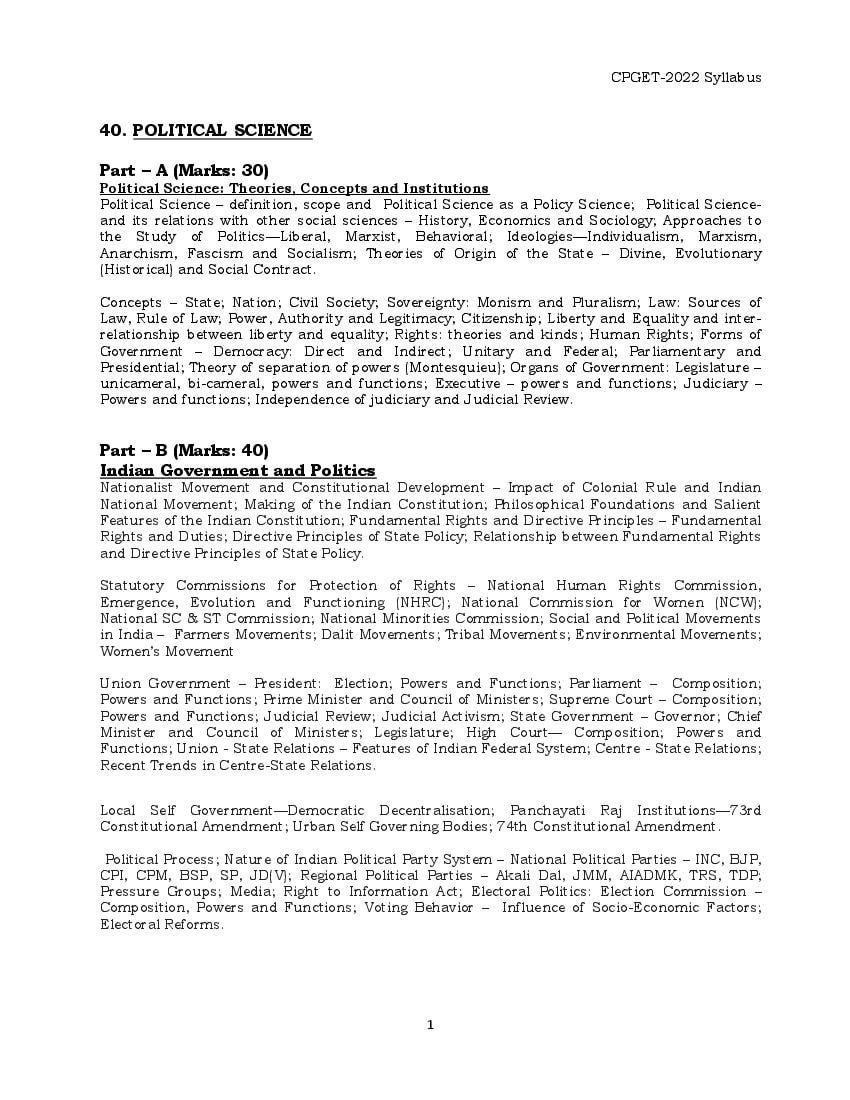
CPGET-2022 Syllabus 40. POLITICAL SCIENCE Part – A (Marks: 30) Political Science: Theories, Concepts and Institutions Political Science – definition, scope and Political Science as a Policy Science; Political Science- and its relations with other social sciences – History, Economics and Sociology; Approaches to the Study of Politics—Liberal, Marxist, Behavioral; Ideologies—Individualism, Marxism, Anarchism, Fascism and Socialism; Theories of Origin of the State – Divine, Evolutionary (Historical) and Social Contract. Concepts – State; Nation; Civil Society; Sovereignty: Monism and Pluralism; Law: Sources of Law, Rule of Law; Power, Authority and Legitimacy; Citizenship; Liberty and Equality and inter- relationship between liberty and equality; Rights: theories and kinds; Human Rights; Forms of Government – Democracy: Direct and Indirect; Unitary and Federal; Parliamentary and Presidential; Theory of separation of powers (Montesquieu); Organs of Government: Legislature – unicameral, bi-cameral, powers and functions; Executive – powers and functions; Judiciary – Powers and functions; Independence of judiciary and Judicial Review. Part – B (Marks: 40) Indian Government and Politics Nationalist Movement and Constitutional Development – Impact of Colonial Rule and Indian National Movement; Making of the Indian Constitution; Philosophical Foundations and Salient Features of the Indian Constitution; Fundamental Rights and Directive Principles – Fundamental Rights and Duties; Directive Principles of State Policy; Relationship between Fundamental Rights and Directive Principles of State Policy. Statutory Commissions for Protection of Rights – National Human Rights Commission, Emergence, Evolution and Functioning (NHRC); National Commission for Women (NCW); National SC & ST Commission; National Minorities Commission; Social and Political Movements in India – Farmers Movements; Dalit Movements; Tribal Movements; Environmental Movements; Women’s Movement Union Government – President: Election; Powers and Functions; Parliament – Composition; Powers and Functions; Prime Minister and Council of Ministers; Supreme Court – Composition; Powers and Functions; Judicial Review; Judicial Activism; State Government – Governor; Chief Minister and Council of Ministers; Legislature; High Court— Composition; Powers and Functions; Union - State Relations – Features of Indian Federal System; Centre - State Relations; Recent Trends in Centre-State Relations. Local Self Government—Democratic Decentralisation; Panchayati Raj Institutions—73rd Constitutional Amendment; Urban Self Governing Bodies; 74th Constitutional Amendment. Political Process; Nature of Indian Political Party System – National Political Parties – INC, BJP, CPI, CPM, BSP, SP, JD(V); Regional Political Parties – Akali Dal, JMM, AIADMK, TRS, TDP; Pressure Groups; Media; Right to Information Act; Electoral Politics: Election Commission – Composition, Powers and Functions; Voting Behavior – Influence of Socio-Economic Factors; Electoral Reforms. 1
Page 2
CPGET-2022 Syllabus Part – C (Marks: 30) Political Thought Political Thought – Nature, Methods and Significance; Western and Indian Political Thought – Comparison; Ancient and Medieval Political Thought – Plato: Theory of Justice and Ideal State; Aristotle: Classification of Governments, Theory of Revolutions and Slavery; Manu-Dharma and Varna; Kautilya – Saptanga Theory, Mandala Theory; Thomas Aquinas: Theory of Law; Early Modern Western Political Thought: Church - State Controversy; Nicolo Machiavelli as a modern political thinker and views on State Craft. Social Contractualists: Thomas Hobbes- Individualism and Absolute (State) Sovereignty; John Locke - Natural Rights and Limited Government; Jean Jacques Rousseau- General Will and Popular Sovereignty; Utilitarians: Jeremy Bentham- Principles of Utilitarianism; J.S. Mill-Liberty, Representative Government; Idealists: GWF Hegel- Dialectics and Theory of State; TH Green- Rights and Political Obligation. Marxist Philosophy – Karl Marx: Dialectical and Historical Materialism; Mao Ze dong: On Contradictions, New Democratic Revolution; Antonio Gramsci: Hegemony and Civil Society. Indian Political Thought: Buddha- Social and Political Ideas; Dhamma and Sangha; Basava - Social Ideas; Jyotirao Phule- Critique of Brahmanism, Social Revolution; Mohandas Karamchand Gandhi - Ahimsa, Satyagraha; Jawaharlal Nehru - Democratic Socialism, Secularism; Dr. B.R. Ambedkar- Theory of Caste, Annihilation of Caste and State Socialism. 2