Page 1
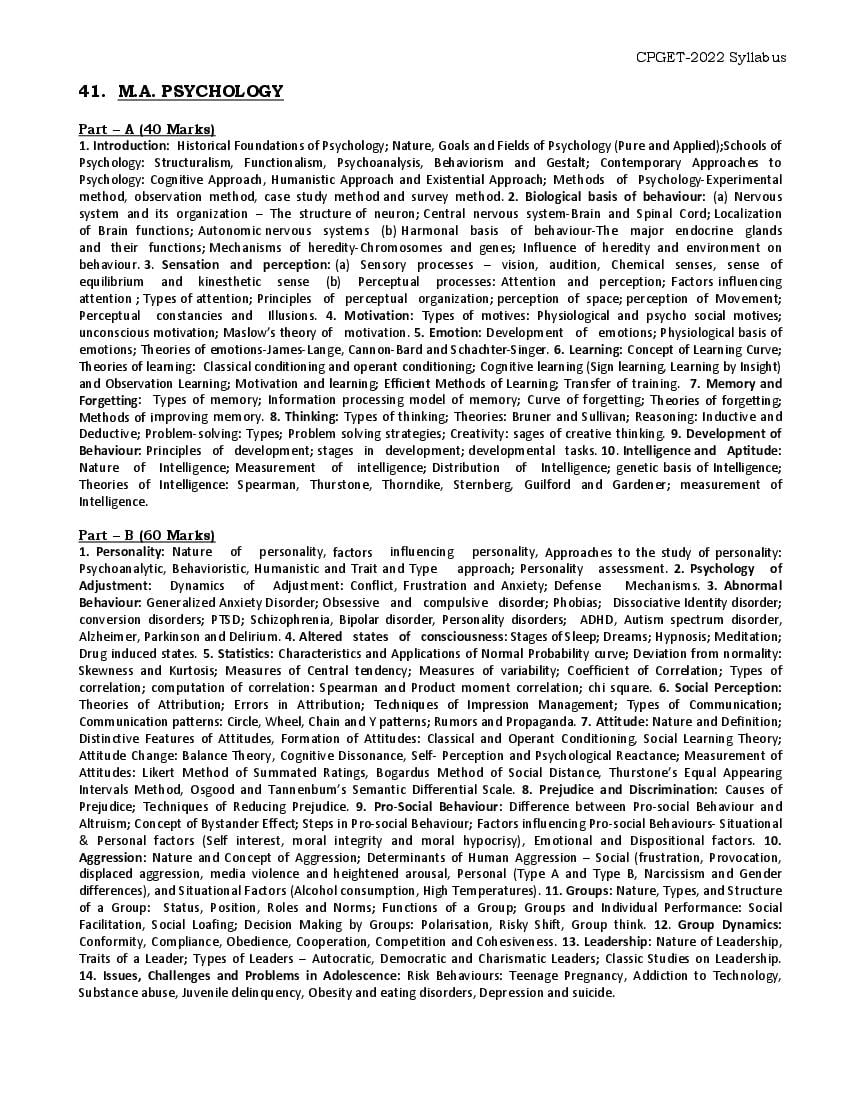
CPGET-2022 Syllabus 41. M.A. PSYCHOLOGY Part – A (40 Marks) 1. Introduction: Historical Foundations of Psychology; Nature, Goals and Fields of Psychology (Pure and Applied);Schools of Psychology: Structuralism, Functionalism, Psychoanalysis, Behaviorism and Gestalt; Contemporary Approaches to Psychology: Cognitive Approach, Humanistic Approach and Existential Approach; Methods of Psychology-Experimental method, observation method, case study method and survey method. 2. Biological basis of behaviour: (a) Nervous system and its organization – The structure of neuron; Central nervous system-Brain and Spinal Cord; Localization of Brain functions; Autonomic nervous systems (b) Harmonal basis of behaviour-The major endocrine glands and their functions; Mechanisms of heredity-Chromosomes and genes; Influence of heredity and environment on behaviour. 3. Sensation and perception: (a) Sensory processes – vision, audition, Chemical senses, sense of equilibrium and kinesthetic sense (b) Perceptual processes: Attention and perception; Factors influencing attention ; Types of attention; Principles of perceptual organization; perception of space; perception of Movement; Perceptual constancies and Illusions. 4. Motivation: Types of motives: Physiological and psycho social motives; unconscious motivation; Maslow’s theory of motivation. 5. Emotion: Development of emotions; Physiological basis of emotions; Theories of emotions-James-Lange, Cannon-Bard and Schachter-Singer. 6. Learning: Concept of Learning Curve; Theories of learning: Classical conditioning and operant conditioning; Cognitive learning (Sign learning, Learning by Insight) and Observation Learning; Motivation and learning; Efficient Methods of Learning; Transfer of training. 7. Memory and Forgetting: Types of memory; Information processing model of memory; Curve of forgetting; Theories of forgetting; Methods of improving memory. 8. Thinking: Types of thinking; Theories: Bruner and Sullivan; Reasoning: Inductive and Deductive; Problem-solving: Types; Problem solving strategies; Creativity: sages of creative thinking. 9. Development of Behaviour: Principles of development; stages in development; developmental tasks. 10. Intelligence and Aptitude: Nature of Intelligence; Measurement of intelligence; Distribution of Intelligence; genetic basis of Intelligence; Theories of Intelligence: Spearman, Thurstone, Thorndike, Sternberg, Guilford and Gardener; measurement of Intelligence. Part – B (60 Marks) 1. Personality: Nature of personality, factors influencing personality, Approaches to the study of personality: Psychoanalytic, Behavioristic, Humanistic and Trait and Type approach; Personality assessment. 2. Psychology of Adjustment: Dynamics of Adjustment: Conflict, Frustration and Anxiety; Defense Mechanisms. 3. Abnormal Behaviour: Generalized Anxiety Disorder; Obsessive and compulsive disorder; Phobias; Dissociative Identity disorder; conversion disorders; PTSD; Schizophrenia, Bipolar disorder, Personality disorders; ADHD, Autism spectrum disorder, Alzheimer, Parkinson and Delirium. 4. Altered states of consciousness: Stages of Sleep; Dreams; Hypnosis; Meditation; Drug induced states. 5. Statistics: Characteristics and Applications of Normal Probability curve; Deviation from normality: Skewness and Kurtosis; Measures of Central tendency; Measures of variability; Coefficient of Correlation; Types of correlation; computation of correlation: Spearman and Product moment correlation; chi square. 6. Social Perception: Theories of Attribution; Errors in Attribution; Techniques of Impression Management; Types of Communication; Communication patterns: Circle, Wheel, Chain and Y patterns; Rumors and Propaganda. 7. Attitude: Nature and Definition; Distinctive Features of Attitudes, Formation of Attitudes: Classical and Operant Conditioning, Social Learning Theory; Attitude Change: Balance Theory, Cognitive Dissonance, Self- Perception and Psychological Reactance; Measurement of Attitudes: Likert Method of Summated Ratings, Bogardus Method of Social Distance, Thurstone’s Equal Appearing Intervals Method, Osgood and Tannenbum’s Semantic Differential Scale. 8. Prejudice and Discrimination: Causes of Prejudice; Techniques of Reducing Prejudice. 9. Pro-Social Behaviour: Difference between Pro-social Behaviour and Altruism; Concept of Bystander Effect; Steps in Pro-social Behaviour; Factors influencing Pro-social Behaviours- Situational & Personal factors (Self interest, moral integrity and moral hypocrisy), Emotional and Dispositional factors. 10. Aggression: Nature and Concept of Aggression; Determinants of Human Aggression – Social (frustration, Provocation, displaced aggression, media violence and heightened arousal, Personal (Type A and Type B, Narcissism and Gender differences), and Situational Factors (Alcohol consumption, High Temperatures). 11. Groups: Nature, Types, and Structure of a Group: Status, Position, Roles and Norms; Functions of a Group; Groups and Individual Performance: Social Facilitation, Social Loafing; Decision Making by Groups: Polarisation, Risky Shift, Group think. 12. Group Dynamics: Conformity, Compliance, Obedience, Cooperation, Competition and Cohesiveness. 13. Leadership: Nature of Leadership, Traits of a Leader; Types of Leaders – Autocratic, Democratic and Charismatic Leaders; Classic Studies on Leadership. 14. Issues, Challenges and Problems in Adolescence: Risk Behaviours: Teenage Pregnancy, Addiction to Technology, Substance abuse, Juvenile delinquency, Obesity and eating disorders, Depression and suicide.