AHSEC 1st Year Syllabus 2024-25 Biotechnology
Finished viewing? Save it for later —
Download AHSEC 1st Year Syllabus 2024-25 Biotechnology (PDF · 3 pages)About AHSEC 1st Year Syllabus 2024-25 Biotechnology
AHSEC 1st Year Syllabus 2024-25 Biotechnology is available here for free download. Published by Assam Board for Class 11, this syllabus can be viewed online or downloaded as a PDF (3 pages). Candidates preparing for Class 11 can use AHSEC 1st Year Syllabus 2024-25 Biotechnology to understand the exam pattern, the type of questions asked, and the overall difficulty level.
Frequently Asked Questions
How can I download AHSEC 1st Year Syllabus 2024-25 Biotechnology?
Open this page and click the Download button to save AHSEC 1st Year Syllabus 2024-25 Biotechnology as a PDF. It is completely free on AglaSem Docs.
Is AHSEC 1st Year Syllabus 2024-25 Biotechnology free to download?
Yes. AHSEC 1st Year Syllabus 2024-25 Biotechnology can be viewed online and downloaded as a PDF free of cost on AglaSem Docs.
How many pages does AHSEC 1st Year Syllabus 2024-25 Biotechnology have?
AHSEC 1st Year Syllabus 2024-25 Biotechnology contains 3 pages, which you can read online or download together as a single PDF.
Where can I find more Class 11 study material?
You can find more Class 11 question papers, sample papers, syllabus, and answer keys on AglaSem Docs.
AHSEC 1st Year Syllabus 2024-25 Biotechnology – Text
Read the full text of this syllabus below — useful to quickly search, copy and reference the content online without downloading the PDF.
📄 View text version (3 pages)
Page 1
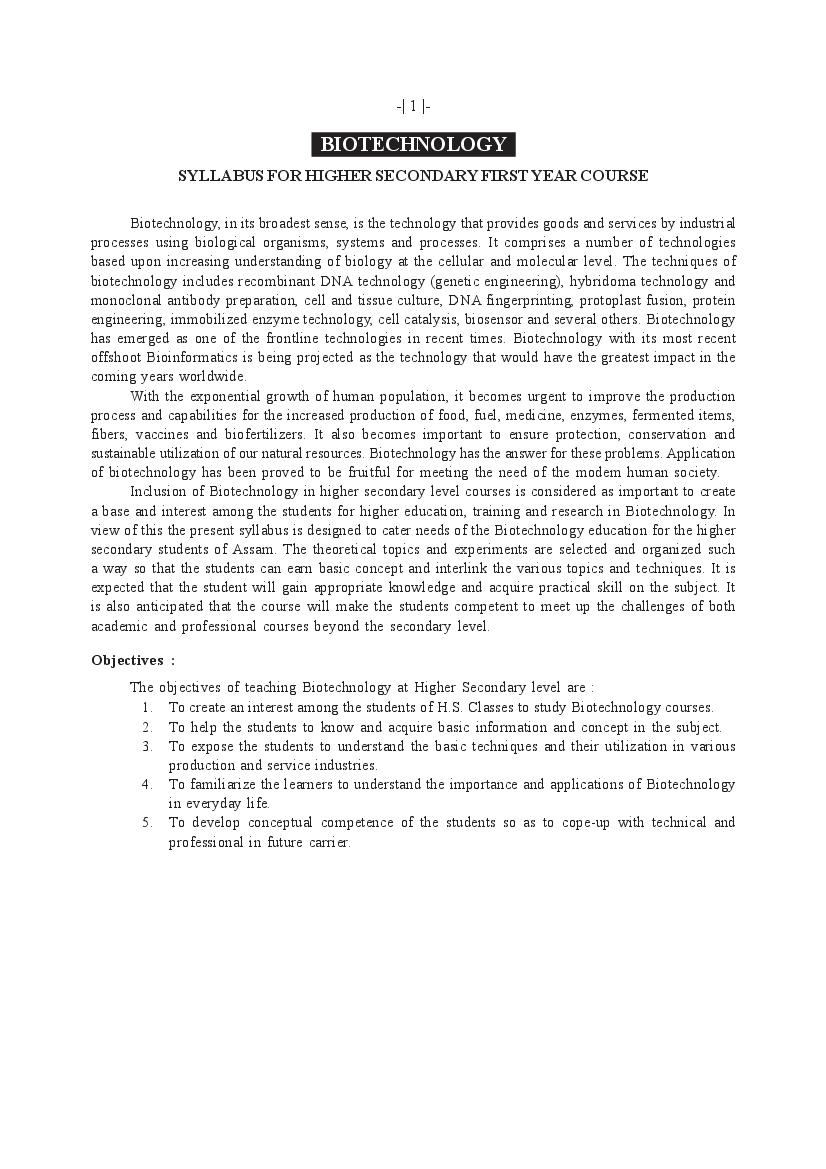
Biotechnology, in its broadest sense, is the technology that provides goods and services by industrial
processes using biological organisms, systems and processes. It comprises a number of technologies
based upon increasing understanding of biology at the cellular and molecular level. The techniques of
biotechnology includes recombinant DNA technology (genetic engineering), hybridoma technology and
monoclonal antibody preparation, cell and tissue culture, DNA fingerprinting, protoplast fusion, protein
engineering, immobilized enzyme technology, cell catalysis, biosensor and several others. Biotechnology
has emerged as one of the frontline technologies in recent times. Biotechnology with its most recent
offshoot Bioinformatics is being projected as the technology that would have the greatest impact in the
coming years worldwide.
With the exponential growth of human population, it becomes urgent to improve the production
process and capabilities for the increased production of food, fuel, medicine, enzymes, fermented items,
fibers, vaccines and biofertilizers. It also becomes important to ensure protection, conservation and
sustainable utilization of our natural resources. Biotechnology has the answer for these problems. Application
of biotechnology has been proved to be fruitful for meeting the need of the modem human society.
Inclusion of Biotechnology in higher secondary level courses is considered as important to create
a base and interest among the students for higher education, training and research in Biotechnology. In
view of this the present syllabus is designed to cater needs of the Biotechnology education for the higher
secondary students of Assam. The theoretical topics and experiments are selected and organized such
a way so that the students can earn basic concept and interlink the various topics and techniques. It is
expected that the student will gain appropriate knowledge and acquire practical skill on the subject. It
is also anticipated that the course will make the students competent to meet up the challenges of both
academic and professional courses beyond the secondary level.
Objectives :
The objectives of teaching Biotechnology at Higher Secondary level are :
1. To create an interest among the students of H.S. Classes to study Biotechnology courses.
2. To help the students to know and acquire basic information and concept in the subject.
3. To expose the students to understand the basic techniques and their utilization in various
production and service industries.
4. To familiarize the learners to understand the importance and applications of Biotechnology
in everyday life.
5. To develop conceptual competence of the students so as to cope-up with technical and
professional in future carrier.
Page 2
One Paper Time : Three hours Marks : 70
Unitwise Distribution of Marks & Periods :
Unit No. Title Marks Periods
Unit-1 Introduction to Biotechnology 10 22
Unit-2 Basic Chemistry of Biomolecules 10 22
Unit-3 Basics of Bio-Chemical Technology 10 16
Unit-4 Cell Biology 15 34
Unit-5 Genetics 10 22
Unit-6 Molecular Biology 15 34
Total 70 150
Unitwise Distribution of Course contents :
Marks
Unlt-I : Introduction to Biotechnology 10
History and definition
Scope & Importance of Biotechnology
Branches of Biotechnology
Biotechnology and Society
Unit-2 : Basic Chemistry of Biomolecules 10
Building Blocks of Biomolecules : Structure and Dynamics
Structure and function of Molecules
Lipids, Proteins and Nucleic acids
Biochemical Techniques
Unit-3 : Basics of Biochemical Technology 10
Unit-4 : Cell Biology 15
Structural Organization of Prokaryotic and Eukaryotic-cells
Cell, divisions and cell cycle
Plasma membrane : Structural organization and function
Cellular techniques
Unit-5 : Genetics 10
Mendel's law of Inheritance
Chromosome theory of Inheritance
Linkage and crossing over, sex-linked Inheritance
Mutation and mutagenesis
Gene and Genome
Page 3
Unit-6 : Molecular Biology 15
Nucleic acids as genetic material
Replication of DNA
Gene action : Transcription and Translation
Genetic Code
Molecular Techniques : Electrophoresis, DNA fingerprinting
SYLLABUS FOR BIOTECHNOLOGY PRACTICAL
Total Marks- 30
Scheme of Evaluation: Marks
1. Two Experiments 20
Preparation of buffers and PH determination
Estimation of total Carbohydrate by Anthrone method
Determination of reducing sugar by Nelson-Somogy Method
Determination of total lipids by Bligh and Dyer Method
Estimation of Protein by Biuret Method
Gram staining of bacteria
Isolation of milk protein (Casein)
Study of various stages of mitosis
Preparation of Karyotypes
Cell counting by haemocytometer
Isolation of genomic DNA
Detection of DNA by gel electrophoresis
2. Viva on practical 05
3. Practical Records 05
Document Details
| Board / Org | Assam Board |
| Exam | Class 11 |
| Type | Syllabus |
| Pages | 3 |
| Updated | 22 Jul 2026 |