Odisha CPET 2020 Question Paper Material Science
Finished viewing? Save it for later —
Download Odisha CPET 2020 Question Paper Material Science (PDF · 15 pages)About Odisha CPET 2020 Question Paper Material Science
Odisha CPET 2020 Question Paper Material Science is available here for free download. Published by Odisha Exams for Odisha CPET, this question paper can be viewed online or downloaded as a PDF (15 pages). Candidates preparing for Odisha CPET can use Odisha CPET 2020 Question Paper Material Science to understand the exam pattern, the type of questions asked, and the overall difficulty level.
Frequently Asked Questions
How can I download Odisha CPET 2020 Question Paper Material Science?
Open this page and click the Download button to save Odisha CPET 2020 Question Paper Material Science as a PDF. It is completely free on AglaSem Docs.
Is Odisha CPET 2020 Question Paper Material Science free to download?
Yes. Odisha CPET 2020 Question Paper Material Science can be viewed online and downloaded as a PDF free of cost on AglaSem Docs.
How many pages does Odisha CPET 2020 Question Paper Material Science have?
Odisha CPET 2020 Question Paper Material Science contains 15 pages, which you can read online or download together as a single PDF.
Where can I find more Odisha CPET study material?
You can find more Odisha CPET question papers, sample papers, syllabus, and answer keys on AglaSem Docs.
Odisha CPET 2020 Question Paper Material Science – Text
Read the full text of this question paper below — useful to quickly search, copy and reference the content online without downloading the PDF.
📄 View text version (15 pages)
Page 1
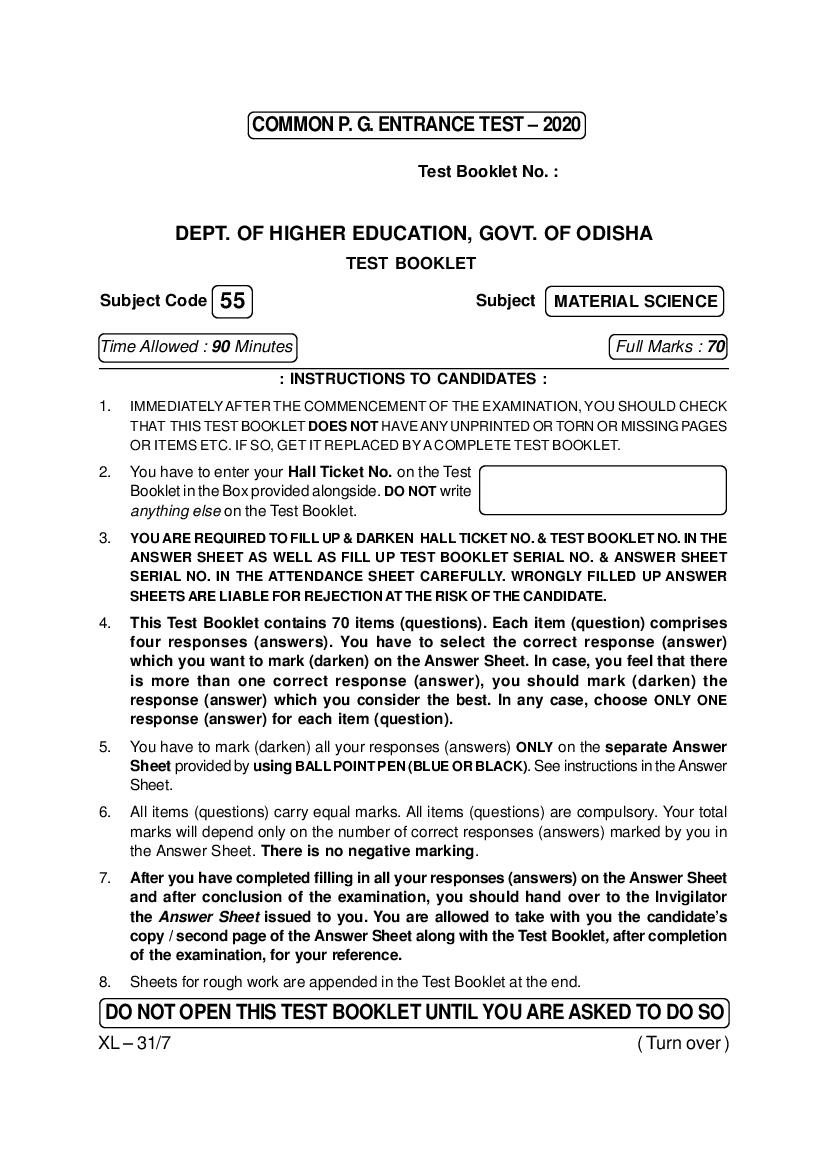
Test Booklet No. :
DEPT. OF HIGHER EDUCATION, GOVT. OF ODISHA
TEST BOOKLET
Subject Code 55 Subject MATERIAL SCIENCE
Time Allowed : 90 Minutes Full Marks : 70
: INSTRUCTIONS TO CANDIDATES :
1. IMMEDIATELY AFTER THE COMMENCEMENT OF THE EXAMINATION, YOU SHOULD CHECK
THAT THIS TEST BOOKLET DOES NOT HAVE ANY UNPRINTED OR TORN OR MISSING PAGES
OR ITEMS ETC. IF SO, GET IT REPLACED BY A COMPLETE TEST BOOKLET.
2. You have to enter your Hall Ticket No. on the Test
Booklet in the Box provided alongside. DO NOT write
anything else on the Test Booklet.
3. YOU ARE REQUIRED TO FILL UP & DARKEN HALL TICKET NO. & TEST BOOKLET NO. IN THE
ANSWER SHEET AS WELL AS FILL UP TEST BOOKLET SERIAL NO. & ANSWER SHEET
SERIAL NO. IN THE ATTENDANCE SHEET CAREFULLY. WRONGLY FILLED UP ANSWER
SHEETS ARE LIABLE FOR REJECTION AT THE RISK OF THE CANDIDATE.
4. This Test Booklet contains 70 items (questions). Each item (question) comprises
four responses (answers). You have to select the correct response (answer)
which you want to mark (darken) on the Answer Sheet. In case, you feel that there
is more than one correct response (answer), you should mark (darken) the
response (answer) which you consider the best. In any case, choose ONLY ONE
response (answer) for each item (question).
5. You have to mark (darken) all your responses (answers) ONLY on the separate Answer
Sheet provided by using BALL POINT PEN (BLUE OR BLACK). See instructions in the Answer
Sheet.
6. All items (questions) carry equal marks. All items (questions) are compulsory. Your total
marks will depend only on the number of correct responses (answers) marked by you in
the Answer Sheet. There is no negative marking.
7. After you have completed filling in all your responses (answers) on the Answer Sheet
and after conclusion of the examination, you should hand over to the Invigilator
the Answer Sheet issued to you. You are allowed to take with you the candidate’s
copy / second page of the Answer Sheet along with the Test Booklet, after completion
of the examination, for your reference.
8. Sheets for rough work are appended in the Test Booklet at the end.
DO NOT OPEN THIS TEST BOOKLET UNTIL YOU ARE ASKED TO DO SO
XL – 31/7 ( Turn over )
Page 2
Page 3
field ?
(A) Metals (B) Smart material
(C) Nanomaterial (D) Biomaterial
2. LPG mainly constitutes :
(A) Methane, ethane and hexane
(B) Ethane, hexane and nonane
(C) Methane, hexane and nonane
(D) Methane, butane and propane
3. Lower critical point for all steels is :
(A) 600 °C (B) 653 °C
(C) 723 °C (D) 913 °C
4. Epoxy resins are used as :
(A) Insecticides (B) Pesticides
(C) Adhesives (D) Detergents
5. Soap is a mixture of Na or K salts of :
(A) Dicarboxylic acids (B) Monocarboxylic acids
(C) Glycerol (D) Tricarboxylic acids
6. Melamine is an example of :
(A) Thermosetting plastic (B) Thermoplastic
(C) Elastomer (D) Artificial polymer
XL – 31/7 (3) ( Turn over )
Page 4
(A) UV rays (B) Infrared rays
(C) γ-rays (D) X-rays
8. Which of the following has gold like colour and is used for imitation jewellery ?
(A) Aluminium bronze (B) Silicon bronze
(C) Gun metal (D) Babbit metal
9. What is the wavelength associated with an electron having kinetic energy equal to
1 MeV ?
o o
(A) 0.01227 A (B) 0.0776 A
o
(C) 0.0007 nm (D) 0.1228 A
10. Which of the following is an extensive property ?
(A) Volume (B) Density
(C) Refractive index (D) Concentration
11. Electron sea exists in :
(A) Polar bond (B) Ionic bond
(C) Covalent bond (D) Metallic bond
12. The device which converts heat into mechanical work is :
(A) Motor (B) Generator
(C) Heat Engine (D) Energy converter
XL – 31/7 (4) ( Continued )
Page 5
(A) Diamagnetic substance
(B) Paramagentic substance
(C) Ferromagentic substance
(D) All substances
14. Hard magnetic material is characterized by :
(A) High coercive force and low residual magnetic induction
(B) Low coercive force and high residual magnetic induction
(C) Only low coercive force
(D) High coercive force and high residual magnetic induction
15. Aluminium is not good for die casting because :
(A) It is light and strong
(B) It takes longer time to cool
(C) It tends to react chemically with the die surface
(D) Its melting point is high and it expands on solidification
16. Colligative property purely depends upon the :
(A) Chemical nature of solute particles
(B) Number of solute particles
(C) Structural feature of solute particles
(D) None of these
XL – 31/7 (5) ( Turn over )
Page 6
(A) Good insulators of heat and electricity
(B) Usually less desired than metals
(C) Ductile in nature
(D) Contains both metallic and nonmetallic elements
18. What is a n-type Si semiconductor (SC) ?
(A) A Si SC without impurities
(B) A Si SC with impurities from column IIIA and VA of the periodic table
(C) A Si SC with impurities from column IIIA of the periodic table
(D) A Si SC with impurities from column VA of the periodic table
19. Coordination number in simple cubic crystal structure is :
(A) 2 (B) 6
(C) 8 (D) 12
20. The atomic diameter of a BCC crystal (if a is lattice parameter) is :
(A) a (B) a/2
(C) a/(4/√3) (D) a/(4/√2)
21. Dielectrics are basically :
(A) Insulators (B) Semiconductors
(C) Superconductors (D) Conductors
22. The charge carriers in superconductors are :
(A) Only electrons (B) Only holes
(C) Both electron and holes (D) Neutrons
XL – 31/7 (6) ( Continued )
Page 7
(A) X-rays (B) UV radiations
(C) α rays (D) β rays
24. Which of the following is a renewable source of energy and never cause atmospheric
pollution ?
(A) Solar energy (B) Nuclear energy
(C) Coal (D) Wood
25. Which of the following solids exhibit long range order ?
(A) Crystalline solids (B) Amorphous solids
(C) Both (A) and (B) (D) None of these
26. Amorphous metals can be produced by ——————.
(A) Melt spinning and mechanical alloying
(B) Chemical reduction
(C) Chemical precipitation
(D) None of these
27. Metallic glass was first invented by :
(A) Klement (B) Willens
(C) Duwez (D) All of them
28. Detrimental property of material for shock load application is :
(A) High density (B) Low toughness
(C) High strength (D) Low hardness
XL – 31/7 (7) ( Turn over )
Page 8
(A) Lycurgus cup
(B) Medieval stained glass windows in churches
(C) Damascus steel swords
(D) All of these
30. Which of the following components is present in calomel electrode ?
(A) NH4Cl (B) AgCl
(C) Pt/H2(g) (D) Hg2Cl2
31. During oxidation process electrons are :
(A) Lost (B) Gained
(C) Paired up (D) Remains same
32. Repeatable entity of a crystal structure is known as :
(A) Crystal (B) Lattice
(C) Unit cell (D) Miller indices
33. The windows of aeroplane are made from :
(A) PVC (B) PTFE
(C) PMMA (D) PC
34. At absolute temperature, an intrinsic semiconductor acts as a/an :
(A) Semiconductor (B) Insulator
(C) Conductor (D) Superconductor
XL – 31/7 (8) ( Continued )
Page 9
(A) Polyethylene (B) Bakelite
(C) Nylon 6,6 (D) Rubber
36. Which of the following is not an inorganic functional material ?
(A) Ferroelectric
(B) Reverse micelles
(C) Magnetic sensor
(D) Light detectors
37. Which of the following metals is used for galvanizing iron ?
(A) Al (B) Cu
(C) Fe (D) Zn
38. In spectroscopy, the transition from S1 to S0 state corresponds to :
(A) Non-radiative transition (C) Fluorescence
(B) Absorption (D) Phosphorescence
39 Which of the following is not a ferromagnetic material ?
(A) Zn (B) Fe
(C) Co (D) Ni
40. Copper is used for making electrical conductors because it is :
(A) Ductile (B) Corrosion resistance
(C) Low resistance (D) Cheap
XL – 31/7 (9) ( Turn over )
Page 10
(A) Rotational (B) Electronic
(C) Nuclear (D) Vibrational
42. The dielectric constant of a solid material is equal to —————.
(A) ε0 = ε0/εr (B) εr = εε0
(C) ε0 = εεr (D) εr = ε/ε0
43. The unit of dipole moment per unit volume is :
(A) Coulomb/m (B) Coulomb/m2
(C) Coulomb/m3 (D) Coulomb
44. The elastic stress strain behaviour of rubber is :
(A) Linear
(B) Nonlinear
(C) Plastic
(D) No fixed relationship
45. Mild steel contains :
(A) Less than 0.3% carbon (B) 0.5 – 1.4% carbon
(C) 0.3-0.5% carbon (D) 3-4% carbon
46. Cemented carbide tools are not found to be suitable for cutting :
(A) Brass (B) Cast iron
(C) Aluminium (D) Steel
XL – 31/7 ( 10 ) ( Continued )
Page 11
(A) Fixed structure at all temperatures
(B) Atoms distributed in random pattern
(C) Different crystal structure at different temperatures
(D) Fixed structure at low temperatures
48. A semiconductor diode is made of :
(A) The junction of n and p-type semiconductor
(B) The junction of two n-type semiconductor
(C) The junction of two p-type semiconductor
(D) The junction of two non-doped semiconductor
49. Foundry crucible is made up of :
(A) Mild Steel (B) German Silver
(C) Lead (D) Graphite
50. Which of the following is added to steel to increase the corrosion resistance ?
(A) W and V (B) Zn and Pb
(C) Cr and Ni (D) S and P
51. For one mole of gas, relation between Cp and Cv is :
(A) Cp = Cv (B) Cp = Cv – R
(C) Cp = Cv + R (D) Cp = Cv × R
52. The compressibility factor for ideal gas is :
(A) Zero (B) 1
(C) > 1 (D) < 1
XL – 31/7 ( 11 ) ( Turn over )
Page 12
(A) Melting Point (B) Boiling Point
(C) Solubility (D) Reactivity
54. Which of the following cannot be used as bio-materials ?
(A) Metals (B) Ceramics
(C) Polymers (D) None of these
55. The composite GFRP stands for :
(A) Glass Fiber Reinforced Polymer
(B) Gelatin Fiber Reinforced Polymer
(C) Graphite Fiber Reinforced Polymer
(D) Glass Fiber Reinforced Polyether
56. Corundum and Cryolite are important ores of which of the following metals ?
(A) Fe (B) Ag
(C) Sn (D) Al
57. Gun metal contains :
(A) 70% Cu and 30% Zn
(B) 90% Cu and 10% Sn
(C) 88% Cu and 10% Sn with 2% Zn
(D) 88% Cu and 10% Zn with 2% Sn
58. The property of a material by virtue of which it can be beaten or rolled into plates is
called :
(A) Malleability (B) Ductility
(C) Plasticity (D) Elasticity
XL – 31/7 ( 12 ) ( Continued )
Page 13
(A) Low wear resistance (B) Low hardness
(C) Low tensile strength (D) Toughness
60. Age-hardening is related with :
(A) Stainless Steel (B) Duralumin
(C) German Silver (D) Gun metal
61. Solder in an alloy consisting of :
(A) Sn, Sb and Cu (B) Sn and Cu
(C) Sn and Pb (D) Zn and Pb
62. Which type of materials are used as bridges between human tissues and metals ?
(A) Polymeric Biomaterials (B) Ceramic Biomaterials
(C) Metallic Biomaterials (D) All of these
63. When magnetic field is removed, which type of materials maintain magnetic
properties ?
(A) Diamagnetic Materials (B) Ferromagnetic materials
(C) Paramagnetic Materials (D) Electronic Materials
64. The secondary structure of protein is primarily maintained by :
(A) Van der Waals Force (B) Ionic Bond
(C) Hydrogen Bond (D) Covalent Bond
65. Which of the following is not involved in formation of photochemical smog ?
(A) NO (B) O3
(C) CXHY (D) SO2
XL – 31/7 ( 13 ) ( Turn over )
Page 14
(A) Photon with molecule (B) Photon with electron
(C) Electron with atom (D) Electron with molecule
67. A device that converts sunlight into electrical energy is called :
(A) Light emitting diode (B) Photovoltaic Cell
(C) Fuel Cells (D) Galvanic Cell
68. The electrode for a battery must be :
(A) A semiconductor (B) A good cunductor of electricity
(C) An insulator (D) A bad conductor of electricity
69. Class of dielectric material which exhibit a hysteresis loop of polarization versus
electric field is termed as :
(A) Conductor (B) Ferrites
(C) Ferroelectrics (D) Dipolar
70. When electric field is reduced to zero, the material still remain polarized and
polarization vector has a certain value. This process is known as :
(A) Remanent Polarization (B) Permanent Polarization
(C) Ionic Polarization (D) Atomic Polarization
XL – 31/7 ( 14 ) ( Continued )
Page 15
XL – 31/7 (360) ( 15 ) Material Science
Document Details
| Board / Org | Odisha Exams |
| Exam | Odisha CPET |
| Type | Question Paper |
| Pages | 15 |
| Updated | 22 Jul 2026 |