ISC Class 12 Specimen Paper 2018 for Maths
Finished viewing? Save it for later —
Download ISC Class 12 Specimen Paper 2018 for Maths (PDF · 6 pages)About ISC Class 12 Specimen Paper 2018 for Maths
ISC Class 12 Specimen Paper 2018 for Maths is available here for free download. Published by CISCE for Class 12, this sample paper can be viewed online or downloaded as a PDF (6 pages). Candidates preparing for Class 12 can use ISC Class 12 Specimen Paper 2018 for Maths to understand the exam pattern, the type of questions asked, and the overall difficulty level.
Frequently Asked Questions
How can I download ISC Class 12 Specimen Paper 2018 for Maths?
Open this page and click the Download button to save ISC Class 12 Specimen Paper 2018 for Maths as a PDF. It is completely free on AglaSem Docs.
Is ISC Class 12 Specimen Paper 2018 for Maths free to download?
Yes. ISC Class 12 Specimen Paper 2018 for Maths can be viewed online and downloaded as a PDF free of cost on AglaSem Docs.
How many pages does ISC Class 12 Specimen Paper 2018 for Maths have?
ISC Class 12 Specimen Paper 2018 for Maths contains 6 pages, which you can read online or download together as a single PDF.
Where can I find more Class 12 study material?
You can find more Class 12 question papers, sample papers, syllabus, and answer keys on AglaSem Docs.
ISC Class 12 Specimen Paper 2018 for Maths – Text
Read the full text of this sample paper below — useful to quickly search, copy and reference the content online without downloading the PDF.
📄 View text version (6 pages)
Page 1
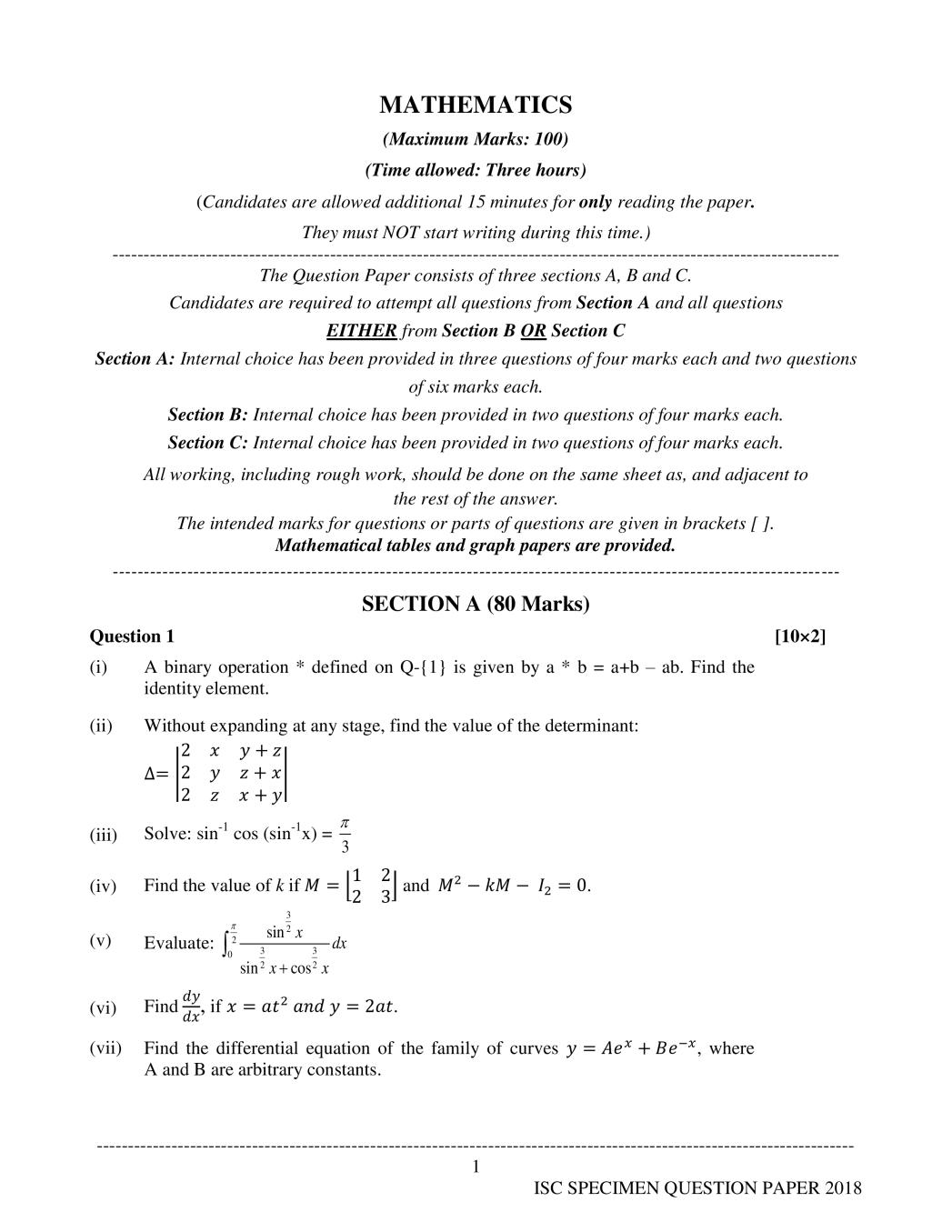
(Maximum Marks: 100)
(Time allowed: Three hours)
(Candidates are allowed additional 15 minutes for only reading the paper.
They must NOT start writing during this time.)
---------------------------------------------------------------------------------------------------------------------
The Question Paper consists of three sections A, B and C.
Candidates are required to attempt all questions from Section A and all questions
EITHER from Section B OR Section C
Section A: Internal choice has been provided in three questions of four marks each and two questions
of six marks each.
Section B: Internal choice has been provided in two questions of four marks each.
Section C: Internal choice has been provided in two questions of four marks each.
All working, including rough work, should be done on the same sheet as, and adjacent to
the rest of the answer.
The intended marks for questions or parts of questions are given in brackets [ ].
Mathematical tables and graph papers are provided.
---------------------------------------------------------------------------------------------------------------------
SECTION A (80 Marks)
Question 1 [10×2]
(i) A binary operation * defined on Q-{1} is given by a * b = a+b – ab. Find the
identity element.
(ii) Without expanding at any stage, find the value of the determinant:
| |
(iii) Solve: sin-1 cos (sin-1x) =
3
(iv) Find the value of k if ⌊ ⌋ and .
3
sin 2 x
(v) Evaluate: 0
2
3 3
dx
sin x cos x
2 2
(vi) Find , if .
(vii) Find the differential equation of the family of curves , where
A and B are arbitrary constants.
1
Page 2
( ) .
(ix) A family has two children. What is the probability that both children are boys,
given that at least one of them is a boy?
(x) Given that the events A and B are such that P(A) = , P( ) and
P (B) = k. Find k if:
(a) A and B are mutually exclusive.
(b) A and B are independent.
Question 2
[4]
+
Let R be the set of all positive real numbers and f: R +
[4, ): f(x) = x + 4. Show
2
that inverse of f exists and find f -1.
Question 3 [4]
Using properties of determinants, prove:
| | ( )( )( )( ) where is any scalar.
Question 4 [4]
Prove that ( ).
Question 5 [4]
(a) Prove that the function ( ) | | , is continuous at x = 1 but not
differentiable.
OR
(b) Verify Rolle’s Theorem for the following function:
( ) [ ]
Question 6 [4]
If then show that:
( )
2
Page 3
(a) Evaluate : ∫
√( )( )
OR
(b) Evaluate: ∫ ( ) expressing as a limit of sum.
Question 8 [4]
(a) Find the equations of the normals to the curve which are parallel
to the line .
OR
(b) A circular disc of radius 3 cm. is heated. Due to expansion its radius increases at
the rate of 0·05 cm/s. Find the rate at which its area increases when the radius is
3·2 cm.
Question 9 [4]
Solve the following differential equation:
Question 10 [4]
Let X denote the number of hours you study during a randomly selected school day. The
probability that X can take the values ‘x’ has the following form, where ‘k’ is some
unknown constant.
0.1, if x 0
kx, if x 1 or 2
P(X= x) =
k (5 x), if x 3 or 4
0, otherwise
(a) Find the value of ‘k’.
(b) What is the probability that you study:
(i) at least two hours?
(ii) exactly two hours?
(iii) at most 2 hours?
3
Page 4
(a) Evaluate [ ][ ]
Hence , Solve the system of equations,
OR
(b) Using elementary transformations, find the inverse of the matrix:
[ ]
Question 12 [6]
(a) Show that the altitude of a right circular cone of maximum volume that can be
inscribed in a sphere of radius r is .
OR
(b) An open topped box is to be made by removing equal squares from each corner of a
3 m by 8 m rectangle sheet of aluminium and by folding up the sides. Find the
volume of the largest such box.
Question 13 [6]
Evaluate: ∫
Question 14 [6]
A, B and C throw a die one after the other in the same order till one of them gets a ‘6’
and wins the game. Find their respective probability of winning, if A starts the game.
4
Page 5
Question 15 [6]
(a) Find the area of the parallelogram whose adjacent sides are given by the vectors
⃗ ̂ ̂ ̂ and ⃗⃗ ̂ ̂ ̂
(b) Find the angle between the line and the plane = 4.
(c) Find the Cartesian equation of the line passing through the points
( ) ( ).
Question 16 [4]
(a) Show that:
(⃗ ⃗⃗) |⃗ ⃗ ⃗ ⃗⃗⃗⃗ |
⃗ ⃗⃗⃗⃗ ⃗⃗⃗⃗⃗⃗
OR
(b) Show that:
⃗ ( ⃗⃗ ⃗) (⃗ ⃗⃗ ⃗) [⃗ ⃗⃗ ⃗]
Question 17 [4]
(a) Find the shortest distance between the lines and
.
OR
(b) Find the cartesian equation of the plane passing through the intersection of the
planes
⃗ ( ̂ ̂) and and at a unit distance from
origin.
Question 18
Using integration, find the area of the following region: [6]
{( ) }
5
Page 6
Question 19 [6]
(a) Find the cost of increasing from 100 to 200 units if the marginal cost in Rupees
per unit is given by the function MC = 0 003 x2– 0 01 x + 2 5.
(b) If two lines of regression are 4x + 2y – 3=0 and 3x +6y +5 =0, find the correlation
coefficient between x and y.
(c) The total variable cost of manufacturing x units in a firm is ` (3 + ). Show that
average variable cost increases with output .
Question 20 [4]
(a) Given that the observations are (9,-4), (10, -3), (11,-1), (13,1), (14,3), (15,5),
(16,8), find the two lines of regression. Estimate the value of y when x = 13.5.
OR
(b) Find the regression coefficient byx and bxy and the two lines of regression for the
following data.
X 2 6 4 7 5
Y 8 8 5 6 2
Also, compute the correlation coefficient.
Question 21 [4]
(a) If the demand function is given by x = , where the price is ` per unit
and the manufacturer produces x unit per week at the total cost of ` x2 + 78x +
2500, find the value of x for which the profit is maximum.
OR
(b) The fixed cost of new product is ` 35000 and the variable cost per unit is ` 500.
If the demand function : = 5000-100 , find the break-even value(s)?
Question 22 [6]
A toy company manufactures two types of dolls A and B. Market test and available
resources have indicated that the combined production level should not exceed
1200 dolls per week and the demands for the dolls of type B is atmost half of that for
dolls of type A. Further, the production level of type A can exceed three times the
production of dolls of other type by at most 600 units. If the company makes profit of
` 12 and ` 16 per doll respectively on dolls A and B, how many of each type of dolls
should be produced weekly, in order to maximise the profit?
6
Document Details
| Board / Org | CISCE |
| Exam | Class 12 |
| Type | Question Paper |
| Pages | 6 |
| Updated | 22 Jul 2026 |