Odisha CPET 2020 Question Paper Microbiology
Finished viewing? Save it for later —
Download Odisha CPET 2020 Question Paper Microbiology (PDF · 15 pages)About Odisha CPET 2020 Question Paper Microbiology
Odisha CPET 2020 Question Paper Microbiology is available here for free download. Published by Odisha Exams for Odisha CPET, this question paper can be viewed online or downloaded as a PDF (15 pages). Candidates preparing for Odisha CPET can use Odisha CPET 2020 Question Paper Microbiology to understand the exam pattern, the type of questions asked, and the overall difficulty level.
Frequently Asked Questions
How can I download Odisha CPET 2020 Question Paper Microbiology?
Open this page and click the Download button to save Odisha CPET 2020 Question Paper Microbiology as a PDF. It is completely free on AglaSem Docs.
Is Odisha CPET 2020 Question Paper Microbiology free to download?
Yes. Odisha CPET 2020 Question Paper Microbiology can be viewed online and downloaded as a PDF free of cost on AglaSem Docs.
How many pages does Odisha CPET 2020 Question Paper Microbiology have?
Odisha CPET 2020 Question Paper Microbiology contains 15 pages, which you can read online or download together as a single PDF.
Where can I find more Odisha CPET study material?
You can find more Odisha CPET question papers, sample papers, syllabus, and answer keys on AglaSem Docs.
Odisha CPET 2020 Question Paper Microbiology – Text
Read the full text of this question paper below — useful to quickly search, copy and reference the content online without downloading the PDF.
📄 View text version (15 pages)
Page 1
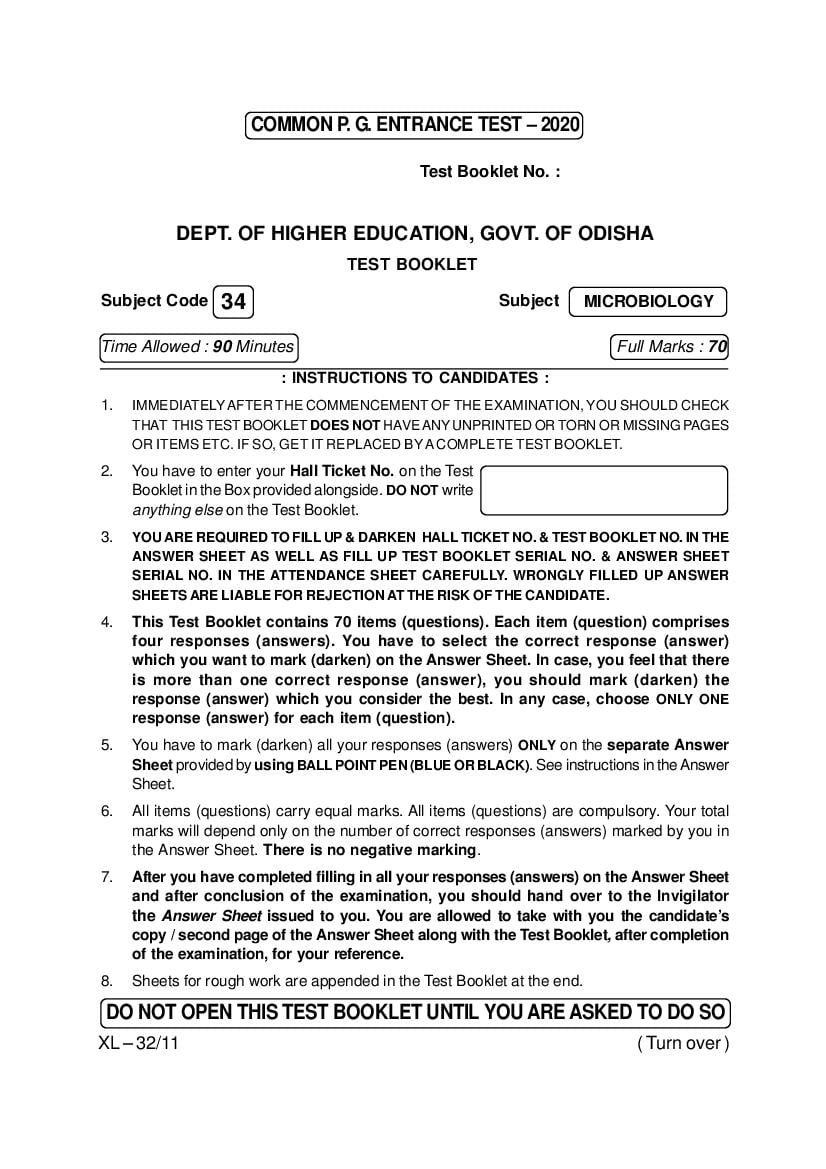
Test Booklet No. :
DEPT. OF HIGHER EDUCATION, GOVT. OF ODISHA
TEST BOOKLET
Subject Code 34 Subject MICROBIOLOGY
Time Allowed : 90 Minutes Full Marks : 70
: INSTRUCTIONS TO CANDIDATES :
1. IMMEDIATELY AFTER THE COMMENCEMENT OF THE EXAMINATION, YOU SHOULD CHECK
THAT THIS TEST BOOKLET DOES NOT HAVE ANY UNPRINTED OR TORN OR MISSING PAGES
OR ITEMS ETC. IF SO, GET IT REPLACED BY A COMPLETE TEST BOOKLET.
2. You have to enter your Hall Ticket No. on the Test
Booklet in the Box provided alongside. DO NOT write
anything else on the Test Booklet.
3. YOU ARE REQUIRED TO FILL UP & DARKEN HALL TICKET NO. & TEST BOOKLET NO. IN THE
ANSWER SHEET AS WELL AS FILL UP TEST BOOKLET SERIAL NO. & ANSWER SHEET
SERIAL NO. IN THE ATTENDANCE SHEET CAREFULLY. WRONGLY FILLED UP ANSWER
SHEETS ARE LIABLE FOR REJECTION AT THE RISK OF THE CANDIDATE.
4. This Test Booklet contains 70 items (questions). Each item (question) comprises
four responses (answers). You have to select the correct response (answer)
which you want to mark (darken) on the Answer Sheet. In case, you feel that there
is more than one correct response (answer), you should mark (darken) the
response (answer) which you consider the best. In any case, choose ONLY ONE
response (answer) for each item (question).
5. You have to mark (darken) all your responses (answers) ONLY on the separate Answer
Sheet provided by using BALL POINT PEN (BLUE OR BLACK). See instructions in the Answer
Sheet.
6. All items (questions) carry equal marks. All items (questions) are compulsory. Your total
marks will depend only on the number of correct responses (answers) marked by you in
the Answer Sheet. There is no negative marking.
7. After you have completed filling in all your responses (answers) on the Answer Sheet
and after conclusion of the examination, you should hand over to the Invigilator
the Answer Sheet issued to you. You are allowed to take with you the candidate’s
copy / second page of the Answer Sheet along with the Test Booklet, after completion
of the examination, for your reference.
8. Sheets for rough work are appended in the Test Booklet at the end.
DO NOT OPEN THIS TEST BOOKLET UNTIL YOU ARE ASKED TO DO SO
XL – 32/11 ( Turn over )
Page 2
Page 3
(A) Robert Koch
(B) Louis Pasteur
(C) Carl Woese
(D) R. H. Whittaker
2. One of the following Genus belongs to Archaebacteria :
(A) Acidothiobacillus
(B) Lactobacillus
(C) Clostridium
(D) Halobacterium
3. During the Gram staining of bacteria, iodine is used as :
(A) Primary stain
(B) Mordant
(C) Secondary stain
(D) Decolourising agent
4. In a microfungal cell, the ribosomes are of :
(A) 80 S type
(B) 70 S type
(C) 60 S type
(D) 50 S type
5. Germ theory of Disease was proposed by :
(A) Robert Koch
(B) Martin Alexander
(C) Fransesco Redi
(D) Edward Jenner
XL – 32/11 (3) ( Turn over )
Page 4
endosporulation ?
(A) 2 (B) 4
(C) 1 (D) Many
7. A bacterium having a tuft of flagella at one end of the cell exhibits :
(A) Lophotrichous flagellation
(B) Amphitrichous flagellation
(C) Peritrichous flagellation
(D) Monotrichous flagellation
8. Antibiotics synthesized by microbial cells, are the example of :
(A) Intermediary metabolites
(B) Primary metabolites
(C) Secondary metabolites
(D) Tertiary metabolites
9. When a plasmid in a bacterial cell gets itself integrated into bacterial chromosome,
it is called :
(A) Perisome (B) Episome
(C) Mesosome (D) Diplosome
10. The device, that is used for the continuous culture of microorganisms is called :
(A) Flow cytometer
(B) Laminar flow
(C) Cryostat
(D) Chemostat
11. In a solid agar microbial culture medium , agar acts as the :
(A) Source of Carbon
(B) Source of Nitrogen
(C) Source of growth factor
(D) Solidifying agent
XL – 32/11 (4) ( Continued )
Page 5
(A) Ammonia
(B) Nitrite
(C) Nitrate
(D) Dinitrogen
13. Chlorobium sp. is a :
(A) Purple sulphur bacterium
(B) Purple non sulphur bacterium
(C) Green sulphur bacterium
(D) Green non sulphur bacterium
14. One of the following is not a nitrogen fixing microorganism :
(A) Rhizobium (B) Rhizopus
(C) Frankia (D) Anabaena
15. The type of bacteria found in a saltern is :
(A) Osmophiles (B) Psychrophiles
(C) Thermophiles (D) Halophiles
16. A bacterium having a generation time of 5 minutes, is introduced into an appropriate
culture medium to enter into log phase. What will be its number after 30 minutes ?
(A) 32 (B) 256
(C) 64 (D) 128
17. One of the following is the characteristic feature of photosynthetic green and purple
bacteria :
(A) Absence of Photosystem II
(B) Absence of Photosystem I
(C) Presence of Photosystem II
(D) Absence of both Photosystem I and II
XL – 32/11 (5) ( Turn over )
Page 6
the ATP production step ?
(A) Ferredoxin to Ubiquinone
(B) Ubiquinone to Cytochrome b
(C) Cytochrome b to Cytochrome f
(D) Cytochrome f to excited bacteriochlorophyll
19. Which of the following structure is found in a bacterial cell ?
(A) Mitochondria
(B) Golgi body
(C) Chloroplast
(D) Mesosome
20. Microbes which uses inorganic elements as reductant, are :
(A) Prototrophs
(B) Auxotrophs
(C) Lithotrophs
(D) Autotrophs
21. Which pathway of glucose dissimilation do yeasts carry out during alcohol fermenta-
tion ?
(A) ED pathway
(B) EMP pathway
(C) Pentose phosphate pathway
(D) All of the above.
22. Name the electron acceptor during nitrate respiration :
(A) Oxygen
(B) Nitrite
(C) Nitrate
(D) Hydroxylamine
XL – 32/11 (6) ( Continued )
Page 7
(A) Tetanus
(B) Meningitis
(C) Measles
(D) Dermatitis
24. One of the following is usually the skin inhabitant :
(A) Escherichia coli
(B) Lactobacillus lactis
(C) Pseudomonas aeruginosa
(D) Staphylococcus aureus
25. The bacterial species involved in Yoghurt preparation :
(A) Lactobacillus bulgaricus
(B) Streptococcus thermophilus
(C) Streptococcus cremoris
(D) Mixed culture of (A) and (B)
26. Which of the following can be used as biofertilizer ?
(A) Nostoc
(B) Anabaena
(C) Both (A) and (B)
(D) Clostridium
27. Tyndallisation refers to :
(A) Heating with incubation
(B) Heating with longer duration
(C) Prolonged heating at low temperature
(D) Steaming with pressure
XL – 32/11 (7) ( Turn over )
Page 8
is called :
(A) Sanitization
(B) Disinfection
(C) Sterilisation
(D) Antisepsis
29. During lactic acid fermentation by Lactic acid bacteria, one of the following acts as
the oxidant :
(A) Lactic acid
(B) Acetaldehyde
(C) Pyruvic acid
(D) Oxygen
30. Bacteria present in hydrothermal vents under the sea are :
(A) Hyperthermophiles
(B) Hyper barophiles
(C) Hydrophiles
(D) Psychrophiles
31. C, N, P, S, K, Mg, Ca and Na ————— which of these is a micronutrient for micro-
organisms ?
(A) Na
(B) P
(C) Mg
(D) None of these
32. In a microbial culture, when all the growing cells are in same stage of division, the
culture is called :
(A) Batch culture
(B) Synchronous culture
(C) Asynchronous culture
(D) Pure culture
XL – 32/11 (8) ( Continued )
Page 9
(A) Phenol
(B) Detol
(C) Chloramines
(D) None of the above
34. One of the following is not an antibiotic :
(A) Tetracycline
(B) Amoxycillin
(C) Bacitracin
(D) Sulfadiazine
35. Pasteurised milk samples are :
(A) Sterile
(B) Pathogen free
(C) Fortified items
(D) None of the above
36. Aflatoxins are :
(A) Phycotoxin
(B) Bacteriotoxin
(C) Mycotoxin
(D) Viral toxin
37. Sugar constituents of the bacterial wall peptidoglycan are :
(A) Amino -acetylated glucose
(B) Acetylated glucose
(C) Acetylated fructose
(D) None of the above
XL – 32/11 (9) ( Turn over )
Page 10
(A) Prophage (B) Virion
(C) Viroid (D) Virusoid
39. The viral genome, when remains integrated with the host bacterial genome, is called :
(A) Prophage (B) Lytic phage
(C) Progenote (D) Metaphage
40. One of the following genetic exchange in bacteria, involves physical contact between
bacterial pair :
(A) Transformation
(B) Transduction
(C) Co-Transformation
(D) Conjugation
41. As per Bergey’s manual of systematic Bacteriology the phylum Proteobacteria
comprises of :
(A) 5 classes (B) 4 classes
(C) 3 classes (D) 6 classes
42. Name the domain to which Cyanobacteria belong :
(A) Archaea (B) Eukarya
(C) Eubacteria (D) None of the above
43. What is the function of an impeller in an Industrial Fermenter ?
(A) Aeration
(B) Mixing the content
(C) Temperature control
(D) pH control
44. For the industrial fermentation of glutamic acid, which bacterial genus is employed :
(A) Corynebacterium
(B) Clostridium
(C) Propionibacterium
(D) Acetobacter
XL – 32/11 ( 10 ) ( Continued )
Page 11
(A) Normal starch
(B) Glycogen
(C) Cyanophycean starch remaining glycogen
(D) None of the above
46. Which is NOT true for the heterocyst of Nostoc ?
(A) Intercalary position
(B) Site of Nitrogen fixation
(C) Presence of polar nodule
(D) CO2 fixation ability
47. One of the following can be used for sterilizing microbial growth media :
(A) Hot air oven (B) Thermocycler
(C) Autoclave (D) Centrifuge
48. The process of making beer is called :
(A) Mashing (B) Brewing
(C) Malting (D) Sparging
49. One of the following is an acidophile :
(A) Thiobacillus ferroxidance
(B) Aspergillus niger
(C) Lactobacillus acidophilus
(D) Mycobacterium tuberculosis
50. Nitrate respiring bacteria are :
(A) Aerobes (B) Anaerobes
(C) Microaerophilic (D) None of the above
51. One of the following is not a prokaryote :
(A) Methanogen (B) Acetogen
(C) Enterobacteria (D) Candida
XL – 32/11 ( 11 ) ( Turn over )
Page 12
(A) Wavelength of light used
(B) Numerical aperture of lens system
(C) Refractive Index
(D) Both (A) and (B)
53. In which specific growth phase,the recipient bacterial cell develops competency to
take up donor DNA during transformation ?
(A) Lag phase
(B) Stationary phase
(C) Late exponential phase
(D) Early exponential phase
54. Name the enzyme that acts on the DNA after its entry into the recipient cell during
bacterial transformation :
(A) Ligase (B) Endonuclease
(C) Deoxyribonuclease (D) Exonuclease
55. A HFR bacterium conjugates with a ‘F’ plasmid containing bacterium. What will be
type of bacterium after the conjugation is complete ?
(A) F+ (B) F-
(C) F (D) HFR
56. Yeast extract is usually employed in bacteriological culture medium , because it acts
as the source of :
(A) Vitamin and micronutrient
(B) Nitrogen
(C) Carbon
(D) Carbon and vitamin
57. Which of the following microbial product is used as bioplastic ?
(A) Polystyrene (B) Polypropylene
(C) Polyhydroxy butyrate (D) Dextran
XL – 32/11 ( 12 ) ( Continued )
Page 13
(A) Insecticide (B) Fungicide
(C) Rodenticide (D) Micro biocide
59. Which of the following is rich source of protein ?
(A) Spirulina (B) Chlorella
(C) Scenedesmus (D) All of the above
60. Retrovirses, like HIV which causes AIDS are :
(A) RNA virus
(B) DNA virus
(C) Both RNA and DNA present
(D) No genetic materials
61. Which of the following is single stranded RNA virus ?
(A) SARS coronavirus
(B) Rotavirus
(C) Hepatitis B Virus
(D) All of the above
62. Capsid of a virus constitutes :
(A) Proteins embedded in lipid layer
(B) Protein and lipid
(C) Capsomeres
(D) Glycolipid
63. Which clinical sample is used to diagnose hepatitis B ?
(A) Liver biopsy (B) Blood
(C) Faecal samples (D) Throat swab
64. Enveloped viruses matured and released by :
(A) Rupturing the cell membrane
(B) Incorporating host DNA into viral capsid
(C) Budding from cell membrane
(D) Recombination of virus and host genome
XL – 32/11 ( 13 ) ( Turn over )
Page 14
(A) Antonie van Leeuwenhoek
(B) Charles Chamberland
(C) Martinus Beijerinck
(D) Louis Pasteur
66. Poxviruses are :
(A) Enveloped DNA virus
(B) Non enveloped DNA Virus
(C) Enveloped RNA virus
(D) Non enveloped RNA Virus
67. Icosahedral structure of virus has :
(A) 6 faces (B) 20 faces
(C) 10 faces (D) Single face
68. The virus of family Baculoviridae infects :
(A) Cattles (B) Tobacco
(C) Fish (D) Insects
69. The structure of tobacco mosaic virus is :
(A) Helical (B) Cuboidal
(C) Round (D) Icosahedral
70. Industrial fermentation of vinegar involves :
(A) Yeasts only
(B) Yeasts and Lactic acid bacteria
(C) Yeasts and Acetic acid bacteria
(D) Yeasts and Butyric acid bacteria
XL – 32/11 ( 14 ) ( Continued )
Page 15
XL – 32/11 (1,290) ( 15 ) Microbiology
Document Details
| Board / Org | Odisha Exams |
| Exam | Odisha CPET |
| Type | Question Paper |
| Pages | 15 |
| Updated | 22 Jul 2026 |