Odisha CPET 2020 Question Paper Philosophy
Finished viewing? Save it for later —
Download Odisha CPET 2020 Question Paper Philosophy (PDF · 15 pages)About Odisha CPET 2020 Question Paper Philosophy
Odisha CPET 2020 Question Paper Philosophy is available here for free download. Published by Odisha Exams for Odisha CPET, this question paper can be viewed online or downloaded as a PDF (15 pages). Candidates preparing for Odisha CPET can use Odisha CPET 2020 Question Paper Philosophy to understand the exam pattern, the type of questions asked, and the overall difficulty level.
Frequently Asked Questions
How can I download Odisha CPET 2020 Question Paper Philosophy?
Open this page and click the Download button to save Odisha CPET 2020 Question Paper Philosophy as a PDF. It is completely free on AglaSem Docs.
Is Odisha CPET 2020 Question Paper Philosophy free to download?
Yes. Odisha CPET 2020 Question Paper Philosophy can be viewed online and downloaded as a PDF free of cost on AglaSem Docs.
How many pages does Odisha CPET 2020 Question Paper Philosophy have?
Odisha CPET 2020 Question Paper Philosophy contains 15 pages, which you can read online or download together as a single PDF.
Where can I find more Odisha CPET study material?
You can find more Odisha CPET question papers, sample papers, syllabus, and answer keys on AglaSem Docs.
Odisha CPET 2020 Question Paper Philosophy – Text
Read the full text of this question paper below — useful to quickly search, copy and reference the content online without downloading the PDF.
📄 View text version (15 pages)
Page 1
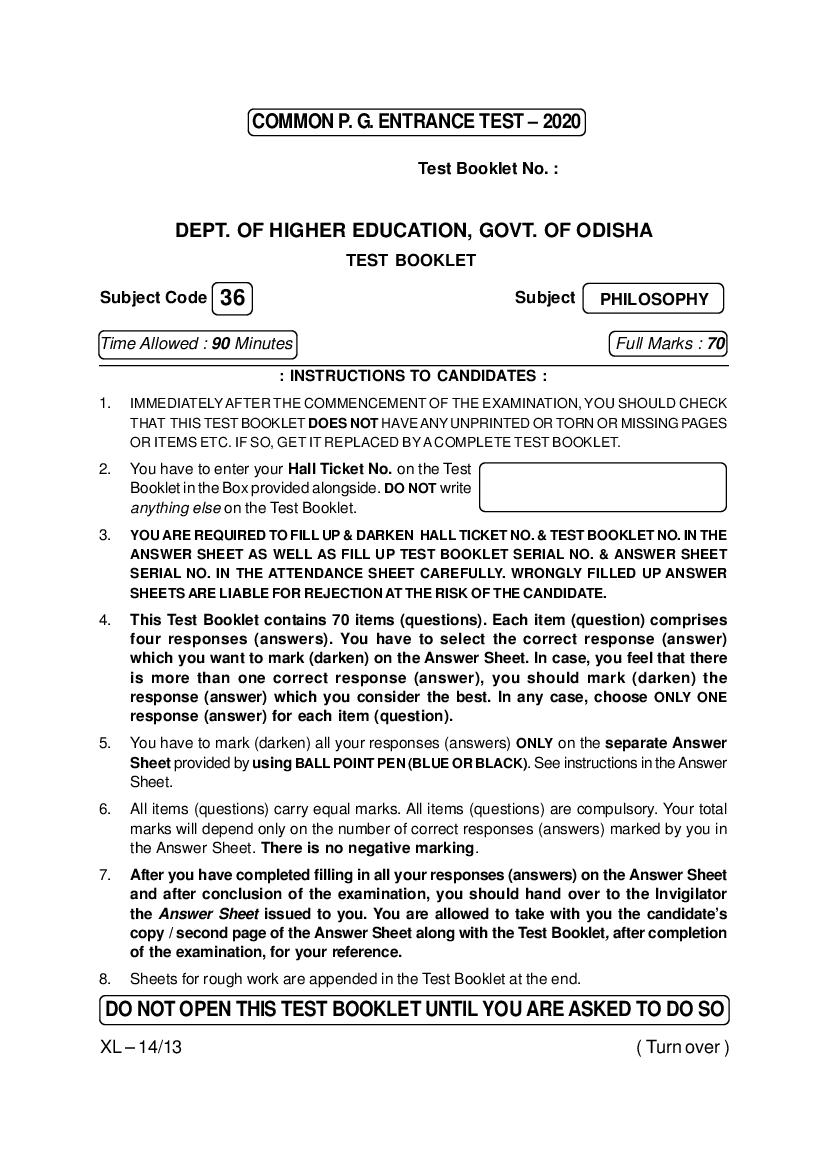
Test Booklet No. :
DEPT. OF HIGHER EDUCATION, GOVT. OF ODISHA
TEST BOOKLET
Subject Code 36 Subject PHILOSOPHY
Time Allowed : 90 Minutes Full Marks : 70
: INSTRUCTIONS TO CANDIDATES :
1. IMMEDIATELY AFTER THE COMMENCEMENT OF THE EXAMINATION, YOU SHOULD CHECK
THAT THIS TEST BOOKLET DOES NOT HAVE ANY UNPRINTED OR TORN OR MISSING PAGES
OR ITEMS ETC. IF SO, GET IT REPLACED BY A COMPLETE TEST BOOKLET.
2. You have to enter your Hall Ticket No. on the Test
Booklet in the Box provided alongside. DO NOT write
anything else on the Test Booklet.
3. YOU ARE REQUIRED TO FILL UP & DARKEN HALL TICKET NO. & TEST BOOKLET NO. IN THE
ANSWER SHEET AS WELL AS FILL UP TEST BOOKLET SERIAL NO. & ANSWER SHEET
SERIAL NO. IN THE ATTENDANCE SHEET CAREFULLY. WRONGLY FILLED UP ANSWER
SHEETS ARE LIABLE FOR REJECTION AT THE RISK OF THE CANDIDATE.
4. This Test Booklet contains 70 items (questions). Each item (question) comprises
four responses (answers). You have to select the correct response (answer)
which you want to mark (darken) on the Answer Sheet. In case, you feel that there
is more than one correct response (answer), you should mark (darken) the
response (answer) which you consider the best. In any case, choose ONLY ONE
response (answer) for each item (question).
5. You have to mark (darken) all your responses (answers) ONLY on the separate Answer
Sheet provided by using BALL POINT PEN (BLUE OR BLACK). See instructions in the Answer
Sheet.
6. All items (questions) carry equal marks. All items (questions) are compulsory. Your total
marks will depend only on the number of correct responses (answers) marked by you in
the Answer Sheet. There is no negative marking.
7. After you have completed filling in all your responses (answers) on the Answer Sheet
and after conclusion of the examination, you should hand over to the Invigilator
the Answer Sheet issued to you. You are allowed to take with you the candidate’s
copy / second page of the Answer Sheet along with the Test Booklet, after completion
of the examination, for your reference.
8. Sheets for rough work are appended in the Test Booklet at the end.
DO NOT OPEN THIS TEST BOOKLET UNTIL YOU ARE ASKED TO DO SO
XL – 14/13 ( Turn over )
Page 2
Page 3
(A) It is to produce synergy.
(B) It is to produce clarity in thinking.
(C) It is to advise what to do and what not to do.
(D) It is to discover truths about the world.
2. Who says that mind in the beginning is a ‘tabula rasa’, a ‘dark chamber’, or an
‘empty cabinet’ ?
(A) Locke
(B) Berkeley
(C) Hume
(D) Russell
3. Match the following :
a. An Enquiry Concerning Human Understanding 1. Hegel
b. An Essay Concerning Human Understanding 2. Hume
c. Cartesian Meditations 3. Locke
d. The Phenomenology of the Mind 4. Husserl
Codes:
a b c d
(A) 3 2 1 4
(B) 2 1 4 3
(C) 3 4 1 2
(D) 2 3 4 1
4. Realism is the doctrine that :
(A) Whatever I perceive exists
(B) Whatever I conceive exists
(C) Objects exist independent of our perception
(D) Objects exist independent of our introspection
XL – 14/13 (3) ( Turn over )
Page 4
(A) Plato, Aristotle and Bradley
(B) Berkeley, Bradley and Bergson
(C) Berkeley, Kant and Russell
(D) Plato, Berkeley and Bradley
6. Who has made the distinction between simple ideas and complex ideas ?
(A) Locke (B) Berkeley
(C) Hume (D) Kant
7. Which position Berkeley is led ultimately to by saying that esse est percipi ?
(A) Idea-ism (B) Scepticism
(C) Agnosticism (D) Solipsism
8. Who is the author of The Philosophy of Logical Atomism ?
(A) A. J. Ayer (B) B. Spinoza
(C) B. Russell (D) G. Frege
9. Who considers that ‘an unexamined life is not worth living’ ?
(A) Plato (B) Aristotle
(C) Socrates (D) Thales
10. Who holds that ‘man is the measure of all things’ ?
(A) Plato (B) Protagoras
(C) Zeno (D) Aristotle
11. Who said, “percepts without concepts are blind, concepts without percepts are
empty” ?
(A) Rousseau
(B) Hume
(C) Kant
(D) Hobbes
XL – 14/13 (4) ( Continued )
Page 5
(A) Contradiction
(B) Ambiguity
(C) Category mistake
(D) Pictorial thinking
13. Which of the following is not a purusartha ?
(A) Jnana
(B) Artha
(C) Kama
(D) Moks.a
14. According to whom, nirguna Brahman is the ultimate reality ?
(A) Samkara
(B) Ramanuja
(C) Madhva
(D) Nimbarka
15. According to Ramanuja, what is liberation as nearness to Isvara, called ?
(A) Samipya
(B) Salokya
(C) Sajujya
(D) Sanidhya
16. According to whom is consciousness an epiphenomenon ?
(A) Carvaka
(B) Buddhism
(C) Samkhya
(D) Jainism
–mkhya ?
17. Which of the following is responsible for evolution in Sa
(A) Sattva
(B) Rajas
(C) Tamas
(D) None of these
XL – 14/13 (5) ( Turn over )
Page 6
(A) Vivartavada
(B) Parinamavada
(C) Satkaryavada
(D) Asatkaryavada
19. Which school believes that both the particulars and the universals are separately
real ?
(A) Nyaya – Vaisesika
(B) Sankhya – Yoga
(C) Buddhism – Jainism
(D) None of these
20. In which way the Buddhist pratityasamutpada can be defined ?
(A) There is no permanent self
(B) Whatever is, is momentary
(C) There is no origination of some elements
(D) Whatever originates, originates on some conditions
21. Who of the following are regarded as pluralists ?
(A) Jainaites
(B) Buddhists
(C) Vaisesikaites
(D) All of these
22. Who advocated the concept of anuvrata ?
(A) Lokayatikas
(B) Mahayana Buddhists
(C) Hinayana Buddhists
(D) Jainaites
23. Vaishesika believes in how many categories ?
(A) Five
(B) Six
(C) Seven
(D) Eight
XL – 14/13 (6) ( Continued )
Page 7
List - I List - II
a. The Madhyamika school 1. Representationism
b. The Yogacaya school 2. Direct realism
c. The Sautranika school 3. Subjective idealism
d. The Vaibhasika school 4. Nihilism
Code:
a b c d
(A) 2 1 4 3
(B) 3 4 2 1
(C) 4 3 1 2
(D) 1 2 4 3
25. Unlike Naiyayikas, both Pravakara and Kumarila admit ——————- as an
independent means of valid knowledge.
(A) Arthapatti
(B) Anupalabdhi
(C) Sabda
(D) All of these
26. Which of the Vedic literature discusses the Varna system ?
(A) Rigveda
(B) Samaveda
(C) Yajurveda
(D) Atharvaveda
27. Which of the following are included in the list of ten principal Upanisads ?
(A) Isha, Kena, Katha
(B) Mundaka, Mandukya
(C) Chhandogya and Brihadaranyaka
(D) All of these
XL – 14/13 (7) ( Turn over )
Page 8
(A) Personal God (B) Ruler
(C) Creator (D) Destroyer
29. What does the Sun symbolise ?
(A) Observer of actions (B) Virtue
(C) Destroyer of vice (D) Knowledge
30. Who advocated that democracy is a perverted form of government ?
(A) Aristotle (B) Bentham
(C) Churchill (D) Democritus
31. What is the Sarvodaya movement based on ?
(A) Truth
(B) Non-violence
(C) Self-denial
(D) All of these
32. Who has written An Idealist View of Life ?
(A) Tagore
(B) Radhakrishnan
(C) J. Krishnamurti
(D) K. C. Bhattacharya
33. Which of the following are the three catchwords for Ambedkar ?
(A) Caste, Varna and Karma
(B) Karma, Destiny and Rebirth
(C) Educate, Organise and Agitate
(D) None of these
34. Which of the following explains political disorder elaborately ?
(A) Plato’s The Republic
(B) Machiavelli’s The Prince
(C) Aristotle’s The Politics
(D) None of these
XL – 14/13 (8) ( Continued )
Page 9
——————— and ——————— respectively.
(A) The Upanisads and Sri Aurobindo
(B) The Vedas and Tolstoy
(C) The Bhagavadgita and H.D. Thoreau
(D) The Bhagavadgita and Sri Aurobindo
36. Who holds that a special duty of a human being is strictly determined by his particular
station in life ?
(A) Kant (B) Bradley
(C) Manu (D) Kautilya
37. Which is the absolute value for ethics ?
(A) Truth (B) Beauty
(C) Goodness (D) Morality
38. Which doctrine advocates ‘greatest happiness of the greatest number’ ?
(A) Psychological Hedonism
(B) Egoistic Hedonism
(C) Altruistic Hedonism
(D) None of these
39. Which of the following statements are true ?
(i) Mill holds that quality as well as quantity of pleasure should be taken into
account.
(ii) Mill holds that quality of pleasure should be taken into account.
(iii) Bentham holds quantity of pleasure should be taken into account.
(iv) Bentham holds that quality as well as quantity of pleasure should be taken
into account.
(A) (i) and (iii)
(B) (ii) and (iii)
(C) (ii) and (iv)
(D) None of these
XL – 14/13 (9) ( Turn over )
Page 10
(A) Mill (B) Bentham
(C) Plato (D) Kant
41. Which of the following does The Old Testament present ?
(A) Retributive theory (B) Reformative theory
(C) Both (A) and (B) (D) None of these
42. Which one of the following statements is correct ?
(A) Reason is the chief element of ethics
(B) Knowledge is the chief element of ethics
(C) Both (A) and (B)
(D) None of these
43. ———————- is the founder of Milesian school of philosophy ?
(A) Parmenides (B) Empedocles
(C) Thales (D) Pythagoras
44. Who is the advocate of deontology ?
(A) Socrates (B) Butler
(C) Broad (D) None of them
45. Who of the following are non-consequentialists ?
(A) Mill and Bentham (B) Bentham and Kant
(C) Kant and Plato (D) Plato and Mill
46. Who made a distinction between deep ecology and shallow ecology ?
(A) Aldo Leopold (B) Arne Naess
(C) Tom Regan (D) Peter Singer
47. For whom universalisability is a logical feature of moral judgements ?
(A) Plato (B) Plotinus
(C) Ayer (D) Hare
XL – 14/13 ( 10 ) ( Continued )
Page 11
(A) Dr. S. Radhakrishnan
(B) Dr. T. M. P. Mahadevan
(C) Sri Aurobindo
(D) Dr. K. C. Bhattacharya
49. Who propounds that ‘Religion is not meant for empty belly’ ?
(A) Radhakrishnan (B) Tagore
(C) Vivekananda (D) Krishnamurti
50. “The mind creates the ideas of causality and necessity; we do not observe them.”
This statement can be attributed to which of the following modern western
philosophers ?
(A) Mill (B) Hume
(C) Descartes (D) Locke
51. The proposition “I jumped ten thousand feet into the air” is :
(A) Technically possible (B) Empirically possible
(C) Logically possible (D) None of these
52. The sentence “It cannot be both a table and not a table” is expressing :
(A) Law of causation
(B) Law of identity
(C) Law of excluded middle
(D) Law of non-contradiction
53. What is the position of the middle term in the fourth figure ?
(A) Subject term of both the premises
(B) Predicate term of both the premises
(C) Subject term of the major premise and Predicate term of the minor premise
(D) Predicate term of the major premise and Subject term of the minor premise
XL – 14/13 ( 11 ) ( Turn over )
Page 12
falsity of the following ?
1. No youngsters are cricket lovers.
2. Some youngsters are cricket lovers.
3. Some youngsters are not cricket lovers.
4. No youngsters are non-cricket lovers.
Select the correct answer using the code given below :
(A) 1 is false, 2 is true, 3 is false, 4 is true
(B) 1 is true, 2 is true, 3 is false, 4 is true
(C) 1 is false, 2 is false, 3 is true, 4 is false
(D) 1 is false, 2 is true, 3 is true, 4 is true
55. If in a syllogism major premise is particular and minor premise is negative, then the
conclusion is —————.
(A) Particular (B) Universal
(C) Negative (D) No conclusion follows
56. “p & q” is equivalent to which of the following ?
(A) ~p ⊃ ~q (B) ~p ∨ q
(C) p & q (D) ~(~p ∨ ~q)
57. What is the status of the following argument ?
No M is P.
Some S is M.
∴ Some S is not P.
(A) Valid (B) Invalid
(C) True (D) False
58. In the formula “Fx ⊃ Gx”, ‘x’ is :
(A) Quantifier (B) Constant
(C) Proposition (D) Variable
XL – 14/13 ( 12 ) ( Continued )
Page 13
(A) Thales (B) Anaximander
(C) Heraclitus (D) Anaximenes
60. “Being is real” is the view of who of the following ——————.
(A) Heraclitus (B) Plato
(C) Parmenides (D) Zeno
61. Which theory is propounded by Descartes regarding the relationship between mind
and body ?
(A) Pre-established harmony
(B) Psycho-physical parallelism
(C) Interactionism
(D) None of these
62. Which philosopher made Descartes logically consistent ?
(A) Leibnitz (B) Spinoza
(C) Kant (D) Hegel
63. Which one of the following begins his metaphysics with the concept of representation
and ends with the harmony of the universe ?
(A) Spinoza (B) Leibnitz
(C) Locke (D) Plato
64. Sri Aurobindo is known as a –—————— .
(A) Advaitin (B) Dvaitin
(C) Purnavadin (D) Visistadvaitin
65. The Bhagavadgita advocates ——————.
(A) Renunciation of action
(B) Only self-surrender
(C) Renunciation in action
(D) None of these
XL – 14/13 ( 13 ) ( Turn over )
Page 14
(A) Hedonism
(B) Emotivism
(C) Eudaemonism
(D) Utilitarianism
67. Which one of the following statements was put forward by Wittgenstein ?
(A) To be is to be perceived.
(B) I think, therefore I am.
(C) I am, therefore I think.
(D) Whereof one cannot speak, one must pass over in silence.
68. Who is the author of the paper “The Refutation of Idealism” ?
(A) Russell
(B) G. E. Moore
(C) Hume
(D) Locke
69. Who advanced the first cause argument in support of the belief in the existence of
God ?
(A) Thomas Aquinas
(B) Saint Anselm
(C) Rene Descartes
(D) Saint Augustine
70. Who first propounded the ontological argument for the existence of God ?
(A) St. Augustine
(B) St. Anselm
(C) Thomas Aquinas
(D) Rene Descartes
XL – 14/13 ( 14 ) ( Continued )
Page 15
XL – 14/13 (1,060) ( 15 ) Philosophy
Document Details
| Board / Org | Odisha Exams |
| Exam | Odisha CPET |
| Type | Question Paper |
| Pages | 15 |
| Updated | 22 Jul 2026 |