CBSE Class 10 Social Science Question Paper 2020 Set 32-2-1 Solutions
Finished viewing? Save it for later —
Download CBSE Class 10 Social Science Question Paper 2020 Set 32-2-1 Solutions (PDF · 11 pages)About CBSE Class 10 Social Science Question Paper 2020 Set 32-2-1 Solutions
CBSE Class 10 Social Science Question Paper 2020 Set 32-2-1 Solutions is available here for free download. Published by CBSE for Class 10, this solution can be viewed online or downloaded as a PDF (11 pages). Candidates preparing for Class 10 can use CBSE Class 10 Social Science Question Paper 2020 Set 32-2-1 Solutions to understand the exam pattern, the type of questions asked, and the overall difficulty level.
Frequently Asked Questions
How can I download CBSE Class 10 Social Science Question Paper 2020 Set 32-2-1 Solutions?
Open this page and click the Download button to save CBSE Class 10 Social Science Question Paper 2020 Set 32-2-1 Solutions as a PDF. It is completely free on AglaSem Docs.
Is CBSE Class 10 Social Science Question Paper 2020 Set 32-2-1 Solutions free to download?
Yes. CBSE Class 10 Social Science Question Paper 2020 Set 32-2-1 Solutions can be viewed online and downloaded as a PDF free of cost on AglaSem Docs.
How many pages does CBSE Class 10 Social Science Question Paper 2020 Set 32-2-1 Solutions have?
CBSE Class 10 Social Science Question Paper 2020 Set 32-2-1 Solutions contains 11 pages, which you can read online or download together as a single PDF.
Where can I find more Class 10 study material?
You can find more Class 10 question papers, sample papers, syllabus, and answer keys on AglaSem Docs.
CBSE Class 10 Social Science Question Paper 2020 Set 32-2-1 Solutions – Text
Read the full text of this solution below — useful to quickly search, copy and reference the content online without downloading the PDF.
📄 View text version (11 pages)
Page 1
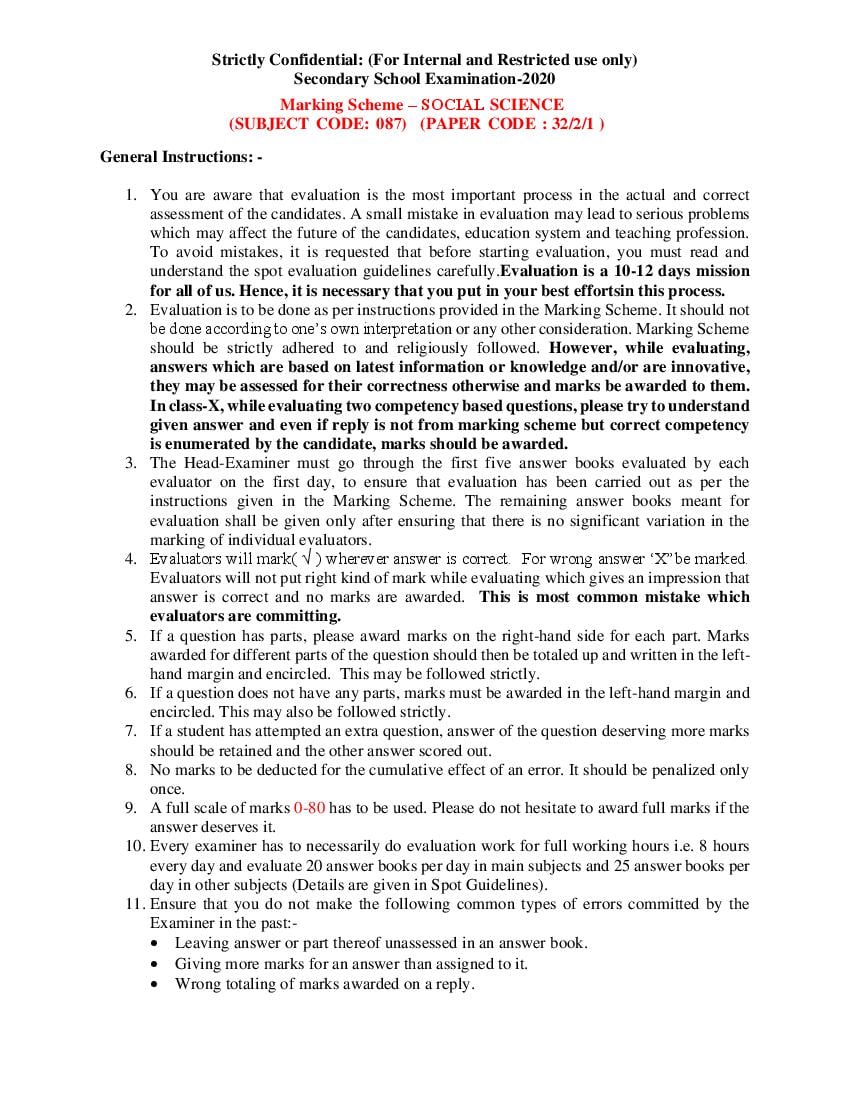
Secondary School Examination-2020
Marking Scheme – SOCIAL SCIENCE
(SUBJECT CODE: 087) (PAPER CODE : 32/2/1 )
General Instructions: -
1. You are aware that evaluation is the most important process in the actual and correct
assessment of the candidates. A small mistake in evaluation may lead to serious problems
which may affect the future of the candidates, education system and teaching profession.
To avoid mistakes, it is requested that before starting evaluation, you must read and
understand the spot evaluation guidelines carefully.Evaluation is a 10-12 days mission
for all of us. Hence, it is necessary that you put in your best effortsin this process.
2. Evaluation is to be done as per instructions provided in the Marking Scheme. It should not
be done according to one’s own interpretation or any other consideration. Marking Scheme
should be strictly adhered to and religiously followed. However, while evaluating,
answers which are based on latest information or knowledge and/or are innovative,
they may be assessed for their correctness otherwise and marks be awarded to them.
In class-X, while evaluating two competency based questions, please try to understand
given answer and even if reply is not from marking scheme but correct competency
is enumerated by the candidate, marks should be awarded.
3. The Head-Examiner must go through the first five answer books evaluated by each
evaluator on the first day, to ensure that evaluation has been carried out as per the
instructions given in the Marking Scheme. The remaining answer books meant for
evaluation shall be given only after ensuring that there is no significant variation in the
marking of individual evaluators.
4. Evaluators will mark( √ ) wherever answer is correct. For wrong answer ‘X”be marked.
Evaluators will not put right kind of mark while evaluating which gives an impression that
answer is correct and no marks are awarded. This is most common mistake which
evaluators are committing.
5. If a question has parts, please award marks on the right-hand side for each part. Marks
awarded for different parts of the question should then be totaled up and written in the left-
hand margin and encircled. This may be followed strictly.
6. If a question does not have any parts, marks must be awarded in the left-hand margin and
encircled. This may also be followed strictly.
7. If a student has attempted an extra question, answer of the question deserving more marks
should be retained and the other answer scored out.
8. No marks to be deducted for the cumulative effect of an error. It should be penalized only
once.
9. A full scale of marks 0-80 has to be used. Please do not hesitate to award full marks if the
answer deserves it.
10. Every examiner has to necessarily do evaluation work for full working hours i.e. 8 hours
every day and evaluate 20 answer books per day in main subjects and 25 answer books per
day in other subjects (Details are given in Spot Guidelines).
11. Ensure that you do not make the following common types of errors committed by the
Examiner in the past:-
• Leaving answer or part thereof unassessed in an answer book.
• Giving more marks for an answer than assigned to it.
• Wrong totaling of marks awarded on a reply.
Page 2
• Wrong question wise totaling on the title page.
• Wrong totaling of marks of the two columns on the title page.
• Wrong grand total.
• Marks in words and figures not tallying.
• Wrong transfer of marks from the answer book to online award list.
• Answers marked as correct, but marks not awarded. (Ensure that the right tick mark is
correctly and clearly indicated. It should merely be a line. Same is with the X for
incorrect answer.)
• Half or a part of answer marked correct and the rest as wrong, but no marks awarded.
12. While evaluating the answer books if the answer is found to be totally incorrect, it should
be marked as cross (X) and awarded zero (0)Marks.
13. Any unassessed portion, non-carrying over of marks to the title page, or totaling error
detected by the candidate shall damage the prestige of all the personnel engaged in the
evaluation work as also of the Board. Hence, in order to uphold the prestige of all
concerned, it is again reiterated that the instructions be followed meticulously and
judiciously.
14. The Examiners should acquaint themselves with the guidelines given in the Guidelines for
spot Evaluation before starting the actual evaluation.
15. Every Examiner shall also ensure that all the answers are evaluated, marks carried over to
the title page, correctly totaled and written in figures and words.
16. The Board permits candidates to obtain photocopy of the Answer Book on request in an
RTI application and also separately as a part of the re-evaluation process on payment of
the processing charges.
Page 3
Social Science (087)
Marking Scheme 32/2/1
MM-80
QNO EXPECTED ANSWERS/VALUE POINTS PAGE MARK
. Section -A NO. S
1. D / Russia was given German confederation of 39 states. H-11 1
2. Gandhiji support to Khilafat issue
i. To launch Non-cooperation movement as a broad-based
movement.
ii. To bring Hindus and Muslims communities together.
iii. Any other relevant point.
Any one point to be explained. H-56
1
3. Japan printed the Buddhist Diamond Sutra in 868 AD. H-154 1
4. Tariff-Tax imposed on a country’s imports from rest of the world. H-100 1
OR
Fly shuttle- It is a mechanical device used for weaving, moved by means 1
of ropes and pullies. H-122
5. Fill in the blank- Portuguese H-168 1
OR
Tamil H-168 1
6. (a)/ They were cheap and small books H-162 1
7. a/Print popularized the ideas of the enlightened thinkers. H-163 1
8. Fill in the blanks G-2 ½
A- Community Resource +½=1
B- Individual Resource
9. Kandla was the major sea port developed soon after independence G-88 1
OR
Kolkata is an inland riverine major sea port of India. G-88 1
10. (a)/Karnataka G-61 1
11. (c) /Bauxite Mines (iii) Odisha G-55 1
12. Fill in the blanks G-62 1
Jaisalmer
13. (b) / Dutch and French D.P-2 1
14. Reasons for the alienation of Tamils in Sri Lanka D.P-3 1
i. The Sri Lankan government followed preferential policies that
favored Sinhala.
ii. Constitution protected and fostered Buddhism.
iii. Sinhala was recognized as the only official language disregarding
Tamil.
(Any one of the above)
15. D.P-8 1
(d)/ Union government, State Government and local bodies.
1
Page 4
i. The laws made by the government for equal wages to Men and Women
in all areas of work should be followed strictly.
ii. Any other relevant point
OR
Family laws
i. Family laws made by all religions should not do any type of D.P-46 1
discrimination and oppression with women.
ii. Small family norms be followed by every religion.
iii. Any other relevant point.
(Any one of the above)
17. d / a girl from a rich urban --- (iv)she gets as much freedom as her E-4 1
brother.
18. Table based question E-7 1
Kerala
19. Measures for the development of secondary sector E-20 1
I Adoption of new and advance technology.
ii. In service training programs.
iii. Incentives to be provided by the government to promote secondary
sector.
iv. Any other relevant point.
(Any one of the above)
20. Difference between Organized and Unorganized Sector E-30 1
Organized Sector
i. Employment are regular.
ii. Rules and regulations are followed.
iii. Paid leave, Provident fund gratuity given.
(Any one to be explained)
Unorganised Sector
i. Employment are not regular.
ii. Rules and regulations are not followed.
iii. Paid leave, Provident fund not gratuity given.
(Any one to be explained)
OR
Disguised unemployment E-26 1
In an activity when more people are engaged than required it comes under
disguised employment: It is also known as underemployment.
21. Section –B
Source based question
21.1 Weapon of Mahatma Gandhi to fight against British Empire. (1) H-57 1+1+1=
3
(i) Non-Cooperation movement.
21.2 British Survived in India (1)
(i) Because of Co-operation of Indians.
21.3 Gandhiji’s Ideas for making Non-Cooperation movement. (1)
2
Page 5
in stages.
(ii) Surrender of titles.
(iii) Boycott of civil services, army, police, courts and legislative
councils, boycott of schools and foreign goods.
(Any one to be explained)
22. Three effects of scraping Corn laws in Britain
i. Food could be imported into Britain more cheaply than it could be.
ii. British agriculture was unable to compete with imports. H-81 3
iii. Vast areas of land were now left uncultivated.
iv. Thousands of men and women thrown out of work.
v. Any other relevant point.
(Any three to be explained)
OR
Reasons of Silk and Cotton goods dominance
i. Finer quality of cotton and silk of India.
ii. Bales of fine textile were carried on camel back via the north-west
frontier, through mountain passes and across deserts.
iii. A vibrant sea trade operated through the main pre-colonial ports.
iv. Surat on the Gujarat coast connected India to Gulf and Red sea ports. H-113 3
v. Any other relevant point.
(Any three to be explained)
23. Major problems faced by Jute Industries in India
i. Stiff competition in the international market from synthetic substitutes.
ii. Competitor countries like Bangladesh, Brazil, Philippines, Egypt and G-70 3
Thailand.
iii. Increase in international demand.
iv. Government policy of mandatory use of jute packaging in India
effected international market.
v. Any other relevant point.
(Any three to be described.)
OR
Factors affecting location of industries in a region.
i. Availability of raw material.
ii. Availability of cheap labour.
iii. Availability of Capital G-66
iv.Avaliability of Power 3
v. Close proximity to Market
(Any three points to be described.)
24. Distribution of Roads is not uniform in India
i. Density of roads uneven in all states. G-84 3
ii. Kerala has high road density whereas Jammu Kashmir has very low
density of roads.
iii. About half of the total roads are unmetalled.
3
Page 6
v. National Highways are inadequate.
(Any three points to be explained.)
25. Characteristics of Union list
i. Union list includes subjects of National importance.
ii. Subjects include—Defense of country, Foreign affairs banking,
communication and currency.
iii. Union government alone can make laws on their subjects.
iv. There are the basis for making uniform policy for the whole nation. D.P-16
3
(Any three points to be described.)
26. Problems of communalism in Indian Politics
i.. Sometimes religion is expressed in politics in exclusive and partisan
terms.
Ii Religious prejudices, stereotypes of religious communities and belief in D.P-47 3
the superiority of one’s religion over other religions.
iii.. Political mobilization on religious lines
iv A communal mind often leads to a quest for political dominance of
one’s own religious Community.
iv. Special appeal to the interests or emotions of voters of one religion
in preference to others.
v. Sometimes communication can cause communal violence, riots
and massacre.
vi. Any other relevant point
(Any three points to be described.)
OR
Problems of low representation of women in Indian legislature.
i. India is still a male dominated, Patriarchal society.
ii. Law literacy rates among women.
iii. The problems of women are not given proper attention.
vii. A bill for reservation of one-third of seats in Lok Sabha for women is
D.P-44 3
pending for more than one decade.
viii. Any other relevant point
(Any three points to be described.)
27. Measures to improve environmental degradation
i. Reduce over exploitation of resources
ii. Maximize the use of renewable resources.
iii. Use of public transport.
iv. Recycling and reuse of resources.
ix. Ban on use of single used plastic. E-15-
3
x. Any other relevant point 16
(Any three points to be described.)
28.
Workers in the organized sector enjoy security of employment
i. Terms of employment are regular E-30-
ii. Paid leave and Medical leave. 31 3
iii. Gratuity and provident fund.
iv. Minimum wages cut.
4
Page 7
ii. Any other relevant point
(To be assessed as a whole)
OR
All services are not growing equally
i. Service section in India has different kinds of people in service
sector.
ii.At one end there are a limited number of services that employ highly
skilled and educated workers.
Iii At the other end, there are a very large number of workers engaged
in services such as small shopkeepers, repair persons, transport
persons, etc.
iv. These people barely manage to earn a living and yet perform these E-25 3
services.
(iii) There is no alternative opportunity for them. Only a part of this
sector is growing in importance.
Any other relevant point
(To be assessed as a whole)
29. SECTION-C
Role of Otto-Von Bismarck
i. Otto Von Bismarck was the architect in the process of carried for the H-19
5
unification of Germany.
ii. In this process he took the help of Prussian army and bureaucracy.
iii. He fought three wars for seven years with Austria, Denmark and
France.
iv. The wars ended with Prussian victory and complied the process of
unification of Germany.
v. In Jan 1871 , The Prussian king , William I was proclaimed German
emperor.
vi. The nation-building process in Germany demonstrated the dominance
of Prussian state power.
Vii The currency, banking, legal and judicial system in Germany were
modernized.
vii. Any other relevant point.
(To be assessed as a whole)
OR
Role of Giuseppe Mazzini
i. Giuseppe Mazzini was an Italian Revolutionary. H-20 5
ii. He has sought to put together a programme for a united Italian
Republic.
iii. He formed a secret society called Young Italy for the dissemination of
his goals.
iv. After the failure of revolutionary uprising both in 1831 and 1843 the
responsibility of unification of Italy fell on Sardinia- Piedmont ruled by
5
Page 8
v. In 1861 Victor Emmanuel II was proclaimed king of United Italy.
vi. A unified Italy offered them a possibility of economic development
and political dominance.
vii. Any other relevant point.
( To be assessed as a whole)
30. Technological and Institutional reforms in Indian Agriculture.
i. Collectivization and consolidation of land holding. G-42- 5
ii. Abolition of Zamindari. 43
iii. Land reforms was the main focus of our first five-year plan.
iv. Provision of crops insurance against droughts, floods, cyclone etc. to
protect farmers.
v. Grameen banks, Co-operative societies and banks provided loan
facilities to farmers at low rates of interest.
vi. Kissan credit cards and personal accident insurance for farmers
introduced by government.
Vii Special weather bulleting and agricultural programme for farmers
through radio and television.
Viii Green Revolution based on the use of technology
xi. White revolution
xii. Any other relevant point
(Any five points to be described.)
31. Political Party :- A political party is a group of people who came
together to contest elections and hold power in the government. They
agree on some policies and programmes for the society with a view to
promote collective good. D.P- (1+4=5
)
(1) 83-84
Challenges
i. Lack of internal democracy with parties.
ii. Dynastic succession.
iii. Growing role of money and muscles power in parties specially during
elections.
iv. Political parties do not seem to offer a meaningful choice to the voters.
v. Any other relevant point. (4)
32. Source based question
Source A- Accountable, Responsive and Legitimate government.
(1+2+2=
32.1 How does democratic government develop mechanism for citizens DP 5)
to be the part of political decision making?
i) By ensuring that people will have the right to choose their rulers and 91, 93,
have control over them. 97
ii) Citizens are able to participate in decision making through their
representatives. (1)
iii) any other relevant point
Anyone point to be explained
6
Page 9
32.2 To what extent we can say democracy work for economic
development?
i) Democracy works for people s welfare
ii) Democracy try to promote economic growth
iii)Democratic govt try to reduce poverty and inequality
iv)Any other relevant point.
Any two points to be explained (2)
Source C – Dignity and Freedom of Citizens
32.3 To what extent democracy promote dignity and freedom of
individual?
i. Democracy has strengthened the claims of disadvantaged and
discriminated castes and minorities by providing them equal status and
equal opportunities. Example - Untouchability has been abolished by law.
ii. Respect and equal treatment with women.
iv)Any other relevant point.
Any two points to be explained (2)
33. The Reserve Bank of India
i. The Reserve Bank of India supervises the functioning of formal sources
of loan.
ii. The RBI monitors the banks in actually maintaining the cash balance. E-48 5
iii. RBI ensures that the banks give loans not just to a profit-making
business and trades but also to small cultivators and small-scale industries
and farmers also.
iv. Periodically banks have to submit information to RBI on how much
they are lending to whom and at what interest rate.
v. RBI supervises whether banks maintain minimum cash balance out of
the deposits they receive.
vi. Any other relevant point.
(Any five points to be described.)
OR
Self Help Group
i. Rural poor in particular women organize SHGs and pool their savings.
ii. Members can take small loans from the group to meet their needs.
iii. The group charges very less rate of interest on the loan.
iv. SHGs help borrowers overcome the problem of lack of collaterals.
v. After one or two years if the group is regular in saving it becomes eligible for
availing loan from the bank.
vi. Loan is given on the name of group which create employment opportunities
to its members. E-51 5
vii. Small loans are provided to its members for working capital needs-
purchasing seeds, fertilizers, raw material, sewing machines etc.
(To be assessed as a whole)
7
Page 10
i. It aims at liberalization of foreign trade and investment in countries.
ii. WTO says that Trade barriers should be abolished by the countries for
free trade. E-65 5
iii. It establishes rules regarding international trade.
iv. All countries in the world should liberalize their policies.
v. WTO sees that the rules made by it are obeyed by the member
countries.
vi. Though WTO is supposed to allow free trade for all but in practice it is
seen that developed countries have unfairly retained trade barriers.
vii. WTO rules are forced on developing countries.
viii. Any other relevant point.
(Any five points to be explained.)
35. For 35 a and 35- see filled attached map
2+4=6
For visually impaired candidates
35.1 Punjab
35.2 Ahmedabad
35.3 Madras
1X6=6
35.4 Uttarakhand
35.5 Chhattisgarh
35.6 Karnataka
35.7 Uttar Pradesh
35.8 Tamil Nadu
8
Page 11
Document Details
| Board / Org | CBSE |
| Exam | Class 10 |
| Type | Solution |
| Pages | 11 |
| Updated | 22 Jul 2026 |