ICSE Class 10 Question Paper 2019 for Economics
Finished viewing? Save it for later —
Download ICSE Class 10 Question Paper 2019 for Economics (PDF · 4 pages)About ICSE Class 10 Question Paper 2019 for Economics
ICSE Class 10 Question Paper 2019 for Economics is available here for free download. Published by CISCE for Class 10, this question paper can be viewed online or downloaded as a PDF (4 pages). Candidates preparing for Class 10 can use ICSE Class 10 Question Paper 2019 for Economics to understand the exam pattern, the type of questions asked, and the overall difficulty level.
Frequently Asked Questions
How can I download ICSE Class 10 Question Paper 2019 for Economics?
Open this page and click the Download button to save ICSE Class 10 Question Paper 2019 for Economics as a PDF. It is completely free on AglaSem Docs.
Is ICSE Class 10 Question Paper 2019 for Economics free to download?
Yes. ICSE Class 10 Question Paper 2019 for Economics can be viewed online and downloaded as a PDF free of cost on AglaSem Docs.
How many pages does ICSE Class 10 Question Paper 2019 for Economics have?
ICSE Class 10 Question Paper 2019 for Economics contains 4 pages, which you can read online or download together as a single PDF.
Where can I find more Class 10 study material?
You can find more Class 10 question papers, sample papers, syllabus, and answer keys on AglaSem Docs.
ICSE Class 10 Question Paper 2019 for Economics – Text
Read the full text of this question paper below — useful to quickly search, copy and reference the content online without downloading the PDF.
📄 View text version (4 pages)
Page 1
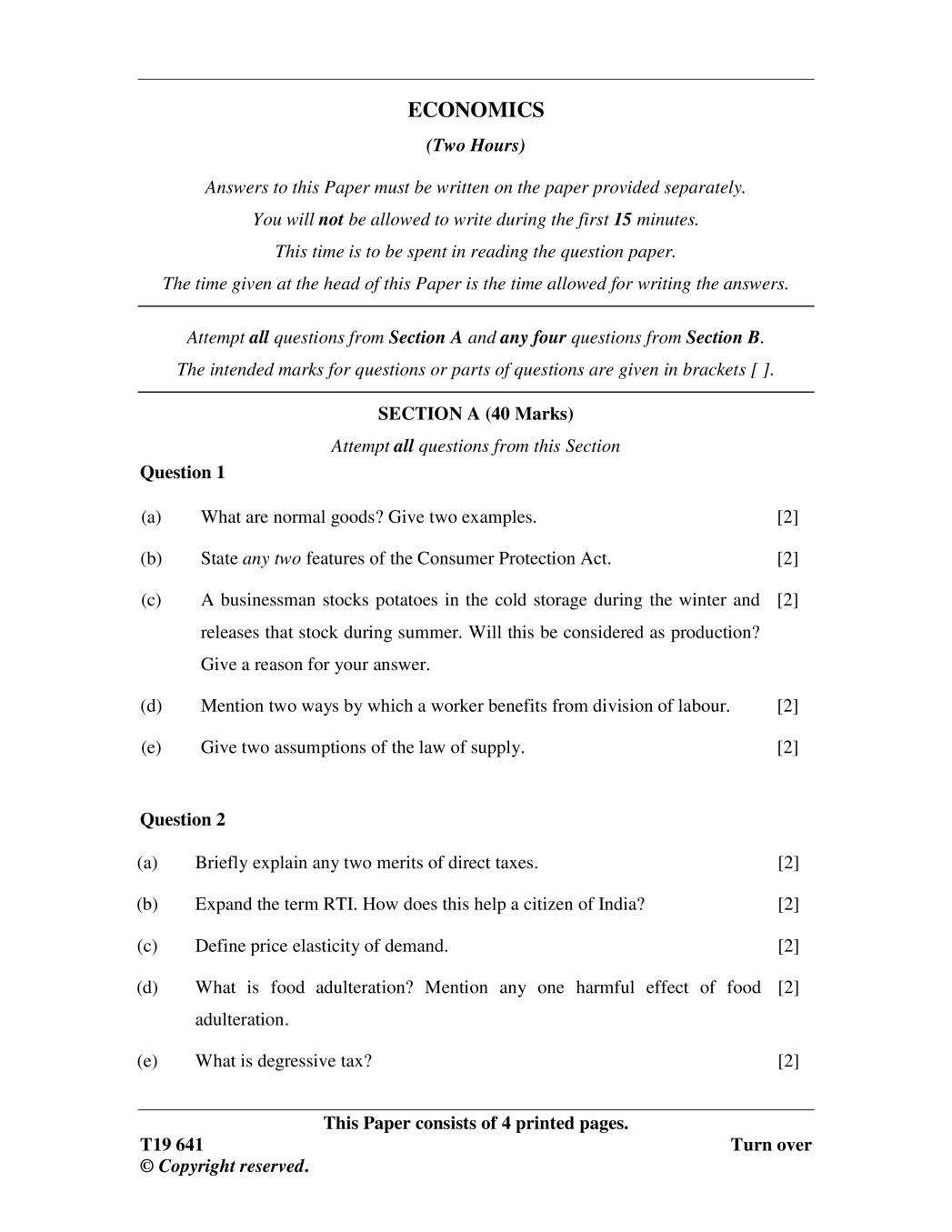
(Two Hours)
Answers to this Paper must be written on the paper provided separately.
You will not be allowed to write during the first 15 minutes.
This time is to be spent in reading the question paper.
The time given at the head of this Paper is the time allowed for writing the answers.
Attempt all questions from Section A and any four questions from Section B.
The intended marks for questions or parts of questions are given in brackets [ ].
SECTION A (40 Marks)
Attempt all questions from this Section
Question 1
(a) What are normal goods? Give two examples. [2]
(b) State any two features of the Consumer Protection Act. [2]
(c) A businessman stocks potatoes in the cold storage during the winter and [2]
releases that stock during summer. Will this be considered as production?
Give a reason for your answer.
(d) Mention two ways by which a worker benefits from division of labour. [2]
(e) Give two assumptions of the law of supply. [2]
Question 2
(a) Briefly explain any two merits of direct taxes. [2]
(b) Expand the term RTI. How does this help a citizen of India? [2]
(c) Define price elasticity of demand. [2]
(d) What is food adulteration? Mention any one harmful effect of food [2]
adulteration.
(e) What is degressive tax? [2]
This Paper consists of 4 printed pages.
T19 641 Turn over
© Copyright reserved.
Page 2
(a) If a buyer buys less of a commodity when his income falls, how will his [2]
demand curve change? Illustrate your answer with a diagram
(b) State two factors which affect productivity of land. [2]
(c) Give two differences between recurring deposits and fixed deposits. [2]
(d) What is overdraft facility? [2]
(e) State any two reasons for the growth of public expenditure in a country [2]
like India in recent times.
Question 4
(a) Draw a well labelled diagram showing the price elasticity of supply of a [2]
commodity starting from the origin.
(b) What is land in Economics? [2]
(c) Define supply. [2]
(d) Indirect taxes are regressive in nature. How can they be made [2]
progressive?
(e) The income earned by an entrepreneur is residual in nature. Explain. [2]
SECTION B (40 Marks)
Attempt any four questions from this Section
Question 5
(a) (i) State the law of demand. [5]
(ii) Briefly explain any two reasons for its occurrence.
(b) Define inflation. Explain its impact on the producers and salaried class. [5]
T19 641 2
Page 3
(a) (i) Define Public debt. [5]
(ii) What are Redeemable debts?
(iii) Mention two examples of unproductive debt.
(b) Briefly explain the following with reference to the barter system of [5]
exchange:
(i) Lack of common measure of value.
(ii) Lack of standard of deferred payments.
Question 7
(a) Explain the following functions of the Central Bank: [5]
(i) Fiscal agent of the government.
(ii) Advisor to the government.
(b) Explain any five characteristics of land. [5]
Question 8
(a) Discuss the risk bearing and decision-making functions of an entrepreneur. [5]
(b) What is Cost Push inflation? Briefly explain three causes of cost push [5]
inflation.
Question 9
(a) (i) Define Tax. [5]
(ii) Give three differences between direct taxes and indirect taxes.
(b) (i) Define capital formation. [5]
(ii) Briefly discuss the process of capital formation.
T19 641 3 Turn Over
Page 4
(a) Define and draw the following: [5]
(i) Relatively elastic supply.
(ii) Relatively inelastic demand.
(b) Briefly discuss any two quantitative measures adopted by the Reserve [5]
Bank of India to control credit.
T19 641 4
Document Details
| Board / Org | CISCE |
| Exam | Class 10 |
| Type | Question Paper |
| Pages | 4 |
| Updated | 22 Jul 2026 |