Odisha CPET 2020 Question Paper Population Studies
Finished viewing? Save it for later —
Download Odisha CPET 2020 Question Paper Population Studies (PDF · 15 pages)About Odisha CPET 2020 Question Paper Population Studies
Odisha CPET 2020 Question Paper Population Studies is available here for free download. Published by Odisha Exams for Odisha CPET, this question paper can be viewed online or downloaded as a PDF (15 pages). Candidates preparing for Odisha CPET can use Odisha CPET 2020 Question Paper Population Studies to understand the exam pattern, the type of questions asked, and the overall difficulty level.
Frequently Asked Questions
How can I download Odisha CPET 2020 Question Paper Population Studies?
Open this page and click the Download button to save Odisha CPET 2020 Question Paper Population Studies as a PDF. It is completely free on AglaSem Docs.
Is Odisha CPET 2020 Question Paper Population Studies free to download?
Yes. Odisha CPET 2020 Question Paper Population Studies can be viewed online and downloaded as a PDF free of cost on AglaSem Docs.
How many pages does Odisha CPET 2020 Question Paper Population Studies have?
Odisha CPET 2020 Question Paper Population Studies contains 15 pages, which you can read online or download together as a single PDF.
Where can I find more Odisha CPET study material?
You can find more Odisha CPET question papers, sample papers, syllabus, and answer keys on AglaSem Docs.
Odisha CPET 2020 Question Paper Population Studies – Text
Read the full text of this question paper below — useful to quickly search, copy and reference the content online without downloading the PDF.
📄 View text version (15 pages)
Page 1
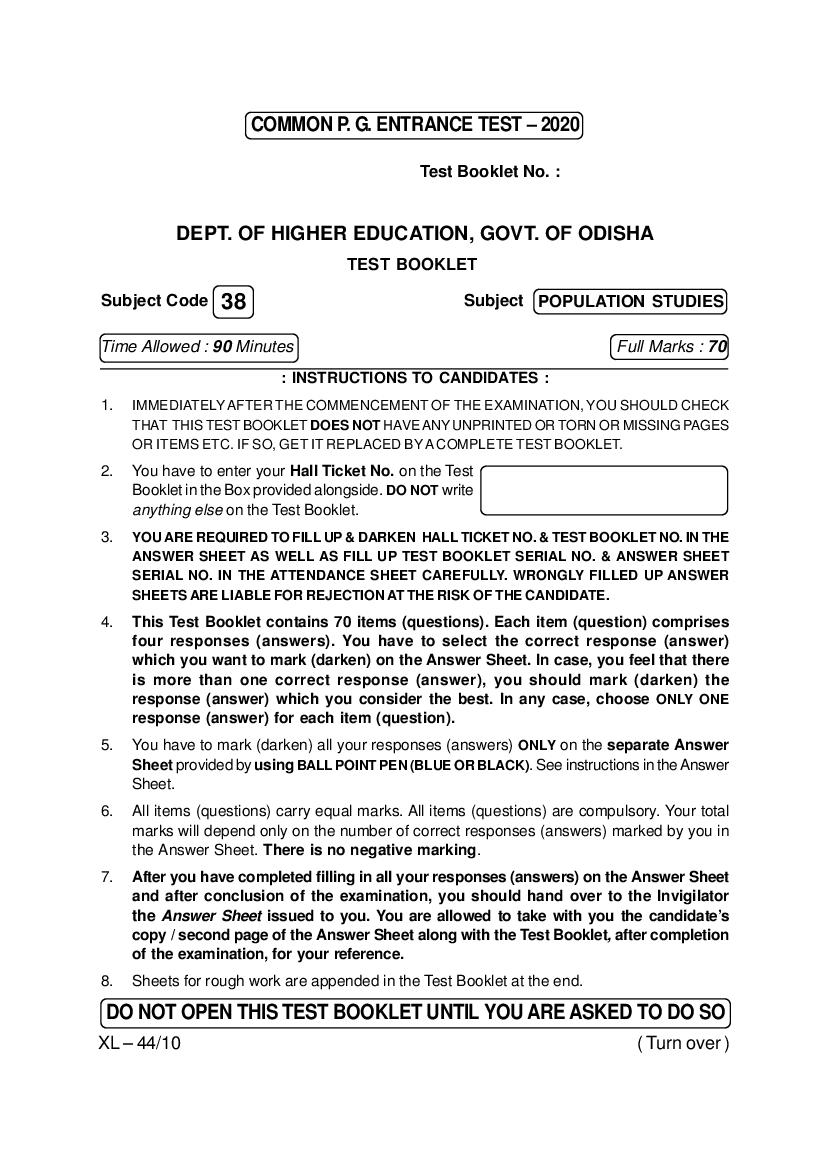
Test Booklet No. :
DEPT. OF HIGHER EDUCATION, GOVT. OF ODISHA
TEST BOOKLET
Subject Code 38 Subject POPULATION STUDIES
Time Allowed : 90 Minutes Full Marks : 70
: INSTRUCTIONS TO CANDIDATES :
1. IMMEDIATELY AFTER THE COMMENCEMENT OF THE EXAMINATION, YOU SHOULD CHECK
THAT THIS TEST BOOKLET DOES NOT HAVE ANY UNPRINTED OR TORN OR MISSING PAGES
OR ITEMS ETC. IF SO, GET IT REPLACED BY A COMPLETE TEST BOOKLET.
2. You have to enter your Hall Ticket No. on the Test
Booklet in the Box provided alongside. DO NOT write
anything else on the Test Booklet.
3. YOU ARE REQUIRED TO FILL UP & DARKEN HALL TICKET NO. & TEST BOOKLET NO. IN THE
ANSWER SHEET AS WELL AS FILL UP TEST BOOKLET SERIAL NO. & ANSWER SHEET
SERIAL NO. IN THE ATTENDANCE SHEET CAREFULLY. WRONGLY FILLED UP ANSWER
SHEETS ARE LIABLE FOR REJECTION AT THE RISK OF THE CANDIDATE.
4. This Test Booklet contains 70 items (questions). Each item (question) comprises
four responses (answers). You have to select the correct response (answer)
which you want to mark (darken) on the Answer Sheet. In case, you feel that there
is more than one correct response (answer), you should mark (darken) the
response (answer) which you consider the best. In any case, choose ONLY ONE
response (answer) for each item (question).
5. You have to mark (darken) all your responses (answers) ONLY on the separate Answer
Sheet provided by using BALL POINT PEN (BLUE OR BLACK). See instructions in the Answer
Sheet.
6. All items (questions) carry equal marks. All items (questions) are compulsory. Your total
marks will depend only on the number of correct responses (answers) marked by you in
the Answer Sheet. There is no negative marking.
7. After you have completed filling in all your responses (answers) on the Answer Sheet
and after conclusion of the examination, you should hand over to the Invigilator
the Answer Sheet issued to you. You are allowed to take with you the candidate’s
copy / second page of the Answer Sheet along with the Test Booklet, after completion
of the examination, for your reference.
8. Sheets for rough work are appended in the Test Booklet at the end.
DO NOT OPEN THIS TEST BOOKLET UNTIL YOU ARE ASKED TO DO SO
XL – 44/10 ( Turn over )
Page 2
Page 3
(A) 12 percent
(B) 14 percent
(C) 17 percent
(D) 20 percent
2. What is the percentage of world’s land area India has ?
(A) 2 percent
(B) 2.4 percent
(C) 2.9 percent
(D) 3.2 percent
3. How many states are there in India ?
(A) 22
(B) 28
(C) 29
(D) 30
4. Which of the following is a non-conventional source of energy ?
(A) Atomic energy
(B) Thermal power
(C) Solar energy
(D) Hydro-electricity
5. What is the population of India, according to 2011 Census ?
(A) 110 crore
(B) 112 crore
(C) 121 crore
(D) 126 crore
6. When was the First Five-Year Plan launched in India ?
(A) 1947
(B) 1948
(C) 1950
(D) 1951
XL – 44/10 (3) ( Turn over )
Page 4
(A) No. of males per 1000 females
(B) No. of females per 1000 males
(C) No. of females in a country
(D) No of males in a country
8. Which country in the world has the largest population ?
(A) India
(B) Russia
(C) China
(D) USA
9. When a body of land is surrounded by water on three sides, it is called :
(A) Peninsula
(B) Gulf
(C) Strait
(D) Island
10. Which of the following imaginary line almost divides India into two equal parts ?
(A) Equator
(B) Tropic of Cancer
(C) Tropic of Capricorn
(D) Arctic circle
11. Which of the following country have common frontier with the Indian states like
Uttarakhand, Uttar Pradesh, Bihar, West Bengal and Sikkim ?
(A) China
(B) Nepal
(C) Bhutan
(D) Myanmar
XL – 44/10 (4) ( Continued )
Page 5
(A Bhutan
(B) Bangladesh
(C) Tajikistan
(D) Nepal
13. India’s highest annual rainfall is reported at :
(A) Namchi, Sikkim
(B) Churu, Rajasthan
(C) Maysynram, Meghalaya
(D) Chamba, Himachal Pradesh
14. Which state in India has the largest area of forest cover ?
(A) Arunachal Pradesh
(B) Haryana
(C) Madhya Pradesh
(D) Assam
15. Which of the following group of states has the largest deposit of iron ore ?
(A) Andhra Pradesh and Karnataka
(B) Bihar and Odisha
(C) Madhya Pradesh and Maharashtra
(D) West Bengal and Assam
16. Which of the following crop needs maximum water per hectare ?
(A) Barley
(B) Maize
(C) Sugarcane
(D) Wheat
17. Which of the following is the most important raw material for generation of power in
India ?
(A) Coal (B) Mineral oil
(C) Natural gas (D) Uranium
XL – 44/10 (5) ( Turn over )
Page 6
(A) Kohima (B) Aizawl
(C) Gangtok (D) Agartala
19. Guwahati is situated on the banks of which river ?
(A) Brahmaputra (B) Ganga
(C) Yamuna (D) Godavari
20. In which state do the monsoon arrives first ?
(A) Assam (B) West Bengal
(C) Maharashtra (D) Kerala
21. Who is known as the “Father of White Revolution” in India ?
(A) M. S. Swaminathan
(B) V. Kurien
(C) Bal Gangadhar Tilak
(D) Netaji Subash Chandra Bose
22. Which one of the following Indian states leads in the production of rubber ?
(A) Kerala (B) Tamil Nadu
(C) Maharashtra (D) Odisha
23. Which state is the highest producer of coffee in India ?
(A) Kerala (B) Assam
(C) Karnataka (D) West Bengal
24. Which state is the largest producer of Tobacco ?
(A) Tamil Nadu (B) Andhra Pradesh
(C) Odisha (D) Gujarat
25. The Rengali Dam in Odisha is on the river :
(A) Mahanadi River
(B) Machkund River
(C) Brahmani River
(D) Sankha River
XL – 44/10 (6) ( Continued )
Page 7
(A) Bhadrak
(B) Balasore
(C) Mayurbhanj
(D) Koraput
27. Who was the first Chief Minister of Odisha ?
(A) Biswanath Das
(B) Harekrushna Mahatab
(C) Biju Patnaik
(D) Nabakrushna Choudhury
28. In which year the famous war of Kalinga was fought ?
(A) 270 BC
(B) 261 BC
(C) 265 BC
(D) 296 BC
29. When was the Super Cyclone held in Odisha ?
(A) 1990 (B) 1995
(C) 1999 (D) 2000
30. When was the first Census held in India ?
(A) 1870 (B) 1871
(C) 1872 (D) 1874
31. Which of the following state has the highest sex ratio, as per 2011 Census ?
(A) Mizoram
(B) Manipur
(C) Haryana
(D) Delhi
XL – 44/10 (7) ( Turn over )
Page 8
(A) 1901-1911
(B) 1911-1921
(C) 1931-1941
(D) 1951-1961
33. What is the overall literacy rate of India as per 2011 Census ?
(A) 74.04%
(B) 82.14%
(C) 76.06%
(D) 65.5%
34. Which period is referred to as the period of population explosion ?
(A) 1901-1921
(B) 1921-1951
(C) 1951-1981
(D) 1981-2001
35. Which state has the minimum sex ratio in India ?
(A) Odisha
(B) Delhi
(C) Haryana
(D) Punjab
36. Which state has the highest population of Scheduled Tribe in India ?
(A) Gujarat
(B) Madhya Pradesh
(C) Maharashtra
(D) Odisha
37. Which state has the highest percentage of Hindus in India ?
(A) Uttar Pradesh
(B) Chhattisgarh
(C) Himachal Pradesh
(D) Maharashtra
XL – 44/10 (8) ( Continued )
Page 9
(A) Assam
(B) West Bengal
(C) Jharkhand
(D) Chhattisgarh
39. What is the population of Odisha, according to 2011 Census ?
(A) 4.19 Crore
(B) 3.92 Crore
(C) 4.62 Crore
(D) 2.92 Crore
40. Which of the following states has the lowest literacy rate in India ?
(A) Rajasthan
(B) Jharkhand
(C) Chhattisgarh
(D) Bihar
41. Which is the longest dam in India ?
(A) Hirakud Dam
(B) Tehri Dam
(C) Nagarjuna Sagar Dam
(D) Sardar Sarovar Dam
42. Which is the largest district in Odisha ?
(A) Cuttack
(B) Mayurbhanj
(C) Koraput
(D) Ganjam
43. Which is the highest mountain in Odisha ?
(A) Mahendragiri
(B) Nimgiri
(C) Megasini
(D) Deomali
XL – 44/10 (9) ( Turn over )
Page 10
(A) Krishna
(B) Narmada
(C) Kaveri
(D) Tungabhadra
45. When people leave an area to go elsewhere, that is called :
(A) Immigration
(B) Net Migration
(C) Population transfer
(D) Migration
46. Who predicted that population would increase by geometric progression, while food
production would increase in arithmetic progression ?
(A) Thomas Robert Malthus
(B) Emile Durkheim
(C) Ferdinand Tonnies
(D) Jean Gottman
47. The study of the interaction of living organisms and the natural environment is called :
(A) Ecology
(B) Pastoralism
(C) Horticulture
(D) Agriculture
48. Which is the world’s most populated city ?
(A) New York
(B) Tokyo
(C) Mexico City
(D) New Delhi
49. When was Ganga Action Plan started ?
(A) 1952
(B) 1986
(C) 1963
(D) 1972
XL – 44/10 ( 10 ) ( Continued )
Page 11
(A) Methane
(B) Carbon
(C) Sulphur
(D) Acetylene
51. Carbon dioxide is primarily called a greenhouse gas because :
(A) Traps heat
(B) Traps light
(C) Traps warm currents
(D) None of the above
52. A narrow gap in a mountain range providing access to the other side is :
(A) Dam
(B) Pass
(C) Valley
(D) Strait
53. Which of the following is the highest peak in India ?
(A) Mt. Everest
(B) Nanga Parbat
(C) Kanchenjunga
(D) Nandadevi
54. Which one of the following places in India have cooler climate even during summers ?
(A) Jaisalmer
(B) Surat
(C) Mussorie
(D) All of these
55. From where do we get information regarding the population of our country ?
(A) Survey
(B) Census
(C) Text Books
(D) All of these
XL – 44/10 ( 11 ) ( Turn over )
Page 12
(A) Kerala
(B) Maharashtra
(C) Punjab
(D) West Bengal
57. In how many years the official enumeration of population is carried out in our country
for Census ?
(A) 5 years
(B) 16 Years
(C) 2 Years
(D) 10 Years
58. Study of trends in human population growth and prediction of future growth is called :
(A) Demography
(B) Paleography
(C) Biography
(D) Psychology
59. Region where fresh water meets salt water is called :
(A) Sea
(B) Lake
(C) River
(D) Estuarine
60. Noise is measured using sound meter and the unit is called :
(A) Hertz
(B) Decibel
(C) Joule
(D) Sound
61. World Environment Day is observed on :
(A) 5th April
(B) 5th June
XL – 44/10 ( 12 ) ( Continued )
Page 13
(D) 20th November
62. 71% of earth’s surface is covered with :
(A) Land
(B) Air
(C) Water
(D) Coal
63. Which gas has highest concentration in our environment ?
(A) Oxygen
(B) Hydrogen
(C) Nitrogen
(D) Carbon dioxide
64. Bronze is a mixture of two metals. These two metals are :
(A) Copper and zinc
(B) Copper and tin
(C) Copper and iron
(D) Aluminum and tin
65. Nuclear family refers to :
(A) Any family born after 1950
(B) Family includes parents and their children
(C) Entire family including children, their parents and grand parents
(D) Only husband and wife
66. Which of the following is not an air pollutant ?
(A) Smoke
(B) Carbon dioxide
(C) Nitrogen gas
(D) Sulphur dioxide
XL – 44/10 ( 13 ) ( Turn over )
Page 14
(A) Aedes mosquito
(B) Culex mosquito
(C) Housefly
(D) Anopheles mosquito
68. The young ones of the frog are called :
(A) Young frogs
(B) Frog cubs
(C) Puppies
(D) Tadpoles
69. During summer the earth is :
(A) Closer to the sun
(B) Away from the sun
(C) Closer to the moon
(D) Away from the moon
70. A human body consists of how many bones ?
(A) 205
(B) 206
(C) 207
(D) 208
XL – 44/10 ( 14 ) ( Continued )
Page 15
XL – 44/10 (180) ( 15 ) Population Studies
Document Details
| Board / Org | Odisha Exams |
| Exam | Odisha CPET |
| Type | Question Paper |
| Pages | 15 |
| Updated | 22 Jul 2026 |