Odisha CPET 2020 Question Paper Psychology
Finished viewing? Save it for later —
Download Odisha CPET 2020 Question Paper Psychology (PDF · 15 pages)About Odisha CPET 2020 Question Paper Psychology
Odisha CPET 2020 Question Paper Psychology is available here for free download. Published by Odisha Exams for Odisha CPET, this question paper can be viewed online or downloaded as a PDF (15 pages). Candidates preparing for Odisha CPET can use Odisha CPET 2020 Question Paper Psychology to understand the exam pattern, the type of questions asked, and the overall difficulty level.
Frequently Asked Questions
How can I download Odisha CPET 2020 Question Paper Psychology?
Open this page and click the Download button to save Odisha CPET 2020 Question Paper Psychology as a PDF. It is completely free on AglaSem Docs.
Is Odisha CPET 2020 Question Paper Psychology free to download?
Yes. Odisha CPET 2020 Question Paper Psychology can be viewed online and downloaded as a PDF free of cost on AglaSem Docs.
How many pages does Odisha CPET 2020 Question Paper Psychology have?
Odisha CPET 2020 Question Paper Psychology contains 15 pages, which you can read online or download together as a single PDF.
Where can I find more Odisha CPET study material?
You can find more Odisha CPET question papers, sample papers, syllabus, and answer keys on AglaSem Docs.
Odisha CPET 2020 Question Paper Psychology – Text
Read the full text of this question paper below — useful to quickly search, copy and reference the content online without downloading the PDF.
📄 View text version (15 pages)
Page 1
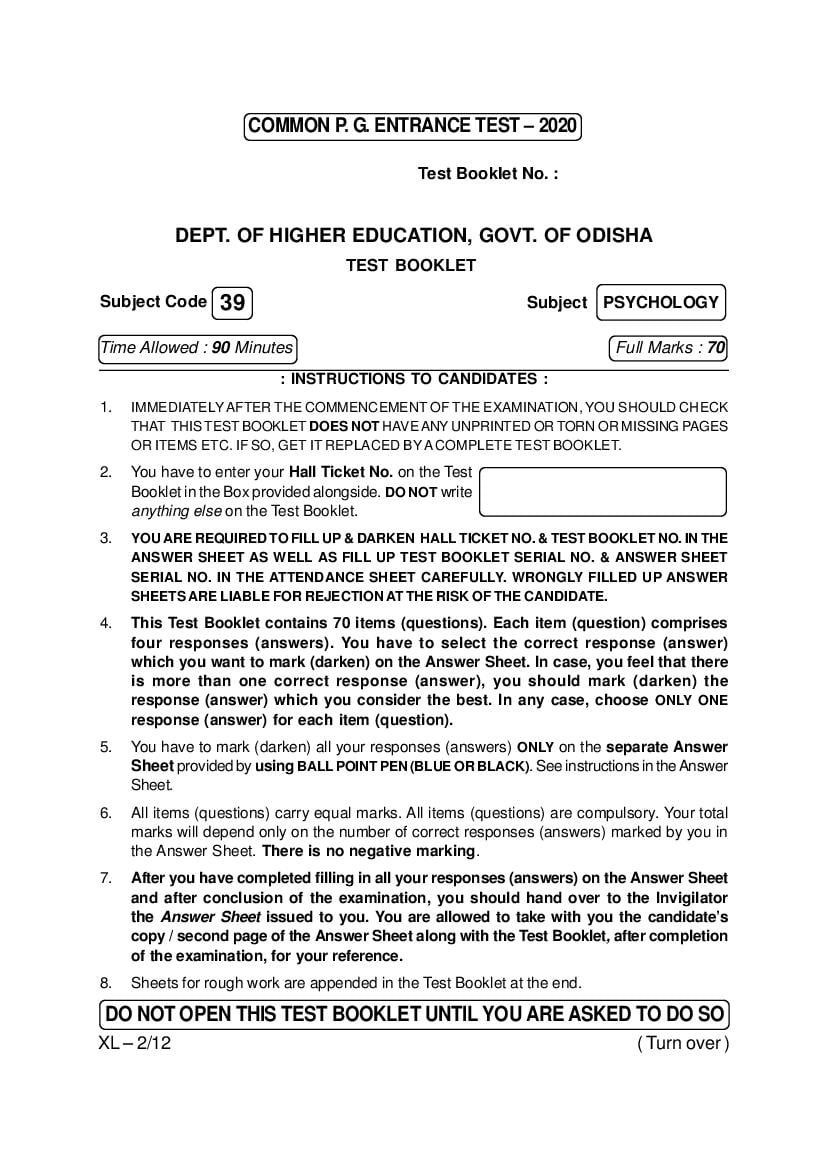
Test Booklet No. :
DEPT. OF HIGHER EDUCATION, GOVT. OF ODISHA
TEST BOOKLET
Subject Code 39 Subject PSYCHOLOGY
Time Allowed : 90 Minutes Full Marks : 70
: INSTRUCTIONS TO CANDIDATES :
1. IMMEDIATELY AFTER THE COMMENCEMENT OF THE EXAMINATION, YOU SHOULD CHECK
THAT THIS TEST BOOKLET DOES NOT HAVE ANY UNPRINTED OR TORN OR MISSING PAGES
OR ITEMS ETC. IF SO, GET IT REPLACED BY A COMPLETE TEST BOOKLET.
2. You have to enter your Hall Ticket No. on the Test
Booklet in the Box provided alongside. DO NOT write
anything else on the Test Booklet.
3. YOU ARE REQUIRED TO FILL UP & DARKEN HALL TICKET NO. & TEST BOOKLET NO. IN THE
ANSWER SHEET AS WELL AS FILL UP TEST BOOKLET SERIAL NO. & ANSWER SHEET
SERIAL NO. IN THE ATTENDANCE SHEET CAREFULLY. WRONGLY FILLED UP ANSWER
SHEETS ARE LIABLE FOR REJECTION AT THE RISK OF THE CANDIDATE.
4. This Test Booklet contains 70 items (questions). Each item (question) comprises
four responses (answers). You have to select the correct response (answer)
which you want to mark (darken) on the Answer Sheet. In case, you feel that there
is more than one correct response (answer), you should mark (darken) the
response (answer) which you consider the best. In any case, choose ONLY ONE
response (answer) for each item (question).
5. You have to mark (darken) all your responses (answers) ONLY on the separate Answer
Sheet provided by using BALL POINT PEN (BLUE OR BLACK). See instructions in the Answer
Sheet.
6. All items (questions) carry equal marks. All items (questions) are compulsory. Your total
marks will depend only on the number of correct responses (answers) marked by you in
the Answer Sheet. There is no negative marking.
7. After you have completed filling in all your responses (answers) on the Answer Sheet
and after conclusion of the examination, you should hand over to the Invigilator
the Answer Sheet issued to you. You are allowed to take with you the candidate’s
copy / second page of the Answer Sheet along with the Test Booklet, after completion
of the examination, for your reference.
8. Sheets for rough work are appended in the Test Booklet at the end.
DO NOT OPEN THIS TEST BOOKLET UNTIL YOU ARE ASKED TO DO SO
XL – 2/12 ( Turn over )
Page 2
Page 3
discount of one third. This best illustrates :
(A) Framing
(B) Belief bias
(C) Representativeness heuristics
(D) Confirmation bias
2. If two variables, X and Y, are correlated, what are the possible directions of
causality ?
(A) X could be causing Y
(B) Y could be causing X
(C) Some third factor could be causing both X and Y
(D) All of these
3. During an emotional state, which of the following would indicate physiological
arousal ?
(A) A sense of fear
(B) Perception of the event as dangerous
(C) Screaming
(D) An increase in blood pressure
4. As a door opens towards you, you perceive it as a rectangular door rather than going
through actual image changes on the retina from rectangular to trapezoid. This is an
example of :
(A) Perceptual closure
(B) Shape constancy
(C) Ambiguous stimuli
(D) Retinal disparity
5. ————— is defined as the process that accounts for an individual’s intensity,
direction, and persistence of efforts toward attaining a goal.
(A) Leadership
(B) Management
(C) Learning
(D) Motivation
XL – 2/12 (3) ( Turn over )
Page 4
(A) Health psychology talks about disease and clinical psychology talks about
treatment
(B) Health psychology talks about physical illness and clinical psychology talks about
mental illness
(C) Health psychology talks about prevention, care and cure of any illness and
clinical psychology talks about cause, symptoms and treatment of mental
illness
(D) Health psychology is practiced by doctors and clinical psychology is practiced
by psychologists
7. Foolish conformity to peer pressure is most likely to be motivated by —————
needs.
(A) Safety (B) Belongingness
(C) Achievement (D) Self-Actualization
8. The fact that we can walk and chew gum at the same time illustrates that :
(A) Our attention depends on different motor systems
(B) We use selective attention
(C) We use divided attention
(D) We use sequential attention
9. Which situation describes the phenomenon of retroactive interference ?
(A) Smita can’t recall what day of the week it is
(B) Jita enters her old PIN with her new ATM card
(C) Diya refers to her old VCR as DVD player
(D) Farida often calls her new friend by her old friend’s name
10. Materials like food for the hungry, and water for the thirsty are called :
(A) Primary reinforcers (B) Secondary reinforcers
(C) Intermittent reinforcers (D) Fixed reinforcers
XL – 2/12 (4) ( Continued )
Page 5
(A) Increase the frequency
(B) Take the average of the frequencies
(C) Increase the length of the class interval
(D) Smooth the curve
12. In which type of reinforcement schedule every appropriate response is reinforced ?
(A) Intermittent reinforcement schedule
(B) Fixed interval reinforcement schedule
(C) Continuous reinforcement schedule
(D) Fixed ratio reinforcement schedule
13. Recognizing is —————, whereas recalling is —————.
(A) Remembering it in its absence, Remembering something in its presence
(B) Remembering something in its presence, remembering it in its absence
(C) Reconstructing it in its presence, remembering it in its absence
(D) Remembering something in its presence, relearning it in its absence
14. Which of the following approaches has the most optimistic view of human nature ?
(A) Humanism (B) Behaviorism
(C) Psychoanalysis (D) Structuralism
15. Which of the following is not a continuous variable ?
(A) Temperature of water
(B) Number of persons in a family
(C) Time taken to complete a task
(D) Weight of a person
16. The bodily depth cue generated by changes in the shape of the lens of the eye is
called :
(A) Retinal disparity (B) Aerial perspective
(C) Accommodation (D) Diversity
XL – 2/12 (5) ( Turn over )
Page 6
(A) Undesirable Response (B) Desirable Response
(C) Positive Response (D) All of these
18. Psychology’s answer to the question of, whether we are born or made, tends to be :
(A) We are born (B) We are made
(C) Both (A) and (B) (D) None of these
19. The chief function of the control group in an experiment is that it :
(A) Allows mathematical relationships to be established
(B) Provides a point of reference against which the behavior of the experimental
group can be compared
(C) Balances the experiment to eliminate all dependent variables
(D) Controls all independent variables
20. Which of the following is not a way of defining psychopathology ?
(A) Deviation from the statistical norm
(B) Distress and impairment
(C) Measuring IQ
(D) Maladaptive behaviour
21. The study of similarities and differences in the behavior of different species is
called :
(A) Biology (B) Comparative Psychology
(C) Environmental Psychology (D) Differential Psychology
22. The percentage of persons scoring below a specific raw score is known as :
(A) Percentage
(B) Percentile
(C) Centile
(D) None of these
XL – 2/12 (6) ( Continued )
Page 7
found in :
(A) Analysis of dreams
(B) Physical or biological impairments
(C) Traumatic life events
(D) Family dynamics
24. A complete sleep cycle lasts for about :
(A) Whole night (B) 60 minutes
(C) 90 minutes (D) 120 minutes
25. Which perspective would be most useful when explaining how people from different
countries express anger ?
(A) Psychodynamic (B) Behavioral
(C) Socio-cultural (D) Biological
26. The acronym PET stands for :
(A) Positron emission tomography
(B) Positive emotion tracking
(C) Psychological evaluation technique
(D) Physiological emission technique
27. Which of the following is an example of covert behavior ?
(A) Blinking in response to a light
(B) Imitating a friend’s gesture
(C) Remembering a pleasant experience
(D) Rapid eye movements
XL – 2/12 (7) ( Turn over )
Page 8
(A) Mid-point of scores
(B) Cumulative frequencies of scores
(C) Cumulative percentage of frequencies of scores
(D) Cumulative class intervals
29. Negative symptoms of schizophrenia include all of the following, except :
(A) Affective flattening (B) Loss of directedness
(C) Poverty of thought content (D) Hallucination
30. Geeta experiences guilt or discomfort because she realizes that she is not being
truthful with her friend Seema. She may be experiencing :
(A) Blaming the victim (B) Self-Serving bias
(C) Cognitive dissonance (D) Learned helplessness
31. Hypnosis can be described as a heightened state of :
(A) Suggestibility (B) Accountability
(C) Reactivity (D) Movability
32. What does the endocrine system do ?
(A) Responsible for digestion
(B) Regulate bone growth
(C) Release hormones into the bloodstream
(D) Maintains immune system
33. The fundamental attribution error occurs when a person underestimates or does not
consider ——————— attributes and focuses too much on ———————
attributes or personal factors.
(A) Situational; dispositional (B) Dispositional; situational
(C) Situational; unconscious (D) Unconscious; dispositional
XL – 2/12 (8) ( Continued )
Page 9
(A) 10th of February (B) 1st of October
(C) 10th of October (D) 10th of November
35. A broad mental capacity that influences performance on cognitive ability measures
is known as :
(A) Specific intelligence (B) Fluid intelligence
(C) General intelligence (D) Crystallized intelligence
36. The judge who is caught cheating on paying his income tax is likely to experience :
(A) Role diffusion (B) Attribution failure
(C) Role conflict (D) Attribution error
37. Educational psychology is concerned with :
(A) The learner (B) The learning process
(C) The learning situation (D) All of these
38. Health is best defined as :
(A) The absence of illness or pain
(B) A positive state of mental, social and physical well being
(C) A condition with no risk of physical illness
(D) A condition with no current physical or mental illness
39. Preeti takes a test in the army to see if she would make a good pilot. Such a test is :
(A) A standardized test (B) An aptitude test
(C) An intelligence test (D) An achievement test
40. Immediacy skills of a counselor refer to :
(A) The ability to see the incomplete picture that clients paint with their words
(B) The ability to feel with clients, as opposed to feeling for clients
(C) The ability to communicate and demonstrate genuine caring and concern for
clients
(D) The ability to deal with the here-and-now factors that operate within the helping
relationship
XL – 2/12 (9) ( Turn over )
Page 10
starts acting the way people perceive her. This behavioral change is called :
(A) Social influence (B) Groupthink
(C) Group polarization (D) Self-fulfilling prophecy
42. Prof. Dash makes sure that she fairly represents the whole year’s course in the
General Psychology question for the final examination. She is trying to achieve :
(A) Test-retest reliability (B) Construct validity
(C) Content validity (D) Split-half reliability
43. According to Vygotsky, helping a child in the form of asking questions and giving
examples is known as :
(A) Scaffolding (B) Zone of proximal development
(C) Habituation (D) Verbal learning
44. We have a tendency to make normal use of certain household articles, but it is
difficult for us to put them to some novel use. Psychologists have named this
tendency as :
(A) Functional fixedness (B) Generalization
(C) Concept formation (D) Abstraction
45. Tendency of people to keep a fairly stable baseline level of happiness despite
fluctuations in circumstances is known as :
(A) Happiness set point (B) Resilience
(C) Positive thinking (D) Initiative
46. The process in which the clients displace unconscious feelings from the past onto
the therapist is referred to as :
(A) Transference (B) Blocking
(C) Counter transference (D) Dream analysis
XL – 2/12 ( 10 ) ( Continued )
Page 11
(A) James Lovelock (B) Roger Barker
(C) James Gibson (D) John Dawson
48. Which statement does not represent a professional helping relationship?
(A) It is initially structured by the counselor or therapist but is open to cooperative
restructuring based upon the needs of the client.
(B) It is one that provides for the personal growth of all persons involved.
(C) It is one in which all persons involved perceive the existence of trust, caring,
concern, and commitment and act accordingly.
(D) It is simply one in which one person does something for the other.
49. The two dimensions of leadership which emerged from the Ohio State Leadership
Studies are ‘consideration’ and ‘—————’.
(A) Energization (B) Initiating structure
(C) Deliberation (D) Command
50. Which of the following theory emphasized the difference between the ability to solve
novel problems and learned knowledge ?
(A) Cattell’s fluid and crystallized intelligence
(B) Das-Naglieri Cognitive Assessment System
(C) Gardner’s multiple intelligences
(D) Thurstone’s primary mental abilities
51. Which level in the Bronfenbrenner’s ecological model is characterised by
interactions between immediate environments ?
(A) Microsystem (B) Macrosystem
(C) Mesosystem (D) Exosystem
52. What are the major themes of existential therapy ?
(A) Empathy and genuineness
(B) Transference and counter-transference
(C) Restructuring of client’s irrational thoughts
(D) Client’s responsibility and freedom
XL – 2/12 ( 11 ) ( Turn over )
Page 12
(A) Role ambiguity
(B) Loss of interest by members in organization
(C) Low morale and low job satisfaction
(D) All of these
54. If we know that all dogs have tails, and thus poodles must have tails, we are
demonstrating ————— reasoning.
(A) Determined (B) Deductive
(C) Insight (D) Inductive
55. Which of the following is not true about flow experience ?
(A) A loss of reflective self-consciousness.
(B) A sense of personal control or agency over the situation or activity.
(C) A distortion of temporal experience, one’s subjective experience of time is
altered.
(D) An apprehension for failure.
56. Social facilitation occurs :
(A) When people do less in a group setting
(B) When people keep their personal opinions to themselves for fear of upsetting
the group
(C) When the presence of other people watching improves one’s performance
(D) When the presence of other people watching hinders a person’s performance
57. A manager praises the employees to motivate them for even better performance.
This is an example of :
(A) Maslow’s need-hierarchy (B) ERG Theory
(C) Reinforcement theory (D) All of these
XL – 2/12 ( 12 ) ( Continued )
Page 13
performance of a reference group is known as :
(A) Norm-referenced test (B) Criterion-referenced test
(C) Behavioural tests (D) Culture-fair test
59. In Erikson’s crisis of —————, children develop a sense of competence.
(A) Trust versus mistrust
(B) Autonomy versus shame and doubt
(C) Initiative versus guilt
(D) Industry versus inferiority
60. Which form of reliability gives an estimate of temporal stability ?
(A) Split-half reliability (B) Alternate-forms reliability
(C) Interscorer reliability (D) Test-retest reliability
61. In which Piagetian stage the child becomes capable of understanding conservation ?
(A) Sensorimotor (B) Pre-operational
(C) Concrete operational (D) Formal operational
62. Which theory assumes that the manager’s role is to coerce and control
employees ?
(A) Theory X (B) Theory Y
(C) Theory Z (D) None of these
63. According to behaviorists, personality is :
(A) A collection of specific traits
(B) Driven by unconscious forces
(C) A set of learned responses
(D) Motivated by a striving for success
64. Body language refers to :
(A) Postures, gestures, and facial expressions
(B) The exchange of information through the use of words
(C) Speak from your point of view
(D) All of these
XL – 2/12 ( 13 ) ( Turn over )
Page 14
exaggerated self-image, and require constant, excessive admiration ?
(A) Histrionic (B) Narcissistic
(C) Borderline (D) Schizotypal
66. Which of the following is not an attachment style that children develop with their
parent/ caregivers ?
(A) Secure (B) Synchronized
(C) Avoidant (D) Disorganized
67. What does EEG do ?
(A) Track anatomical structure
(B) Examines neurons to track electrical signals in the brain
(C) Detect lesions early
(D) Make images of the brain
68. The “Decay Theory” is also known as :
(A) Trace Theory (B) Interference Theory
(C) Inhibition Theory (D) Levels-of-processing Theory
69. Cephalocaudal development implies :
(A) The development of arms is followed by development of hands
(B) The legs grow earlier than the trunk
(C) The growth of legs takes place earlier than the hands
(D) The trunk grows faster than the legs
70. The fact that objects that are near to each other tend to be grouped together is known
as :
(A) Closure (B) Continuation
(C) Nearness (D) Similarity
XL – 2/12 ( 14 ) ( Continued )
Page 15
XL – 2/12 (1,300) ( 15 ) Psychology
Document Details
| Board / Org | Odisha Exams |
| Exam | Odisha CPET |
| Type | Question Paper |
| Pages | 15 |
| Updated | 22 Jul 2026 |