Odisha CPET 2020 Question Paper Public Administration
Finished viewing? Save it for later —
Download Odisha CPET 2020 Question Paper Public Administration (PDF · 15 pages)About Odisha CPET 2020 Question Paper Public Administration
Odisha CPET 2020 Question Paper Public Administration is available here for free download. Published by Odisha Exams for Odisha CPET, this question paper can be viewed online or downloaded as a PDF (15 pages). Candidates preparing for Odisha CPET can use Odisha CPET 2020 Question Paper Public Administration to understand the exam pattern, the type of questions asked, and the overall difficulty level.
Frequently Asked Questions
How can I download Odisha CPET 2020 Question Paper Public Administration?
Open this page and click the Download button to save Odisha CPET 2020 Question Paper Public Administration as a PDF. It is completely free on AglaSem Docs.
Is Odisha CPET 2020 Question Paper Public Administration free to download?
Yes. Odisha CPET 2020 Question Paper Public Administration can be viewed online and downloaded as a PDF free of cost on AglaSem Docs.
How many pages does Odisha CPET 2020 Question Paper Public Administration have?
Odisha CPET 2020 Question Paper Public Administration contains 15 pages, which you can read online or download together as a single PDF.
Where can I find more Odisha CPET study material?
You can find more Odisha CPET question papers, sample papers, syllabus, and answer keys on AglaSem Docs.
Odisha CPET 2020 Question Paper Public Administration – Text
Read the full text of this question paper below — useful to quickly search, copy and reference the content online without downloading the PDF.
📄 View text version (15 pages)
Page 1
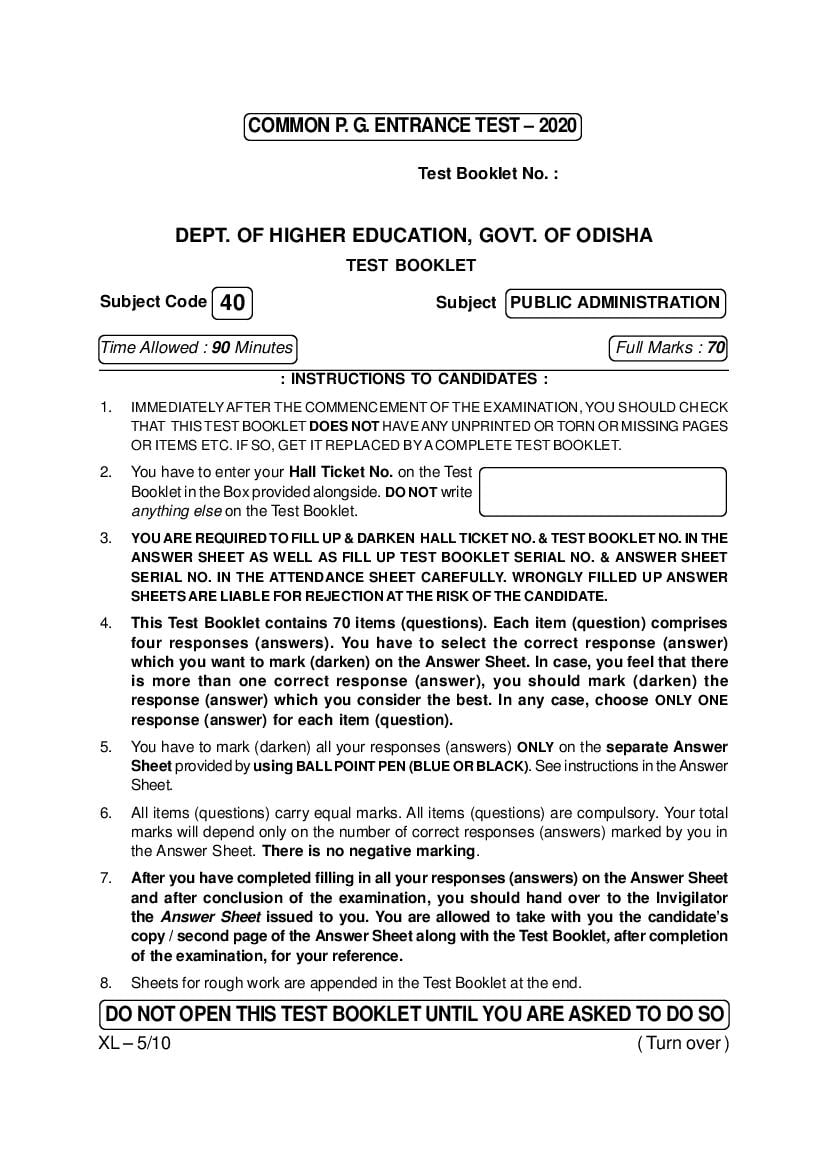
Test Booklet No. :
DEPT. OF HIGHER EDUCATION, GOVT. OF ODISHA
TEST BOOKLET
Subject Code 40 Subject PUBLIC ADMINISTRATION
Time Allowed : 90 Minutes Full Marks : 70
: INSTRUCTIONS TO CANDIDATES :
1. IMMEDIATELY AFTER THE COMMENCEMENT OF THE EXAMINATION, YOU SHOULD CHECK
THAT THIS TEST BOOKLET DOES NOT HAVE ANY UNPRINTED OR TORN OR MISSING PAGES
OR ITEMS ETC. IF SO, GET IT REPLACED BY A COMPLETE TEST BOOKLET.
2. You have to enter your Hall Ticket No. on the Test
Booklet in the Box provided alongside. DO NOT write
anything else on the Test Booklet.
3. YOU ARE REQUIRED TO FILL UP & DARKEN HALL TICKET NO. & TEST BOOKLET NO. IN THE
ANSWER SHEET AS WELL AS FILL UP TEST BOOKLET SERIAL NO. & ANSWER SHEET
SERIAL NO. IN THE ATTENDANCE SHEET CAREFULLY. WRONGLY FILLED UP ANSWER
SHEETS ARE LIABLE FOR REJECTION AT THE RISK OF THE CANDIDATE.
4. This Test Booklet contains 70 items (questions). Each item (question) comprises
four responses (answers). You have to select the correct response (answer)
which you want to mark (darken) on the Answer Sheet. In case, you feel that there
is more than one correct response (answer), you should mark (darken) the
response (answer) which you consider the best. In any case, choose ONLY ONE
response (answer) for each item (question).
5. You have to mark (darken) all your responses (answers) ONLY on the separate Answer
Sheet provided by using BALL POINT PEN (BLUE OR BLACK). See instructions in the Answer
Sheet.
6. All items (questions) carry equal marks. All items (questions) are compulsory. Your total
marks will depend only on the number of correct responses (answers) marked by you in
the Answer Sheet. There is no negative marking.
7. After you have completed filling in all your responses (answers) on the Answer Sheet
and after conclusion of the examination, you should hand over to the Invigilator
the Answer Sheet issued to you. You are allowed to take with you the candidate’s
copy / second page of the Answer Sheet along with the Test Booklet, after completion
of the examination, for your reference.
8. Sheets for rough work are appended in the Test Booklet at the end.
DO NOT OPEN THIS TEST BOOKLET UNTIL YOU ARE ASKED TO DO SO
XL – 5/10 ( Turn over )
Page 2
Page 3
(A) F. W. Taylor (B) L. D. White
(C) Woodrow Wilson (D) Aristotle
2. The letter ‘R’ in the acronym POSDCORB stands for —————.
(A) Revenue
(B) Reporting
(C) Regenerating
(D) Review
3. Four ‘P’s in the theory of Departmentalization as propounded by Luther Gulick stand
for —————.
(A) Purpose, process, planning, place
(B) Place, persons, programmes, process
(C) Purpose, process, place, pension
(D) Purpose, process, persons, place
4. Scientific Management theory advocates —————.
(A) Science of work
(B) Piece-rate wage system
(C) Functional foremanship
(D) All of these
5. Elton Mayo, the early twentieth century philosopher in Public Administration belongs
to the group of —————.
(A) Classical thinkers
(B) Thinkers of Open System Model
(C) Neo-classical thinkers
(D) Socio-psychological thinkers
6. A. V. Dicey has propounded the concept —————.
(A) Administrative Law
(B) Administrative Justice
(C) Rule of Law
(D) Judicial Review
XL – 5/10 (3) ( Turn over )
Page 4
(A) 21 April (B) 24 April
(C) 21 June (D) 7 July
8. Which of the following is not a behavioural thinker in Public Administration ?
(A) Elton Mayo (B) Henry Fayol
(C) Chris Argyris (D) Herbert Simon
9. Who is the present Secretary General of United Nations ?
(A) Ban-Ki-Moon
(B) António Guterres
(C) Kristalina Georgieva
(D) Trygvie Lie
10. Which of the following step/s is/are included in making a decision according to
Herbert Simon ?
(A) Intelligence (B) Design
(C) Choice (D) All of these
11. ‘Oriya’ is replaced by ‘Odia’ in which of the following amendments to Constitution of
India ?
(A) 96th Amendment
(B) 95th Amendment
(C) 86th Amendment
(D) 103rd Amendment
12. 10% reservation for Economically Weaker Sections (EWS) of society for admission
to Central Government-run educational institutions and private educational institutions
is provided by —————.
(A) 113th Amendment
(B) 103rd Amendment
(C) 105th Amendment
(D) 106th Amendment
XL – 5/10 (4) ( Continued )
Page 5
(A) Karl Marx (B) Max Weber
(C) Henry Fayol (D) Woodrow Wilson
14. ‘Gang-plank’ refers to —————.
(A) Level Jumping (B) Initiative
(C) Discipline (D) Equity
15. Indian Constitution was framed by —————.
(A) Dr. B. R. Ambedkar
(B) Mahatma Gandhi
(C) Parliament of India
(D) Constituent Assembly of India
16. Who is the author of ‘Arthasashtra’ ?
(A) Baraha Mihira (B) Panini
(C) Kautilya (D) Banabhatta
17. The process by which a manager assigns some of his/her total workload to others
is called —————.
(A) Delegation
(B) Devolution
(C) Division of work
(D) Decentralization
18. Power that has been legitimized by the State is —————.
(A) Political authority
(B) Legal authority
(C) Traditional authority
(D) Charismatic authority
19. ‘Span of Control’ means —————.
(A) Power to control an enterprise
(B) Number of subordinates under a superior’s direct control
(C) Duration of executive control
(D) Structural design of an organization
XL – 5/10 (5) ( Turn over )
Page 6
year —————.
(A) 1992 (B) 1997
(C) 2000 (D) 2003
21. Which of the following matters related to Civil Services in India does not concern the
Union Public Service Commission ?
(A) Recruitment
(B) Classification of services
(C) Disciplinary matters
(D) Promotion
22. Who among the following defined public administration as “detailed and systematic
execution of law” ?
(A) Woodrow Wilson
(B) Frank J. Goodnow
(C) Max Weber
(D) Luther Gulick
23. Which one of the following was the first committee to demand Constitutional
recognition for Panchayats ?
(A) Balwant Rai Mehta Committee
(B) Ashok Mehta Committee
(C) L. M. Singhvi Committee
(D) Santhanam Committee
24. The term ‘Sala’ used by F. W. Riggs in his Ecological Approach is borrowed from
which language ?
(A) Greek
(B) Italian
(C) Spanish
(D) French
XL – 5/10 (6) ( Continued )
Page 7
1. Santhanam Committee
2. Appleby Committee
3. Balwant Rai Mehta Committee
4. G.V.K. Rao Committee
Codes:
(A) 1, 2, 3 and 4
(B) 2, 3, 1 and 4
(C) 4, 2, 1 and 3
(D) 3, 1, 2 and 4
26. Which Schedule of the Constitution of India details the power and functions of
Panchayats ?
(A) Eighth Schedule (B) Ninth Schedule
(C) Tenth Schedule (D) Eleventh Schedule
27. Which of the following amendments deals with Municipalities or Urban Local
Governments ?
(A) 73rd Constitutional Amendment
(B) 74th Constitutional Amendment
(C) 93rd Constitutional Amendment
(D) 94th Constitutional Amendment
28. Which of the following is considered as the most powerful Upper House in the world ?
(A) House of Lords in U.K.
(B) Council of States in India
(C) U.S.A. Senate
(D) Federation Council in Russia
29. In which of the following countries, Spoils System was prevalent until it was replaced
by Pendleton Civil Service Reform Act ?
(A) USA (B) UK
(C) Germany (D) Switzerland
XL – 5/10 (7) ( Turn over )
Page 8
(A) UK (B) USA
(C) India (D) Denmark
31. Who among the following is not associated with Ecological approach to Public
Administration ?
(A) John M. Gaus (B) Robert A. Dahl
(C) F. W. Riggs (D) Luther Gulick
32. Election Commission of India is not concerned with the election of —————.
(A) President of India
(B) Vice-President of India
(C) Members of Legislative Assemblies
(D) Members of Municipal Councils
33. JNNURM was launched in the year :
(A) 1999 (B) 2005
(C) 2009 (D) 2014
34. Who among the following emphasized that if Unity of Command is violated, “Authority
is undermined, discipline is in jeopardy, order is disturbed and stability will be
threatened” ?
(A) Max Weber
(B) Chester Barnard
(C) F. W. Taylor
(D) Henry Fayol
35. Who among the following are the authors of the book ‘Reinventing Government’ ?
(A) Luther Gulick and Lyndall Urwick
(B) David Osborne and Ted Gaebler
(C) Janet V. Denhardt and Robert Denhardt
(D) Christopher Hood and Mark Bevir
XL – 5/10 (8) ( Continued )
Page 9
(A) Systems Theory (B) Incremental Theory
(C) Group Theory (D) Institutional Theory
37. Which of the following statements most appropriately describes the National Human
Rights Commission of India ?
(A) It is a Statutory and Constitutional body.
(B) It is a Non-statutory and Constitutional body.
(C) It is a Non-statutory, Non-Constitutional executive body.
(D) It is a Statutory and Non-Constitutional body.
38. Which of the following is not one of the themes of New Public Administration ?
(A) Social Equity (B) Relevance
(C) Client Focus (D) Public Interest
39. Neo-classical Theory of Organisation focuses on —————.
(A) Decentralisation
(B) Non-formal Organisation
(C) Human-orientation
(D) All of these
40. Introduction to the Study of Public Administration, considered as the first
textbook on Public Administration was written by —————.
(A) Woodrow Wilson (B) L.D. White
(C) Frank J. Goodnow (D) Henri Fayol
41. Which of the following is not a characteristic of ‘Good Governance’ ?
(A) Transparency
(B) Responsiveness
(C) Judicial Activism
(D) Accountability
XL – 5/10 (9) ( Turn over )
Page 10
List-I List- II
(Administrative Theory) (Thinkers)
a. Scientific Management Theory (i) Max Weber
b. Ecological Theory (ii) F. W. Riggs
c. Human Relations Theory (iii) F.W. Taylor
d. Bureaucratic Theory (iv) Elton Mayo
Codes:
(A) a-(i) b-(ii) c-(iii) d-(iv)
(B) a-(iii) b-(iv) c-(i) d-(ii)
(C) a-(i) b- (iii) c- (ii) d-(iv)
(D) a- (iii) b- (ii) c-(iv) d-(i)
43. The ————— leadership style is an expression of the leader’s trust in the abilities
of his subordinates.
(A) Delegative (B) Transformational
(C) Authoritarian (D) Charismatic
44. Who among the following propounded the Theory of Motivation in Organizational
Behaviour ?
(A) Abraham Maslow (B) M. P. Follett
(C) Chester Bernard (D) F. W. Taylor
45. Match List – I with List – II and select the correct answer by using code given below :
List – I List – II
(Term) (Meaning)
(a) Recruitment (i) Order for holding the position
(b) Selection (ii) Attracting candidates for service
(c) Appointment (iii) Selecting the candidates for position
(d) Placement (iv) The office where the appointee is posted
(A) a-(ii) b-(i) c-(iii) d-(iv)
(B) a-(i) b-(ii) c-(iv) d-(iii)
(C) a-(iii) b- (ii) c- (i) d-(iv)
(D) a- (ii) b- (iii) c-(i) d-(iv)
XL – 5/10 ( 10 ) ( Continued )
Page 11
Constitution ?
(A) Drinking Water
(B) Prevention of Cruelty to Animal
(C) Libraries
(D) Markets and Fairs
47. “Right promotion at the right time is an essential part of the process of developing full
relents of men and women in service.” This statement is made by —————.
(A) Fulton Committee (B) Northcote Report
(C) Hoover Commission (D) ARC of India
48. Who of the following is associated with the concept of New Despotism ?
(A) Ramsay Muir (B) Harland Cleveland
(C) F. M. Marx (D) Lord Hewart
49. Constituent Assembly which framed India’s Constitution was set up by —————.
(A) Indian Independence Act
(B) Government of India Act, 1935
(C) Cabinet Mission Plan - 1946
(D) Queen’s Proclamation
50. Where can impeachment proceedings against the President be initiated ?
(A) In Lok Sabha
(B) Joint sitting of the two Houses called for this purpose
(C) In either House of Parliament
(D) In the Supreme Court
51. In a situation of tie, the speaker’s vote in the Lok Sabha is called —————.
(A) Casting vote (B) Sound vote
(C) Direct vote (D) Indirect vote
52. If the office of the President falls vacant due to any reason, in how many months
should it be filled ?
(A) 3 Months (B) 6 Months
(C) 9 Months (D) 12 Months
XL – 5/10 ( 11 ) ( Turn over )
Page 12
(A) Reasonably accurate
(B) Free from personal biases
(C) An economical method of data collection
(D) All of these
54. Research can be classified as —————.
(A) Basic and Applied Research
(B) Quantitative and Qualitative Research
(C) Survey and Experimental Research
(D) All of these
55. Which of the following is the first step in research ?
(A) Review of literature
(B) Identification of problem
(C) Research design
(D) Formulation of hypothesis
56. Field-work based research is classified as :
(A) Historical (B) Empirical
(C) Biographical (D) Experimental
57. In appointing a Governor, the President Consults the Chief Minister of the State as
this is —————.
(A) Constitutionally imperative
(B) A convention
(C) Ensured under an Act of the Parliament
(D) A moral duty of the President
58. The office of District Collector was created by —————.
(A) Robert Clive (B) Lord Cornwallis
(C) Lord Warren Hastings (D) Lord Wellesley
XL – 5/10 ( 12 ) ( Continued )
Page 13
(A) A Policy-making agency
(B) A Constitutional agency
(C) A Statutory agency
(D) An Executive agency
60. Panchayats (Extension to Scheduled Areas), Act was enacted in the year
—————.
(A) 1991 (B) 1992
(C) 1993 (D) 1996
61. The Advocate General for a State should have qualifications equal to the qualifications
of —————.
(A) A High Court Judge
(B) A Session Court Judge
(C) A Supreme Court Judge
(D) Any Practising Lawyer
62. Which of the following countries has a plural executive ?
(A) Great Britain
(B) France
(C) Japan
(D) Switzerland
63. Who has authored the book ‘The Theory and Practice of Modern Government’ ?
(A) Herman Finer
(B) O. Glenn Sthal
(C) L. D. White
(D) Harlod J Laski
64. The seniority principle in promotion is determined on the basis of —————.
(A) Age of the employee
(B) Length of the service of the employee
(C) Efficiency of the employee
(D) Employees relationship with other employees
XL – 5/10 ( 13 ) ( Turn over )
Page 14
(A) Neutrality
(B) Anonymity
(C) Patronage
(D) Merit
66. In which year the Ministry of Personnel, Public Grievances and Pensions in India
was created ?
(A) 1970 (B) 1975
(C) 1980 (D) 1985
67. Which of the following article of Indian Constitution provides for the Union Public
Service Commission ?
(A) Article 312
(B) Article 315
(C) Article 324
(D) Article 322
68. Which of the following Articles in Constitution of India deals with a Money Bill ?
(A) Article 99 (B) Article 105
(C) Article 106 (D) Article 110
69. Reserve Bank of India was established in the year —————.
(A) 1936 (B) 1935
(C) 1939 (D) 1938
70. The term ‘Performance Budget’ was coined by —————.
(A) Pendleton Commission
(B) First Hoover Commission
(C) Warren Commission
(D) Second Hoover Commission
XL – 5/10 ( 14 ) ( Continued )
Page 15
XL – 5/10 (1,070) ( 15 ) Public Administration
Document Details
| Board / Org | Odisha Exams |
| Exam | Odisha CPET |
| Type | Question Paper |
| Pages | 15 |
| Updated | 22 Jul 2026 |