Odisha CPET 2020 Question Paper Public Health
Finished viewing? Save it for later —
Download Odisha CPET 2020 Question Paper Public Health (PDF · 15 pages)About Odisha CPET 2020 Question Paper Public Health
Odisha CPET 2020 Question Paper Public Health is available here for free download. Published by Odisha Exams for Odisha CPET, this question paper can be viewed online or downloaded as a PDF (15 pages). Candidates preparing for Odisha CPET can use Odisha CPET 2020 Question Paper Public Health to understand the exam pattern, the type of questions asked, and the overall difficulty level.
Frequently Asked Questions
How can I download Odisha CPET 2020 Question Paper Public Health?
Open this page and click the Download button to save Odisha CPET 2020 Question Paper Public Health as a PDF. It is completely free on AglaSem Docs.
Is Odisha CPET 2020 Question Paper Public Health free to download?
Yes. Odisha CPET 2020 Question Paper Public Health can be viewed online and downloaded as a PDF free of cost on AglaSem Docs.
How many pages does Odisha CPET 2020 Question Paper Public Health have?
Odisha CPET 2020 Question Paper Public Health contains 15 pages, which you can read online or download together as a single PDF.
Where can I find more Odisha CPET study material?
You can find more Odisha CPET question papers, sample papers, syllabus, and answer keys on AglaSem Docs.
Odisha CPET 2020 Question Paper Public Health – Text
Read the full text of this question paper below — useful to quickly search, copy and reference the content online without downloading the PDF.
📄 View text version (15 pages)
Page 1
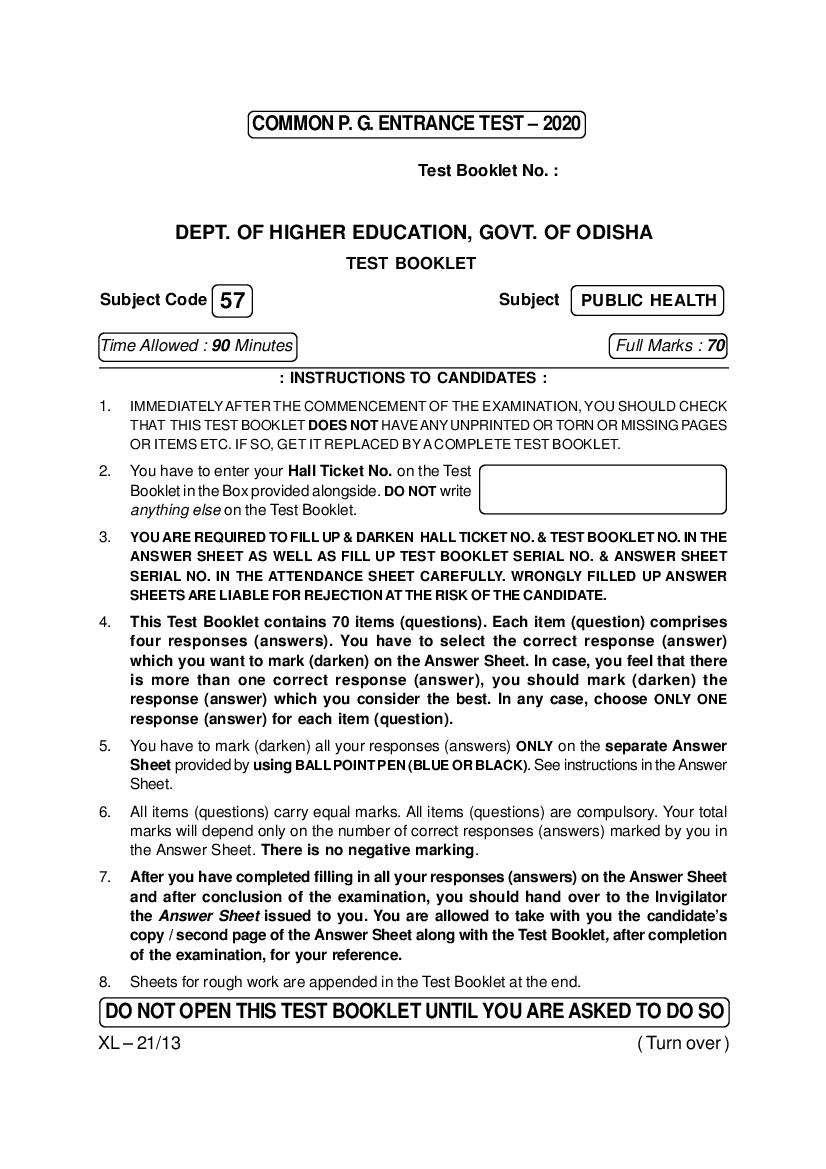
Test Booklet No. :
DEPT. OF HIGHER EDUCATION, GOVT. OF ODISHA
TEST BOOKLET
Subject Code 57 Subject PUBLIC HEALTH
Time Allowed : 90 Minutes Full Marks : 70
: INSTRUCTIONS TO CANDIDATES :
1. IMMEDIATELY AFTER THE COMMENCEMENT OF THE EXAMINATION, YOU SHOULD CHECK
THAT THIS TEST BOOKLET DOES NOT HAVE ANY UNPRINTED OR TORN OR MISSING PAGES
OR ITEMS ETC. IF SO, GET IT REPLACED BY A COMPLETE TEST BOOKLET.
2. You have to enter your Hall Ticket No. on the Test
Booklet in the Box provided alongside. DO NOT write
anything else on the Test Booklet.
3. YOU ARE REQUIRED TO FILL UP & DARKEN HALL TICKET NO. & TEST BOOKLET NO. IN THE
ANSWER SHEET AS WELL AS FILL UP TEST BOOKLET SERIAL NO. & ANSWER SHEET
SERIAL NO. IN THE ATTENDANCE SHEET CAREFULLY. WRONGLY FILLED UP ANSWER
SHEETS ARE LIABLE FOR REJECTION AT THE RISK OF THE CANDIDATE.
4. This Test Booklet contains 70 items (questions). Each item (question) comprises
four responses (answers). You have to select the correct response (answer)
which you want to mark (darken) on the Answer Sheet. In case, you feel that there
is more than one correct response (answer), you should mark (darken) the
response (answer) which you consider the best. In any case, choose ONLY ONE
response (answer) for each item (question).
5. You have to mark (darken) all your responses (answers) ONLY on the separate Answer
Sheet provided by using BALL POINT PEN (BLUE OR BLACK). See instructions in the Answer
Sheet.
6. All items (questions) carry equal marks. All items (questions) are compulsory. Your total
marks will depend only on the number of correct responses (answers) marked by you in
the Answer Sheet. There is no negative marking.
7. After you have completed filling in all your responses (answers) on the Answer Sheet
and after conclusion of the examination, you should hand over to the Invigilator
the Answer Sheet issued to you. You are allowed to take with you the candidate’s
copy / second page of the Answer Sheet along with the Test Booklet, after completion
of the examination, for your reference.
8. Sheets for rough work are appended in the Test Booklet at the end.
DO NOT OPEN THIS TEST BOOKLET UNTIL YOU ARE ASKED TO DO SO
XL – 21/13 ( Turn over )
Page 2
Page 3
(A) Poverty
(B) Gender
(C) Education
(D) Quality of life
2. Understanding and identifying with a person’s situation and feeling is known as :
(A) Pitying
(B) Grieving
(C) Empathy
(D) Sympathy
3. The construct of Gender is :
(A) Biological
(B) Sociological
(C) Physical
(D) Supernatural
4. Amoebiasis is a common condition caused by :
(A) Bacteria
(B) Virus
(C) Fungus
(D) Protozoa
5. ABC in First Aid refers to :
(A) Airway, Breathing & Circulation
(B) Affordable, Balanced & Cost effective
(C) Airway, Breathing & Communication
(D) Assistance, Blood & Circulation
6. The best word that describes the following sentence: “sample taken from a population
should be” :
(A) Representative
(B) Best in quality
(C) Precise
(D) Confident
XL – 21/13 (3) ( Turn over )
Page 4
(A) Occurrence of cases that are more than the expected frequency
(B) Occurrence of cases more than existing ones at that point of time
(C) Occurrence of cases that never occurred before
(D) Old cases that have come up again
8. Which of the following is considered as the power house of a cell ?
(A) Nucleus
(B) DNA
(C) Mitochondria
(D) Sarcoplasmic reticulum
9. What is herd immunity ?
(A) The immune status of a population
(B) The immune status of shepherds
(C) The immune status of domestic animals
(D) The immune status of the head of the household
10. One PHC is located for a population of :
(A) 5,000
(B) 30,000
(C) 100,000
(D) 500
11. Which of the following is the correct sequence of various components of the
communication process ?
(A) Receiver, Message, Channel, Feedback, Sender
(B) Sender, Feedback, Message, Channel, Receiver
(C) Sender, Message, Channel, Receiver, Feedback
(D) Message, Sender, Channel, Feedback, Receiver
12. What is the color-coding of bag in hospitals to dispose of human anatomical wastes
such as body parts ?
(A) Yellow
(B) Black
(C) Red
(D) Blue
XL – 21/13 (4) ( Continued )
Page 5
(A) Tiger mosquito
(B) Jackal mosquito
(C) Wolf mosquito
(D) Lion mosquito
14. Learned behavior which is socially acquired is known as :
(A) Customs
(B) Acculturation
(C) Standard of living
(D) Culture
15. Pulses are deficient in :
(A) Lysine and threonine
(B) Lysine and tryptophan
(C) Methionine and cysteine
(D) Lysine and methionine
16. Dash diet is important in case of :
(A) Diabetes
(B) Hypertension
(C) Both (A) and (B)
(D) None of these
17. “Hidden Hunger” is an important issue, which occurs due to deficiency of :
(A) Fats
(B) Vitamins and minerals
(C) Protein
(D) Carbohydrate
18. Breast cancer screening is an example of :
(A) Primary prevention
(B) Secondary prevention
(C) Tertiary prevention
(D) Quaternary prevention
XL – 21/13 (5) ( Turn over )
Page 6
(A) India
(B) China
(C) America
(D) German
20. Which of the following is a form of Non-probability sampling ?
(A) Purposive sampling
(B) Stratified sampling
(C) Cluster sampling
(D) Simple random sampling
21. Match the following Pioneers of Preventive Medicine and their achievements :
a. Edward Jenner (I) Transmission of Yellow fever
b. James Lind (II) Vaccination against Smallpox
c. Walter Reed (III) Prevention of scurvy
(A) a. (III), b. (I), c. (II)
(B) a. (III), b. (II), c. (I)
(C) a. (II), b. (I), c. (III)
(D) a. (II), b. (III), c. (I)
22. Hypothesis is a :
(A) Established document
(B) Axiom
(C) Variable to be tested
(D) Verified variable
23. Migration study is used to study :
(A) Diseases with long incubation period
(B) Prevalence of disease in a population
(C) Socio-demographic reasons for migration of a population
(D) Environmental and genetic factors in a disease in population
XL – 21/13 (6) ( Continued )
Page 7
(A) Exotic
(B) Anthropozoonoses
(C) Zooanthroponoses
(D) Epizootic
25. Quarantine period should be :
(A) Minimum incubation period
(B) Maximum incubation period
(C) Period of communicability
(D) Median incubation period
26. At Primary Health Center (PHC) level, vaccines are stored in the :
(A) Cold Box
(B) Deep freezer
(C) Ice lined refrigerator
(D) Walk in cold room
27. Sputum is sterilized by all expect :
(A) Boiling
(B) Chlorhexidine
(C) Cresol
(D) Autoclaving
28. KAP studies were first used in India to study :
(A) HIV
(B) Malaria
(C) Carcinoma cervix
(D) Family planning
29. Most reliable test for screening of diabetes mellitus :
(A) GTT
(B) Glycosylated hemoglobin
(C) Fasting blood sugar
(D) Urine for sugar
XL – 21/13 (7) ( Turn over )
Page 8
(A) Toga virus
(B) Paramyxovirus
(C) Orthomyxovirus
(D) Arbovirus group B
31. Incubation period of swine flu :
(A) 1-3 days
(B) 10-15 days
(C) 2-3 weeks
(D) 5 weeks
32. Urban malaria is due to :
(A) Anopheles stephensi
(B) Anopheles culicifacies
(C) Culex vishnaui
(D) Aedes
33. False about Leprosy is :
(A) It has been eliminated from India
(B) It can be transmitted through breast milk
(C) Lepromin test is not a diagnostic test
(D) MDT is contraindicated during pregnancy
34. Window period for HIV infection is :
(A) 3-12 weeks
(B) 8-20 weeks
(C) 6-24 weeks
(D) None of these
35. Food poisoning is caused by all except :
(A) Staphylococcus aureus
(B) Clostridium difficile
(C) Vibrio parahaemolyticus
(D) Bacillus cereus
XL – 21/13 (8) ( Continued )
Page 9
(A) Lung cancer
(B) Cancer of pancreas
(C) Buccal mucosa cancer
(D) Colorectal cancer
37. Internationally accepted method of measuring obesity is :
(A) Lorentz index
(B) Ponderal index
(C) BMI
(D) Corpulence index
38. The most common cause of blindness in India is :
(A) Trachoma
(B) Refractive errors
(C) Vitamin A deficiency
(D) Cataract
39. IT based TB monitoring is known as :
(A) Nischay
(B) Nikshay
(C) Nirbhay
(D) e – DOTS
40. Vital statistics in a population include :
(A) Sex ratio
(B) Birth rate
(C) Age composition
(D) Dependency ratio
41. Most common cause of low birth weight baby is :
(A) Prematurity
(B) Infection
(C) Anemia
(D) Diabetes
XL – 21/13 (9) ( Turn over )
Page 10
(A) Immunization
(B) Health Education
(C) Prevention of Iodine deficiency disorders
(D) Supplementary nutrition
43. First requisite before conducting an interview is :
(A) Securing rapport
(B) Probe questions
(C) Establishing contact
(D) Guiding the interview
44. Poverty line is defined as expenditure required for daily calorie consumption below
(urban) :
(A) 1800
(B) 2100
(C) 2000
(D) 2200
45. Principles of Health education include all except :
(A) Participation
(B) Motivation
(C) Reinforcement
(D) Punishment
46. Following occupational diseases are notifiable under the Indian Factory Act, 1976
except :
(A) Silicosis
(B) Asbestosis
(C) Byssinosis
(D) Bagassosis
47. Haemophilia is a genetic disorder of coagulation seen only in males. It is transmitted
as :
(A) X-linked dormant
(B) Y-linked dormant
(C) X-linked recessive
(D) Autosomal recessive
XL – 21/13 ( 10 ) ( Continued )
Page 11
illness ?
(A) Emotional stress
(B) Frustration
(C) Endocrine disease
(D) Anxiety
49. Number of ASHA visits after home delivery is :
(A) 4
(B) 6
(C) 5
(D) 7
50. Rural Health scheme introduced by :
(A) Bhore committee
(B) Mukherjee committee
(C) Shrivastava committee
(D) Mudaliar committee
51. The term “tracking” of blood pressure refers to :
(A) 24 hour BP monitoring
(B) Identifying children at risk of developing Hypertension at future date
(C) Pictorial representation of BP
(D) BP control with medication as tablet
52. Which is not correct regarding commercial surrogacy ?
(A) Made commercial surrogacy legal in India
(B) Only allows altruistic surrogacy for needy, infertile Indian couples
(C) Requires intended parents to be married for five years and have a doctor’s
certificate of their infertility
(D) Restricts women to being surrogates only once, and only if they are a close
relative of the intended parents, are married and have a biological child
53. What is the most serious potential side effect of vaccination ?
(A) Swelling
(B) Soreness
(C) Fever
(D) Anaphylaxis
XL – 21/13 ( 11 ) ( Turn over )
Page 12
(A) Metastasis
(B) Peritonitis
(C) Pnemothorax
(D) Hemophilia
55. At the village level, which one of the following is the executive organ and agency for
planning and development ?
(A) Gram sabha
(B) Gram panchayat
(C) Nyaya panchayat
(D) Zila panchayat
56. Thanatology is the study of :
(A) Life expectancy
(B) Biological aging
(C) Death and Dying
(D) Adulthood
57. Action research means :
(A) A longitudinal research
(B) An applied research
(C) A research initiated to solve an immediate problem
(D) A research with socio-economic objective
58. Which of the following is not a “graphic representation” ?
(A) Pie chart
(B) Bar chart
(C) Table
(D) Histogram
59. All of the following diseases require surveillance according to WHO, except :
(A) Chickenpox
(B) Yellow fever
(C) Malaria
(D) Rabies
XL – 21/13 ( 12 ) ( Continued )
Page 13
(A) Proteins
(B) Water
(C) Fats
(D) Minerals
61. Census in India is done every :
(A) 10 years
(B) 05 years
(C) 15 years
(D) 20 years
62. Kidneys maintain blood pressure by regulating :
(A) Toxins levels in the body
(B) Lipids and Proteins in the body
(C) Nutrients levels in the body
(D) Salt and fluid levels in the body
63. Which of the following is the lowest source of energy in our diet ?
(A) Carbohydrates
(B) Fiber
(C) Proteins
(D) Fats and oils
64. The headquarter of WHO is in :
(A) Rome
(B) New York
(C) Paris
(D) Geneva
65. Assertion (a): Pasteurization of milk is a sterilization process.
Reason (r): its purpose is to destroy all the pathogenic organisms.
(A) Both (a) and (r) are true and (r) is the correct explanation of (a).
(B) Both (a) and (r) are true and (r) is not the correct explanation of (a).
(C) (a) is true, but (r) is false.
(D) (a) is false, but (r) is true.
XL – 21/13 ( 13 ) ( Turn over )
Page 14
(A) 27
(B) 21
(C) 9
(D) 3
67. Which of the following statements is incorrect about WHO ?
(A) Objective of WHO is attainment by all people of the highest level of health.
(B) Headquarters of WHO are located in Geneva.
(C) WHO is a non-specialized, political agency of United Nations.
(D) World Health Assembly is the ‘Health Parliament’ and supreme governing body
of the organization.
68. Global warming true is :
(A) CO2 is major greenhouse gas
(B) Stratosphere ozone layer is harmful.
(C) CFC increases stratosphere ozone layer
(D) Kyoto protocol called for 20% reduction in green house emissions
69. In normal delivery, breast feeding should be started within :
(A) 1 hour of delivery
(B) 1 hour of delivery
(C) 4 hour of delivery
(D) 6 hour of delivery
70. Vaccine which should not be given to an elderly man is :
(A) Measles vaccine
(B) H. influenza vaccine
(C) TT vaccine
(D) Pneumococcal vaccine
XL – 21/13 ( 14 ) ( Continued )
Page 15
XL – 21/13 (470) ( 15 ) Public Health
Document Details
| Board / Org | Odisha Exams |
| Exam | Odisha CPET |
| Type | Question Paper |
| Pages | 15 |
| Updated | 22 Jul 2026 |