Odisha CPET 2020 Question Paper Wild Life and Biodiversity Conservation
Finished viewing? Save it for later —
Download Odisha CPET 2020 Question Paper Wild Life and Biodiversity Conservation (PDF · 15 pages)About Odisha CPET 2020 Question Paper Wild Life and Biodiversity Conservation
Odisha CPET 2020 Question Paper Wild Life and Biodiversity Conservation is available here for free download. Published by Odisha Exams for Odisha CPET, this question paper can be viewed online or downloaded as a PDF (15 pages). Candidates preparing for Odisha CPET can use Odisha CPET 2020 Question Paper Wild Life and Biodiversity Conservation to understand the exam pattern, the type of questions asked, and the overall difficulty level.
Frequently Asked Questions
How can I download Odisha CPET 2020 Question Paper Wild Life and Biodiversity Conservation?
Open this page and click the Download button to save Odisha CPET 2020 Question Paper Wild Life and Biodiversity Conservation as a PDF. It is completely free on AglaSem Docs.
Is Odisha CPET 2020 Question Paper Wild Life and Biodiversity Conservation free to download?
Yes. Odisha CPET 2020 Question Paper Wild Life and Biodiversity Conservation can be viewed online and downloaded as a PDF free of cost on AglaSem Docs.
How many pages does Odisha CPET 2020 Question Paper Wild Life and Biodiversity Conservation have?
Odisha CPET 2020 Question Paper Wild Life and Biodiversity Conservation contains 15 pages, which you can read online or download together as a single PDF.
Where can I find more Odisha CPET study material?
You can find more Odisha CPET question papers, sample papers, syllabus, and answer keys on AglaSem Docs.
Odisha CPET 2020 Question Paper Wild Life and Biodiversity Conservation – Text
Read the full text of this question paper below — useful to quickly search, copy and reference the content online without downloading the PDF.
📄 View text version (15 pages)
Page 1
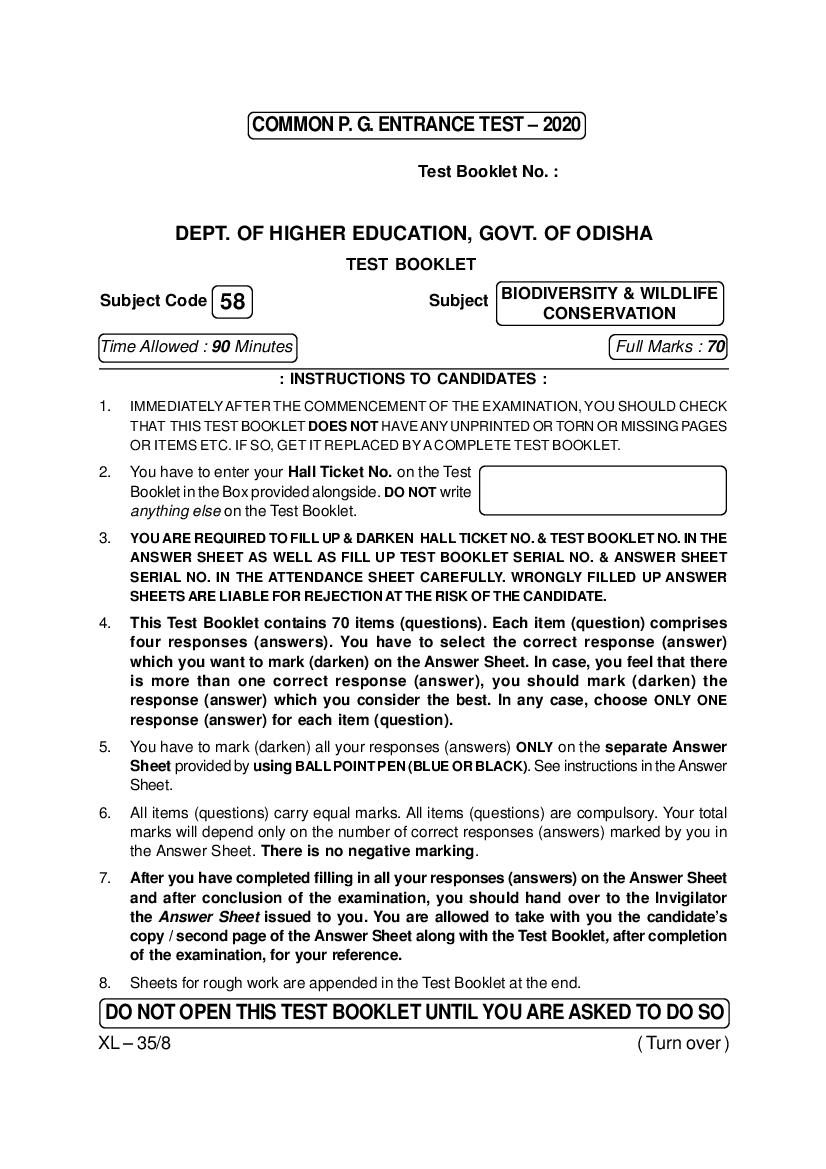
Test Booklet No. :
DEPT. OF HIGHER EDUCATION, GOVT. OF ODISHA
TEST BOOKLET
Subject Code 58 Subject BIODIVERSITY & WILDLIFE
CONSERVATION
Time Allowed : 90 Minutes Full Marks : 70
: INSTRUCTIONS TO CANDIDATES :
1. IMMEDIATELY AFTER THE COMMENCEMENT OF THE EXAMINATION, YOU SHOULD CHECK
THAT THIS TEST BOOKLET DOES NOT HAVE ANY UNPRINTED OR TORN OR MISSING PAGES
OR ITEMS ETC. IF SO, GET IT REPLACED BY A COMPLETE TEST BOOKLET.
2. You have to enter your Hall Ticket No. on the Test
Booklet in the Box provided alongside. DO NOT write
anything else on the Test Booklet.
3. YOU ARE REQUIRED TO FILL UP & DARKEN HALL TICKET NO. & TEST BOOKLET NO. IN THE
ANSWER SHEET AS WELL AS FILL UP TEST BOOKLET SERIAL NO. & ANSWER SHEET
SERIAL NO. IN THE ATTENDANCE SHEET CAREFULLY. WRONGLY FILLED UP ANSWER
SHEETS ARE LIABLE FOR REJECTION AT THE RISK OF THE CANDIDATE.
4. This Test Booklet contains 70 items (questions). Each item (question) comprises
four responses (answers). You have to select the correct response (answer)
which you want to mark (darken) on the Answer Sheet. In case, you feel that there
is more than one correct response (answer), you should mark (darken) the
response (answer) which you consider the best. In any case, choose ONLY ONE
response (answer) for each item (question).
5. You have to mark (darken) all your responses (answers) ONLY on the separate Answer
Sheet provided by using BALL POINT PEN (BLUE OR BLACK). See instructions in the Answer
Sheet.
6. All items (questions) carry equal marks. All items (questions) are compulsory. Your total
marks will depend only on the number of correct responses (answers) marked by you in
the Answer Sheet. There is no negative marking.
7. After you have completed filling in all your responses (answers) on the Answer Sheet
and after conclusion of the examination, you should hand over to the Invigilator
the Answer Sheet issued to you. You are allowed to take with you the candidate’s
copy / second page of the Answer Sheet along with the Test Booklet, after completion
of the examination, for your reference.
8. Sheets for rough work are appended in the Test Booklet at the end.
DO NOT OPEN THIS TEST BOOKLET UNTIL YOU ARE ASKED TO DO SO
XL – 35/8 ( Turn over )
Page 2
Page 3
(A) Genetic diversity
(B) Species diversity
(C) Ecosystem diversity
(D) All of the above
2. The varieties of mango with different flavour, colour, sugar and fleshy content is due
to :
(A) Hybridization
(B) Genetic diversity
(C) Species diversity
(D) Induced mutation
3. Biodiversity :
(A) Increases towards equator
(B) Decreases towards equator
(C) Remains same throughout the planet
(D) Increases towards pole
4. Which of the following has maximum global biodiversity ?
(A) Angiosperms
(B) Algae
(C) Fungi
(D) Mosses
5. The most important reason for decrease in biodiversity is :
(A) Habitat destruction
(B) Introduction of exotic species
(C) Over exploitation
(D) Habitat pollution
XL – 35/8 (3) ( Turn over )
Page 4
(A) Mangroves
(B) Temperate rain forest
(C) Tiaga
(D) Coral reefs
7. Ex-situ conservation includes :
(A) Zoo
(B) Germplasm bank
(C) Botanical Garden
(D) All of the above
8. Endemic species are :
(A) Cosmopolitan in distribution
(B) Endangered species
(C) Species localized in a specific region
(D) Rare species
9. How many mega-biodiverse countries are there in the world ?
(A) 15
(B) 17
(C) 25
(D) 35
10. Which one of the following areas in India is a hotspot of biodiversity ?
(A) Sunderbans
(B) Western Ghats
(C) Eastern Ghats
(D) Gangetic plains
11. Which one of the following is not observed in biodiversity hotspots ?
(A) Species richness
(B) Endemism
(C) Accelerated species loss
(D) Lesser inter-specific competition
XL – 35/8 (4) ( Continued )
Page 5
(A) Genetic diversity
(B) Community and ecosystem diversity
(C) Species diversity
(D) Biome diversity
13. The percentage of forest cover recommended by the National Forest Policy (1988)
is :
(A) 33% for plains and 67% for hills
(B) 25% for plains and 75% for hills
(C) 20% for plains and 80% for hills
(D) 35% for plains and 65% for hills
14. Biodiversity of a geographical region represents :
(A) Genetic diversity present in the dominant species of the region
(B) Species endemic to the region
(C) Endangered species found in the region
(D) The diversity in the organisms living in the region
15. Which one of the following is not an in-situ conservation method ?
(A) Zoo
(B) National Parks
(C) Biosphere Reserves
(D) Sanctuaries
16. The activities of cultivation of land, timber harvesting is permitted in :
(A) Sanctuaries
(B) National Parks
(C) Biosphere Reserves
(D) Protected Areas
17. Which of the following statement is correct ?
(A) Decreased diversity contributed to higher productivity.
(B) Decreased diversity contributed to decreased productivity.
(C) Increased diversity contributed to increased productivity.
(D) Increased diversity contributed to decreased productivity.
XL – 35/8 (5) ( Turn over )
Page 6
(A) Brazil
(B) South Africa
(C) Sweden
(D) Argentina
19. Which region of the earth has the greatest biodiversity on earth ?
(A) Amazonian rain forest
(B) Indonesian tropical forest
(C) European temperate forest
(D) Siberian scrubland
20. .”International Biodiversity Day” is celebrated on :
(A) 22nd March
(B) 22nd April
(C) 22nd May
(D) 22nd June
21. The National tree of India is ________.
(A) Peepal
(B) Mango
(C) Sal
(D) Banyan
22. Which of the following area of India has the largest number of endemic plant species ?
(A) Himalayn Region
(B) Malabar Region
(C) Gangetic Plains
(D) Western Ghats
23. India’s first National Centre for Marine Bio-diversity (NCMB) is located at :
(A) Bhavnagar
(B) Jamnagar
(C) Mumbai
(D) Pondicherry
XL – 35/8 (6) ( Continued )
Page 7
credited for being of much help in launching the environment movement ?
(A) Rachel Carson
(B) Norman Mayers
(C) E. P. Odum
(D) Pat Hutchings
25. Which among the following is the main objective(s) of National Green Corps ?
(A) Educate youngsters about environment and eco-systems
(B) Prosecute and Punish the violators of Environment laws
(C) Promote Green Products
(D) All of the above
26. A keystone species is one that :
(A) Has a higher likelihood of extinction than a non keystone species
(B) Exerts a strong influence on an ecosystem
(C) Causes other species to become extinct
(D) Has a weak influence on an ecosystem
27. Which of the following Environmentalists first gave the concept of “Biodiversity
Hotspots” ?
(A) Gaylord Nelson
(B) Norman Myers
(C) John Muir
(D) Aristotle
28. Which of the following is not a reason that accounts for greater biodiversity of tropics ?
(A) availability of more solar energy
(B) more niche specialization
(C) more time for species diversification
(D) large seasonal variations in environmental factors
XL – 35/8 (7) ( Turn over )
Page 8
(A) 12%, 7%
(B) 2.4%, 9%
(C) 8.1%, 2.4%
(D) 4%, 3%
30. Sundar Lal Bahuguna is known for his involvement in :
(A) Chipko Andolan
(B) Narmada Bachhao Andolan
(C) BALCO Andolan
(D) None of the above
31. The Environment (Protection) Act of India was enacted in which of the following year ?
(A) 1976
(B) 1986
(C) 1996
(D) 1992
32. The State flower of Odisha is ________.
(A) Rose
(B) Lotus
(C) Shephali
(D) Palash
33. Wildlife is important because it provides :
(A) Ecological value
(B) Aesthetic value
(C) Economic value
(D) All of the above
34. Which of the following is mainly responsible for extinction of wildlife ?
(A) Pollution of air and water
(B) Hunting for flesh
(C) Destruction of habitats
(D) All of the above
XL – 35/8 (8) ( Continued )
Page 9
(A) Red Panda
(B) Giant Panda
(C) Yellow Panda
(D) Blue Panda
36. How many Biodiversity Hotspots in the world have been identified till date by Norman
Myers ?
(A) 17
(B) 25
(C) 34
(D) 43
37. Red Data Book provides data on :
(A) Plants species
(B) Animal species
(C) Economically important species
(D) Threatened species
38. When is the World Wildlife week is celebrated ?
(A) First week of October
(B) First week of September
(C) Last week of September
(D) Last week of October
39. The one-horned rhinoceros is specific to which of the following sanctuary ?
(A) Bandipur
(B) Corbett park
(C) Kaziranga
(D) Simlipal
40. Which of the following organization is responsible for maintaining the Red Data Book ?
(A) UNEP
(B) IUCN
(C) UNESCO
(D) WWF
XL – 35/8 (9) ( Turn over )
Page 10
(A) Increased number of predatory birds
(B) Over exploitation by humans
(C) Non-availability of the food
(D) Bird flu virus infection
42. How many wildlife sanctuaries are there in India ?
(A) 408
(B) 448
(C) 478
(D) 428
43. 70 per cent of the animal species recorded are ——————.
(A) Protozoa
(B) Arthropods
(C) Reptiles
(D) Mammals
44. What is the mission of Ramsar convention ?
(A) Wetland conservation
(B) Forest conservation
(C) Desert conservation
(D) Biodiversity conservation
45. How many national parks are there in India ?
(A) 50
(B) 70
(C) 90
(D) 110
46. “Dancing Deer” is found in which of the following states of India ?
(A) Jammu & Kashmir
(B) UP
(C) Kerala
(D) Manipur
XL – 35/8 ( 10 ) ( Continued )
Page 11
(A) Bird
(B) Reptile
(C) Mammal
(D) Arthropod
48. Project Elephant was launched by the Government of India in which year ?
(A) 1991
(B) 1992
(C) 1993
(D) 1994
49. Lion-tailed macaque is found in ——————.
(A) Eastern Ghats
(B) Western Ghats
(C) East Himalayas
(D) West Himalayas
50. Which of the following is India’s First National Marine Park ?
(A) Mahatma Gandhi Marine National Park
(B) Marine National Park, Gulf of Kutch
(C) Rani Jhansi Marine National Park
(D) Gulf of Mannar Marine National Park
51. World Wetland Day is observed on :
(A) 2nd February
(B) 22nd April
(C) 5th June
(D) 11th July
52. The Washington Convention whose formal name is abbreviated as CITES is
related to which among the following ?
(A) Ozone Layer Depletion
(B) Animal Rights
(C) Deforestation
(D) Endangered Species
XL – 35/8 ( 11 ) ( Turn over )
Page 12
(A) White Tiger (B) Gharial
(C) Hippo (D) Chimpanzee
54. In which year project Tiger was launched ?
(A) 1963 (B) 1983
(C) 1993 (D) 1973
55. Which among the following awards instituted by the Government of India for individuals
or communities from rural areas that have shown extraordinary courage and
dedication in protecting Wildlife ?
(A) Indira Gandhi Paryavaran Puraskar
(B) Medini Puruskar Yojana
(C) Amrita Devi Bishnoi Award
(D) Pitambar Pant National Award
56. The highest number of endangered species is seen in ——————.
(A) Fishes (B) Reptiles
(C) Birds (D) Mammals
57. In which year Indian Wildlife (Protection) Act was implemented ?
(A) 1962 (B) 1968
(C) 1972 (D) 1982
58. Which of the following statement is correct about the National Park ?
(A) Multipurpose protected areas to preserve genetic diversity in representative
ecosystem.
(B) A reserve area meant for preserving its natural vegetation, wildlife and natural
beauty.
(C) A reserved area meant for preservation and development of endangered
species
(D) All of the above
XL – 35/8 ( 12 ) ( Continued )
Page 13
(A) Sheep (B) Goat
(C) Rabbit (D) Yak
60. Flagship species are species with which of the following characteristics ?
(A) Indicating health of ecosystem
(B) Supporting basic requirements of ecosystem
(C) Species leading to conservation of other linked species
(D) Species with charismatic appeal
61. Which of the following Sanctuary is famous for the rare gangetic dolphin and also for
magar (Crocodile) and Gharial (Aligator) ?
(A) Kaziranga Wildlife Sanctuary
(B) Mahatma Gandhi Marine National Park
(C) Gahirmatha Marine Wildlife Sanctuary
(D) National Chambal Sanctuary
62. The volume of trade in endangered species is monitored by :
(A) TRAFFIC (B) MOEF
(C) CITES (D) WWF
63. The Indian Board of Wildlife was constituted in the year ——————.
(A) 1948 (B) 1952
(C) 1958 (D) 1962
64. Gangetic Dolphin is a type of :
(A) Rare Species
(B) Vulnerable species
(C) Extinct species
(D) None of the above
65. Viable materials of endangered species can be preserved in :
(A) Gene Bank (B) Gene pool
(C) Gene Library (D) Herbarium
XL – 35/8 ( 13 ) ( Turn over )
Page 14
(A) Switzerland (B) France
(C) USA (D) UK
67. Which of the following statement is correct about the Biosphere Reserve ?
(A) Multipurpose protected areas to preserve genetic diversity in representative
ecosystem
(B) A reserve area meant for preserving its natural vegetation, wildlife and beauty
(C) A reserved area meant for preservation and development of endangered
species
(D) All of the above
68. Which of the following is the most suitable natural place for Olive Ridely Sea Turtles
for mating and nesting ?
(A) Gulf of Kutch Marine National Park
(B) Mahatma Gandhi Marine National Park
(C) Gahirmatha Marine Wildlife Sanctuary
(D) Gulf of Mannar Marine National Park
69. The National Bird of India is ——————.
(A) Dove
(B) Peacock
(C) Parrot
(D) None of the above
70. The State animal of Odisha is——————.
(A) Elephant
(B) Deer
(C) Gaur
(D) Sambar
XL – 35/8 ( 14 ) ( Continued )
Page 15
XL – 35/8 (570) ( 15 ) Biodiversity and Wildlife Conservation
Document Details
| Board / Org | Odisha Exams |
| Exam | Odisha CPET |
| Type | Question Paper |
| Pages | 15 |
| Updated | 30 Apr 2026 |