Odisha CPET 2020 Question Paper Yoga Naturopathy
Finished viewing? Save it for later —
Download Odisha CPET 2020 Question Paper Yoga Naturopathy (PDF · 15 pages)About Odisha CPET 2020 Question Paper Yoga Naturopathy
Odisha CPET 2020 Question Paper Yoga Naturopathy is available here for free download. Published by Odisha Exams for Odisha CPET, this question paper can be viewed online or downloaded as a PDF (15 pages). Candidates preparing for Odisha CPET can use Odisha CPET 2020 Question Paper Yoga Naturopathy to understand the exam pattern, the type of questions asked, and the overall difficulty level.
Frequently Asked Questions
How can I download Odisha CPET 2020 Question Paper Yoga Naturopathy?
Open this page and click the Download button to save Odisha CPET 2020 Question Paper Yoga Naturopathy as a PDF. It is completely free on AglaSem Docs.
Is Odisha CPET 2020 Question Paper Yoga Naturopathy free to download?
Yes. Odisha CPET 2020 Question Paper Yoga Naturopathy can be viewed online and downloaded as a PDF free of cost on AglaSem Docs.
How many pages does Odisha CPET 2020 Question Paper Yoga Naturopathy have?
Odisha CPET 2020 Question Paper Yoga Naturopathy contains 15 pages, which you can read online or download together as a single PDF.
Where can I find more Odisha CPET study material?
You can find more Odisha CPET question papers, sample papers, syllabus, and answer keys on AglaSem Docs.
Odisha CPET 2020 Question Paper Yoga Naturopathy – Text
Read the full text of this question paper below — useful to quickly search, copy and reference the content online without downloading the PDF.
📄 View text version (15 pages)
Page 1
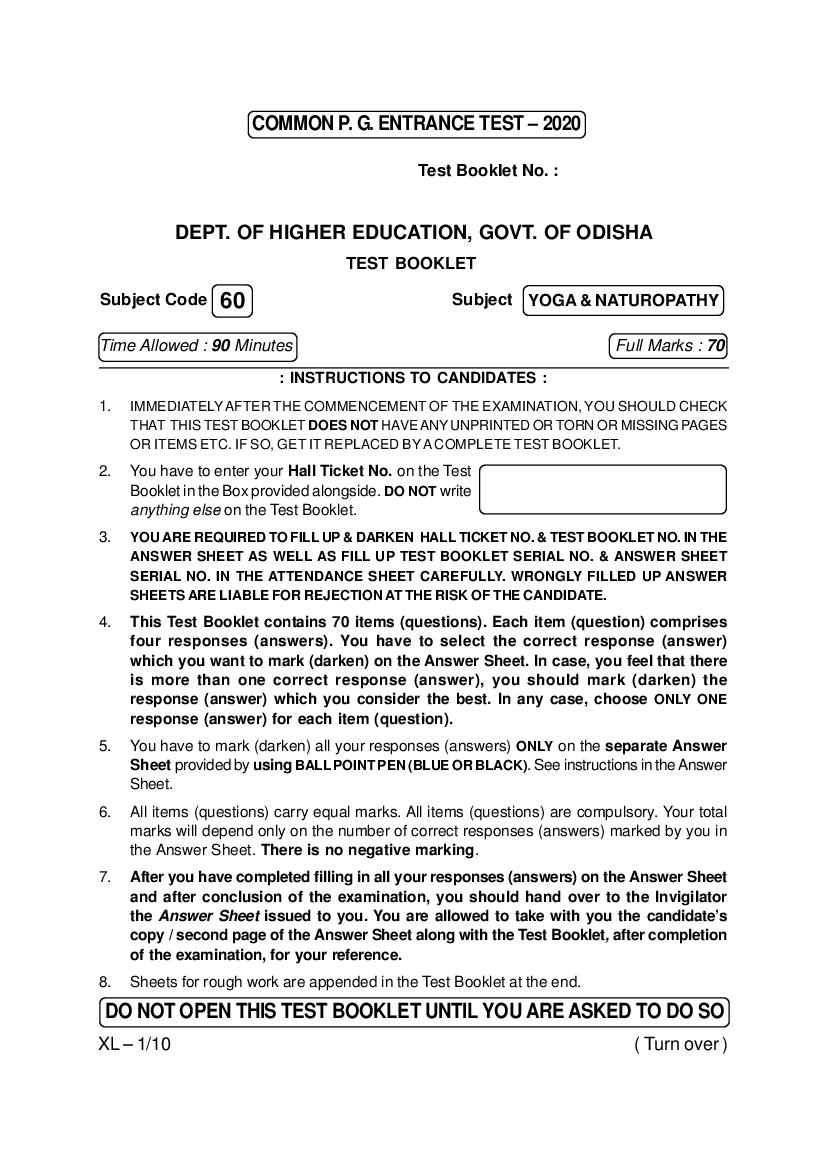
Test Booklet No. :
DEPT. OF HIGHER EDUCATION, GOVT. OF ODISHA
TEST BOOKLET
Subject Code 60 Subject YOGA & NATUROPATHY
Time Allowed : 90 Minutes Full Marks : 70
: INSTRUCTIONS TO CANDIDATES :
1. IMMEDIATELY AFTER THE COMMENCEMENT OF THE EXAMINATION, YOU SHOULD CHECK
THAT THIS TEST BOOKLET DOES NOT HAVE ANY UNPRINTED OR TORN OR MISSING PAGES
OR ITEMS ETC. IF SO, GET IT REPLACED BY A COMPLETE TEST BOOKLET.
2. You have to enter your Hall Ticket No. on the Test
Booklet in the Box provided alongside. DO NOT write
anything else on the Test Booklet.
3. YOU ARE REQUIRED TO FILL UP & DARKEN HALL TICKET NO. & TEST BOOKLET NO. IN THE
ANSWER SHEET AS WELL AS FILL UP TEST BOOKLET SERIAL NO. & ANSWER SHEET
SERIAL NO. IN THE ATTENDANCE SHEET CAREFULLY. WRONGLY FILLED UP ANSWER
SHEETS ARE LIABLE FOR REJECTION AT THE RISK OF THE CANDIDATE.
4. This Test Booklet contains 70 items (questions). Each item (question) comprises
four responses (answers). You have to select the correct response (answer)
which you want to mark (darken) on the Answer Sheet. In case, you feel that there
is more than one correct response (answer), you should mark (darken) the
response (answer) which you consider the best. In any case, choose ONLY ONE
response (answer) for each item (question).
5. You have to mark (darken) all your responses (answers) ONLY on the separate Answer
Sheet provided by using BALL POINT PEN (BLUE OR BLACK). See instructions in the Answer
Sheet.
6. All items (questions) carry equal marks. All items (questions) are compulsory. Your total
marks will depend only on the number of correct responses (answers) marked by you in
the Answer Sheet. There is no negative marking.
7. After you have completed filling in all your responses (answers) on the Answer Sheet
and after conclusion of the examination, you should hand over to the Invigilator
the Answer Sheet issued to you. You are allowed to take with you the candidate’s
copy / second page of the Answer Sheet along with the Test Booklet, after completion
of the examination, for your reference.
8. Sheets for rough work are appended in the Test Booklet at the end.
DO NOT OPEN THIS TEST BOOKLET UNTIL YOU ARE ASKED TO DO SO
XL – 1/10 ( Turn over )
Page 2
Page 3
How many maha –tas are there?
(A) 9
(B) 5
(C) 7
(D) 10
2. Number of lungs present in human body are :
(A) 2
(B) 1
(C) 3
(D) 4
3. Total numbers of bones of human body are :
(A) 306
(B) 206
(C) 270
(D) 207
4. Number of chambers of human heart are :
(A) 4
(B) 6
(C) 2
(D) 3
5. The basic structural and functional unit of human body is :
(A) Cell
(B) Tissue
(C) Organ
(D) System
XL – 1/10 (3) ( Turn over )
Page 4
(A) Vein
(B) Artery
(C) Both artery and vein
(D) Lymphatic vessels
7. Branches of Yoga as mentioned by Maharshi Patanjali are :
(A) 6
(B) 5
(C) 8
(D) 10
8. How many chapters are there in Bhagabat Gita– :
(A) 16
(B) 18
(C) 20
(D) 21
9. Liver comes under which system of Human body ?
(A) Respiratory
(B) Digestive
(C) Excretory
(D) Circulatory
10. Brain and spinal cord are included under which system of Human body ?
(A) Reproductive
(B) Endocrine
(C) Nervous
(D) Circulatory
XL – 1/10 (4) ( Continued )
Page 5
(A) Lungs
(B) Liver
(C) Heart
(D) Spleen
12. The most important organ of excretory system of human body :
(A) Liver
(B) Pancreas
(C) Kidney
(D) Stomach
13. The normal pulse rate of human body is :
(A) 72/ min
(B) 65/min
(C) 80/min
(D) 75/min
14. The normal blood pressure of human body is :
(A) 120/ 80 mmHg
(B) 130/90 mmHg
(C) 110/70 mmHg
(D) 130/80 mmHg
15. Who codified Astanga Yoga ?
(A) Maharshi Balmiki
(B) Maharshi Vyasadev
(C) Maharshi Patanjali
(D) Swami Svatmarama
XL – 1/10 (5) ( Turn over )
Page 6
(A) 7
(B) 6
(C) 9
(D) 5
17. How many koshas present in human body as per Yoga &Ayurveda ?
(A) 4
(B) 5
(C) 6
(D) 3
18. How many doshas present in human body as per Yoga & Ayurveda ?
(A) Tridosha
(B) Saptadosha
(C) Panchadosha
(D) Astadosha
19. How many dhatus present in human body as per Yoga & Ayurveda ?
(A) Saptadhatu
(B) Astadhatu
(C) Panchadhatu
(D) Tridhatu
20. How many gunas are present in human body as per Yoga & Ayurveda ?
(A) Triguna
(B) Panchaguna
(C) Sadguna
(D) Astaguna
XL – 1/10 (6) ( Continued )
Page 7
(A) 21 (B) 20
(C) 24 (D) 16
22. Number of Karmendriyas are :
(A) 4 (B) 5
(C) 7 (D) 9
23. Number of Jnanendriyas are :
(A) 4 (B) 5
(C) 7 (D) 9
24. How many Vedas are there ?
(A) 3 (B) 4
(C) 6 (D) 7
25. Number of major Upanishads are :
(A) 10 (B) 8
(C) 9 (D) 15
26. Bhagabat Gita describes the following yogic paths are :
(A) Karma,Raja, Jnana and Bhakti yoga
(B) Karma, Jnana and Bhakti yoga
(C) Karma , Bhakti and Dhyana yoga
(D) Karma, Jnana and Dhyana yoga
27. Number of incarnations of Lord Visnu are :
(A) 9 (B) 7
(C) 10 (D) 12
28. Number of Siddhis are :
(A) 7 (B) 9
(C) 10 (D) 8
XL – 1/10 (7) ( Turn over )
Page 8
(A) 7 (B) 9
(C) 6 (D) 8
30. Which are known as “Shrutis”, the revealed wisdom ?
(A) Puranas
(B) Upanishads
(C) Vedas
(D) All of these
31. Which deity is associated with the science of medicine, Ayurveda ?
(A) Lord Shiva
(B) Lord Brahma
(C) Lord Dhanwantari
(D) Lord Ganesh
32. Who is known as Yogeswar ?
(A) Lord Krusna
(B) Lord Rama
(C) Lord Shiva
(D) Lord Brahma
33. Number of Tanmatras(subtle elements) are :
(A) 3 (B) 6
(C) 9 (D) 5
34. Number of Ubhayendriya (both sensory and motor) are :
(A) 4 (B) 10
(C) 7 (D) 5
–nendriyas(sense organs) are :
35. Number of Jna
(A) 3 (B) 2
(C) 4 (D) 5
XL – 1/10 (8) ( Continued )
Page 9
(A) Allopathy
(B) Homeopathy
(C) Ayurveda
(D) Naturopathy
37. The science that treats and prevents diseases not by medicines but by mahabhutas
and diet :
(A) Ayurveda
(B) Naturopathy
(C) Siddha
(D) Unani
38. Number of kidney present in human body are / is :
(A) 2 (B) 1
(C) 3 (D) 4
–rthas are :
39. The number of Purusha
(A) 3 (B) 5
(C) 4 (D) 7
–di includes :
40. Trividha-na
(A) Ida, Pingala, Susumna
(B) Ida, Pingala,Pusa
(C) Ida, Gandhari, Susumna
(D) Pingala, Susumna, Saraswati
41. The first book to mention yoga :
(A) Puranas
(B) Ramayana
(C) Vedas
(D) Mahabharata
XL – 1/10 (9) ( Turn over )
Page 10
(A) 32 (B) 33
(C) 29 (D) 35
43. The function of Jatharagni is :
(A) Digestion
(B) Respiration
(C) Circulation
(D) Reproduction
44. Kundalini shakti resides in :
(A) Mula–dha–ra chakra
(B) Navi
(C) Nadi
(D) Nasagra
45. The structural and functional unit of excretory system is :
(A) Neuron
(B) Nephron
(C) Both (A) and (B)
(D) None of these
46. The structural and functional unit of nervous system is :
(A) Neuron
(B) Nephron
(C) Both (A) and (B)
(D) None of these
47. Which organ is called as power house of cell ?
(A) Nucleus
(B) Mitochondria
(C) Ribosomes
(D) Lysosomes
XL – 1/10 ( 10 ) ( Continued )
Page 11
(A) 98.4 degree F
(B) 97 degree F
(C) 95 degree F
(D) 99 degree F
49. The number of chromosomes of human being are :
(A) 23 pairs
(B) 25 pairs
(C) 22 pairs
(D) 24 pairs
50. The blood cells that carry oxygen and carbon dioxide is :
(A) RBC
(B) WBC
(C) Platelets
(D) All of these
51. The blood cells that helps in body immunity :
(A) RBC
(B) WBC
(C) Platelets
(D) All of these
52. The process of regulation of prana through breath control is called :
(A) Pranayaama
(B) Mudra
(C) Meditation
(D) Relaxation
XL – 1/10 ( 11 ) ( Turn over )
Page 12
(A) Teja (B) Birjya
(C) Oja (D) Bala
54. Which day is celebrated as International Yoga Day ?
(A) 21st June
(B) 20th August
(C) 25st December
(D) 22nd July
55. Bhagabat Gita is a part of :
(A) Ramayana
(B) Mahabharata
(C) Bhagavata
(D) None of these
56. Kriyayoga includes :
(A) Tapa
(B) Svadhyaya
(C) Iswarapranidhana
(D) All of these
–natrayee is :
57. Prastha
(A) Upanishad
(B) Brahmasutra
(C) Bhagavad Gita
(D) All of these
58. No. of branches of Ayurveda are :
(A) 6 (B) 7
(C) 8 (D) 5
XL – 1/10 ( 12 ) ( Continued )
Page 13
(A) 6 (B) 4
(C) 3 (D) 5
60. No. of Niyamas mentioned in Patanjali Yogasutra are :
(A) 6
(B) 8
(C) 7
(D) 5
–das of Patanjali Yogasutra are :
61. No. of Pa
(A) 6 (B) 4
(C) 3 (D) 5
62. Jainism and Budhism are included under :
(A) Nastika darshana
(B) Astika darsana
(C) Both (A) and (B)
(D) None of these
63. Yoga and Vedanta are included under :
(A) Nastika darshana
(B) Astika darsana
(C) Both (A) and (B)
(D) None of these
64. Which of the following substances is found in greater quantity in exhaled air ?
(A) Carbon dioxide
(B) Carbon monoxide
(C) Nitrogen
(D) Oxygen
XL – 1/10 ( 13 ) ( Turn over )
Page 14
(A) Alveoli (B) Bronchi
(C) Bronchioles (D) Capillaries
66. Which of the following is the master gland of the endocrine system ?
(A) Adrenal (B) Pineal
(C) Pituitary (D) Thyroid
67. Transcendental Meditation was propagated by :
(A) Swami Ram Dev
(B) Maharshi Dayanand
(C) Swami Shivananda
(D) Maharshi Mahesh Yogi
68. Integral yoga is the concept of :
(A) Swami Vivekananda
(B) Maharshi Dayanand
(C) Swami Shivananda
(D) Sri Aurobindo
69. Which is the Sanskrit root (verb form) for the etymological derivation of the word
“Yoga” ?
(A) Yug (B) Yuge
(C) Yuj (D) Yuje
70. The Yoga class usually begin with a ?
(A) A Prayer (B) Suryanamaskar
(C) Yogic Sukshma Vyayama (D) Yogasana
XL – 1/10 ( 14 ) ( Continued )
Page 15
XL – 1/10 (370) ( 15 ) Yoga and Naturopathy
Document Details
| Board / Org | Odisha Exams |
| Exam | Odisha CPET |
| Type | Question Paper |
| Pages | 15 |
| Updated | 22 Jul 2026 |