PSTET 2025 Syllabus
Finished viewing? Save it for later —
Download PSTET 2025 Syllabus (PDF · 32 pages)About PSTET 2025 Syllabus
PSTET 2025 Syllabus is available here for free download. Published by Punjab Exams for PSTET, this syllabus can be viewed online or downloaded as a PDF (32 pages). Candidates preparing for PSTET can use PSTET 2025 Syllabus to understand the exam pattern, the type of questions asked, and the overall difficulty level.
Frequently Asked Questions
How can I download PSTET 2025 Syllabus?
Open this page and click the Download button to save PSTET 2025 Syllabus as a PDF. It is completely free on AglaSem Docs.
Is PSTET 2025 Syllabus free to download?
Yes. PSTET 2025 Syllabus can be viewed online and downloaded as a PDF free of cost on AglaSem Docs.
How many pages does PSTET 2025 Syllabus have?
PSTET 2025 Syllabus contains 32 pages, which you can read online or download together as a single PDF.
Where can I find more PSTET study material?
You can find more PSTET question papers, sample papers, syllabus, and answer keys on AglaSem Docs.
PSTET 2025 Syllabus – Text
Read the full text of this syllabus below — useful to quickly search, copy and reference the content online without downloading the PDF.
📄 View text version (33 pages)
Page 1
EXAM YEAR TYPE
PSTET 2025 Syllabus
Notes · Sample Papers · Previous Year Papers · Mock Tests
Page 2
N
m
m .co
c. o s e m
em l a
las a g
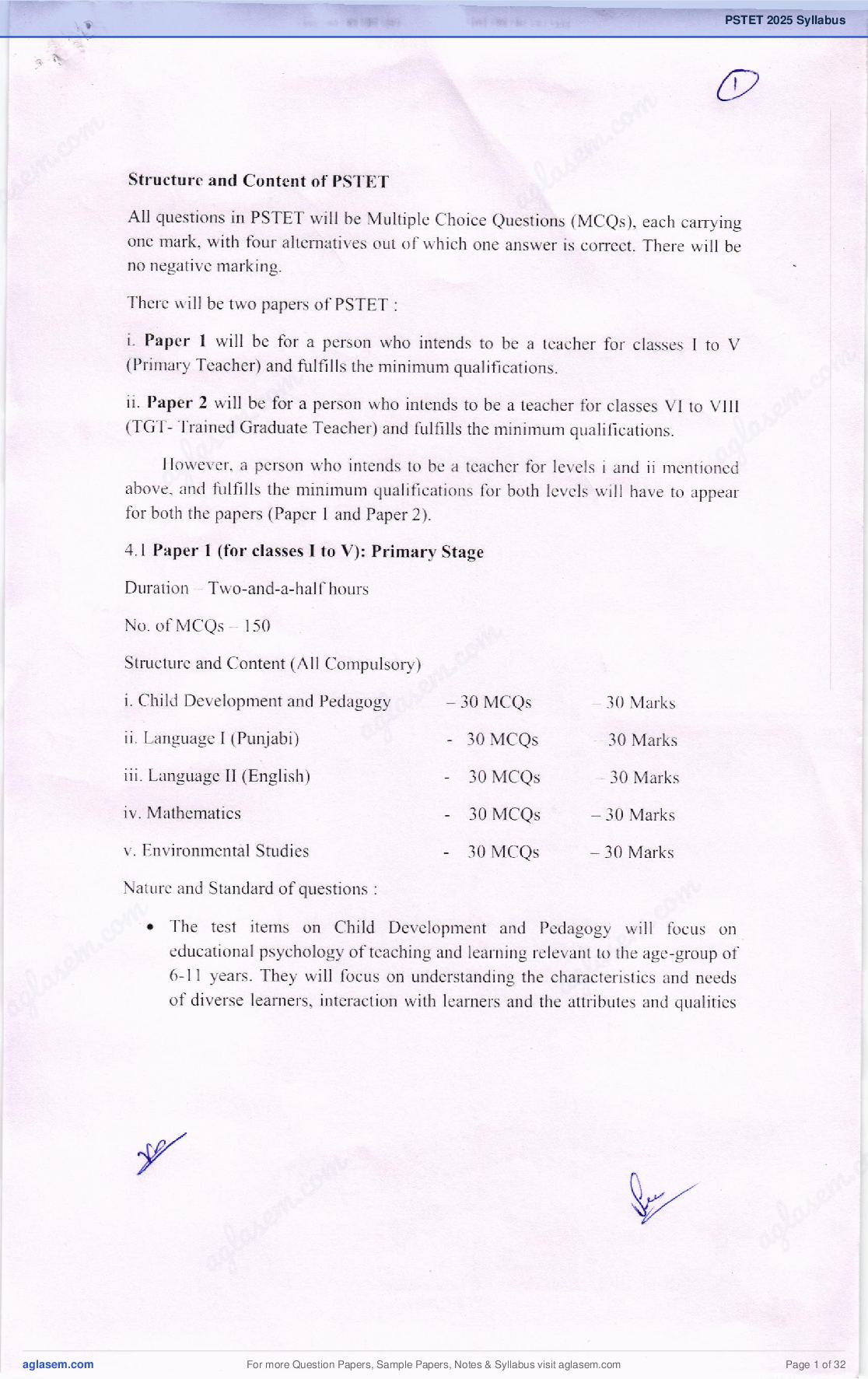
Structurc and Contcnt of IrS'l ll'f
All questions in PSTET w'ill bc Multiple c'hoice eucsrions (MCes), each ca*ying
one mark. with lbur altematives out ol u hich one answcr is correct. There will be
no negati\, e rnark ing.
l'here n ill be two papers of PS'|ET .
i. Paper I will be for a person rvho intends to be a teacher for classes I to V
m
m .co
(Prin-rary Teacher) and fulfllls the r-ninimum qualifications.
c. o s e m
(TG-l-- Trained m
ii. Paper 2 will be for a person u,ho intends to bc a teacher lor classes Vl to VIII
s e g l a
la a person * ho intcntls to bc a tcachcr- tbr lcr,cls i and ii mcnti.nr-ti
Graduate Teacher) and fulfills the rninimum qualifications.
g a
above.a antl lirlfills the nrinirnurn tlualiticatitus fbr both levels r'ill havc to uppear
I l.u'c'c-r.
fbr both thc papers (Paper I ar.rd Paper 2).
4. I Paper I (lbr classes I to V): Primarl, Stage
Duratitrn Trvo-and-a-half hor"rrs
m
No. of MCQs 150
.c o
m
e 30 MCQs
Structure and Content (All Cornpulsor_r,
i. Chil.l Development and Pedagogir s
)
g l a -i0 Marks
ii. l-anguasc I lPunlabi) a - 30 MCQs i0 Marks
iii . Language Il (English) - 30 MCQs 30 Marks
iv. Mathematics - 30 MCQs --l0 Marks
r.. Environrnental Studics - 30 MCQs 30 Marks
o m
c
NuiLrrc arrd Standard ol-qucstions .
m test items on Child Devclopment and Pcdagogy will. fbcus on
c. o The emage-group of
cducational psychology of teaching and learning relevant to sthe
em l a
l as 6-ll
a g
ag
years. They will focus on understanding the characteristics and needs
of diverse leamers, interaction with learners and the attributes and qualities
m . c
c. o em
{
em la s
la s a g
ag
For more Question Papers, Sample Papers, Notes & Syllabus visit Page 1 of 32
Page 3
ofa good facilitator oflearning. Alound 70 percent of the items rvogll fgcgs
on the mentioned llnits (a) and (b) in the syllabus rvhile 30 percent woulcl be
related to Learning and pcdagogy.
o The test items fbr Language I (Puniabi),uvill locus on proficiencics related ro
the medium of instruction. Pedagogy of language development wourd cover
45-50 percent ol'the tcst itc ls.
o Thc Language ll (English) will locus on thc elements of language,
communication and comprehension ski[s. pedagogy of language
development would cover 45-50 pcrcent of the test items.
o The test items in Mathe.-ratics and Environnrental strrdies will focus on thc
concepts. problern solvirrg abilities and pedagogical understanding of thc
subjects. In both the subjcct areas. Pedagogical undcrstanding would cover
25-30 percent of the iterns. In both the subject areas. tesr iten-rs shall bc
evenly distributed over different divisions of the sytlabus of that sr-rbject
prescribed for classes I to V by the Education Depaftment. Gort. of
Punjab/NCERT.
. The questions in the test lor Paper- I w,ill be based on the topics pr-escribed in
the svllabus of classes I to V. but rheir diflicLrlty standard as ell as r,r
linkages. could be up to Secondary stage.
4.2 Paper -2 (for classes VI to VIII) Elementarv Stage :
Duration - Tu o-and-a-half hours
No. of MCQs 150
Structule and Content
i. Child Development and Pedagogy (compulsory) 30 MCQs 30 Marks
ii. Language I (Punjabi) (compulsory) - 30 MCQs 30 Marks
iii. Language II (English) (conrpulsory) - 30 MCQs 30 Marks
ir''. For Matherr-ratics and Science teacher
a. Mathematics & Science - 60 MCQs - 60 Marks
r
V
For more Question Papers, Sample Papers, Notes & Syllabus visit Page 2 of 32
Page 4
-
m
m c. o
c. o s e m
em la
las a g
b. For Social Studies/Social Science teacher
Social Science 60 \4( Qs (rU V;rlk.
c. For any other teacher either (a) or (b)
60 MCQs - 60 Marks
d. Art & Craft / Phy. Edu. / Home Sci. / Music / Urdu / Sanskrit
Naturc and Standard of questions :
a The test items on Child Dcvcloprncnt and pcdagogy ,"vill lbcus on
m
.co
educational psychology ol teaching and learning relevant to the age-group of
m
c. o m
I l-14 years. They will fbcus on understanding the characteristics and needs
mand qualities of a good facilitator of learning. Around 70 percenrla
and psychology of diverse leamers, interaction u.ith leamers and the
s e
s e g
a a
attributes
l
g 30 percent would be related to Learning and Pedagogv.
arvhile
of the items would lbcus on the mentioned Units (a) and (b) in thc syllabus
The test items for Larrguage I (Punjabi)r.r'ill locus on proficiencies related to
the medium of instruction. Pedagogv ol language dcl elopr.nent would cover
45-50 percent of the test iterrs.
'I-he Language II (English) u ili fbcus
on the eler.nenrs of Ian-uuaee.
cornrnunication and comprehension skills. Pedagogy of language
m
co
dcvcloprnent rvould cover 45-50 percent of thc tcst items,
.
The tcst items in Mathematics & Science and Social Studies,,Social Science
s em
rvill focus on the concepts. problen'r solvine abilities and pcdagogical
g l a
understandin-q of the subjccts. The test itcrns of Mathematics & Science will
a
be of l0 Marts each. Around 25--j0 perccnt of the items in each subject
rvould focus on pedagogical issues of the related subject. However" besides
around 25-30 percent weight age to pedagogical issues in Social Studies ,
Social Sciences. approrin.rately equal weightage would be given to sections
(i). (ii) and liii). The lest itenrs shall bc crcnly distribured ovcr diffbrcnt
divisions of the syllabus of that subject prescribed fbr classes VI to VIII by
m
the Education Depafiment, Govt. of Punjab/NCERT.
m c. o
a The questions in the test fbr Paper-2 will be based on the topics prescribed in
c. o e m
the svllabus of classes Vl to Vlll, but. their clifficulty srandard as ir,cll as
em
linkascs. could be up to Secondary stage.
l a s
las ag
ag
v om
V m . co
.c s e
e m la
la s ag
ag
For more Question Papers, Sample Papers, Notes & Syllabus visit Page 3 of 32
Page 5
o
i
SYLLABUS FOR PSTET
Paper - I (for classes I to V) Primarv Stage
I. Child Developnrenr and Pedagogy 30 euestions
a. Child Dcvelopment (Primary School Child)
o Concept of development and its relationship with leaming
. Principles of development of children
o [nfluence olHeredity and Environnrent
o Socialization processcs : Social rvorld & children (Teachers. parcnts and
Peers )
. Piaget. Kohlberg and Vygotsky : constrlcts and critical perspecri\/es
o Concepts of ch ild-ccntered and proeressivc cducation
. Critical perspective ol the construct of Intelligurce
. Multi-Dintensional Intelligencc
r Language and Thought
r Gender as a social construct : gencler roles. gender-bias ancl educational
practice
o lndividual differences ar.r.ronq leamers. understanding dilfcrences based o,
divcrsity of language. castc. gender. cornrnunity, religion etc.
o Distinction belween Assessnrent fbr leaming assessmenl of leaming:
School-Based Assessment. Continuous and Cornprchension Evaluation:
Perspective and practice
. Formulating appropriate queslions fbr assessing readincss levels ol leamers:
for enhancing leaming and critical thinking in the classroor.n an<J assessing
leamer achievement
b. Concept of Inclusive Education and underctanding children with special
needs
r V
For more Question Papers, Sample Papers, Notes & Syllabus visit Page 4 of 32
Page 6
t
5)
m
m .co
c. o s e m
em l a
as a g
a Addrcssing leanrcrs fl'orr divcrse backgrounds incltrding disadr antaged
and deprived
a Addressing the needs of children with learning ditTlculties, impairmcnt
etc.
- Addressing the Talerrted. Creative, Specially abled Iearners
c. Learning and Pedagogy
m
co
. How' childrcn think and leam, hou' and why childrcn 'fail' to achievc
m .
.co of teaching and learning : children's strategies ol learning; m
success in school perfonnance
s e
em
. Basic processes
l a
. las a g
leaming as a social activity; social context of learning
g
r aAltemative conceptions of learning in children. understanding children's
Child as a problerr-r solver and a'scientitic investigator'
'errors' as significant steps in the lcarning process
. Cognition and Emotions
. Motivation and Lealning
r Factors contributing to learning - Personal and environmental
m
II. l.anguage- I (Punjabi) 30 Questions
c. o
em one prose/drama and one poem witlr
a. Language Comprehension
s
la grammar and verbal ability (Prose passage
Reading unseen passage - two passages:
a g
questions on comprehension. int'erence.
may be litcrary. scicntiflc. nart'ative or discursive)
b. Pedagogy of Language development
. Learning and Acquisition
. Principles of Language teaching
. Role of listening and speaking I flnction of language and horv childrcn use it
o m
m e Critical Perspective on thc role of grantmar in learning m c
a .languagc tbr
as a tool
c. o s e
em l a
s
cornmunicating ideas verbally or in wdtten totm
. Challenges of teaching languagc in a diversegclassrootn;
l a a
language
ag difficulties. etlot's and disorders
r .co
m
V
m.c
s e
sem g la
la a
ag
For more Question Papers, Sample Papers, Notes & Syllabus visit Page 5 of 32
Page 7
@
. Language skills
o Evaluating language cornprehensior.r and proficiency : Listcning, Speaking.
Reading and Writing
. Teaching-Leaming Materials : Text-books. rnulti-mcdia materials, multi-
lingual resource ol the classroom
. Rernedial Teaching
IIl. Language - II (English) 30 Questions
a. Comprehension
Tw'o unseen plose passages (discursive/literary/nanativersc ientific ) with
questions on comprehension. grammar and verbal ability
b. Pedagogy of Language development
o Learrr irrg and Acquisition
o Principles of Language teaching
. Role of listening and speaking : function of language and how'children use it
as a tool
o Critical Perspective on the role of grammar in leaming a language for
cor-nrnunicating ideas verbally or in written fonr.r
. Challcnges of teaching languagc in a dir,'ersc classroom; language
difficulties. erors and disordcrs
o Language skills
o Evaluating language comprehension and proficiency : Listening, Speaking.
Re ading and Writing
. Teaching-Learning Materials : Text-books. multi-media materials, multi-
lingual resource of the classroonr
o Remedial Teaching
IV. Mathematics 30 Que stions
a. Content
r Geor.netry
. Shapes and Spatial Understanding
9' v.
For more Question Papers, Sample Papers, Notes & Syllabus visit Page 6 of 32
Page 8
-
m
m . co
c. o s e m
em l a
las g
e Solids around us
. Numbers a
. Addition and Subtraction
. Multiplication
o Division
o Measurement
o Weight
m
c. o
o Time
m
c. o m
. Volume
m s e
a
e Data Handling
e l
las ag
r Pattems
ag
. Moltcy
b. Pedagogical lssues
. Nature of Mathematics / Logical Thinking: understanding children's
thinking and reasoning patterns aud strate-qies of making meanins and
leamir-rg
. Place of Mathematics rn Curriculun'r
m
c. o
r Language ol Mathenrat ics
em melhods
. Cornrnunity Matlrematics
la s
o Er.aluation through forrnal and intbrmal
g
e Error analysis and related aaspects ofteaching and lcaming
o Problerns ol teach ing
. Diagnostic and remedial teaching
V. Environmental Studies 30 Questions
a. Contcnt
m
c. o
Farnilv and Friends
o m . Relationships m
. c . Work and Play s e
s em l a
gla ag
. Animals
a
o Plants
('r- ,
Y///
*
m . c
c. o s e m
sem g l a
la a
ag
For more Question Papers, Sample Papers, Notes & Syllabus visit Page 7 of 32
Page 9
Food
Shelter
Water
Travel
Things we Make and Do
b. Pedagogical Issues
o Concept and scope ofEVS
o Signillcance of EVS. integrated EVS
o Environmental Studies and Environntental Education
. Leaming Principles
. Scope and relation to Sciencc and Social Scicnce
. Approaches of presenting concepts
o Activities
o Experimentation ,' Practical Work
. Discussion
. CCE
. Teaching Material / Aids
o Problems of teaching
Paper - 2 (for classes VI to VIII) Elementarv Stage
I. Child Development and Pedagogr, 30 Questions
a. Child Devclopment (Elemcntarv School child)
r Concept of development and its relationship with leaming
. Principles of development of child
. Influcnce of Hercdity and Environntcnt
o Socralization processes : Social world and children (Teachers. Parents and
Peers)
x \7
For more Question Papers, Sample Papers, Notes & Syllabus visit Page 8 of 32
Page 10
o m
c. o
m .c
s em
em la perspectives
as g
. Piaget. Kohlberg and Vygotsky : conslructs and critical
a
. Concepts of child-centered and progressive education
. Critical perspective of the construct of lntelligence
. Multi-Dimensional lntelligence
o Language and Thought
. Gender as a social construct : gender roles. gender-bias and educational
practice
m
co
. Individual differcnces among leamers, understanding differences based on
m .
.co m
diversity of language. caste. gender, community, religion etc.
m
o Distinction between Assessment fbr learning assessment of leaming:
s e
se g l a
a a
School-Based Assessment. Continuous and Conrprehension Evaluation:
l
ag
Perspective and practice
. Formulating appropriate questions lor assessing readiness levels of leamers;
fbr enhancing leaming and critical thinking in the classroom and assessiug
leamer achievenrent
b. Concept of Inclusive Education and understanding children w'ith special
needs
m
co
Addressing learlers fiorn diverse backgrounds rncluding disadvantaged
.
em
and dcprived
a s
Addressing the needs of children with learning diffrcLrlties, 'irrpaimreut'
l
ag Creative, Speciallv abled learners
etc.
Addressing thc Talented.
c. Leaming and Pedagogy
. How children think and learn; how and why children 'fail' to achieve
success in school perfbrmance
o Basic processes ol teaching and leaming : children's stl'ategies of leaming.
o m
learning as a social activity; social context of lcaming
m c
m. children's
. Child as a problem solvcr and a'scientiflc investigator'
. co o Altemative conceptions of leaming in children, undcrstanding s e
em l a
s g
'errors' as significant steps in the leamine process
gla . Cognition and Enrotions a
a
&.- Q*
o/
c. o
m m.c
s e
sem g la
la a
ag
For more Question Papers, Sample Papers, Notes & Syllabus visit Page 9 of 32
Page 11
@
. Motivation and Leaming
. Factors contributing to lcarning Personal and cnvironmental
II. Language-l (Punjabi) 30 Questions
a. Language Comprehension
Reading unseen passage two passages: one prose/drama and onc poem with
questions on comprehension, inferencc. srammar and verbal ability (Prosc passage
may be literary. scientiflc. nan'ativc or discursive)
b. Pedagogy of Language development
. Learning and Acquisition
. Principles of Languagc teaching
o Role of lister-ring and speakin-u : tunction of language arrd horv children use it
as a tool
. Critical Perspective on the role of -erarnmar in learning a language for
cornmunicating idcas verbally ol in written fbrtn
. Challenges of teaching language in a diverse classroom; language
dif ficulties. emors and disorders
. Language skills
o Evaluating language cornprehcnsion and proficiency : Listening, Spcaking.
Reading and Writing
. Teaching-Leaming Materials : Text-books. multi-media rnaterials. multi-
lingual resource of the classrobm
. Remedial Teaching
lII. Languagc - II (English) 30 Questions
a. Comprehension
Trvo unseen prose passages (discursive/literaryi narrativc/scientiti c ) with
questions on comprehension. grammar and rcrbal ability
b. Pedagogy of Language development
V
&-'
For more Question Papers, Sample Papers, Notes & Syllabus visit Page 10 of 32
Page 12
co
1
m .
c. o s e m
em l a
as ag
. Leaming and Acquisition
o Principles of Language teaching
. Role of listening and speaking : tunction oflanguage and how children use it
as a tool
. Critical Perspectivc on the rolc of sratnmar in leaming a langua-ee lbr'
communicating ideas verbally or in written fbnn
o Challenges of tcaching language in a diverse classroomt language
m
c. o
difficulties, errors and disorders
m
co m
r Language skills
m .
o Er.aluating language comprehension and proficiency : Listcning. Speakrng.
s e
s e l a
l a ag
Reading and Wliting
ag
. Teaching-Learning Materials : Text-books. rnulti-media rnaterials, multi-
lingual resource of the classroon-t
r Remedial Tcaching
IV. Mathematics & Science 60 Questions
i. Mathematics 30 Questions
m
a. Content
. co
em
Number System
s
. Playing with Numbers gla
. Knowing our Numbers
o Whole Numbers a
. Negative Numbers and Integers
o Fractions
Algebra
o lntroduction to Algebra
m
m .co
r Ratio and proporlion
c. o Geometry se
m
s em g l a
la a
r
g
Basic Geometrical ldeas (2-D)
a . Understanding Elementary Shapes (2-D and 3-D)
4- V .c
.c om e m
e m l as
l a s a g
ag
For more Question Papers, Sample Papers, Notes & Syllabus visit Page 11 of 32
Page 13
. Slmnetry : (re1'lection)
o Construction (using straight cdge scale. protactor, compasses)
Mensuration
Data Handling
b. Pedagogical lssues
. Nature ol Mathernatics / I-ogical Thinking
. Place of Mathematics in Cun'iculunr
. Language of Mathematics
. Conrr.nur.rity Matlrerratics
o Evaluation
. Remedial Teaching
. Problems of teaching
ii. Science 30 Questions
a. Content
i. Food
. Sources of food
. Components of food
. Cleaning food
ii. Materials
r Materials of daily use
iii. The wortd of the living
iv. Moving things, people and ideas
v. How things work
. Electric currents and circuits
. Magnets
VI. Natural Phenornena
Ce'-
V
For more Question Papers, Sample Papers, Notes & Syllabus visit Page 12 of 32
Page 14
m .co
c. o s e m
em l a
as a g
VII. Natural Resources
b. Pedagogical Issues
. Nature and Structure of Sciences
. Natural Science i Aims and objectives
. Understanding & Appreciating Science
. Approaches / Integrated Approach
m
c. o
o Observation / Experirnent i Discovery (Method of Sciencc)
o Innovation m
.co / Aids s em
em - cognitiveipsychonlotor/affectivc a
o Text Materials
s l
la ag
o Evaluation
g
. a Remedial Teaching
. Problems
\r. Social Studies / Social Sciences 60 Questions
a. Content
i. History
m
c. o
. When. Wherc and hou'
. The First Farmsrs and Herders em
. The Earliest Societies
l a s
ag
o The First Citics
. Earl,v States
. Nes, Ideas
. The F irst Ernpire
. Contacls with Distant lands
o PoliticalDeveloprrents
. Cullure and Sciencc
m
co
o Neu, Kings and Kingdorns
o m . Sultans of Delhi m .
. c . Alchitecture se
s em g la
gl a a
o Creation ol an crnpire
a
. Social Change
\z
m .c
,{
.co s e m
e m l a
l a s a g
ag
For more Question Papers, Sample Papers, Notes & Syllabus visit Page 13 of 32
Page 15
. Regional Cultures
. The Establishment of Company Power
. Rural Life and Society
. Colonialism and Tribal Societies
. The Revolt of l8-57-58
o Women and Reform
. Challenging the Caste System
o The Nationalist Movement
. lndia aftel lndependence
ii. Geography
. Ceography as a social study and as a science
o Planet : Earth in the Solar svstem
. Globe
. Environrlent in its totalitv : natural and human environment
. Air
o Water
o FIuman Environr.nent : settlement. tl'ansport and conrrnunication
o Resources: Types-Natural and Hurnan
. Agricultute
iii. Social and Political t-iic
o Diversity
r Govemment
o Local Governnrent
. Making a Living
. Democracy
. State Govemmcnl
o Understanding Media
. Unpacking Gender
. The Constitution
V
D''
For more Question Papers, Sample Papers, Notes & Syllabus visit Page 14 of 32
Page 16
c. o
m m .c
s e
em l a
las ag
. Parliarllentary Go\ crnlncnl
o Thc Judiciary
. Social .lustice and the Marsinalised
b. Pedagogical Issues
. Concept and Nature of Social Sciences / Social Smdies
. Classroom Processes. activities and discourse
m
c. o
. Developing Critical Thinking
o m Evidence m
.c
. Enquiry En-rpirical
m s e
a
. Problems ofteaching
e Primary & Secondary l
Social Sciences / Social Studics
a s
. Sources
l Work
. gProject ag
oa Evaluation
NOTE : For a detailcd syllabus of classes I VIII. please ref-er to PSEB and
NCERT syllabus and textbooks.
m
. co
A' s em
a g l a tr
m
m .co
c. o se
m
s em g la
gla a
a
c. o
m m .c
s e
sem g l a
la a
ag
For more Question Papers, Sample Papers, Notes & Syllabus visit Page 15 of 32
Page 17
Physical Education
Health Education
(a)Aspect of Health Education
Physical Health, MentalHealth,SocialHealth,SpiritualHealth'
(b) Factor influencing health
(c) Assessment tools of physical Health
First Aid
r Meaning
. Objectives of First Aid
r Equipments of first Aid
r Rules of First Aid
r First Aider
r Qualities of First Aider
o tvfethods of Artificial Respiration
r Conditions in Which First Aid is given
o Treatments given bY First Aiders
o Types of injuries in sPorts
Nutrition and Balanced Diet
r Meaning of Balanced Diet
o Balanced Diet for different People i
r Elements of Balanced Diet
o, Types, Sources, functions,required
quantity,
o Effects of deficiency of protein,
carbohydrates
,Vitamins, Fats,Minerals and
Water.
v,
For more Question Papers, Sample Papers, Notes & Syllabus visit Page 16 of 32
Page 18
-
co
- m
6
m .
c. o s e m
em l a
as a g le)
oEffectsofexcessivenessofprotein,carbohYdrates
,Vitamins,Fats,Minerals and Water'
o Disease related to lack of Vitamins
m
m c. o
Yoga
.co s e m
m
e la
a s ag
gol Definitions
o Meaning
a . History of Origin
r Objectives
o lmportance of Yoga
. Guidelines of Yoga
o Ashtanga Yoga
m
c. o
(a) Meaning
(b) Parts of Ashtanga Yoga
e m
r Surya Namaskara
la s
ag
r Cultural Asanas
o Meditative
r Relaxation Asanas
. Types ,Methods, Guidelines' Benefits and disadvantages
of wrong Method'
. Pranayama- Definition, Meaning ' Types 'Objectives '
GPidelines and Benefits'
m
m .co
co
Personal HYgiene
. m
em
o Meaning
la se
las . Definition
a g
ag o Benefits
r Cleanliness of School, Home , Classroom and
Surrounding.
\r/-
M
m .c
c. o s e m
sem gl a
la a
ag
For more Question Papers, Sample Papers, Notes & Syllabus visit Page 17 of 32
Page 19
o Early Life
o Carrier
o Role in lndian Hockey
. Awards
Folk ( Traditional ) Games of Punjab
r Types - KotlaChhapaki, Bandar Killa , Rope Skipping ,,
Pitrhu.
r lmportance
o Methods of fixing turn
National Song and NationalAnthem
o History
r Authors and Books
r Occasions
.lnstructions
. Duration
. Precautions
Human BodY
r Meaning
o Categories
. Body Posture - Meaning, Functions , How to cure and
lmprove.
. Body Functions - Meaning, Various systems of Human
Body.
Physical Capacity
. Meaning
a-
V
For more Question Papers, Sample Papers, Notes & Syllabus visit Page 18 of 32
Page 20
-
m
(e
m c. o
c. o s e m
em l a
las ag
,, l
o Qualities
o lmportance
m
.co
o Advantages of exercise
Safetyom
.c
education
e m
e m la s
s
o Meaning
l a ag
g
a
Home
o Causes of accidents on roads, Schools and
o Safety Guidelines.
National Flag
o HistorY
r Shape
m
c. o
r Colours
m Unfirl'
eand
s
o Size
a
'Ot.rsion'for
.
g l
hoisting
a
'i Fr-
oPrecautionsregardingtheuseofNationalFlag'
Kila RaiPur
r HistorY of village Kila Raipur
e Origin of Rural Olympics'
m
c. o
. nural SPorts in Kila Raipur'
m
c. o . Modu'n SPorts in Kila RaiPur'
s e m
s em in Rural OlYmoics'
g l a
la
o Girls
a countrles'
festivaL-
g
Raipur Sports
a
o'Specialities of
Kila
^
games in foreign
Raipur
e Popularity of Kila
@r-
m V . c
c. o s e m
sem la
la ag
ag
For more Question Papers, Sample Papers, Notes & Syllabus visit Page 19 of 32
Page 21
r lnterest in Shooting
r Training in Shooting
r Achievements
Discipline
o Meaning
o Types
. N'eed And lmportance
o Role of Sports and Discipline
Posture and its deformities
o Meaning
o Causes
o Exercise to prevent
Sport$ injuries
r Meaning
r Causes
. Types
. Symptoms
r Treatment
Value of Sports
o Vblue for individual
o Value for Nation
+-
-r
For more Question Papers, Sample Papers, Notes & Syllabus visit Page 20 of 32
Page 22
m c. o
m .co s em
e m l a
l a s ag
a g (d I
I
m
m c. o
m
Scout and Guide
. co e m
c. o s em la s
em l a ag
o History
la s a g
ag r lmportance
r Scout Law
r Scout promise
r Scout MOTTO and Salute m
om .co
. c em
m
e-Ao l a s a
s
\
a a g
agl
q
-l
For more Question Papers, Sample Papers, Notes & Syllabus visit Page 21 of 32
Page 23
PART -1
ff,€kfrdu rdEdr /Ea?6 rd.fE.dr
GEOMETRICAL DRAWING /SCALE DRAWING
fn€ri-Jrdu rs'lt'a zmitl rd.fudr Ed <es n--E e.E r.d
TOOLS USED IN GEOI!4ETRICAL / SCALE DWAWING
drtr-e. l./i iH.e+ Ary- fdmn
LINES AND TYPES OF LINE
AE rrr] #
$"n fumn
ANGLE AND TYPES OF ANGLES
t*iE Dd ffi ebn fdllr
TRIANGLES AND TYPES OF TRIANGLES
ego_*a r. tria
QUADRILATERALS
EU-a;rrEi aorg
POLYGONS
8q.il6 fu{.}-d-d-F€ iff'-
SCALES AND DIAGONAL SCALES
ii-d 4G Eu!'H Aur<i'
CIRCLES
rlqLl rri Hlrrd )rf6u..s
RATIO AND PROPORTION
nr-ofi rra'o
SIMILAR FIGURES
bi-S hB s.ilfi brd.o
INSCRIBED AND DESCRIBED FIGURES
6H m. fiidrd f{_8ffi r ue.*ua. fg.ii6, ,€!u,.ur€irrd.fir6d,
SOLIDS : CONE, SPHERE,TETRAHEDRON,PRISIV,PYRAMID,CYLINDER,CUBE
tr3 qs-su i arl 3x dE EE€i
LAYING SOLIDS INCLINED TO THE VERTICAL PLAN
Fd-6 )lri x*6td6 rd.fu'dT
SCALES AND MECHANICAL DRAWING
V ly
For more Question Papers, Sample Papers, Notes & Syllabus visit Page 22 of 32
Page 24
m c. o
PART -2
c. o s e m
em DRAWING AND PAINTINGl a
ffro ao
las ag
dgr : rridErrxr, famn, €tE
ART : DEFINITION,TYPES OF ART , AIMS OF ART
ao, i .is : tw , vrrqq, iidr, idrsd, -,
ELEIIENTS OF ART :LINE ,COLOUR ,TEXTURE ,TONE, FORM
itar 6 frr€arfr
m
c. o
COLOUR THEORY
o m m
.c
fJarl€6, frEin,rrri ffi86 A ftuH rrt_s66. &nr .qrr+,rrkrcrs,gild6, Dr,6r,-Jr
s e
em l a
DESIGN, TYPES
s
OF DESIGN AND PRINCIPLES OF DESIGN (BALANCE RHYTHM,
g
,
a a
DOMINANCE.TRANSITION,RATIO,REPETITION
d&+rlHEffar }?ri -{fu
)
g
aCLAY MODELLING TECHNIQUE
ig fr
COLLAGE
eag fure-e: ( frfitrE .Ea3d . ,14113 . les ffi. # 3 u.od.€- ,
MODEL DRAWING : (OBSERVATION, DRAWING .RATIO-PROPORTtON,PERSPECT|VE.
LIGHT AND SHADE )
o m
.c
inrs a<.rz hri ElidrS
e m
s
PAPER CRAFT AND MATERIAL
)rftfil 6{E *5r
g l a
ART OF LETTERING /CALLIGRAPHY
a
LrT-d brj &rr-ry'*a: r fu€-s rrl f6fr6.ffi3-d.fuH.f . Fsdr;.iiaT fu,
POSTER AND LAY-OUT : (PLANNING AND COMPOSITION .ILLUSTRATION ,
LETTERING, SLOGAN,COLOUR SCHEI\4E )
F-H6
STENCILLING
m
co
qd$ ftE
m .
c. o aouaryd furo
LANDCAPE DRAWING
m
em la se
las a g
IMAGINATIVE DRAWING
ag rs6rfi ;* lt-'= u
FIGURE DRAWING
z\-- v
om .co
.c e m
m s
la se
a gla
ag
For more Question Papers, Sample Papers, Notes & Syllabus visit Page 23 of 32
Page 25
+ tq)l: titi,// I
qflHl q)l ,Jt \
), +
i
,lrr ?r{i '.r()[l,r{ 11,t,n,,!! i1,r;
1
I
qF)l.t,Jl '' ['r','l t,l,.io I rtt rt I
..1 -
r. tfl',tr,11,1i tr.'.1 t ( t r,1 1l'r, )
I ll"q'.i,rl': tlrt) tit',i
[i) ]r.D1J,,,1 ''1{lciil 11n'i;' rllr t'l'' 'i'l ,'i't,
q;6
3\()i, i)\rl ,'lvt'1,'l'til , <ttt R
?!1,, e-.1)I, 'Jl>l I
1r
i )e1qri1t.r) ,l,1tt,Uftrr1 ffi :- 1fit/ ,'{t ' 1i>:''
*lrd, 5{d6 I
{,+1F;r qgq;- trdr,
.nrt,r'.
[iii ) mqnm
qrfr+t, (ITr[ ,-$n t
t- r
gftc.r flr{ j- f{i"f o;i4,'*1tt
-;-
(.'v)
sr} r
"**
iv2 Ery-Ffq1$-' f',*'
(vr) aa,t?t',t -'fa'i
?la+: llldi ' )llq
]i+tr r
.E--;.l" I r, i
\' ,i)
l'ri t lift'rr1
--ili"+-"
(vti ) 3.11?
(
, ,..
lJ
.l
l \rn\''
.:\ .
i.rd- €n,j-
[](,
{Viii) flarlll'rL
(l t. )11i-l
J
i" l'li: / .. 1, ,'
'rl.i.':
ri r'r 'r ' '\r'r '
.} il,l ( r'J /
trX )
l-rlrl(
(l r rt'l'll)J '{\clll i \ {l rl.',Qil(
l
ll,
I
+- w
For more Question Papers, Sample Papers, Notes & Syllabus visit Page 24 of 32
Page 26
m .co
c. o s e m
em l a
las g
4ff +
a
( 't-\' r)tllqtl llrrrt-u ) 1\rtl,| htfu (!')
(lrrr| E2 (lr:ltulll E
m
m
I ll\lllls
o
'{ r1l[U^\i]
.co
c
'srFuiu.. ta\.F)!' ]z1F1h-$r :-F,yt.,Lcti$ tltii e m
em la s
s
la l?tt"\' t"{'E l?\Pl:}) ag
!ua g
rlgi-ltt-
-i trr)
't:r1tl:{Etr i:..\11 }tudrtt' lTilB P-Pr
B;5* f+ cl Jl,&L 1
rltrffi -flB ')ro' l"fo'$ t)
""
r tr$bs lrrL ,"n
t:L,
@ POl ; yBm 5
] ]'is m
Ltt' : re5 le4tt{s l tti
co I .lrai' l!-
Lr[rr ',.e
.
s em
' la ' ''tE ' 'i#
'PYy '
'\ T* ' )tr.l ltt, '1]1 tnt
ag -rr* 'b')r' 3h 'J<
# t ; ilb' -he'
Ib qelLrr*ptr-J ie \tsIcl< !F
-; ar& IS" 'to"re trr" httrtl '4
1'
iL, ]sE "0" royl"
I 'dF
m
m 'iF'!ir+ ; [rrsq$F t
.co
Nn
c. o m
i)rc 'acP
s e
s em I bfI' bE' !D'
r$ tsuc|,irclP la
g
l rtn
gla a
a r nB| ' gzL 'GB) ' )$'
-;lotelP! , rrl
,i, 'ary).t"-u+ 'irl4y 5I+
()aP,l llr> '-!) Bl-t
' \al"
-rr1.,-'h$ ' iU'(uli )fir -; l.t\cl\tu; ( !)
co
iw'lrb'
om .
f
j 1)ur IhtrL\''
c em
I
\''Lt
m . s
se g la
a I It'tl" i'\]lt1\\,\'
a
( \
g l
a
'-ir:ruigr'Ltp)0 ''\t'{'lr":!lr ' It'ptr )ll) : Jr} !-L'
, )-
For more Question Papers, Sample Papers, Notes & Syllabus visit Page 25 of 32
Page 27
@
'L
g)t ; iF
F LIT,
l-
l- lr
lr- V.
\_.+-- u\ iyN
i-e-
o.) f-\ '
l- 'T.
H
...',}
']Y th Y
IP
-t- # L
.lu
.l-
in
IF T
!
'l-+
\-l I rr fI1l-
I
-rg fC
--,_ .h: r- t\
Y fr
.\l..,, l-:- t- W
--+- "
t_i n
tl,) lc.
(- rU
r,cj rd
,1 IA'
t- t=
l' +. H
ol: "p M
T
,v q
TP
? --c\.
.J
't Itr rc
' \* a,-_r-
.^-/. ' l-. lh
./- 7 r-- y'1-=
'.Y i,9
L-R
tA !
f' V
l
tr
ty' .-/
-|,
.-
rD'
'e a)
i,S V
rY tF :- -
C.r
-) l(
V? rftr fr
ry /-lf lrr'
,f
-7
..= . 4) ,r;
,T \.,)
la
.r
'a lr
.r liu
t-- i-r re rY
{, l^,
,.: ,'1
,V
,\^,. t-':
n
r],
l-.1
,
V
For more Question Papers, Sample Papers, Notes & Syllabus visit Page 26 of 32
Page 28
m
m .co
c. o m
I
em @:irra@ lase
as 1) uffisa n+r y*q FIfo RrFs,) ag
I
l
t. qfofrsrq uhrdq, )fiiT€h{3+rd
u. uffif,q H'T.r s yEiq
m
nt. urg &, iE hrj ffi ydq
om0 n s Fg€ ry3IbE c. o
.c m
rv. urJg xxn
m s e
v. se l a
ag
,rieEr&mnse'rr3lb,s
g larriegffi mrr€drr3+e1nia'yiu
a
vt.
2l Ergs'rJMsf<fdpt{'6
r. dA'rri dfrni s re-e?-+sa
u. eirrk4{t d eE, eusg 4r3 }iys
m
c. o
3) er6 rtr3 rhe f€fdr',t'6
em
r. }l-o ,,r3 rHaq rg 64, sdH,h{ftr+J'rr3
a
"rE e 5s'<1
g l
rr. ira € zfx a
n. it-6 r.r+ -'0E e T&4, frq'-J',r3 }f,6 S }ivg
rv. ifl6 d fr-Cari$
4l srsfu+arr3uffit4rdq
m
m
r. E g ffdE g Yrraq hd )fiiYfl
.co
c. o rr. raffgqraeuJryt{ se
m
s em g la
gla a
a
m. ufo€E
brflrrEr rrr3 rax m
tv. drErg YHfu"'
v. qys xn &'o x"{3 6-€dfi iid * ec-ss
m .c
c. o Y32
s e m
sem gl a
la a
ag
For more Question Papers, Sample Papers, Notes & Syllabus visit Page 27 of 32
Page 29
frj L L JI @
/
1
t_
I
l')/
)
/
2
/
) /r ')
..7
j )// ) 2 ,
r
JL,, I
,,4>o" ,tb_.tl :-
tJ, L
-'- // I
-ti-r I t: e /, -;1 L1
-l
Z
L L) r
,
r J UI
)
L.:
,.i')t.r't- \
///
pl
; I
()
'll" t
.) r) lrl )
a'-- v
For more Question Papers, Sample Papers, Notes & Syllabus visit Page 28 of 32
Page 30
m .,,1c itt
///
c. o s e m
em l a
las ag r2rl lt/.2 t1'
t tt t,. I Jt1 i ,1r' ''- )
m
m .co
I
co m
( )
m . s e
s e la
la ag
_/t >
(L-t2: ) ) U
a g '-::-rL
2:'Cral 9l ' -: (,
;-\ )tj )
J/J tl12-) \) 2t? 5 )'l-tt f ct ,o --L \
t) m
co
( ) ,2 \*-
.
-
s em
g l a \^, \ v2
a
( L,
.i
(
( .) tt ) (1
,
6
L.
m
l,t b \
co
/
m .
c. o
L.
m
em la se
las a g
ag
\
.c om
o.' v em
. c
e m la s
l a s a g
ag
For more Question Papers, Sample Papers, Notes & Syllabus visit Page 29 of 32
Page 31
\
)
\l
:
,,k_ I (
,\\..-
I Lr - \
, ! L\
(. \
\\
LN
(
\ \
\p -\
\
5 C^J
{,
For more Question Papers, Sample Papers, Notes & Syllabus visit Page 30 of 32
Page 32
m
c. o
3\
m
c. o s e m
em
SUB'ECT . MUSIC
l a
las ag
SYttABus toR lrT
t) KnowledS€ Of Musical Terms:
> taya,(Types of Laya)
! Alankar, Aroh, Avroh,Pakad
> Vadi Swar, Samvadl Swar, Vivadi Swar, Anuvadi swat, Vadit Swal
> Adhvadarshak Swar, Shudh Swar, Komal swar, Teevra Swar
> Matra, Sam. Tali, Khall, Thah, DuBun, Chautun
m
c. o
i Vibhag, Alap, Taan, Kampan
o mApanias, Aplatva, Bahutva, m
c Maseetkhani Gat, Razakhani 6at, Miirab
. Greh-Ansh, Niyas,
u Upaj, Baaj, .Jod-Alap, e
Tirobhav-Avirbhav
m Shruti, SaPtak, Sangeet
z Nada,eSwar, l a s
l a s ag
a,.g
Raga, Sargam Geet, Sthai-Antra
' Khatka' Murki,Ghaseet,
Mukhda' Gamak
Margi-Deshi, Varan, Kan, Jamima, Meend'
2) Explain The Following Gayan Shailies:
- Dhamar, DhruPad
,- Khyal( Orut And Vilambit)
z Thumri
m
r farana
co
', lapga
.
em
- Geet, [ok'Geet
z Bhaian, Shabad
l a s
3I Musical Definitions
a g
; Drfinition Of Raga
7 Shudh Raga
z ChaYalagRaga
, Sankeeran RaEa
. lanY} RaEa
m
., AshtaYaRaga'
c. o
of Ragas)'
, i"j13t', i"t t(Jaties And upiaties
m
c. o m
. AEra Gharana lVocall
s e
em la
t Gwalior Gharana (Vocal)
las , Punlab Gharana (Tabla)
ag
g
. Delhi Gharana (Tabla)
a . laiPur Gharana (5itarI
, Lakhnow 6harana (5itar)
om
Y . c
m
{
.c s e
e m l a
l a s ag
ag
For more Question Papers, Sample Papers, Notes & Syllabus visit Page 31 of 32
Page 33
4) Detatled Study 0f The Fot lowing
, Tanpura lnstruments:-
, Tabla
, Shar
' Harmonlum
5) Biographical Sketches And
Contributions Towards Music 0f rhe Fo owing Musicians:
i Tansen
i Ust. taiyar Khan
> Pandit Bhlmsen loshi
> Sardar Sohan Singh
, Ustad Bade Ghulam Ali Khan Sahib
. Ustad Allaudin Khan Sahib
, Pandit Ravi Shankar
; Ustad Kishan Ji Maharai,
i Ustad Alla Rakha Khan
' Pandit Nikhil Banerjee.
6) Detailed Knowledte Of Ragas ln lndian Cla5sicalMusic.
z Bhupali
i Kalyan
z Khamal
- Bhairav
- Bhairavi
, Des
z Vrindavani sarang
; Alahiya Bilaval
; Malbuns
. Bageshri
. Bihag
. Kedar
z theemplasi
7) Detailed fno$led8e otTalas ln Indian Classical Music
z Dadra
i Roopak
/ leevn
, Nehrwa
r )haplal
z Sooltal
z E*tal
' Chaulal
. Dhamar
' Deepchandi
,. Tcental
. filwada.
.r\
V
For more Question Papers, Sample Papers, Notes & Syllabus visit Page 32 of 32
Document Details
| Board / Org | Punjab Exams |
| Exam | PSTET |
| Type | Syllabus |
| Pages | 32 |
| Updated | 11 Nov 2026 |