PSTET 2023 Syllabus
Finished viewing? Save it for later —
Download PSTET 2023 Syllabus (PDF · 38 pages)About PSTET 2023 Syllabus
PSTET 2023 Syllabus is available here for free download. Published by Punjab Board for Punjab State Teacher Eligibility Test, this syllabus can be viewed online or downloaded as a PDF (38 pages). Candidates preparing for Punjab State Teacher Eligibility Test can use PSTET 2023 Syllabus to understand the exam pattern, the type of questions asked, and the overall difficulty level.
Frequently Asked Questions
How can I download PSTET 2023 Syllabus?
Open this page and click the Download button to save PSTET 2023 Syllabus as a PDF. It is completely free on AglaSem Docs.
Is PSTET 2023 Syllabus free to download?
Yes. PSTET 2023 Syllabus can be viewed online and downloaded as a PDF free of cost on AglaSem Docs.
How many pages does PSTET 2023 Syllabus have?
PSTET 2023 Syllabus contains 38 pages, which you can read online or download together as a single PDF.
Where can I find more Punjab State Teacher Eligibility Test study material?
You can find more Punjab State Teacher Eligibility Test question papers, sample papers, syllabus, and answer keys on AglaSem Docs.
PSTET 2023 Syllabus – Text
Read the full text of this syllabus below — useful to quickly search, copy and reference the content online without downloading the PDF.
📄 View text version (24 pages)
Page 1
---
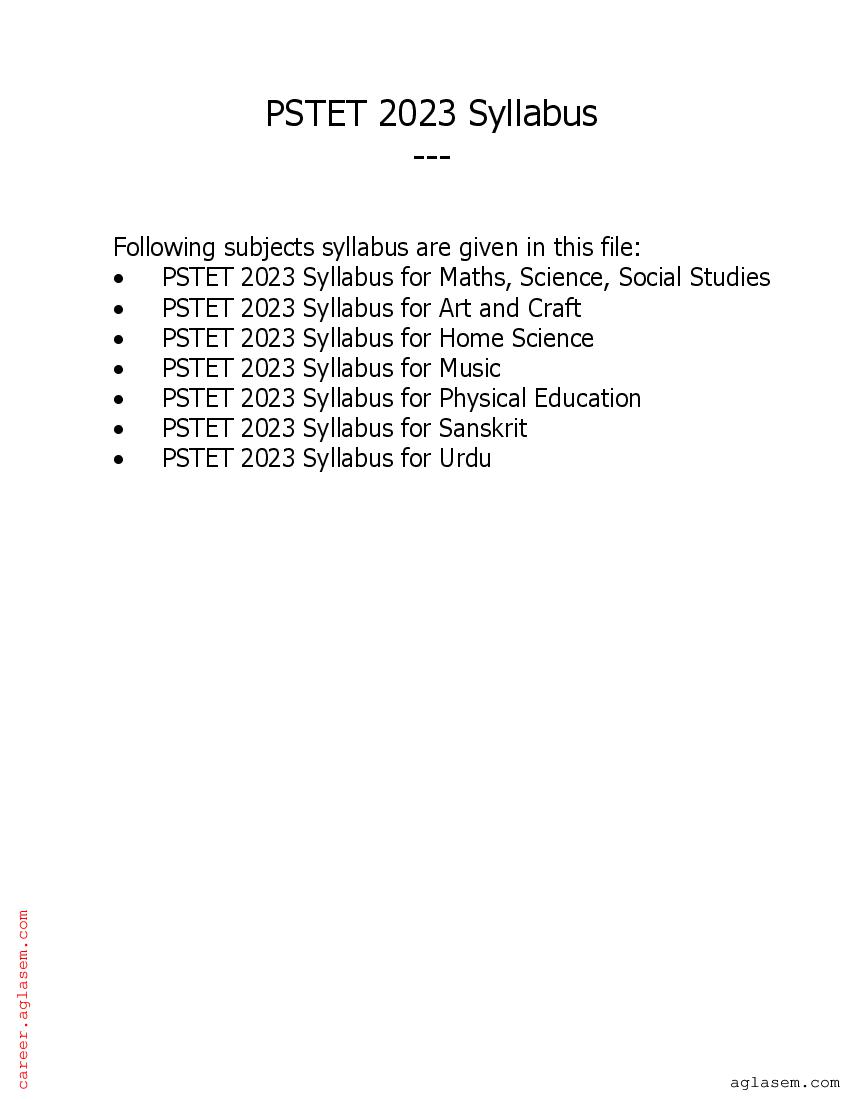
Following subjects syllabus are given in this file:
• PSTET 2023 Syllabus for Maths, Science, Social Studies
• PSTET 2023 Syllabus for Art and Craft
• PSTET 2023 Syllabus for Home Science
• PSTET 2023 Syllabus for Music
• PSTET 2023 Syllabus for Physical Education
• PSTET 2023 Syllabus for Sanskrit
• PSTET 2023 Syllabus for Urdu
Page 2
Maths, Science, Social Studies
Page 3
SYLLABUS FOR PSTET
Paper 1 (for classes I to V) Primary Stage
I. Child Development and Pedagogy 30 Questions
a. Child Development (Primary School Child)
Concept of development and its relationship with learning
Principles of development of children
Influence of Heredity and Environment
Socialization processes : Social world & children (Teachers, Parents and
Peers)
Piaget, Kohlberg and Vygotsky : constructs and critical perspectives
Concepts of child-centered and progressive education
Critical perspective of the construct of Intelligence
Multi-Dimensional Intelligence
Language and Thought
Gender as a social construct : gender roles, gender-bias and educational
practice
Individual differences among learners, understanding differences based on
diversity of language, caste, gender, community, religion etc.
Distinction between Assessment for learning assessment of learning;
School-Based Assessment, Continuous and Comprehension Evaluation:
Perspective and practice
Formulating appropriate questions for assessing readiness levels of learners;
for enhancing learning and critical thinking in the classroom and assessing
learner achievement
b. Concept of Inclusive Education and understanding children with special
needs
Page 4
and deprived
Addressing the needs of children with learning difficulties, impairment
etc.
Addressing the Talented, Creative, Specially abled learners
c. Learning and Pedagogy
success in school performance
learning as a social activity; social context of learning
Cognition and Emotions
Motivation and Learning
Factors contributing to learning Personal and environmental
II. Language- I (Punjabi) 30 Questions
a. Language Comprehension
Reading unseen passage two passages: one prose/drama and one poem with
questions on comprehension, inference, grammar and verbal ability (Prose passage
may be literary, scientific, narrative or discursive)
b. Pedagogy of Language development
Learning and Acquisition
Principles of Language teaching
Role of listening and speaking ; function of language and how children use it
as a tool
Critical Perspective on the role of grammar in learning a language for
communicating ideas verbally or in written form
Challenges of teaching language in a diverse classroom; language
difficulties, errors and disorders
Page 5
Evaluating language comprehension and proficiency : Listening, Speaking,
Reading and Writing
Teaching-Learning Materials : Text-books, multi-media materials, multi-
lingual resource of the classroom
Remedial Teaching
III. Language II (English) 30 Questions
a. Comprehension
Two unseen prose passages (discursive/literary/narrative/scientific) with
questions on comprehension, grammar and verbal ability
b. Pedagogy of Language development
Learning and Acquisition
Principles of Language teaching
Role of listening and speaking ; function of language and how children use it
as a tool
Critical Perspective on the role of grammar in learning a language for
communicating ideas verbally or in written form
Challenges of teaching language in a diverse classroom; language
difficulties, errors and disorders
Language skills
Evaluating language comprehension and proficiency : Listening, Speaking,
Reading and Writing
Teaching-Learning Materials : Text-books, multi-media materials, multi-
lingual resource of the classroom
Remedial Teaching
IV. Mathematics 30 Questions
a. Content
Geometry
Shapes and Spatial Understanding
Page 6
Numbers
Addition and Subtraction
Multiplication
Division
Measurement
Weight
Time
Volume
Data Handling
Patterns
Money
b. Pedagogical Issues
Nature of Mathematics / Logical Thinking; understanding chi
thinking and reasoning patterns and strategies of making meaning and
learning
Place of Mathematics in Curriculum
Language of Mathematics
Community Mathematics
Evaluation through formal and informal methods
Problems of teaching
Error analysis and related aspects of teaching and learning
Diagnostic and remedial teaching
V. Environmental Studies 30 Questions
a. Content
Family and Friends
Relationships
Work and Play
Animals
Plants
Page 7
Shelter
Water
Travel
Things we Make and Do
b. Pedagogical Issues
Concept and scope of EVS
Significance of EVS, integrated EVS
Environmental Studies and Environmental Education
Learning Principles
Scope and relation to Science and Social Science
Approaches of presenting concepts
Activities
Experimentation / Practical Work
Discussion
CCE
Teaching Material / Aids
Problems of teaching
Page 8
Paper 2 (for classes VI to VIII) Elementary Stage
I. Child Development and Pedagogy 30 Questions
a. Child Development (Elementary School child)
Concept of development and its relationship with learning
Principles of development of child
Influence of Heredity and Environment
Socialization processes : Social world and children (Teachers, Parents and
Peers)
Page 9
Concepts of child-centered and progressive education
Critical perspective of the construct of Intelligence
Multi-Dimensional Intelligence
Language and Thought
Gender as a social construct : gender roles, gender-bias and educational
practice
Individual differences among learners, understanding differences based on
diversity of language, caste, gender, community, religion etc.
Distinction between Assessment for learning assessment of learning;
School-Based Assessment, Continuous and Comprehension Evaluation:
Perspective and practice
Formulating appropriate questions for assessing readiness levels of learners;
for enhancing learning and critical thinking in the classroom and assessing
learner achievement
b. Concept of Inclusive Education and understanding children with special
needs
Addressing learners from diverse backgrounds including disadvantaged
and deprived
Addressing the needs of children with learning difficult
etc.
Addressing the Talented, Creative, Specially abled learners
c. Learning and Pedagogy
success in school performance
Basic processes of teaching and learning ; child
learning as a social activity; social context of learning
learning process
Cognition and Emotions
Page 10
Factors contributing to learning Personal and environmental
II. Language-I (Punjabi) 30 Questions
a. Language Comprehension
Reading unseen passage two passages: one prose/drama and one poem with
questions on comprehension, inference, grammar and verbal ability (Prose passage
may be literary, scientific, narrative or discursive)
b. Pedagogy of Language development
Learning and Acquisition
Principles of Language teaching
Role of listening and speaking ; function of language and how children use it
as a tool
Critical Perspective on the role of grammar in learning a language for
communicating ideas verbally or in written form
Challenges of teaching language in a diverse classroom; language
difficulties, errors and disorders
Language skills
Evaluating language comprehension and proficiency : Listening, Speaking,
Reading and Writing
Teaching-Learning Materials : Text-books, multi-media materials, multi-
lingual resource of the classroom
Remedial Teaching
III. Language II (English) 30 Questions
a. Comprehension
Two unseen prose passages (discursive/literary/narrative/scientific) with
questions on comprehension, grammar and verbal ability
b. Pedagogy of Language development
Page 11
Principles of Language teaching
Role of listening and speaking ; function of language and how children use it
as a tool
Critical Perspective on the role of grammar in learning a language for
communicating ideas verbally or in written form
Challenges of teaching language in a diverse classroom; language
difficulties, errors and disorders
Language skills
Evaluating language comprehension and proficiency : Listening, Speaking,
Reading and Writing
Teaching-Learning Materials : Text-books, multi-media materials, multi-
lingual resource of the classroom
Remedial Teaching
IV. Mathematics & Science 60 Questions
i. Mathematics 30 Questions
a. Content
Number System
Knowing our Numbers
Playing with Numbers
Whole Numbers
Negative Numbers and Integers
Fractions
Algebra
Introduction to Algebra
Ratio and proportion
Geometry
Basic Geometrical Ideas (2-D)
Understanding Elementary Shapes (2-D and 3-D)
Page 12
Construction (using straight edge scale, protactor, compasses)
Mensuration
Data Handling
b. Pedagogical Issues
Nature of Mathematics / Logical Thinking
Place of Mathematics in Curriculum
Language of Mathematics
Community Mathematics
Evaluation
Remedial Teaching
Problems of teaching
ii. Science 30 Questions
a. Content
i. Food
Sources of food
Components of food
Cleaning food
ii. Materials
Materials of daily use
iii. The world of the living
iv. Moving things, people and ideas
v. How things work
Electric currents and circuits
Magnets
VI. Natural Phenomena
Page 13
b. Pedagogical Issues
Nature and Structure of Sciences
Natural Science / Aims and objectives
Understanding & Appreciating Science
Approaches / Integrated Approach
Observation / Experiment / Discovery (Method of Science)
Innovation
Text Materials / Aids
Evaluation cognitive/psychomotor/affective
Problems
Remedial Teaching
V. Social Studies / Social Sciences 60 Questions
a. Content
i. History
When, Where and how
The Earliest Societies
The First Farmers and Herders
The First Cities
Early States
New Ideas
The First Empire
Contacts with Distant lands
Political Developments
Culture and Science
New Kings and Kingdoms
Sultans of Delhi
Architecture
Creation of an empire
Social Change
Page 14
The Establishment of Company Power
Rural Life and Society
Colonialism and Tribal Societies
The Revolt of 1857-58
Women and Reform
Challenging the Caste System
The Nationalist Movement
India after Independence
ii. Geography
Geography as a social study and as a science
Planet : Earth in the Solar system
Globe
Environment in its totality : natural and human environment
Air
Water
Human Environment : settlement, transport and communication
Resources : Types-Natural and Human
Agriculture
iii. Social and Political Life
Diversity
Government
Local Government
Making a Living
Democracy
State Government
Understanding Media
Unpacking Gender
The Constitution
Page 15
The Judiciary
Social Justice and the Marginalised
b. Pedagogical Issues
Concept and Nature of Social Sciences / Social Studies
Classroom Processes, activities and discourse
Developing Critical Thinking
Enquiry / Empirical Evidence
Problems of teaching Social Sciences / Social Studies
Sources Primary & Secondary
Project Work
Evaluation
NOTE : For a detailed syllabus of classes I VIII, please refer to PSEB and
NCERT syllabus and textbooks.
Page 16
Page 17
fiUw?Nqheb vokfJzr $;e/b vokfJzr
GEOMETRICAL DRAWING /SCALE DRAWING
fiUw?Nqheb vokfJzr $;e/b vokfJzr ftZu tos/ ikD tkb/ :zso
TOOLS USED IN GEOMETRICAL / SCALE DWAWING
o/yktK ns/ o/yktK dhnK fe;wK
LINES AND TYPES OF LINE
e'D ns/ e'DK dhnK fe;wK
ANGLE AND TYPES OF ANGLES
fse'D ns/ fse'DK dhnK fe;wK
TRIANGLES AND TYPES OF TRIANGLES
us[oG[I iK ue'o
QUADRILATERALS
pj[^G[iktK neko
POLYGONS
;XkoB g?wkB/^eoBts g?wkB/
SCALES AND DIAGONAL SCALES
uZeo ns/ ;go;a o/yktK
CIRCLES
nB[gks ns/ ;wkB nB[gks
RATIO AND PROPORTION
;wo{gh nkeko
SIMILAR FIGURES
nzsoh ns/ pkjoh nkeko
INSCRIBED AND DESCRIBED FIGURES
m'; iK fBZro fiT[w?Noh (xD,p/bD, ;ze{,r'bk ,u"w[yk,xDy/so,fwBko)
SOLIDS : CONE , SPHERE ,TETRAHEDRON ,PRISM ,PYRAMID ,CYLINDER ,CUBE
yV/ Xoksb d/ Bkb m'; e'D pDkT[D/
LAYING SOLIDS INCLINED TO THE VERTICAL PLAN
;e/b ns/ we?Bheb vokfJzr
SCALES AND MECHANICAL DRAWING
Page 18
fuZso ebk
DRAWING AND PAINTING
ebk L gfoGk;k, fe;wK, T[d/;
ART : DEFINITION,TYPES OF ART , AIMS OF ART
ebk d/ sZs L o/yk , nkeko, ozr, N?e;uo, N'B,
ELEMENTS OF ART :LINE ,COLOUR ,TEXTURE ,TONE, FORM
ozrK dh ikDekoh
COLOUR THEORY
fvikfJB, fe;wK,ns/ fvikfJB d/ fB:w (;zs[bB, b?n ,gqpbsk,gfotosB,d[jokJh, nB[gks)
DESIGN, TYPES OF DESIGN AND PRINCIPLES OF DESIGN (BALANCE , RHYTHM,
DOMINANCE.TRANSITION ,RATIO ,REPETITION )
eb/n wkvfbzr ns/ seBheK
CLAY MODELLING TECHNIQUE
e'bki
COLLAGE
t;s{ fusoDL (fBohyD ,pDso , nB[gks , ftE ;'Mh, o';Bh s/ goSktK )
MODEL DRAWING : (OBSERVATION, DRAWING ,RATIO-PROPORTION,PERSPECTIVE,
LIGHT AND SHADE )
g/go eokcN ns/ ;wZroh
PAPER CRAFT AND MATERIAL
nZyo b/yD ebk
ART OF LETTERING /CALLIGRAPHY
g';No ns/ b/n^nkT[NL (ftUAs ns/ ;z:'iB,fuZso,fbykJh , ;b'rB,ozr :'iBK)
POSTER AND LAY-OUT : (PLANNING AND COMPOSITION ,ILLUSTRATION ,
LETTERING, SLOGAN,COLOUR SCHEME )
;N?A;b
STENCILLING
Xosh fdq;
LANDCAPE DRAWING
ebgBkwJh fuso
IMAGINATIVE DRAWING
nkekoh o/yk fuZso
FIGURE DRAWING
Page 19
Page 21
Page 24
Page 31
Page 35
Page 38
Contact: support@
Document Details
| Board / Org | Punjab Board |
| Exam | Punjab State Teacher Eligibility Test |
| Type | Syllabus |
| Pages | 38 |
| Updated | 22 Jul 2026 |