ISC Class 12 Sample Paper 2023 Economics
Finished viewing? Save it for later —
Download ISC Class 12 Sample Paper 2023 Economics (PDF · 7 pages)About ISC Class 12 Sample Paper 2023 Economics
ISC Class 12 Sample Paper 2023 Economics is available here for free download. Published by CISCE for Class 12, this sample paper can be viewed online or downloaded as a PDF (7 pages). Candidates preparing for Class 12 can use ISC Class 12 Sample Paper 2023 Economics to understand the exam pattern, the type of questions asked, and the overall difficulty level.
Frequently Asked Questions
How can I download ISC Class 12 Sample Paper 2023 Economics?
Open this page and click the Download button to save ISC Class 12 Sample Paper 2023 Economics as a PDF. It is completely free on AglaSem Docs.
Is ISC Class 12 Sample Paper 2023 Economics free to download?
Yes. ISC Class 12 Sample Paper 2023 Economics can be viewed online and downloaded as a PDF free of cost on AglaSem Docs.
How many pages does ISC Class 12 Sample Paper 2023 Economics have?
ISC Class 12 Sample Paper 2023 Economics contains 7 pages, which you can read online or download together as a single PDF.
Where can I find more Class 12 study material?
You can find more Class 12 question papers, sample papers, syllabus, and answer keys on AglaSem Docs.
ISC Class 12 Sample Paper 2023 Economics – Text
Read the full text of this sample paper below — useful to quickly search, copy and reference the content online without downloading the PDF.
📄 View text version (7 pages)
Page 1
----------------------------------------------------------------------------------------------------
Maximum Marks: 80
Time Allowed: Three hours
(Candidates are allowed additional 15 minutes for only reading the paper.
They must NOT start writing during this time).
---------------------------------------------------------------------------------------------------------------------
Answer all questions in Section A, Section B and Section C.
Section A consists of objective/ very short answer questions.
Section B consists of short answer questions.
Section C consists of long answer questions.
The intended marks for questions or parts of questions are given in brackets [ ].
---------------------------------------------------------------------------------------------------------------------
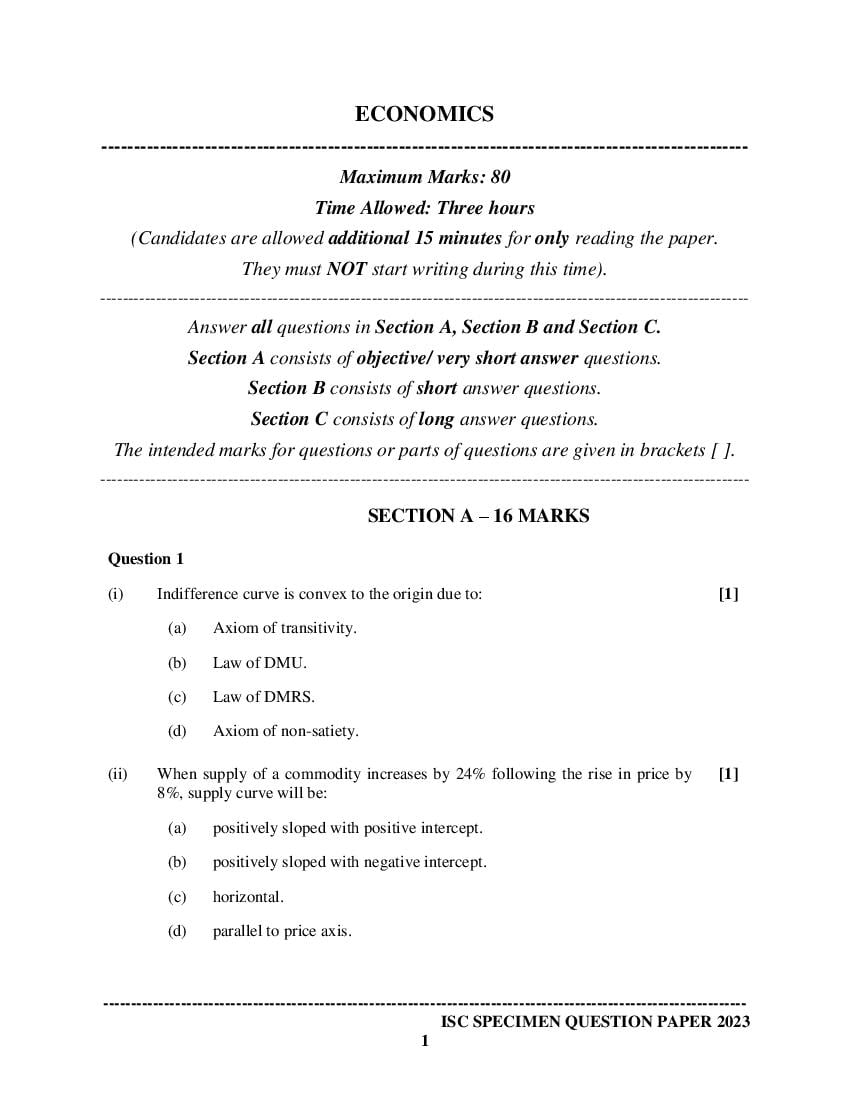
SECTION A – 16 MARKS
Question 1
(i) Indifference curve is convex to the origin due to: [1]
(a) Axiom of transitivity.
(b) Law of DMU.
(c) Law of DMRS.
(d) Axiom of non-satiety.
(ii) When supply of a commodity increases by 24% following the rise in price by [1]
8%, supply curve will be:
(a) positively sloped with positive intercept.
(b) positively sloped with negative intercept.
(c) horizontal.
(d) parallel to price axis.
1
Page 2
Price
D’
D
O
Quantity
In the figure given above, D is demand curve for normal good. It shifts to D’
which is a case of:
(a) extension of demand due to change in price level.
(b) increase in demand due to rice in expected future price of the commodity.
(c) contraction of demand due to increase in price of the substitute.
(d) increase in demand due to rise in price of the complimentary good.
(iv) A demand curve parallel to X axis signifies: [1]
(a) perfectly elastic.
(b) perfectly inelastic.
(c) elastic.
(d) inelastic.
(v) Which one of the following is a pair of direct taxes? [1]
(a) Excise duty and Wealth Tax
(b) Service Tax and Income Tax
(c) Excise Duty and Service Tax
(d) Wealth Tax and Income Tax
(vi) Which one of the following is included in the calculation of National Income? [1]
(a) Transfer Earnings
(b) Sale proceeds of Shares and Bonds
(c) Black Money
(d) None of the Above
2
Page 3
like food, coal etc., as compared to freight charges for other products like T.V.,
Air coolers etc. This is an example of:
(a) Price ceiling.
(b) Price discrimination.
(c) Price control.
(d) Floor pricing.
(viii) A firm produces its profit maximising level of output only when: [1]
(a) MR = AR
(b) MR > MC
(c) AR < MR
(d) MC = MR
(ix) Complete the following table: [1]
INCOME (Y) ` CONSUMPTION MPC ` MPS `
(C) `
8000/- 6800/-
10000/- 8000/-
(x) What is investment multiplier? [1]
(xi) Mention any two sources of receipts from tax revenue of government budget. [1]
(xii) State whether the following statement is True or False. Give one reason for your [1]
answer.
Undistributed profits are not a part of domestic factor income.
(xiii) An oligopolist has an indeterminate demand curve. What is the reason for this [1]
feature of Oligopoly?
(xiv) Why is AR=MR=P a horizontal straight line under perfect competition in the [1]
short run?
(xv) What does 0<c<1 signify? [1]
(xvi) What is meant by autonomous consumption? [1]
3
Page 4
Question 2 [4]
(i) The following headline appeared in the newspaper –
“Crop damage in Himachal Pradesh sent tomato prices soaring in Delhi.”
Analyse the statement with reference to the relationship between price and
supply.
(ii) The initial demand for a commodity was 100 units. With a rise in price by ₹ 5,
the demand for the quantity decreases by 5 units. The elasticity of demand is 1‧2.
Calculate the price before the change in demand.
Question 3 [4]
(i) State any two differences between a direct tax and an indirect tax.
(ii) Refunding and Debt conversion are two methods of Debt redemption. Briefly
explain these two methods of debt redemption.
Question 4
(i) What is marginal cost of a firm? [1]
(ii) Calculate Total fixed cost, Marginal cost and Average Cost from the following [3]
data:
Output (Units) 0 1 2 3 4
Total cost (`) 100 240 360 540 620
Question 5
(i) Explain any two features of Perfect Competition. [2]
(ii) What is meant by intense competition under Oligopoly? [2]
OR
(i) Explain the equilibrium of a firm when it enjoys supernormal profit in the short [4]
run under perfect competition.
4
Page 5
(i) In the short run under perfect competition, a firm should produce if and only if
P or AR ≥ AVC. Justify.
(ii) Why do firms earn normal profit in the long run under Perfect competition?
Question 7 [4]
(i) What is meant by inflation? Mention the types of Inflation.
(ii) Explain the role of ‘repo rate’ in controlling inflation.
Question 8 [4]
(i) Illustrate the process of credit creation by Commercial banks with the help of a
numerical example.
OR
(ii) How does Central bank control credit by using Qualitative methods?
Question 9 [4]
Explain the equilibrium level of income and output determination by Aggregate demand
and Aggregate supply approach with the help of a diagram.
SECTION C – 32 MARKS
Question 10
(i) State the law of variable proportions. Explain its three stages by using a diagram. [6]
(ii) Briefly explain why the producer is comfortable in the second stage of [2]
production.
5
Page 6
(i) Differentiate between total utility and marginal utility. [2]
(ii) Explain the Consumer’s equilibrium through Indifference curve approach with [6]
the help of a diagram.
OR
(i) Differentiate between increase in demand and contraction of demand with the [2]
help of diagrams.
(ii) Explain four properties of Indifference curves. [6]
Question 12
(i) What is the difference between GDPmp and NNPfc? [2]
(ii) Calculate Domestic Income and National Income from the following [6]
information:
Items ` (in Crore)
1. Rent 120
2. Interest 15
3. Profits 45
4. Wages & Salaries 330
5. Consumption of fixed capital 150
6. Factor income earned abroad 30
7. Factor income paid abroad 60
8. Mixed income of self-employed 360
9. Employer’s contribution to social security schemes 30
OR
(i) Differentiate between personal income and national income. [2]
6
Page 7
Items ` (in Crore)
1. Government final consumption expenditure 800/-
2. Net factor income earned from abroad (-) 10/-
3. Import 300/-
4. Export 250/-
5. Net Indirect taxes 70/-
6. Private final consumption expenditure 1200/-
7. Net domestic capital formation 385/-
8. Consumption of fixed capital 85/-
Question 13
Read the passage given below and answer the questions that follow.
India is predominantly an agriculture based country. It is the second largest producer of
wheat in the world and wheat export is also an important component in its international
business transactions. Recently, Indian Government put a ban on the export of wheat to
other countries to control inflation in the country. This decision of Indian Government
may decrease the flow of foreign exchange in credit side of the balance of payments of
our country in comparison to the debit side of it. This may affect the Balance of Payment
as India has been following flexible exchange rate system, to some extent, since
1991-92.
(i) What is meant by balance of payments? [1]
(ii) State any two causes of adverse balance of payments. [2]
(iii) In the context of international business relations, what does flexible exchange [2]
rate system mean?
(iv) What is meant by net exports? [2]
(v) What economic variables are measured along x-axis and y-axis for the [1]
determination of foreign exchange rate?
7
Document Details
| Board / Org | CISCE |
| Exam | Class 12 |
| Type | Sample Paper |
| Pages | 7 |
| Updated | 30 Apr 2026 |