Karnataka SSLC Model Question Paper 2027 for Mathematics (Paper 4, English Medium) Key Answers
Finished viewing? Save it for later —
Download Karnataka SSLC Model Question Paper 2027 for Mathematics (Paper 4, English Medium) Key Answers (PDF · 33 pages)About Karnataka SSLC Model Question Paper 2027 for Mathematics (Paper 4, English Medium) Key Answers
Karnataka SSLC Model Question Paper 2027 for Mathematics (Paper 4, English Medium) Key Answers is available here for free download. Published by Karnataka Board for Class 10, this answer key can be viewed online or downloaded as a PDF (33 pages). Candidates preparing for Class 10 can use Karnataka SSLC Model Question Paper 2027 for Mathematics (Paper 4, English Medium) Key Answers to understand the exam pattern, the type of questions asked, and the overall difficulty level.
Frequently Asked Questions
How can I download Karnataka SSLC Model Question Paper 2027 for Mathematics (Paper 4, English Medium) Key Answers?
Open this page and click the Download button to save Karnataka SSLC Model Question Paper 2027 for Mathematics (Paper 4, English Medium) Key Answers as a PDF. It is completely free on AglaSem Docs.
Is Karnataka SSLC Model Question Paper 2027 for Mathematics (Paper 4, English Medium) Key Answers free to download?
Yes. Karnataka SSLC Model Question Paper 2027 for Mathematics (Paper 4, English Medium) Key Answers can be viewed online and downloaded as a PDF free of cost on AglaSem Docs.
How many pages does Karnataka SSLC Model Question Paper 2027 for Mathematics (Paper 4, English Medium) Key Answers have?
Karnataka SSLC Model Question Paper 2027 for Mathematics (Paper 4, English Medium) Key Answers contains 33 pages, which you can read online or download together as a single PDF.
Where can I find more Class 10 study material?
You can find more Class 10 question papers, sample papers, syllabus, and answer keys on AglaSem Docs.
Karnataka SSLC Model Question Paper 2027 for Mathematics (Paper 4, English Medium) Key Answers – Text
Read the full text of this answer key below — useful to quickly search, copy and reference the content online without downloading the PDF.
📄 View text version (34 pages)
Page 1
Karnataka SSLC Model
Question Paper 2027 for
Mathematics (Paper 4, English
Medium) Key Answers
EXAM YEAR TYPE SUBJECT
Karnataka Class 10 2027 Answer Key Maths
Notes · Sample Papers · Previous Year Papers · Mock Tests
Page 2
.co s e m
s em l a
a ag
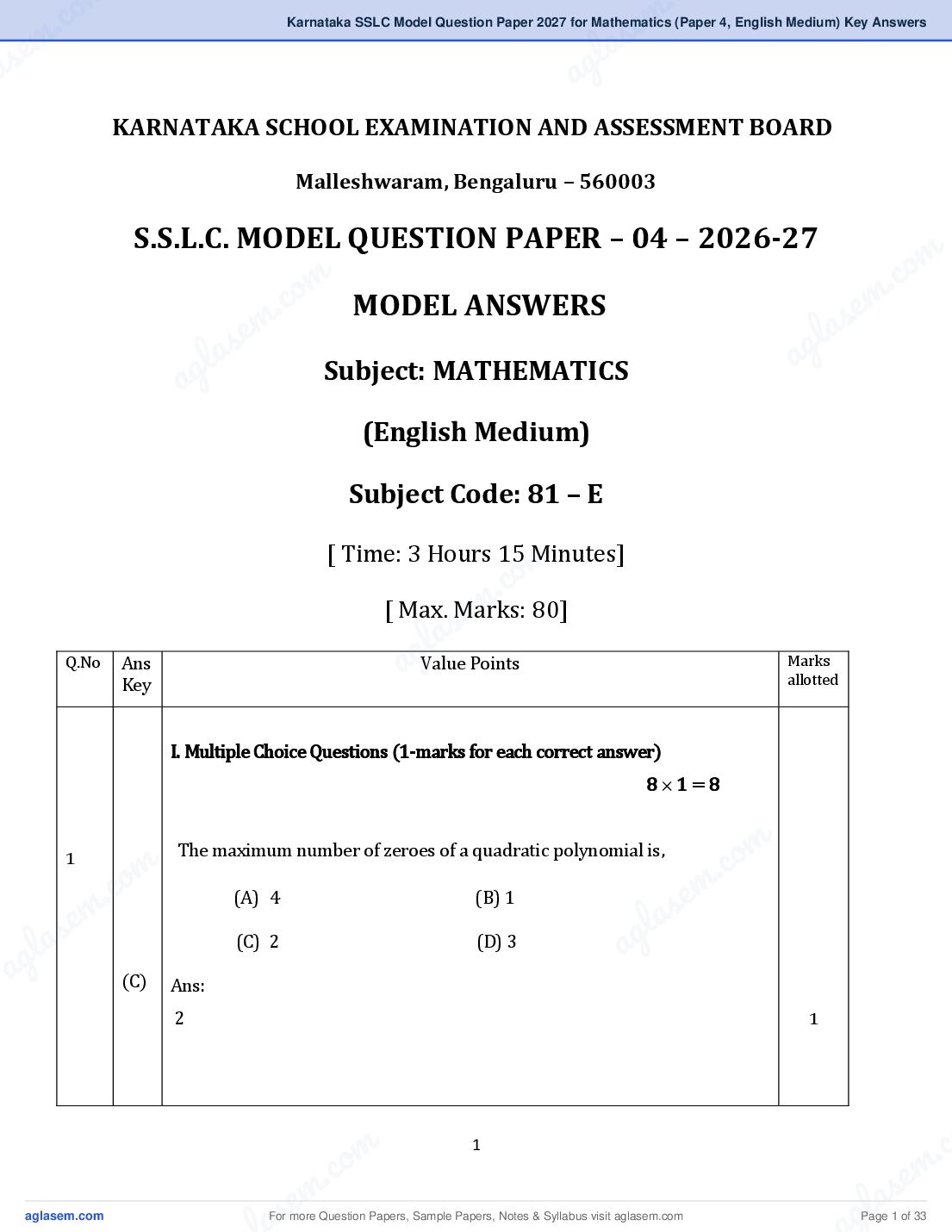
KARNATAKA SCHOOL EXAMINATION AND ASSESSMENT BOARD
Malleshwaram, Bengaluru – 560003
S.S.L.C. MODEL QUESTION PAPER – 04 – 2026-27
m
om . co
. c e m
em MODEL ANSWERS
l as
l as ag
ag Subject: MATHEMATICS
(English Medium)
Subject Code: 81 – E
[ Time: 3 Hours 15 m
Minutes]
. co
e 80] m
l as
[ Max. Marks:
Q.No Ans
Key
agValue Points Marks
allotted
I. Multiple Choice Questions (1-marks for each correct answer)
8 1=8
m
.co
The maximum number of zeroes of a quadratic polynomial is,
1
m
m .co (A) 4 (B) 1
s e m
s e g la
g la (C) 2 (D) 3 a
a (C) Ans:
2 1
om
1
. c
. c e m
m as
se
For more Question Papers, Sample Papers, Notes & Syllabus visit
gl
Page 1 of 33
Page 3
Key allotted
2 If the pair of linear equations a1x + b1y + c1 = 0 and a2x + b2y + c2 = 0
have infinite solutions, then the correct relation among the following is,
a1 b1 a1 b1 c1
(A) (B)
a2 b2 a2 b2 c2
a1 b1 c1
(C) (D)
a2 b2 c2
Ans:
(B) a1 b1 c1
1
a2 b2 c2
3 If one of the roots of the quadratic equation 2x2 +ax +6 =0 is 2, then the
value of ‘a’ is
(A) 7 (B)
(C) 7 (D)
Ans 1
(C) : 7
4 The formula to find the sum of first ‘ n’ natural numbers is,
(A) Sn =n(n+1) (B) Sn = n2
(C) Sn = (D) Sn =
Ans:
(C) 1
Sn =
2
For more Question Papers, Sample Papers, Notes & Syllabus visit Page 2 of 33
Page 4
.co s e m
s em l a
a ag
Q.No Ans Value Points Marks
Key allotted
5 In the given figure, the value of ‘x’ is
m
om . co
. c e m
e m l as
a s
l (A) 4 cm ag
ag (B) 5 cm
(C) 6cm (D) 8 cm
Ans:
1
(B) 5 cm
6
m
.co
The formula to find mean of the grouped data by direct method is
e m
(A) ̅
l as (B) ̅
ag
(C) ̅ (D) ̅
Ans:
(C) ̅ 1
m
m The volume of a cube with edge is 5 cm is .co
7
m .co s e m
s e (B) 30 cmgl
a
la (A) 125 cm2
a
3
ag (C) 100 cm3 (D) 125 cm3
Ans:
1
(D) 125 cm3
om
3
. c
. c e m
m as
se
For more Question Papers, Sample Papers, Notes & Syllabus visit
gl
Page 3 of 33
Page 5
Key allotted
8 If sin , then the value of is,
√
(A) 300 (B ) 450
(C) 900 (D) 600
Ans:
(B) 450 1
Q. No Allotted
II. Answer the following questions: 8
Write the number of zeroes of the polynomial p(x) in the given graph.
9
1
Ans: 4
4
For more Question Papers, Sample Papers, Notes & Syllabus visit Page 4 of 33
Page 6
.co s e m
s em l a
a ag
Q. No Allotted
10 If the lines represented by the equations 12x + py + 8 = 0 and 4x + 2y + 2 = 0
are parallel, then find the value of ‘p’.
m
om . co
. c a1 b1 c1
e m
e m
Ans: If lines are parallel then
a2 b2 c2
½
l as
l as ag
ag
=3
½ 1
11 In an arithmetic progression the sum of the first 4 terms is 20 and the sum of
first 3 terms is 12, then find the 4th term of the progression.
m
m .co
e
Ans: a4=S4 S3 ½
a4=20 – 12
l as
ag
1
a4=8 ½
12 In ∆ABC, DE || AB. If CD = 3 cm, EC = 4 cm, BE = 6 cm, then find the measure
of DA.
Ans: Since DE || AB
m
m .co
m .co s e m
s e g la
la a
=
ag DE=
DE= 4.5 cm
1
om
5
. c
. c e m
m as
se
For more Question Papers, Sample Papers, Notes & Syllabus visit
gl
Page 5 of 33
Page 7
If the probability of winning a game is 0.8 then find the probability of losing the
13
same game.
Ans: P(E) + P( ̅ ) =1 ½
0.8 + P( ̅ ) =1
P( ̅ ) =1 – 0.8
P( ̅ ) = 0.2
The probability of losing the same game = 0.2 ½ 1
If a and b are prime numbers, then write their H.C.F.
14
Ans: 1 1
Two diagonals of a parallelogram intersect at a point ‘O’. If the coordinates of the
15
end points of one of the diagonals are (1, 1) and (7, 4) then find the coordinates
of the point ‘O’.
Ans: O , =( , ) ½
1
, =( , )
, =( , )
, =( , ) ½
Write the formula to find the surface area of a sphere whose radius is ‘r’ units.
16
Ans: Surface area of sphere = 4 r2 1
6
For more Question Papers, Sample Papers, Notes & Syllabus visit Page 6 of 33
Page 8
.co s e m
s em l a
a ag
Q. No Allotted
III. Answer the following questions: 8 x 2 = 16
17 There are 10 terms in an arithmetic progression. If the last term is 34 and
common difference is 3, then find the first term of the progression.
m
om . co
c m
OR
.
Find the number of terms in the arithmetic progression 7, 13, 19..........205
m s e
s e g l a
l a
Ans: an=a+(n 1)d
g
½
a
10a +(10 1)(3)
a = a ½
34 = a + 9(3)
34 = a + 27
a = 34 – 27 ½
a=7 ½ 2
OR
m
m .co
data:
s e
a=7 d=6 n=? an=205
l a
an =a+(n-1)d
ag ½
205= 7+(n-1)6 ½
205= 7+6n-6
205= 6n+1
m
m 204=6n
.co
m .co s e½m
e la
n=
las ag 2
ag n = 34 ½
Number of terms = 34
om
7
. c
. c e m
m as
se
For more Question Papers, Sample Papers, Notes & Syllabus visit
gl
Page 7 of 33
Page 9
18 Determine the nature of the roots of the quadratic equation
Ans:
½
x=√ ½
x= ½
Roots are real and distinct ½
2
19 Solve the given pair of linear equations.
5x y = 14
x y= 2
Ans: 5 x y = 14 -----------------(1)
x – y = 2 ------------------(2)
(-) (+) (+)
--------------------
4x = 16 ½
x=
x=4 ½
Substitute the value of ‘x’ in equation 2
x–y= 2
4–y= 2 ½
–y = 2 4
–y = 6
y=6 ½ 2
8
For more Question Papers, Sample Papers, Notes & Syllabus visit Page 8 of 33
Page 10
.co s e m
s em l a
a ag
Q. No Allotted
20 Write the coordinates of the origin and also write the distance of the point D
, from the -axis.
m
m . co
c. o origin are ,
Ans: Coordinates of the 1
s e m
em
Distancesof the point D ,
g2l
a
a
from the -axis is 4 units. 1
g l a
21 a
Prove that 2 √ is an irrational number.
Ans: Let us assume , to the contrary, that 2 - √ is rational.
That is we can find co prime a and b (b 0 ) such that 2 -√ = ½
√ =2
m
.co
Rearranging this equation, we get
e m
√ =
l as ½
g
Since a and b are integers, we get a is rational, and so √ is rational.
But this contradicts the fact that √ is irrational. ½
This contradiction has arisen because of our incorrect assumption that
2 √ is rational. 2
½m
m
So, we conclude that 2 √ is irrational
.c o
c o
22 . A quadrilateral ABCD is drawn to circumscribe a circle. e m
em Prove that AB + CD = AD + BC las
las ag
ag
om
9
. c
. c e m
m as
se
For more Question Papers, Sample Papers, Notes & Syllabus visit
gl
Page 9 of 33
Page 11
OR
Prove that the angle between the two tangents drawn from an external point to
a circle is supplementary to the angle subtended by the line segments joining the
points of contact at the centre.
Ans:
From the figure,
(i) DR = DS, (ii) BP = BQ, (iii) AP = AS, (iv) CR = CQ ½
(Tangents drawn from an external point a circle are equal)
Now, adding the LHS and RHS of the above equations, we get,
DR+BP+AP+CR = DS+BQ+AS+CQ ½
By rearranging them, we get,
(BP+AP) +(DR+CR) = (DS+AS)+ (CQ+BQ) ½
2
AB + CD = AD + BC ½
OR
Data: A is an external point to a circle with centre O. AB and AC are tangents.
To Prove: O ½
10
For more Question Papers, Sample Papers, Notes & Syllabus visit Page 10 of 33
Page 12
.co s e m
s em l a
a ag
Q. No Allotted
Proof: = =
In Quadrilateral OBAC,
m
om
= 360 ( Angle sum property of quadrilateral) ½
. co
. c = 360 ½
e m
e m = 360
l as
l as = 360 - 1
g
a2
ag =1 ½
23 Evaluate: 2tan2450 + cos2300 – sin2600
√ √
Ans: = 2 ( ) ( ) 1
= 2(1) + ½
om
=2 ½
c 147m and 56m respectively.
The length and breadth of a rectangular field.are
2
m
e can be used to measure both length
24
a s
l this rod has to be used to measure the
Calculate the maximum length of a rod that
a g
and breadth exactly. How many times
length of the field?
2 56
3 147 2 28
7 49 2 14
7
m
.co
7
m
c. o 147 = 3 × s e m1
e m 56 = 2 ×7
la
las ag
g
HCF(147,56) is 7 ½
a Maximum length of the rod = 7m
This rod sholud be used 21 times to measure the field ½ 2
om
11
. c
. c e m
m as
se
For more Question Papers, Sample Papers, Notes & Syllabus visit
gl
Page 11 of 33
Page 13
Answer the following questions: 9 x 3 = 27
Write the quadratic polynomial whose sum of the zeroes is 2 and product of the
25 zeroes is 15. Also and find the zeroes of this polynomial.
Ans: α + β = 2 , α x β = 15
quadratic polynomial P(x) = x2 – (α + β) x + αβ ½
P(x) = x2 2x – 15 ½
P(x) = x2 2x – 15
P(x) = x2 5x + 3x 15 ½
P(x) = x (x 5)+ 3 ( x 5) ½
P(x)= (x 5)(x + 3) ½ 3
x – 5 = 0 or x + 3 =
x = 5 or x = 3
zeroes of polynomials are 5 and 3 ½
26 An umbrella has 8 ribs which are equally spaced . Assuming umbrella to be a flat
circle of radius 45 cm, find the area between the two consecutive ribs of the
umbrella.
12
For more Question Papers, Sample Papers, Notes & Syllabus visit Page 12 of 33
Page 14
.co s e m
s em l a
a ag
Q. No Allotted
OR
A car has two wipers which do not overlap. Each wiper has a blade of length
m
om
25 cm sweeping through an angle of 115°. Find the total area cleaned at each
. co
. c
sweep of the blades.
e m
em
Ans: Total ribs in the umbrella = 8
l as
a s
Thelradius of the umbrella When it to be flat =45cm ag
g
aAngle between consecutive ribs at the centre = = 45 0 ½
Area of sector = ½
= ½
= ½
m
=
m .co ½
= 795.5 cm2
s e
a
½
l
ag OR
3
Radius of the sector = length of the wiper = 25 cm ½
Area of the sector formed by the wiper = ½
=
= 2 2 ½
m
m = 2
.co
m .co s e m ½
la
= cm2
s e g
g la The total area covered by blades of two wipers
a
a =2 cm2 ½
= = 1254.96 cm2 ½
3
om
13
. c
. c e m
m as
se
For more Question Papers, Sample Papers, Notes & Syllabus visit
gl
Page 13 of 33
Page 15
27 In the figure, ABCD is a parallelogram. If point P divides AB in the ratio 2:3 and
the point Q divides DC in the ratio 4 : 1, then prove that OA = 2 OC.
OR
In the trapezium ABCD, AB || DC. Diagonals AC and BD intersect each other at
the point O. Prove that AO . DO = CO . BO
Ans: In ΔOAP and ΔOQC
OAP = QCO (∵AB ǁ CD alternate angles ) ½
AOP = QOC (∵vertically opposite angle ) ½
APO = OQC (∵ third angle)
ΔOAP ~ ΔOQC (∵A A criteria) ½
so and
½
But AB = CD (opposite sides of the parallelogram)
½
2
2
O 2O ½
3
14
For more Question Papers, Sample Papers, Notes & Syllabus visit Page 14 of 33
Page 16
.co s e m
s em l a
a ag
Q. No Allotted
OR
Ans:
In AOB and DOC m
om
AOB= DOC (vertically opposite angles) ½ . co
. c
ABO = ODC (alternate angles)
e m
s
½
e m
BAO =OCD (alternate angles)
l a
l as ag
AOB
g
a COD ( AA criteria) ½
½
AO DO = BO CO ½ 3
28 Prove that, "The tangent at any point of a circle is perpendicular to the radius
m
.co
through the point of contact."
e m
l as
ag
2
Data : X Y is a tangent to a circle with centre O. ‘ ’ is point of contact ½
To Prove : OP ⊥ XY ½
Construction: Mark a point Q on the tangent XY and join OQ .
OQ intersects the circle at R ½
Proof : OP = OR [Radii of same circle]
m
m .co
Now OQ = OR + RQ
.co OQ OR
s e m
s em OQ OP [∵ O O
g la ½
g la Therefore OP is the shortest distance to the tangent from the center O,
a
a OP ⊥ XY [ ∵ Perpendicular distance is always the shortest distance] ½
3
om
15
. c
. c e m
m as
se
For more Question Papers, Sample Papers, Notes & Syllabus visit
gl
Page 15 of 33
Page 17
29 A game consists of tossing a coin three times and noting its outcome each
time. erson ‘ ’ wins if all the tosses give the same result and loses otherwise.
erson ‘ ’ wins if the outcome is at least two heads and loses otherwise.
Calculate which person has the greater probability of losing the game.
Ans: S={ HHH,HHT,HTH,HTT, THH, THT, TTH, TTT} n(S)=8 ½
‘ ’ wins if he get {HHH, TTT } n 2
P(A) = = = 1
‘ ’ wins if he get B={HHH, HHT,HTH,THH } n(B) = 4
P(B) = = = 1
person “ ’ has the greater probability of losing the game ½
3
30 Aniruddha bought some pens for ₹60. If he had bought 5 more pens for the
same amount, the price of each pen would have been reduced by ₹1. Find
the number of pens he bought and the price of each pen.
Ans : Let the number of pens bought be ‘x’.
Total cost = ₹60
price per pen =
If he bought 5 more pens, the new number of pens would be x + 5.
New price per pen =
According to the question, the price per pen exceeds the new price per pen by ₹1
- =1 ½
16
For more Question Papers, Sample Papers, Notes & Syllabus visit Page 16 of 33
Page 18
.co s e m
s em l a
a ag
Q. No Allotted
= x2 + 5x
m
om
300 = x2 + 5x
. co
. cx + 5x – 300 = 0 e m
s
2 ½
e m l a
l as x2 + 20x 15x– 300 = 0 ½
ag
ag x (x+20) – 15 (x+20) = 0
(x 15) (x+20) = 0
x 15 = 0 or x +20 = 0
x =15, x = 20 ½ 3
Since the number of pens cannot be negative, x = 15 ½
Cost of each pen = = ₹4 ½
m
m .co
31
s e
In the figure, find the coordinates of the point which divides the line segment
l a
ag section formula.
‘ ’ internally in the ratio :2 using
m
m .co
m .co s e m
s e g la
g la a
a Ans:
Coordinates of the point A : A (2, 5) = (x1, y1)
Coordinates of the point B : B (5, 2) = (x2, y2) ½
m1 : m2 = 1 : 2, P (x, y) = ?
om
17
. c
. c e m
m as
se
For more Question Papers, Sample Papers, Notes & Syllabus visit
gl
Page 17 of 33
Page 19
P(x, y) = * , + ½
= * , + ½
= * , + ½
3
=* , + ½
= ( 3, 4 )
P(x, y) = (3, 4) ½
Find the Mode for the following frequency distribution table.
32
class interval 10 -20 20 -30 30 -40 40 -50 50 - 60
frequency 3 9 6 7 5
OR
Find the Median for the following frequency distribution table.
class interval frequency
0 – 10 4
10 – 20 9
20 – 30 15
30 – 40 14
40 – 50 8
Ans: Here class interval of the mode is 20 30
20
3
9
6
10 1
18
For more Question Papers, Sample Papers, Notes & Syllabus visit Page 18 of 33
Page 20
.co s e m
s em l a
a ag
Q. No Allotted
* + ½
2 * + ½
m
co
2 * + ½
. c om e m .
2
e
.
m l as
l as ag
ag 2 .
OR
½
class interval frequency cf
0 – 10 4 4
10 – 20 9 13
20 – 30 15 28
30 – 40 14 42 ½
40 – 50 8 50
m
m .co
s e
l=20
l a
ag
cf 13
h =10
f=15
2 1
edian l ( ) h ½
2 ( ) ½
m
.co
2
m
.co
2 ( )
m s em
e la ½
2
las 2
ag
ag 3
om
19
. c
. c e m
m as
se
For more Question Papers, Sample Papers, Notes & Syllabus visit
gl
Page 19 of 33
Page 21
33.
Prove that: 2
OR
Prove that: – .
Ans: LHS
½
½
½
½
½
3
2 = RHS ½
OR
LHS = (cosec A – sin A)(tanA + cot A)
( )( ) 1
( )( ) ½
.
( )( ) ½
.
( )( ) ½
3
. = RHS ½
20
For more Question Papers, Sample Papers, Notes & Syllabus visit Page 20 of 33
Page 22
.co s e m
s em l a
a ag
Q. No Allotted
V. Answer the following questions: 4 x 4 = 16
34 rove that “If one angle of a triangle is equal to one angle of the other
m
triangle and the sides including these angles are proportional, then the two
om . co
. c e m
triangles are similar”.
e m l as
l as OR
ag
agthat “If in two triangles, corresponding angles are equal, then their
rove
corresponding sides are in the same ratio (or in proportion) and hence the
two triangles are similar”.
Ans:
m
m .co
s e
l a
ag
½
Data: In ∆ ∆
D ½
m
omprove: ∆
c. To ∆ m.½co
m Construction: Mark points P and Q on the sides DE and DF s e
s e g la
g la a
a respectively, such that DP = AB and DQ = AC. join PQ. ½
om
21
. c
. c e m
m as
se
For more Question Papers, Sample Papers, Notes & Syllabus visit
gl
Page 21 of 33
Page 23
Proof:
In ∆ BC and ∆DPQ
AB = DP (construction)
A= D (data)
AC = DQ (construction)
∆ABC ≅ ∆DPQ . . . . (1) by SAS criterion congruence ½
=
= (∵ DP = AB, DQ = AC )
PQ || EF (∵ Converse of thales theorem) ½
P = E and Q = F (corresponding angles)
Consider ∆ BC and ∆DPQ:
AB = DP (by construction)
A= D (given)
AC = DQ (by construction)
Therefore, △ABC~∆DPQ (SAS) ½
B= P, C= Q ( CPCT)
So, B = P = E , C= Q= F
Since all three corresponding angles are equal ( A = D, B = E, C= F),
△ABC~DEF (AAA) ½ 4
22
For more Question Papers, Sample Papers, Notes & Syllabus visit Page 22 of 33
Page 24
.co s e m
s em l a
a ag
Q. No Allotted
OR
m
co
Ans. :
. c om e m .
e m l as
l as ag
ag
½
Data : In triangles ABC,
A = D, B = E, C = F ½
To prove : = ½
m
.co
Construction: Cut AB=DP and AC = DQ on DE & DF at P & Q.
em
join PQ ½
Proof: In Δ BC and ΔDPQ ,
l a s
AB = DP , AC = DQ ag (construction)
BAC = PDQ (data)
ΔABC ≅ ΔDPQ (SAS congruency rule) ½
ABC =DPQ
But ABC =DEF
om
m . c
.co DPQ = DEF
s em½
s em l a
la ag
PQ ||EF (Since corresponding angles equal) ½
ag = = ------(1)
But AB = DP , BC = DQ
4
= = ½
om
23
. c
. c e m
m as
se
For more Question Papers, Sample Papers, Notes & Syllabus visit
gl
Page 23 of 33
Page 25
35 The sum of first 5 terms of an arithmetic progression is 70 and the sum of first
10 terms is 290. Find the progression. Find which term of this progression is
48 more than its 10th term.
Let ‘a’ be the first term and ‘d’ be the common difference of the AP.
Sum of first 5 terms S5 = 70
Sn = [2a + (n - 1)d] ½
S5 = [2a + (5 - 1)d]
70 = [2a + 4d]
a + 2d = 14
a=14 2d ……… (1) ½
Sum of first 10 terms S10 = 290
Sn = [2a + (n - 1)d]
S10 = [2a + (10 - 1)d]
290 = 5 [2a + 9d]
2a + 9d = 58
2(14 2d) + 9d = 58 (from 1) ½
28 4d +9d = 58
5d = 58 28
5d = 30
d=6 ½
24
For more Question Papers, Sample Papers, Notes & Syllabus visit Page 24 of 33
Page 26
.co s e m
s em l a
a ag
Q. No Allotted
a=14 2d
m
om
a=14 2(6)
. co
. ca=14 12 e m
e m l as
l as ag
a g a=2 ½
equired A P is 2, , , 2 , 2 . . . .. ½
an = a10 + 48 ½
a + (n 1)d = a + 9d +48
m
2 + (n 1)6 = 2 + (9)6 +48
m .co
s e
a
2 + (n 1)6 = 2 + 54+48
l
2 + (n 1)6 = 104 ag
(n 1)6 = 104 2
n 1=
n 1= 17
m
.co
n = 18
m 18 term of the progression is 48 more than its 10th term.
m .co th
s em½ 4
s e g la
g la a
a
om
25
. c
. c e m
m as
se
For more Question Papers, Sample Papers, Notes & Syllabus visit
gl
Page 25 of 33
Page 27
36 Solve the given pair of linear equations by graphical method.
x + 3y = 11
x+y=5
4
For two tables 1+1 : 2marks
Drawing 2 lines : 1 mark
Finding values of x and y : 1 mark
26
For more Question Papers, Sample Papers, Notes & Syllabus visit Page 26 of 33
Page 28
.co s e m
s em l a
a ag
Q. No Allotted
37 Two poles of height 1.5m are standing vertically on either side of a flag post
on a level ground as shown in the figure. The height of the flag post is 7√ m
and the angle of elevation from the foot of the pole AB to the top of the flag
m
post is 300 and angle of elevation from the top of pole CD to the top of the flag
om . co
c
post is 450. Find the distance between the poles.
. e m
( √ =1.7)
e m l as
l as ag
ag
m
.co
OR
e m
as
A building(AB) and a lamp post (CD) are standing vertically on a level ground
ofldepression of the top and bottom of the
as shown in the figure. The angles g
a
lamp post from the top of the building are found to be 30 and 60 0 0
respectively. If the height of the building is 60m, then find the
(i) distance between the building and lamp post
(ii) height of the lamp post.
m
m .co
m .co s e m
s e g la
g la a
a
om
27
. c
. c e m
m as
se
For more Question Papers, Sample Papers, Notes & Syllabus visit
gl
Page 27 of 33
Page 29
Heights of the poles, AB = CD = 1.5 m
Height of the flag post PR = 7√ m
Angle of elevation to point B, PBR = 300
Angle of elevation to point C, PCQ = 600
In right-angled ∆ PBR:
tan 300 = ½
√
=
√
BR = 7 (√ )2 m
BR = 7 X 3
BR = 21 m ½
Height PQ = PR QR = 7√ - 1.5
= 7X 1.7 1.5
=10.4 m 1
In right-angled triangle PQC
tan 450 = ½
.
1 =
QC = 10.4
RD = QC = 10.4 ½
Total distance between the poles BD = BR + RD ½
= 21+ 10.4
= 31.4m
The distance between the poles is 31.4m. ½
4
28
For more Question Papers, Sample Papers, Notes & Syllabus visit Page 28 of 33
Page 30
.co s e m
s em l a
a ag
Q. No Allotted
OR
m
o m . co
. c
Given :- Heights of the building, AB = 60 m
e m
e m
Let the height of the lamp post CD = h m
l as
a s
l triangle ABD ag
a g
In right-angled
M
tan 600 =
√ =
BD =
√
√
= X
√ √
= 20√ m 2
m
The distance between the building and the lamp post is = 20√ m
m .co
s e
BD = MC = 20√ m
l a ½
In right-angled triangle AMC ag
tan 300 = ½
= ½
√ √
60-h = 20
m
.co
h = 40 m
m
c. oHeight of the lamp post = 40 m s em½ 4
e m la
las ag
ag
om
29
. c
. c e m
m as
se
For more Question Papers, Sample Papers, Notes & Syllabus visit
gl
Page 29 of 33
Page 31
VI. Answer the following questions: 1X5=5
A solid is made by joining a cone and a hemisphere on either sides of a cylinder
38
with the same radius as that of the cylinder as shown in the figure. The height
of the cylinder and the cone are 30cm and 24cm respectively. If the volume of
the cylinder is 4620cm3 , then find the total surface area of the solid.
OR
Sanvi made a solid as shown in the figure. The total height of the solid is 14cm
and the diameter of the hemisphere and cone is 12cm. Find the total surface area
and volume of the solid.
30
For more Question Papers, Sample Papers, Notes & Syllabus visit Page 30 of 33
Page 32
.co s e m
s em l a
a ag
Q. No Allotted
Ans :- Given : Height of cylinder hcyl = 30 cm
Height of cone hcone = 24 cm
m
om
Volume of cylinder Vcyl = 4620cm2
. co
. c e m
m
πr2h = 4620
e
½
l as
as
l r X 30 = 4620 ag
ag 2
r2 = 49
r = 7 cm ½
Slant height (l) of the cone:
l=√ m
c. o
½
e m
=√ 2
l as
=√ ag
=√ 2
= 25 cm ½
Total Surface Area (TSA) of the solid:
m
.co
TSA of the solid = CSA of hemisphere + CSA of cylinder + CSA of cone ½
m 2πr2 + 2πrh + πrl 1
m .co s em½
la
πr (2r + 2h + l)
s e g
g la = (2 x 7 + 2 (30) + 25) a ½
a
= 2178 cm2
5
Total Surface area of the solid is 2178 cm2 ½
om
31
. c
. c e m
m as
se
For more Question Papers, Sample Papers, Notes & Syllabus visit
gl
Page 31 of 33
Page 33
OR
Diameter of base = 12cm Radius r = 6 cm
Total height of solid = 14 cm
Height of hemisphere = Radius r = 6 cm
Height of cone (h) = Total height Height of hemisphere = 14 6 = 8 cm ½
Slant height of cone l = √ ½
=√
=√
=√
= 10 cm ½
Total Surface Area of solid:
TSA = CSA of hemisphere + CSA of cone ½
2πr2 + πrl ½
= πr (2r + l)
32
For more Question Papers, Sample Papers, Notes & Syllabus visit Page 32 of 33
Page 34
.co s e m
s em l a
a ag
= (2 (6) + 10)
= cm2 ½
Total volume of solid = Volume of hemisphere + Volume of cone ½
= πr3 + πr3h ½
m
o= mπr (r + h) . co
c m
2
m . s e
s e = x x 36 x (12+6) ½
g l a
g l a a5
a = cm3 ½
m
m .co
s e
l a
ag
m
m .co
m .co s e m
s e g la
g la a
a
om
33
. c
. c e m
m as
se
For more Question Papers, Sample Papers, Notes & Syllabus visit
gl
Page 33 of 33
Document Details
| Board / Org | Karnataka Board |
| Exam | Class 10 |
| Type | Answer Key |
| Pages | 33 |
| Language | english |
| Updated | 03 Nov 2026 |