Karnataka 1st PUC Model Question Paper 2023 for Economics
Finished viewing? Save it for later —
Download Karnataka 1st PUC Model Question Paper 2023 for Economics (PDF · 9 pages)About Karnataka 1st PUC Model Question Paper 2023 for Economics
Karnataka 1st PUC Model Question Paper 2023 for Economics is available here for free download. Published by Karnataka Board for Class 11, this sample paper can be viewed online or downloaded as a PDF (9 pages). Candidates preparing for Class 11 can use Karnataka 1st PUC Model Question Paper 2023 for Economics to understand the exam pattern, the type of questions asked, and the overall difficulty level.
Frequently Asked Questions
How can I download Karnataka 1st PUC Model Question Paper 2023 for Economics?
Open this page and click the Download button to save Karnataka 1st PUC Model Question Paper 2023 for Economics as a PDF. It is completely free on AglaSem Docs.
Is Karnataka 1st PUC Model Question Paper 2023 for Economics free to download?
Yes. Karnataka 1st PUC Model Question Paper 2023 for Economics can be viewed online and downloaded as a PDF free of cost on AglaSem Docs.
How many pages does Karnataka 1st PUC Model Question Paper 2023 for Economics have?
Karnataka 1st PUC Model Question Paper 2023 for Economics contains 9 pages, which you can read online or download together as a single PDF.
Where can I find more Class 11 study material?
You can find more Class 11 question papers, sample papers, syllabus, and answer keys on AglaSem Docs.
Karnataka 1st PUC Model Question Paper 2023 for Economics – Text
Read the full text of this sample paper below — useful to quickly search, copy and reference the content online without downloading the PDF.
📄 View text version (9 pages)
Page 1
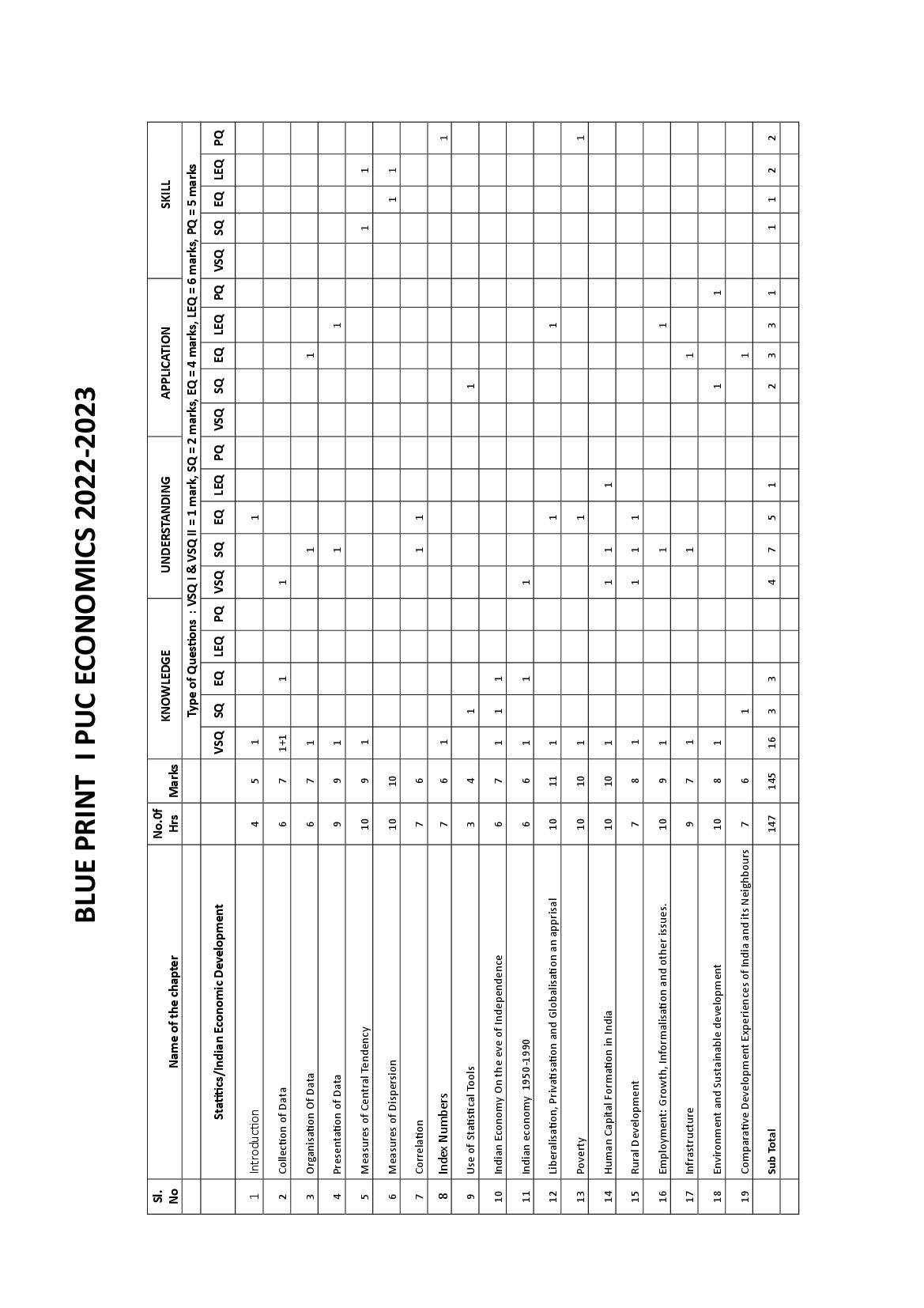
Sl. No.0f
KNOWLEDGE UNDERSTANDING APPLICATION SKILL
No Name of the chapter Hrs Marks
Type of Questions : VSQ I & VSQ II = 1 mark, SQ = 2 marks, EQ = 4 marks, LEQ = 6 marks, PQ = 5 marks
Statitics/Indian Economic Development VSQ SQ EQ LEQ PQ VSQ SQ EQ LEQ PQ VSQ SQ EQ LEQ PQ VSQ SQ EQ LEQ PQ
1 Introduction 4 5 1 1
2 Collection of Data 6 7 1+1 1 1
3 Organisation Of Data 6 7 1 1 1
4 Presentation of Data 9 9 1 1 1
5 Measures of Central Tendency 10 9 1 1 1
6 Measures of Dispersion 10 10 1 1
7 Correlation 7 6 1 1
8 Index Numbers 7 6 1 1
9 Use of Statistical Tools 3 4 1 1
10 Indian Economy On the eve of Independence 6 7 1 1 1
11 Indian economy 1950-1990 6 6 1 1 1
12 Liberalisation, Privatisation and Globalisation an apprisal 10 11 1 1 1
13 Poverty 10 10 1 1 1
14 Human Capital Formation in India 10 10 1 1 1 1
15 Rural Development 7 8 1 1 1 1
16 Employment: Growth, Informalisation and other issues. 10 9 1 1 1
17 Infrastructure 9 7 1 1 1
18 Environment and Sustainable development 10 8 1 1 1
19 Comparative Development Experiences of India and its Neighbours 7 6 1 1
Sub Total 147 145 16 3 3 4 7 5 1 2 3 3 1 1 1 2 2
Page 2
MODEL QUESTION PAPER
I PUC - ECONOMICS (22) NS - 2022-23
Time : 3 Hours 15 minutes [Max. Marks : 100]
Instruction : 1. Write the question numbers legibly in the margin.
2. Answer for a question should be continuous
PART - A
I. Choose the correct answer: 1 × 10 = 10
1. Scarcity is the root of
(a) All economic problems (b) Social problems
(c) Political problems (d) All problems
2. A histogram is a
(a) one dimensional diagram (b) two dimensional diagram
(c) three dimensional diagram (d) four dimensional diagram
3. Which Method of collection of Data gives better result?
(a) Census (b) Sample survey
(c) Innovation (d) Distribution
4. In index number of which year price is assumed to be 100
(a) Current year (b) Base year
(c) Selection of prices (d) None of the above
5. In India census is carried out once in
(a) 5 years (b) 10 years
(c) 1 year (d) 2 years
6. Poverty line separates
(a) Poor and nonpoor (b) Rich and nonrich
(c) Poor and weak (d) None of the above
7. Who can work better in the folllowing
(a) A sick person (b) An unhealthy labourer
(c) A person with sound health (d) None of the above
8. Which state in India is popularly known as ‘God’s own country’?
(a) Kerala (b) Kashmir
(c) Goa (d) Himachal Pradesh
1
Page 3
(a) Ministers (b) Public servant
(c) self employees (d) Government doctor
10. Most of the agricultural labourers are
(a) Rich (b) Middle class
(c) Poor (d) Upper class
II. Fill in the blanks by choosing the correct answer given in the bracket. 1 × 5 = 05
(Financial, Primary data, Prime minister, Spatial data, Carbon dioxide)
11. Data collected by the investigator is called ..................
12. Data classified according to geographical area is called ..................
13. RBI regulates .................. sector.
14. Chairperson of planning commission ..................
15. Thermal power plants emit large quantities of ........................ .
III. Match the following 1 × 5 = 05
16. A B
1) Personal interview 1) A positive development
2) Arithmetic mean 2) A non-institutional source
3) Quota 3) More response
4) Better gender equity 4) Quantity of goods that can be imported
5) Money lender 5) X
PART - B
IV. Answer any 4 of the following questions in about four sentences each. 2 × 4 = 08
17. Differentiate between inclusive and exclusive method of classification.
18. How can you obtain frequency curve?
19. Calculate the value of the median from the following figures.
X : 5 7 9 12 11 8 7 15 25.
20. Name the types of correlation.
21. Name the first four steps in developing a project.
22. Mentions the name of 4 statistical tools.
V. Answer any 5 of the following questions in about four sentences each. 2 × 5 = 10
23. What are the infrastructure facilities developed during colonial rule?
24. What are the various forms of health expenditure?
25. Give the meaning of rural development.
2
Page 4
27. What is the meaning of ‘Global Burden of Diseases’?
28. Mention the four functions of Environment.
29. Give the meaning of liberty indicator.
PART - C
VI. Answer any 3 of the following questions in about twelve sentences each. 3 × 4 = 12
30. “We are not as Lucky as Aladdin” Elucidate this statement.
31. Briefly explain the sampling errors.
32. Write a note on classification of data.
33. Draw scatter diagram and conclude about correlation.
X 10 20 30 40 50 60 70 80
Y 25 20 25 35 40 35 50 45
34. The yield of Jower per acre for ten districts of a state is as under.
District A B C D E F G H I J
Jower 22 29 12 23 18 15 12 34 18 12
Calculate mean deviation from mean.
VII.Answer any 4 of the following questions in about twelve sentences each. 4 × 4 = 16
35. What do you understand by the ‘drain of Indian wealth’ during colonial period?
36. Write a short note on land reforms in India.
37. Write a note on WTO.
38. Write a short note on alternative markets.
39. Explain the state of health infrastructure in Rural India.
40. What do you mean by growth oriented approach to poverty reduction? Why it is not successful in India?
41. Compare and contrast the development of India and China with respect to some salient human
development indicators.
PART - D
VIII. Answer any 2 of the following questions in about twenty sentences each. 6 × 2 = 12
42. Following table shows the Enrollment by gender at schools (%) of children aged 6-14 years in a dis-
trict of Bihar. Draw a component bar diagram by using these datas.
Gender Enrolled (in %) Drop-outs
Boy 91.5 8.5
Girl 58.6 41.4
All 78.0 22.0
3
Page 5
22, 26, 14, 130, 18, 11, 35, 41, 12, 32.
44. The yield of Sugarcane per acre for ten districts of a state is as under.
District A B C D E F G H I J
Sugarcane 12 10 15 19 21 16 18 9 25 10
Calculate standard deviation and co-efficient variation.
IX. Answer any 2 of the following questions in about twenty sentences each. 6 × 2 = 12
45. Explain the important areas of liberalisation.
46. Explain the role of education in the economic development of a nation.
47. What role does the government play in generation employment opportunities in India?
PART - E
X. Answer any 2 of the following project oriented questions. 5 × 2 = 10
48. Write a note on SENSEX.
49. Write the chart of poverty line.
50. Identify and prepare the list of reasons responsible for the land degradation in your locality.
****
4
Page 6
ªÀiÁzÀj ¥Àæ±Éß ¥ÀwæPÉ
¥ÀæxÀªÀÄ ¦AiÀÄĹ (CxÀð±Á¸ÀÛç) 2022-2023
(Kannada Version)
Time : 3 Hours 15 minutes [Max. Marks : 100]
¸ÀÆZÀ£ÉUÀ¼ÀÄ: 1. ¥Àæ±É߸ÀASÉåUÀ¼À£ÀÄß ªÀiÁfð£ï£À°è ¸ÀàµÀÖªÁV §gɬÄj. .
2. MAzÀÄ ¥Àæ±ÉßUÀ¼À GvÀÛgÀUÀ¼ÀÄ ¤gÀAvÀgÀªÁVgÀvÀPÀÌzÀÄÝ.
¨sÁUÀ - J
I. ¸ÀjAiÀiÁzÀ GvÀÛgÀªÀ£ÀÄß Dj¹ §gɬÄj : 1 × 10 = 10
1. PÉÆgÀvÉAiÀÄÄ AiÀiÁªÀÅzÀPÉÌ ªÀÄÆ®PÁgÀtªÁVzÉ?
a) J¯èÁ DyðPÀ ¸ÀªÀĸÉåUÀ½UÉ b) ¸ÁªÀiÁfPÀ ¸ÀªÀĸÉåUÀ½UÉ
c) gÁdQÃAiÀÄ ¸ÀªÀĸÉåUÀ½UÉ d) J¯èÁ jÃwAiÀÄ ¸ÀªÀĸÉåUÀ½UÉ
2. DAiÀÄvÀ avÀæ MAzÀÄ
a) KPÀ ¥ÀjªÀiÁtzÀ DPÀÈw b) JgÀqÀÄ ¥ÀjªÀiÁtzÀ DPÀÈw
c) ªÀÄÆgÀÄ ¥ÀjªÀiÁtzÀ DPÀÈw d) £Á®ÄÌ ¥ÀjªÀiÁtzÀ DPÀÈw
3. PɼÀV£À AiÀiÁªÀ zÀvÁÛA±À ¸ÀAUÀæºÀuÉAiÀÄ «zsÁ£ÀªÀÅ GvÀÛªÀÄ ¥sÀ°vÁA±À ¤ÃqÀÄvÉÛ.
a) d£ÀUÀtw b) ªÀiÁzÀj ¸À«ÄÃPÉë
c) D«µÁÌgÀ d) «vÀgÀuÉ
4. ¸ÀÆZÀåAPÀzÀ°è AiÀiÁªÀ ªÀµÀðzÀ ¨É¯ÉAiÀÄ£ÀÄß 100 JAzÀÄ H»¸À¯ÁUÀÄvÀÛzÉ.
a) ZÁ°Û ªÀµÀð b) DzsÁgÀ ªÀµÀð
c) ¨É¯ÉUÀ¼À DAiÉÄÌ d) ªÉÄð£À AiÀiÁªÀÅzÀÆ C®è
5. ¨sÁgÀvÀzÀ°è ¥Àæwà ............. ªÀµÀðUÀ½UÉ MªÉÄä d£ÀUÀtwAiÀÄ£ÀÄß £ÀqɸÀ¯ÁUÀÄvÀÛzÉ.
a) 5 ªÀµÀðUÀ¼ÀÄ b) 10 ªÀµÀðUÀ¼ÀÄ
c) 1 ªÀµÀð d) 2 ªÀµÀðUÀ¼ÀÄ
6. §qÀvÀ£ÀzÀ gÉÃSÉAiÀÄÄ EªÀgÀ£ÀÄß ¥ÀævÉåÃQ¸ÀÄvÀÛzÉ
a) §qÀªÀ ªÀÄvÀÄÛ §qÀªÀgÀ®èzÀªÀgÀ£ÀÄß b) ²æêÀÄAvÀ ªÀÄvÀÄÛ ²æêÀÄAvÀgÀ®èzÀªÀgÀ£ÀÄß
c) §qÀªÀ ªÀÄvÀÄÛ zÀħð®gÀ£ÀÄß d) ªÉÄð£À AiÀiÁªÀÅzÀÆ C®è
7. F PɼÀV£ÀªÀgÀÄUÀ¼À°è AiÀiÁgÀÄ GvÀÛªÀĪÁV PÉ®¸À ªÀiÁqÀ§®ègÀÄ?
a) C£ÁgÉÆÃUÀå ¦ÃrvÀ ªÀåQÛ b) C£ÁgÉÆÃUÀå ¦ÃrvÀ PÁ«ÄðPÀ
c) ¸ÀzÀÈqsÀ DgÉÆÃUÀåªÀAvÀ d) ªÉÄð£À AiÀiÁªÀÅzÀÆ C®è
8. zÉêÀgÀ ¸ÀéAvÀ £ÁqÀÄ JAzÀÄ PÀgÉAiÀÄ®àqÀĪÀ gÁdå.
a) PÉÃgÀ¼À b) PÁ²äÃgÀ
c) UÉÆêÁ d) »ªÀiÁZÀ® ¥ÀæzÉñÀ
Page 7
a) ªÀÄAwæUÀ¼ÀÄ b) ¸ÁªÀðd¤PÀ ¸ÉêÀPÀ
c) ¸Àé-GzÉÆåÃV d) ¸ÀgÀPÁj ªÉÊzÀå.
10. §ºÀÄvÉÃPÀ PÀȶ PÁ«ÄðPÀgÀÄ.
a) ²æêÀÄAvÀgÀÄ b) ªÀÄzsÀåªÀÄ ªÀUÀðzÀªÀgÀÄ
c) §qÀªÀgÀÄ d) G£ÀßvÀ ªÀUÀðzÀªÀgÀÄ
II. DªÀgÀtzÀ°ègÀĪÀ ¸ÀjAiÀiÁzÀ GvÀÛgÀªÀ£ÀÄß Dj¹ SÁ° ©lÖ ¸ÀܼÀªÀ£ÀÄß vÀÄA©j. 1 × 5 = 05
(ºÀtPÁ¸ÀÄ, ¥ÁæxÀ«ÄPÀ zÀvÁÛA±À, ¥ÀæzsÁ£ÀªÀÄAwæUÀ¼ÀÄ, ¸ÁÜ£Á£ÀĸÁgÀ zÀvÁÛA±À, PÁ§ð£ï qÉÊDPÉìöÊqï)
11. ¸ÀA±ÉÆÃzsÀPÀ£ÀÄ ¸ÀAUÀ滹zÀ zÀvÁÛA±ÀPÉÌ. ...............
12. ¨sËUÉÆýPÀ ¥ÀæzÉñÀPÉÌ C£ÀÄUÀÄtPÉÌ ªÀVÃðPÀj¸À®àqÀĪÀ zÀvÁÛA±ÀªÀ£ÀÄß ............... JAzÀÄ PÀgÉAiÀÄĪÀgÀÄ.
13. RBI .................. ªÀ®AiÀĪÀ£ÀÄß ¤AiÀÄAwæ¸ÀÄvÀÛzÉ. )
14. AiÉÆÃd£Á DAiÉÆÃUÀzÀ CzsÀåPÀëgÀÄ ...............
15. ±ÁSÉÆÃvÀà£Àß ±ÀQÛ PÉÃAzÀæªÀÅ ........................£ÀÄß C¢üPÀ ¥ÀæªÀiÁtzÀ°è ºÉÆgÀ¸ÀƸÀÄvÀÛzÉ.
III. ºÉÆA¢¹ §gɬÄj : 1 × 5 = 05
16. J ©
1) ªÉÊAiÀÄQÛPÀ ¸ÀAzÀ±Àð£À 1) MAzÀÄ zsÀ£ÁvÀäPÀ C©üªÀÈ¢Ý.
2) CAPÀUÀtÂvÀ ¸ÀgÁ¸Àj 2) MAzÀÄ ¸ÁA¹ÜPÉÃvÀgÀ ªÀÄÆ®
3) PÉÆÃmÁ 3) C¢üPÀ ªÉZÀÑ¥Àæw¸ÀàAzÀ£É
4) GvÀÛªÀÄ °AUÀ ¸ÀªÀiÁ£ÀvÉ 4) DªÀÄzÀÄ ¸ÀgÀPÀÄUÀ¼À ¥ÀæªÀiÁt
5) ¯ÉêÁzÉëUÁgÀgÀÄ 5) X
¨sÁUÀ - ©
IV. F PɼÀV£À AiÀiÁªÀÅzÁzÀgÀÆ 4 ¥Àæ±ÉßUÀ½UÉ £Á®ÄÌ ªÁPÀåUÀ¼À°è GwÛj¹. 2 × 4 = 08
17. ¸ÀªÀiÁ«¶ÖvÀ ªÀÄvÀÄÛ ºÉÆgÀvÁzÀ ¥ÀzÀÞwAiÀÄ ªÀVðÃPÀgÀtzÀ £ÀqÀÄ«£À «vÁå¸À w½¹.
18. DªÀÈwÛ gÉÃSÉAiÀÄ£ÀÄß ºÉÃUÉ ¥ÀqÉAiÀÄÄ«j?
19. F PɼÀV£À zÀvÁÛA±ÀUÀ½UÉ ªÀÄzsÁåAPÀªÀ£ÀÄß PÀAqÀÄ»r¬Äj..
X : 5 7 9 12 11 8 7 15 25.\
20. ¸ÀºÀ¸ÀA§AzsÀzÀ JgÀqÀÄ «zsÀUÀ¼ÀÄ CxÀð PÉÆr.
21. AiÉÆÃd£ÉAiÀÄ£ÀÄß C©üªÀÈ¢Þ ¥Àr¸ÀĪÀ°è ªÉÆzÀ® £Á®ÄÌ ºÀAvÀUÀ¼À£ÀÄß §gɬÄj.
22. AiÀiÁªÀÅzÁzÀgÀÆ £Á®ÄÌ ¸ÀASÁåvÀäPÀ ¸ÁzsÀ£ÀUÀ¼À£ÀÄß ºÉ¸Àj¹.
V. F PɼÀV£À AiÀiÁªÀÅzÁzÀgÀÆ 5 ¥Àæ±ÉßUÀ½UÉ £Á®ÄÌ ªÁPÀåUÀ¼À°è GvÀÛj¹. 2 × 5 = 10
23. ªÀ¸ÁºÀvÀıÁ» D½éPÉAiÀÄ°è C©üªÀÈ¢ÞAiÀiÁzÀ ªÀÄÆ® ¸ËPÀAiÀÄðUÀ¼ÀÄ AiÀiÁªÀŪÀÅ?
24. DgÉÆÃUÀå ªÉZÀÑzÀ ««zsÀ ¥ÀæPÁgÀUÀ¼ÁªÀŪÀÅ ?
25. UÁæ«ÄÃuÁ©üªÀÈ¢ÝAiÀÄ CxÀð ¤Ãr.
26. ¸ÀéAiÀÄA GzÉÆåÃVUÀ¼ÁgÀÄ? GzÁºÀgÀuÉ PÉÆr.
27. ‘PÁ¬Ä¯ÉUÀ¼À eÁUÀwPÀ ºÉÆgÉ’ EzÀgÀ CxÀðªÀ£ÀÄß ¤Ãr.
Page 8
29. ¸ÀévÀAvÀæ ¸ÀÆZÀPÀzÀ CxÀð ¤Ãr.
¨sÁUÀ - ¹
VI. F PɼÀV£À AiÀiÁªÀÅzÁzÀgÀÆ 3 ¥Àæ±ÉßUÀ½UÉ ºÀ£ÉßgÀqÀÄ ªÁPÀåUÀ¼À°è GwÛj¹ 4 × 3 = 12
30. “¤d fêÀ£ÀzÀ°è £ÁªÀÅ C¯ÁèªÀÅ¢Ýãï£ÀµÀÄÖ CzÀȵÀÖªÀAvÀgÁVgÀ®Ä ¸ÁzsÀå«®è”. F ºÉýPÉAiÀÄ£ÀÄß ¸ÀªÀÄyð¹.
31. ªÀiÁzÀj zÉÆõÀUÀ¼À£ÀÄß ¸ÀAQë¥ÀÛªÁV «ªÀj¹.
32. zÀvÁÛA±À ªÀVÃðPÀgÀtzÀ §UÉÎ MAzÀÄ n¥Ààt §gɬÄj.
33. ZÀzÀÄjPÉAiÀÄ avÀæªÀ£ÀÄß gÀa¹ ªÀÄvÀÄÛ ¸ÀºÀ¸ÀA§AzsÀªÀ£ÀÄß nÃQ¹.
X 10 20 30 40 50 60 70 80
Y 25 20 25 35 40 35 50 45
34. MAzÀÄ gÁdåzÀ°è£À ºÀvÀÄÛ f¯èÉUÀ¼À°è eÉÆüÀzÀ E¼ÀĪÀjAiÀÄ£ÀÄß F PɼÀUÉ ¤ÃqÀ¯ÁVzÉ. CAPÀUÀtÂvÀ ¸ÀgÁ¸Àj¬ÄAzÀ ªÀiÁ£ÀPÀ
«ZÀ®£ÉAiÀÄ£ÀÄß ¯ÉPÀÌ ºÁQ..
f¯èÉ A B C D E F G H I J
CQÌ 22 29 12 23 18 15 12 34 18 12
VII. F PɼÀV£À AiÀiÁªÀÅzÁzÀgÀÆ 4 ¥Àæ±ÉßUÀ½UÉ ºÀ£ÉßgÀqÀÄ ªÁPÀåUÀ¼À°è GwÛj¹ 4 × 4 = 16
35. ªÀ¸ÁºÀvÀıÁ» D½éPÉAiÀÄ°è ¨sÁgÀvÀzÀ ¸ÀA¥ÀvÀÄÛ §¹zÀÄ ºÉÆìÄvÀÄ. JA§ÄzÀ£ÀÄß K£ÉAzÀÄ CxÉÊð¸ÀÄ«j?
36. ¨sÁgÀvÀzÀ°è ¨sÀÆ ¸ÀÄzsÁgÀuÉAiÀÄ£ÀÄß PÀÄjvÀÄ MAzÀÄ ®WÀÄ n¥Ààt §gɬÄj.
37. WTO PÀÄjvÀÄ n¥Ààt §gɬÄj.
38. ¥ÀAiÀiÁðAiÀÄ ªÀiÁgÀÄPÀmÉÖUÀ¼À §UÉÎ MAzÀÄ ®WÀÄ n¥Ààt §gɬÄj.
39. UÁæ«ÄÃt ¨sÁgÀvÀzÀ°è DgÉÆÃUÀå ¹ÜwUÀwAiÀÄ£ÀÄß «ªÀj¹.
40. §qÀvÀ£ÀªÀ£ÀÄß PÀrªÉÄUÉƽ¸ÀĪÀ ¨É¼ÀªÀtÂUÉ DzsÁjvÀ ªÀiÁUÀð JAzÀgÉãÀÄ? KPÉ CzÀÄ ¨sÁgÀvÀzÀ°è AiÀıÀ¹éAiÀiÁV®è?
41. ¥ÀæªÀÄÄR ªÀiÁ£ÀªÀ C©üªÀÈ¢Þ ¸ÀÆZÀPÀPÉÌ ¸ÀA§A¢ü¹zÀAvÉ ¨sÁgÀvÀ ªÀÄvÀÄÛ aãÁ zÉñÀUÀ¼À C©üªÀÈ¢Þ ºÉÆðPÉ ªÀÄvÀÄÛ ªÀåvÁå¸ÀUÀ¼À£ÀÄß
w½¹.
¨sÁUÀ - r
VIII. F PɼÀV£À AiÀiÁªÀÅzÁzÀgÀÆ 2 ¥Àæ±ÉßUÀ½UÉ E¥ÀàvÀÄÛ ªÁPÀåUÀ¼À°è GwÛj¹
6 × 2 = 12
42. F PɼÀV£À PÉÆõÀÖPÀªÀÅ ©ºÁgÀ gÁdåzÀ°è 6 -14 ªÀµÀð ªÀAiÀĹì£À ªÀÄPÀ̼À ±Á¯ÉUÀ¼À°è °AUÁ£ÀĸÁgÀ zÁR¯ÁwAiÀÄ£ÀÄß
vÉÆÃj¸ÀÄvÀÛzÉ. F zÀvÁÛA±ÀUÀ¼À£ÀÄß §¼À¹ ¸ÀAWÀnPÀ ¸ÀÛA¨sÀ gÉÃSÁ avÀæªÀ£ÀÄß gÀa¹.
°AUÀ zÁR¯Áw (%) ±Á¯É ©lÖªÀgÀÄ (%)
¨Á®PÀgÀÄ 91.5 8.5
¨Á®QAiÀÄgÀÄ 58.6 41.4
MlÄÖ 78.0 22.0
Page 9
22, 26, 14, 130, 18, 11, 35, 41, 12, 32.
44. MAzÀÄ gÁdåzÀ°è£À ºÀvÀÄÛ f¯èÉUÀ¼À°è PÀ©â£À GvÀà£Àß F PɼÀV£ÀAwzÉ.
f¯èÉ A B C D E F G H I J
PÀ§Äâ 12 10 15 19 21 16 18 9 25 10
ªÀiÁ£ÀPÀ «ZÀ®£É ªÀÄvÀÄÛ UÀÄuÁAPÀ «ZÀ®£ÉAiÀÄ£ÀÄß ®PÁÌ ºÁQ.
IX. F PɼÀV£À AiÀiÁªÀÅzÁzÀgÀÆ 2 ¥Àæ±ÉßUÀ½UÉ E¥ÀàvÀÄÛ ªÁPÀåUÀ¼À°è GwÛj¹ 6 × 2 = 12
45. GzÁjÃPÀgÀtzÀ ¥ÀæªÀÄÄR ªÀ®AiÀÄUÀ¼À£ÀÄß «ªÀj¹..
46. MAzÀÄ zÉñÀzÀ DyðPÁ©üªÀÈ¢ÞAiÀÄ°è ²PÀëtzÀ ¥ÁvÀæªÀ£ÀÄß ¥Àj²Ã°¹.
47. ¨sÁgÀvÀzÀ°è GzÉÆåÃUÀªÀPÁ±ÀUÀ¼À£ÀÄß ¸ÀȶָÀĪÀ°è ¸ÀPÁðgÀ ªÀ»¸ÀĪÀ ¥ÁvÀæªÉãÀÄ?
¨sÁUÀ - E
X. F PɼÀV£À AiÀiÁªÀÅzÁzÀgÀÆ 2 PÁAiÀÄð¨sÁgÀ DzsÁjvÀ ¥Àæ±ÉßUÀ½UÉ GwÛj¹
5 × 2 = 10
48. ¸É£É¸ÉPïì (¸ÀAªÉâ ¸ÀÆZÀåAPÀ)£ÀÄß PÀÄjvÀÄ n¥Ààt §gɬÄj.
49. §qÀvÀ£À gÉÃSÉAiÀÄ ¥ÀlªÀ£ÀÄß §gɬÄj.
50. ¤ªÀÄä ¸ÀܽÃAiÀÄ ¥ÀæzÉñÀUÀ¼À°è ¨sÀÆ«ÄAiÀÄ UÀÄtªÀÄlÖ QëÃtvÉAiÀÄ §UÉÎ PÁgÀtªÁVgÀĪÀ CA±ÀUÀ¼À£ÀÄß UÀÄgÀÄw¹. CªÀÅUÀ¼À£ÀÄß
¥ÀnÖ ªÀiÁr.
Document Details
| Board / Org | Karnataka Board |
| Exam | Class 11 |
| Type | Sample Paper |
| Pages | 9 |
| Updated | 30 Apr 2026 |