AP Class 10 Model Paper 2022 Physics (English Medium)
Finished viewing? Save it for later —
Download AP Class 10 Model Paper 2022 Physics (English Medium) (PDF · 5 pages)About AP Class 10 Model Paper 2022 Physics (English Medium)
AP Class 10 Model Paper 2022 Physics (English Medium) is available here for free download. Published by Andhra Pradesh Board for Class 10, this sample paper can be viewed online or downloaded as a PDF (5 pages). Candidates preparing for Class 10 can use AP Class 10 Model Paper 2022 Physics (English Medium) to understand the exam pattern, the type of questions asked, and the overall difficulty level.
Frequently Asked Questions
How can I download AP Class 10 Model Paper 2022 Physics (English Medium)?
Open this page and click the Download button to save AP Class 10 Model Paper 2022 Physics (English Medium) as a PDF. It is completely free on AglaSem Docs.
Is AP Class 10 Model Paper 2022 Physics (English Medium) free to download?
Yes. AP Class 10 Model Paper 2022 Physics (English Medium) can be viewed online and downloaded as a PDF free of cost on AglaSem Docs.
How many pages does AP Class 10 Model Paper 2022 Physics (English Medium) have?
AP Class 10 Model Paper 2022 Physics (English Medium) contains 5 pages, which you can read online or download together as a single PDF.
Where can I find more Class 10 study material?
You can find more Class 10 question papers, sample papers, syllabus, and answer keys on AglaSem Docs.
AP Class 10 Model Paper 2022 Physics (English Medium) – Text
Read the full text of this sample paper below — useful to quickly search, copy and reference the content online without downloading the PDF.
📄 View text version (5 pages)
Page 1
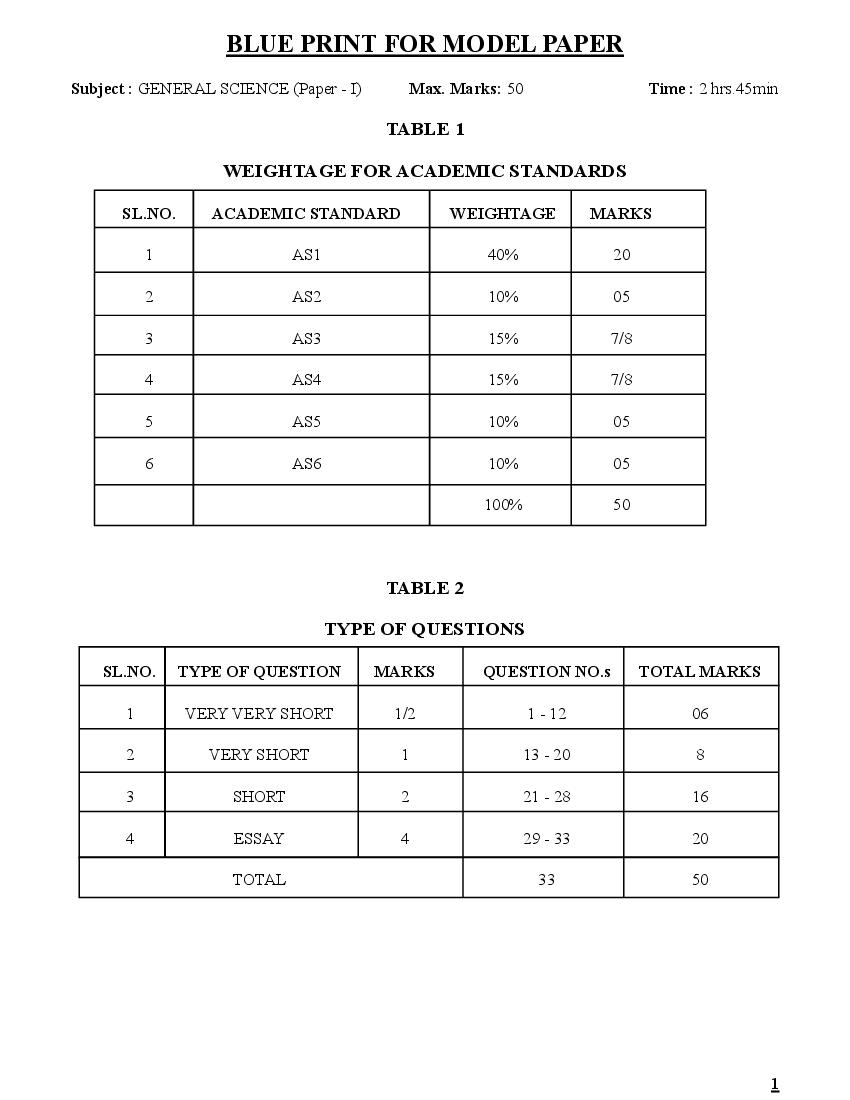
Subject : GENERAL SCIENCE (Paper - I) Max. Marks: 50 Time : 2 hrs.45min
TABLE 1
WEIGHTAGE FOR ACADEMIC STANDARDS
SL.NO. ACADEMIC STANDARD WEIGHTAGE MARKS
1 AS1 40% 20
2 AS2 10% 05
3 AS3 15% 7/8
4 AS4 15% 7/8
5 AS5 10% 05
6 AS6 10% 05
100% 50
TABLE 2
TYPE OF QUESTIONS
SL.NO. TYPE OF QUESTION MARKS QUESTION NO.s TOTAL MARKS
1 VERY VERY SHORT 1/2 1 - 12 06
2 VERY SHORT 1 13 - 20 8
3 SHORT 2 21 - 28 16
4 ESSAY 4 29 - 33 20
TOTAL 33 50
1
Page 2
SSC PUBLIC EXAMINATIONS - 2022
GENERAL SCIENCE - PAPER - I (English Version)
Class : X Max.Marks : 50 Time : 2hrs.45min.
Instructions :
1. 15 minutes of time is allotted for reading the question paper in addition to 2.30 hours for writing the
answers.
2. All the answers should be written in the separate answer booklet.
3. There are four sections in the question paper.
4. There is an internal choice in Section IV.
5. Write all the answers visibly & legibly
SECTION - I 12 × ½ = 6 M
2. Each question carries 1 mark
1. .................... is defined as the degree of hotness or coldness.
2. Latent heat of vapourisation of water is ................... ( )
A) 500 cal/gm B) 540 cal/gm C) 80 K cal/gm D) 500 K cal/gm
3. Imagine and write which gas will be evolved generally when a metal reacts with an acid.
4. A : Aqueous sodium chloride is called brine solution ( )
B : Mg(OH)2 is alkali solution (Alkali)
K) Only A is true L) Only B is true
M) Both A and B are true N) Both A and B false
5. Write any one use of a lens in our daily life ?
6. Lens Shape ( )
1. Biconvex lens ( ) p)
2. Biconcave lens ( ) q)
r)
Match the above
A) 1 - p, 2 - q B) 1 - q, 2 - p C) 1 - q, 2 - r D) 1 - r, 2 - p
7. Which is the coloured part that we see in our eye ?
1
Page 3
A) 6.626×10⁻³⁴ JS B) 6.626×10⁻³⁴ J/S
C) 6.626×10⁻²⁷ JS D) 6.626×10⁻²⁷ J/S
9. When asked Swarup to give examples for Halogens, he stated as Flourine, Chlorine, Neon, Bromine.
By observing the examples given by Swarup find and write which element is not a halogen among
them.
10. According to octet rule ‘Argon’ demonstrates stability, assume and write how many electrons are
there in it’s outer most orbit.
11. What is the SI unit of “Potential difference”.
12. Write name of any metal that is helpful in our daily life.
SECTION - II 8×1=8M
2. Each question carries 1 mark.
13.
A is less optically denser than B. Keeping in view of optical densities rewrite and complete the
diagram in your answer sheet.
14. Write any two required materials to determine the focal length of a lens using UV method in labora-
tory?
15. What is least distance of distinct vision of a healthy human ?
16. An electron in an atom has the following set of four quantum numbers.
n l ml ms
2 O O +½
On the basis of the above table.
Which orbital does the electron belong.
17. Give any one example for Dobereiner’s Triads.
18. Write any other name of ‘Ionic Bond’.
19. What do you call a character of Electric conductor that opposes the motion of electron.
20. Write any two highly reactive metals you know.
2
Page 4
2. Each question carries 2 marks.
21. Assume and write why do we have sweat while doing work.
22. Let A, B, C materials have given red, yellow, red colours when react with methyl orange respectively.
1) Among A, B, C which are acids, which are bases.
2) What is the change in colour when phenolphthalein added to B.
23. Write any two required materials to do the activity to prove that ‘the focal length of a lens depend on
its surroundings and also write any one precaution to do this activity.
24. Doctor suggested to use 4D lens. What is the focal length of the lens?
25. Explain nlx method briefly.
26. What is the bond angle of the following.
ˆ in water molecule
1) Angle of HOH
ˆ in Ammonia
2) Angle of HNH
27. Explain what happen to the value of resistance of a conductor if its cross sectional area is doubled and
length is kept under constant.
28. Write any two questions to understand how the metals extracted from their ore ?
SECTION - IV 5 × 4 = 20 M
1. Write answer for all all the questions.
2. There is an internal choice for each question.
3. All questions carry equal marks.
4. Each question carries 4 marks.
29. Write the appropriate reasons for the following phenomenon.
a) Water melon brought out from a refrigerator retains its coolness for a longer time than other fruits.
b) Oceans behave like heat store houses for the earth.
(OR)
What is myopia ? How can we rectify it?
30 Solution A B C D E F
pH value 0 1 4 7 11 14
3
Page 5
1) Which is the strongest acid ?
2) Which is the weak acid ?
3) Which is the strongest base ?
4) Which is neutral ?
(OR)
Classify the following in to oxides, sulfides, sulfates separately.
Matter Bauxite Zinc Pyrolusite Zincite Heamatite Cinnabar Epsom Galena
Blend salt
Formula Al2O3 ZnS MnO2 ZnO Fe2O3 HgS MgSO4 PbS
2H2O 7H2O
31. Write the lab activity to obtain a relationship between angle of incidence and angle of refraction
(Snell’s law)
(OR)
Write the lab activity to show that the ratio V/I (Ohm’s law) is a constant for a conductor.
32. How the following periodic properties of atom trend in groups and periods.
A) Ionisation Energy
B) Electronegativity
C) Atomic radius
D) Electron affinity
(OR)
A, B and C are three elements with atomic numbers 6, 11 and 17 respectively then
1) Which of these can’t form ionic bond ? Why ?
2) Which of these can’t form covalent bond ? Why ?
33. An object is kept before a convex lens. Draw the ray diagrams to the following positions of object.
1) At 2F2
2) Beyond 2F2
(OR)
Draw a neat diagram of the filling order of atomic orbitals by electrons (Moeller’s chart).
4
Document Details
| Board / Org | Andhra Pradesh Board |
| Exam | Class 10 |
| Type | Sample Paper |
| Pages | 5 |
| Language | english |
| Updated | 30 Apr 2026 |