CBSE Class 10 Question Paper 2022 Solution Home Science
Finished viewing? Save it for later —
Download CBSE Class 10 Question Paper 2022 Solution Home Science (PDF · 9 pages)About CBSE Class 10 Question Paper 2022 Solution Home Science
CBSE Class 10 Question Paper 2022 Solution Home Science is available here for free download. Published by CBSE for Class 10, this solution can be viewed online or downloaded as a PDF (9 pages). Candidates preparing for Class 10 can use CBSE Class 10 Question Paper 2022 Solution Home Science to understand the exam pattern, the type of questions asked, and the overall difficulty level.
Frequently Asked Questions
How can I download CBSE Class 10 Question Paper 2022 Solution Home Science?
Open this page and click the Download button to save CBSE Class 10 Question Paper 2022 Solution Home Science as a PDF. It is completely free on AglaSem Docs.
Is CBSE Class 10 Question Paper 2022 Solution Home Science free to download?
Yes. CBSE Class 10 Question Paper 2022 Solution Home Science can be viewed online and downloaded as a PDF free of cost on AglaSem Docs.
How many pages does CBSE Class 10 Question Paper 2022 Solution Home Science have?
CBSE Class 10 Question Paper 2022 Solution Home Science contains 9 pages, which you can read online or download together as a single PDF.
Where can I find more Class 10 study material?
You can find more Class 10 question papers, sample papers, syllabus, and answer keys on AglaSem Docs.
CBSE Class 10 Question Paper 2022 Solution Home Science – Text
Read the full text of this solution below — useful to quickly search, copy and reference the content online without downloading the PDF.
📄 View text version (9 pages)
Page 1
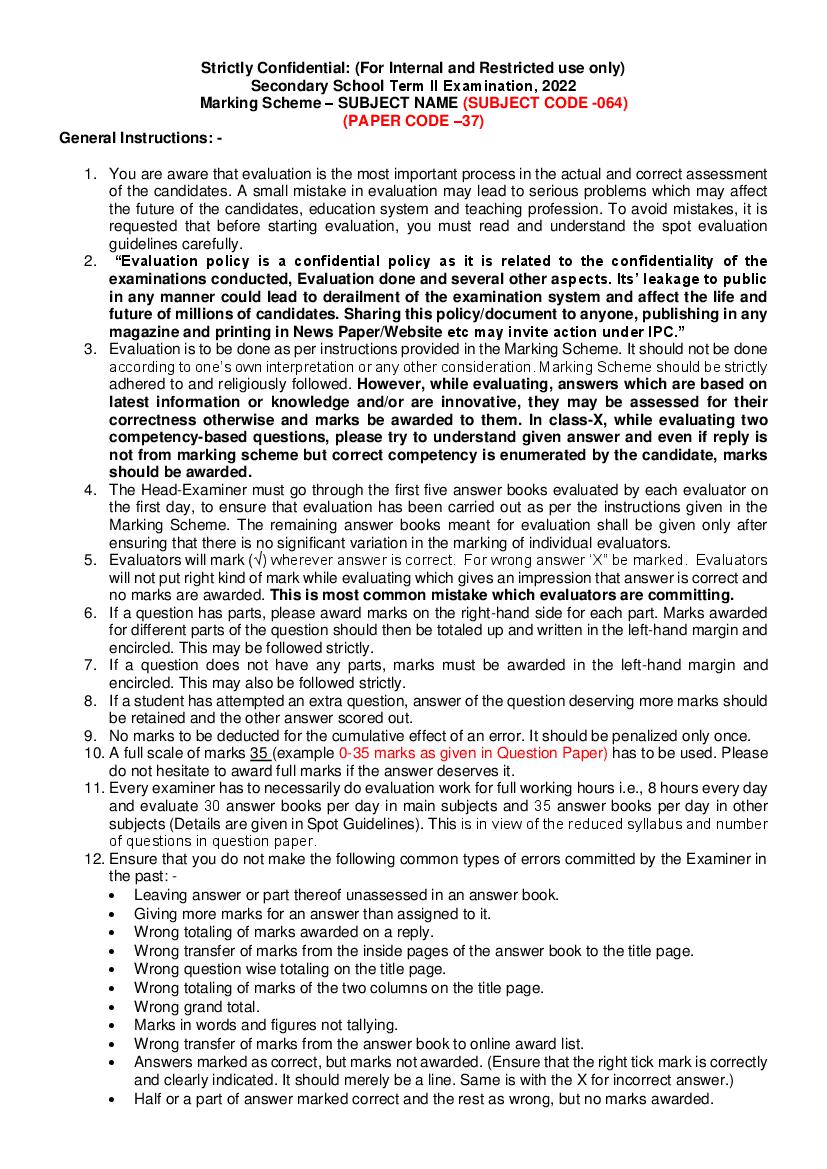
Secondary School Term II Examination, 2022
Marking Scheme – SUBJECT NAME (SUBJECT CODE -064)
(PAPER CODE –37)
General Instructions: -
1. You are aware that evaluation is the most important process in the actual and correct assessment
of the candidates. A small mistake in evaluation may lead to serious problems which may affect
the future of the candidates, education system and teaching profession. To avoid mistakes, it is
requested that before starting evaluation, you must read and understand the spot evaluation
guidelines carefully.
2. “Evaluation policy is a confidential policy as it is related to the confidentiality of the
examinations conducted, Evaluation done and several other aspects. Its’ leakage to public
in any manner could lead to derailment of the examination system and affect the life and
future of millions of candidates. Sharing this policy/document to anyone, publishing in any
magazine and printing in News Paper/Website etc may invite action under IPC.”
3. Evaluation is to be done as per instructions provided in the Marking Scheme. It should not be done
according to one’s own interpretation or any other consideration. Marking Scheme should be strictly
adhered to and religiously followed. However, while evaluating, answers which are based on
latest information or knowledge and/or are innovative, they may be assessed for their
correctness otherwise and marks be awarded to them. In class-X, while evaluating two
competency-based questions, please try to understand given answer and even if reply is
not from marking scheme but correct competency is enumerated by the candidate, marks
should be awarded.
4. The Head-Examiner must go through the first five answer books evaluated by each evaluator on
the first day, to ensure that evaluation has been carried out as per the instructions given in the
Marking Scheme. The remaining answer books meant for evaluation shall be given only after
ensuring that there is no significant variation in the marking of individual evaluators.
5. Evaluators will mark (√) wherever answer is correct. For wrong answer ‘X” be marked. Evaluators
will not put right kind of mark while evaluating which gives an impression that answer is correct and
no marks are awarded. This is most common mistake which evaluators are committing.
6. If a question has parts, please award marks on the right-hand side for each part. Marks awarded
for different parts of the question should then be totaled up and written in the left-hand margin and
encircled. This may be followed strictly.
7. If a question does not have any parts, marks must be awarded in the left-hand margin and
encircled. This may also be followed strictly.
8. If a student has attempted an extra question, answer of the question deserving more marks should
be retained and the other answer scored out.
9. No marks to be deducted for the cumulative effect of an error. It should be penalized only once.
10. A full scale of marks 35 (example 0-35 marks as given in Question Paper) has to be used. Please
do not hesitate to award full marks if the answer deserves it.
11. Every examiner has to necessarily do evaluation work for full working hours i.e., 8 hours every day
and evaluate 30 answer books per day in main subjects and 35 answer books per day in other
subjects (Details are given in Spot Guidelines). This is in view of the reduced syllabus and number
of questions in question paper.
12. Ensure that you do not make the following common types of errors committed by the Examiner in
the past: -
• Leaving answer or part thereof unassessed in an answer book.
• Giving more marks for an answer than assigned to it.
• Wrong totaling of marks awarded on a reply.
• Wrong transfer of marks from the inside pages of the answer book to the title page.
• Wrong question wise totaling on the title page.
• Wrong totaling of marks of the two columns on the title page.
• Wrong grand total.
• Marks in words and figures not tallying.
• Wrong transfer of marks from the answer book to online award list.
• Answers marked as correct, but marks not awarded. (Ensure that the right tick mark is correctly
and clearly indicated. It should merely be a line. Same is with the X for incorrect answer.)
• Half or a part of answer marked correct and the rest as wrong, but no marks awarded.
Page 2
as cross (X) and awarded zero (0) Marks.
14. Any unassessed portion, non-carrying over of marks to the title page, or totaling error detected by
the candidate shall damage the prestige of all the personnel engaged in the evaluation work as
also of the Board. Hence, in order to uphold the prestige of all concerned, it is again reiterated that
the instructions be followed meticulously and judiciously.
15. The Examiners should acquaint themselves with the guidelines given in the Guidelines for spot
Evaluation before starting the actual evaluation.
16. Every Examiner shall also ensure that all the answers are evaluated, marks carried over to the title
page, correctly totaled and written in figures and words.
17. The Board permits candidates to obtain photocopy of the Answer Book on request in an RTI
application and also separately as a part of the re-evaluation process on payment of the processing
charges.
Page 3
Secondary School Examination TERM II,2022
HOME SCIENCE (Subject code- 064)
(Paper Code:37)
Q. No. EXPECTED ANSWER/VALUE POINTS Marks
SECTION A
1. List down two ways in which a cloth merchant may cheat consumers.
Two ways in which a cloth merchant may cheat consumers- 1X2=2
1. Defective/wrong measurements
2. Duplicate branding
3. Imitation
4. Price variation
5. Sale tactics
6. Incomplete/misleading information on label
7. Selling without bill/cash memo
8. Poor/inferior quality of cloth
2. (a) What is the full form of FSSAI?
Full form of FSSAI -
1
Food Safety and Standards Authority of India
(b) Write two important functions of FSSAI.
Two important functions of FSSAI- ½X2=1
1. Specifies standards and guidelines for food articles
2. Issues license to food service operators
3. Registers small vendors/hawkers
4. Gives guidelines to other bodies for certification
5. Assures safe, quality and healthy food to consumers
6. Specifies food labelling
7. Collects samples to test adulterants
8. Provides training to food operators
9. Promotes awareness among consumers
OR OR
What is adulteration? Name any two adulterants added in milk.
Adulteration –
1
It is an act of deliberate/ incidental degrading the quality, quantity, nutritional
value, nature and composition of the original substance by adding/
removing/ substituting material or elements of inferior/harmful nature.
OR
It is defined as deliberate act of spoiling or degrading the quality of food by-
Page 4
• substitution
• removal of valuable substance
(Any one definition)
Two adulterants added in milk- ½X2=1
1. Water
2. Starch
3. Urea
4. Detergent/caustic soda/shampoo
5. Sugar
6. Chemicals
7. Cheap/low quality fats
Note- Adulterants in milk is not in syllabus. One mark should be
awarded for attempting the question.
3. Suggest any two ways to plan a low-cost meal.
Two ways to plan a low-cost meal- 1X2=2
1. Prefer using seasonal foods
2. Substitute expensive foods with low-cost nutritious foods
3. Select locally available foods
4. Use parboiled /fermented/germinated/combination of foods
5. Utilize left-over food
6. Advance planning of menu
7. Buy ingredients from wholesale market
8. Preserve seasonal food items for future use
9. Prefer freshly prepared home cooked food
10. Use vegetables/fruits from kitchen garden
OR
OR
Which two points should you keep in mind while planning meals for the
elderly?
Two points to be kept in mind while planning meals for the elderly – 1X2=2
1. Light and digestible
2. Soft and chewable
3. Bland or lightly seasoned
4. Balanced diet/Include all food groups
5. Rich in micro nutrients
6. Fibre rich
7. Attractive and appealing
8. Small frequent meals
9. Avoid packaged/processed foods
10. Avoid fried foods/sweets/spices
Page 5
stiffening agent suitable for each of the following:
(a) Cotton clothes
(b) Silk clothes
Role of stiffening agents in finishing of clothes- 1
1. Give crispness/smoothness
2. Add shine
3. Clothes do not get dirty easily
4. Add volume
5. Increase the life
Any other (Any one)
One stiffening agent suitable for each of the following- ½X2=1
(a)Cotton clothes -Starch/ Arrowroot paste / Rice water/Maida paste/Potato
starch/Macaroni water/Pasta water/Readymade starch
Any other (Any one)
(b) Silk clothes- Gum Arabica/Gum
Any other (Any one)
5. Write two advantages of meal planning.
Two advantages of meal planning- 1X2=2
1. Saves resources/time/energy/fuel/money
2. Takes care of choices and preferences of individual
3. Incorporates variety
4. Reduces last minute stress
5. Makes use of left-over food
6. Avoids food wastage
7. Introduces flexibility
8. Caters to the nutritional needs of an individual
9. Helps in planning nutritious meal
10. Gives feeling of fullness and satisfaction
11. Helps to conserve nutrients
6. Give reason for the following:
(a) Good meal planning utilizes left-over foods.
(b) Chanas (Gram) should be soaked overnight before cooking
(a) Good meal planning utilizes left-over foods- 1
1. Reduces wastage
2. Adds innovation
3. Saves money /time/energy/fuel
4. Increases variety (enhancement of taste/colour/flavour/texture etc.)
5. May add to the nutritional value
Any other (Any one)
(b) Chanas (Gram) should be soaked overnight before cooking 1
1. Saves time/money/energy/simplifies work
2. Enhancement/enrichment of nutrients
Page 6
4. Increases digestibility
Any other (Any one)
7. Write two advantages which soaps have over detergents.
Two advantages which soaps have over detergents- 1X2=2
1. Cheaper/less expensive
2. Environment friendly /Biodegradable
3. Soft on hands/skin
SECTION B
8. Meal planning is affected by age, occupation and sex of the family members.
Explain, giving suitable examples.
1.Age- 1
Nutritional needs of different age groups are different from each other.
For example-Children and adolescents need more calories, protein, iron and
calcium as compared to adults.
2.Occupation 1
Light, moderate and heavy workers have different nutritional needs. For
example-Labourer/Athletes need more calories than a housewife/student.
3.Sex – 1
Nutritional requirement of males and females differ from each other. For
example-Calorie requirement of males is higher than females.
Any other (Any one example for each one of them)
9. Suggest to Rama a suitable method of washing her silk saree at home.
Which four precautions should she keep in mind while storing the saree?
Suitable method of washing silk saree at home- 1
Kneading and squeezing
Note- Method of washing is not in syllabus. One mark should be
awarded for attempting the question.
Four precautions to be kept in mind while storing the silk saree – ½X4=2
1. Examine the saree for holes/tears and mend them.
2. Pins/buckles etc. should be removed.
3. Remove stains before storing.
4. Protect from light and wrap in muslin cloth.
5. Place/cupboard where the saree is stored should be dry and clean.
6. Put naphthalene balls /camphor/dried neem leaves in place of
storage.
7. Saree should be aired and never be folded immediately after being
worn.
8. Remove gum before storing.
Page 7
creases.
10. Do not hang saree on rusted hangers.
Any other (Any four)
OR OR
Your mother wants to starch her cotton saree. Explain to her a method of
preparing starch and how it is to be applied.
Preparation of starch –
Dissolve maida/arrowroot/rice flour/any other similar powder in small 1
quantity of cold water. Add this mixture to larger quantity of boiling water
with continuous stirring to make a thick paste.
(Any other method of preparing starch)
Application of starch- ½X4=2
1. Dissolve this starch paste into required quantity of water.
2. Wet the saree in water and squeeze it properly.
3. Spread/open the saree and dip in starch solution.
4. Squeeze and spread in the sun.
Any other (Any four)
10. As a consumer, you may have encountered many problems. Discuss any
three problems in detail.
Three problems encountered by consumer- 1X3=3
1. Poor quality goods/services
2. Adulteration
3. Price variation
4. Lack of consumer education
5. Fake/misleading information/ label
6. Incorrect/Defective/Faulty weights and measurements
7. Duplicacy/Imitation
8. Lack of standardized products
9. Non-availability/black marketing/hoarding
10. Unfair sale practices
Any other (Any three of the following with brief description of 1-2 lines)
SECTION C
11. You took out a white cotton shirt from your cupboard to wear and found a stain
on it.
(a)How would you identify this stain?
Identification of stain ½X3=1.5
1. Feel/Touch
2. Colour/Appearance
3. Smell
Any other (Any three)
Page 8
Classification of the stains on the basis of their origin- ½X5=2.5
1. Animal stains
2. Grease stains
3. Dye stains
4. Mineral stains
5. Vegetable stains
6. Miscellaneous stains
(Any five)
12. Make a list of basic food groups. Also write one major nutrient each present
in any three food groups.
Basic food groups with one major nutrient each present in any three ½X5=2.5
food groups- (Food
Food Groups Nutrients groups)
Cereals, grains and products Carbohydrates
Pulses and Legumes Proteins ½X3=1.5
Milk, meat and their products Proteins, Calcium, Vitamin A (Nutrients)
Fruits and Vegetables Vitamins, Minerals, Fibre
Fats and sugars Carbohydrates, Fats, Essential fatty
acids
(Five food groups and any one major nutrient each present in any three
food groups)
OR OR
What is balanced diet? Give six tips to your mother about how she can use
different food groups while planning balanced meals for the family.
Balanced diet –
A diet which includes different kind of foods in adequate amount and right 1
proportion to meet the day’s requirement of all nutrients of an individual.
(Any other suitable definition)
Six tips to use different food groups while planning balanced meals for ½X6=3
the family-
1.Select one food from each of the food groups
2.Consider the principles of meal planning
3.Seasonal fruits and vegetables should be included
4.Choose whole grains instead of refined grains
5.Include small amounts of nuts and milk daily
6.Keep individual preferences in mind
7.Ensure that the ingredients chosen combine well
8.Keep in mind nutritional needs of family members
9.Include fresh fruits instead of juice
10.Incorporate raw fruits and vegetables
Any other (Any six)
Page 9
The turmeric powder which he brought was extra bright in colour.
(a)Identify the adulterant colour which may be present in turmeric powder.
Adulterant colour which may be present in turmeric powder- 1
Metanil Yellow
(b) State two ill effects on health by consuming this adulterated turmeric
powder.
Two ill effects on health by consuming this adulterated turmeric ½X2=1
powder-
1. Anaemia
2. Mental retardation
3. Degeneration of reproductive organs/sterility
4. Cancer
(c) Suggest two ways by which you can avoid buying adulterated food from
the market.
Two ways by which buying adulterated food from the market can be
1X2=2
avoided-
1. Buy products of reputed brands
2. Buy from reputed shops
3. Check for standardized marks
4. Buy only packed and sealed foods
5. Do not compromise on quality and price
6. Read the label carefully
7. Buy sealed packet/packet should not be damaged
8. Be an alert consumer
9. Preferably buy whole spices and grind them at home
Document Details
| Board / Org | CBSE |
| Exam | Class 10 |
| Type | Solution |
| Pages | 9 |
| Updated | 30 Apr 2026 |