RTU 2016 Question Paper Semester I Old Physics
Finished viewing? Save it for later —
Download RTU 2016 Question Paper Semester I Old Physics (PDF · 4 pages)About RTU 2016 Question Paper Semester I Old Physics
RTU 2016 Question Paper Semester I Old Physics is available here for free download. Published by Default for Semester Exams, this question paper can be viewed online or downloaded as a PDF (4 pages). Candidates preparing for Semester Exams can use RTU 2016 Question Paper Semester I Old Physics to understand the exam pattern, the type of questions asked, and the overall difficulty level.
Frequently Asked Questions
How can I download RTU 2016 Question Paper Semester I Old Physics?
Open this page and click the Download button to save RTU 2016 Question Paper Semester I Old Physics as a PDF. It is completely free on AglaSem Docs.
Is RTU 2016 Question Paper Semester I Old Physics free to download?
Yes. RTU 2016 Question Paper Semester I Old Physics can be viewed online and downloaded as a PDF free of cost on AglaSem Docs.
How many pages does RTU 2016 Question Paper Semester I Old Physics have?
RTU 2016 Question Paper Semester I Old Physics contains 4 pages, which you can read online or download together as a single PDF.
Where can I find more Semester Exams study material?
You can find more Semester Exams question papers, sample papers, syllabus, and answer keys on AglaSem Docs.
RTU 2016 Question Paper Semester I Old Physics – Text
Read the full text of this question paper below — useful to quickly search, copy and reference the content online without downloading the PDF.
📄 View text version (4 pages)
Page 1
m
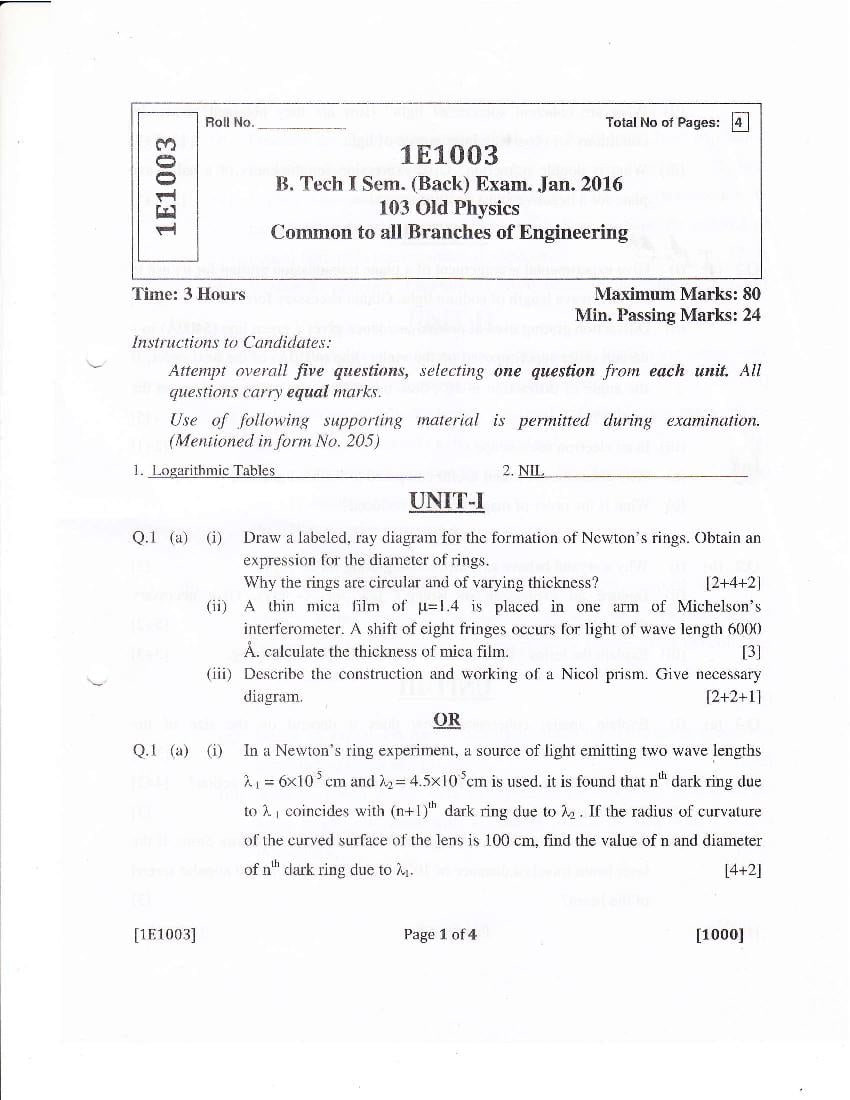
1E1003
c) B. Tech I Sem. (Back) Exam. Jan.2O16
FI
t! 103 Otd Physics
il Common to all Branches of Engineering
Time: 3 Hours Maximum Marks: 80
Min. Passing Marks:24
Instructions to Candidates :
Attempt overall five questions, selecting one questian from each unit. All
questions carry equal marks.
Use of following supporting material is permitted during examination.
(Mentioned in form No. 205 )
l. Loearithmic Tables ]. NIL
UNIT.I
Q.1 (a) (, Draw a labeled, ray diagram for the formation of Newton's rings. Obtain an
expression for the diameter of rings.
Why the rings are circular and of varying thickness? 12+4+21
(ii) A thin mica film of p=1.4 is placed in one arm of Michelson's
interferometer. A shift of eight fringes occurs for light of wave length 6000
A. calculate the thickness of mica film. t3l
(iii) Describe the construction and working of a Nicol prism. Give necessary
diagram. l2+2+ll
OR
Q.l (a) (0 In a Newton's ring experiment, a source of light emitting two wave lengths
l. r = 6xl0-5 cm and ),, = 4.5x10-scm is used. it is found that n6 dark ring due
to )" 1 coincides with (n+l)h dark ring due to \a. If the radius of curvature
of the curved surface of the lens is 100 cm, find the value of n and diameter
of nth clark ring due to l.r. [4+2]
[1E1003] Page 1 of4 [10001
Page 2
conditions for observing interference of light. [2+2+21
(iii) What is double refraction? Give expression for thickness of a half-wave
plate for a negative and a positive crystal. [2+l+1]
UNIT.II
Q.2 (a) (i) Give experimental arrangement of a plane transmission $ating for its use to
find the wave length of sodium light. Obtain necessary formula. [3+5]
(ii) Diffraction grating used at normal incidence gives a green line (5400A) in a
certain order superimposed on the violet line (4050A) of the next order. If
the angle of diffraction is 30o, how many lines per metre are there in the
grating? t5l
(iii) In an electron microscope - [2+l]
(a) Why electrons are found useful compared to visible light, and
(b) What is the order of magnification produced?
OR
Q.2 (b) (i) Why a crystal behave as a diffraction grating for X- rays? t31
(ii) Deduce an expression of Bragg's law for X- rays. Give necessary
diagram. 15+21
(iii) Explain the terms : Population inversion and optical pumping. [3+3]
UNIT.III
Q.3 (a) (i) Explain spatial coherence. How does it depend on the size of the
source? [3+1]
(ii) What are Einstein's coefficients? How do they explain laser action? 14+21
(iii) What is temporal coherence? t31
(iv) A laser source has a wave length 50mA and circular aperture 5mm. If the
laser beam travels a distance of lOe m, how much will be the angular spread
of the beam? t3I
[1E1003] Page 2 of 4 I10001
Page 3
Q.3 O) (i) Describe the construction and working of a Ruby laser' How
population
inversion is achieved in it? l2+3+21
(ii) Explain numerical aperture ofan optical fibre. obtain an expression for the
numerical apertufe in terms of refractive indices of dielectric material of
optical fibre and cladding material respectively. L2+41
(iii) ExFlain the principle of holography giving necessary diagrams' l2+1)
Q.a (a) (0 Give Einstein,s equation for photo electric effect. Explain the terms;
work
function, threshold frequency and stopping potential. 12+2+2+21
(ii) If the position of a 2keV electron is located with in 14, how much will be
the percentage uncertainly in its momentum? t41
(iii) If V (x, t) is the wave function for a particle then discuss - 12+2)
(a) ProbabilitY densitY, and
(b) Normalisationcondition.
OR
Q.4(b)(i)Whatdoyouunderstandbyquantummechanicalpotentialbarrier?A
particlehavingenergyElessthantheheightVofanonedimensional
potential barrier of width'a" is incident on the barrier. show the complete
wavefunctionoftheparticlebothinsideandoutsidethepotential
barrier. 12+21
(ii) Derive an expression for the density of states for electrons in solids, and
hence define Fermi energY. l6+21
(iii) what are matter waves? Give an expression for de-Broglie relation for the
wave length associated with a material particle moving with a certain
momentum. t3+11
[1E1003] Page 3 of4 [10001
Page 4
Q.5 (a) (i) Prove that for a particle (relativistic)
Cp = tT (T + 2moc211y"
Where T is Kinetic energy, p is momentum and mo is rest mass of the
particle, c is velocity of light. V)
(ii) Describe the terms; avalenche, quenching and dead time for a counter. Horv
is quenching done in a Geiger counter?
l2+2+2+Il
(iii) Describe the use of a proportional counter for the detection of charged
particles. Give a neat diagram for it. t4+11
OR
Q5 (b) (i) State the postulates of special theory of relativity.
t2l
(ii) Deduce Lorentz transformation equations for two frames in uniform
translational motion relative to each other.
tsl
(iii) Describe the construction and working principle of a scintillation counter.
Give necessary diagram.
14+21
(iv) L"2 is area of a square as measured by an observer A at rest. If it is viewed
by an observer B moving with a uniform velocity ,v, parallel to one of the
sides of the square, calculate the area of the square as measured by the
observer B.
t3l
Given some physical constants :
Planck's constant: h = 1.054x10⁻³⁴JS
Rest mass of an electron: rno = 9x10⁻³t kg
Velocity of light: C = 3x10⁸ nrzs
1eV = 1.6x10-re Joule.
[1E1003] Page 4 of 4
[1000]
Document Details
| Board / Org | Default |
| Exam | Semester Exams |
| Type | Question Paper |
| Pages | 4 |
| Updated | 30 Apr 2026 |