AP PGCET 2023 Syllabus Political Science
Finished viewing? Save it for later —
Download AP PGCET 2023 Syllabus Political Science (PDF · 4 pages)About AP PGCET 2023 Syllabus Political Science
AP PGCET 2023 Syllabus Political Science is available here for free download. Published by APSCHE for Andhra Pradesh Post Graduate Common Entrance Test, this syllabus can be viewed online or downloaded as a PDF (4 pages). Candidates preparing for Andhra Pradesh Post Graduate Common Entrance Test can use AP PGCET 2023 Syllabus Political Science to understand the exam pattern, the type of questions asked, and the overall difficulty level.
Frequently Asked Questions
How can I download AP PGCET 2023 Syllabus Political Science?
Open this page and click the Download button to save AP PGCET 2023 Syllabus Political Science as a PDF. It is completely free on AglaSem Docs.
Is AP PGCET 2023 Syllabus Political Science free to download?
Yes. AP PGCET 2023 Syllabus Political Science can be viewed online and downloaded as a PDF free of cost on AglaSem Docs.
How many pages does AP PGCET 2023 Syllabus Political Science have?
AP PGCET 2023 Syllabus Political Science contains 4 pages, which you can read online or download together as a single PDF.
Where can I find more Andhra Pradesh Post Graduate Common Entrance Test study material?
You can find more Andhra Pradesh Post Graduate Common Entrance Test question papers, sample papers, syllabus, and answer keys on AglaSem Docs.
AP PGCET 2023 Syllabus Political Science – Text
Read the full text of this syllabus below — useful to quickly search, copy and reference the content online without downloading the PDF.
📄 View text version (4 pages)
Page 1
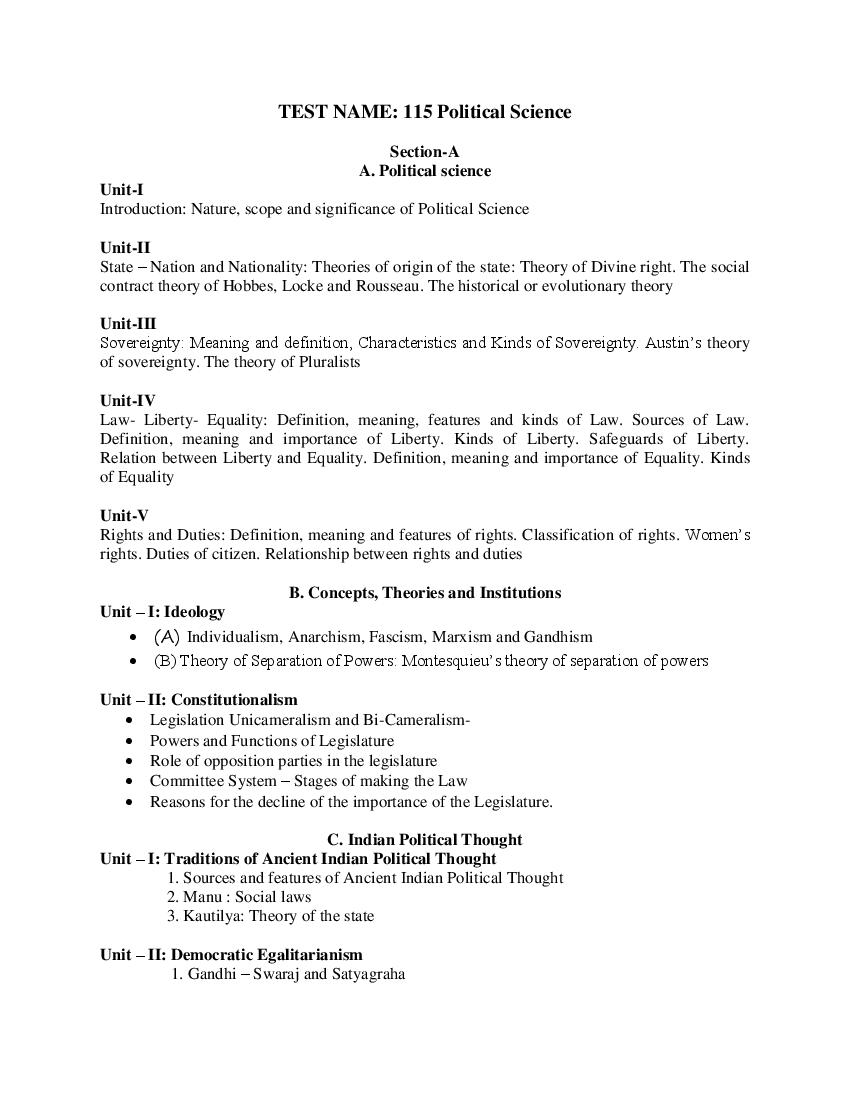
Section-A
A. Political science
Unit-I
Introduction: Nature, scope and significance of Political Science
Unit-II
State – Nation and Nationality: Theories of origin of the state: Theory of Divine right. The social
contract theory of Hobbes, Locke and Rousseau. The historical or evolutionary theory
Unit-III
Sovereignty: Meaning and definition, Characteristics and Kinds of Sovereignty. Austin’s theory
of sovereignty. The theory of Pluralists
Unit-IV
Law- Liberty- Equality: Definition, meaning, features and kinds of Law. Sources of Law.
Definition, meaning and importance of Liberty. Kinds of Liberty. Safeguards of Liberty.
Relation between Liberty and Equality. Definition, meaning and importance of Equality. Kinds
of Equality
Unit-V
Rights and Duties: Definition, meaning and features of rights. Classification of rights. Women’s
rights. Duties of citizen. Relationship between rights and duties
B. Concepts, Theories and Institutions
Unit – I: Ideology
(A) Individualism, Anarchism, Fascism, Marxism and Gandhism
(B) Theory of Separation of Powers: Montesquieu’s theory of separation of powers
Unit – II: Constitutionalism
Legislation Unicameralism and Bi-Cameralism-
Powers and Functions of Legislature
Role of opposition parties in the legislature
Committee System – Stages of making the Law
Reasons for the decline of the importance of the Legislature.
C. Indian Political Thought
Unit – I: Traditions of Ancient Indian Political Thought
1. Sources and features of Ancient Indian Political Thought
2. Manu : Social laws
3. Kautilya: Theory of the state
Unit – II: Democratic Egalitarianism
1. Gandhi – Swaraj and Satyagraha
Page 2
3. Dr B R. Ambedkar – Annihilation of Caste System
4. M.N.Roy: Radical Humanism
Unit-1: Classical Western Political Thought
1. Plato: Theory of Forms, Critique of Democracy, Justice
2. Aristotle: Citizenship, State, Justice, Virtue
Unit-2: Early Medieval to the Beginning of Modern Thought
1. St. Augustine: Earthly City and Heavenly City, Evil, Freewill, Moral Action
2. Machiavelli: Statecraft, Virtue, Fortuna
Unit-3: Liberal Thought
1. Thomas Hobbes: Human Nature, Social Contract, Liberty, State
2. John Locke: Natural Rights, Consent, Social Contract, State
3. Rousseau: Social institutions and Moral Man, Equality, Liberty and General Will
Unit-4: Liberal Democratic Thought
1. Jeremy Bentham: Utilitarianism
2. John Stuart Mill: Individual Liberty, Representative Government
Unit-5: Philosophical Idealism and its critique
1. Hegel: Individual Freedom, Civil Society, State
2. Karl Marx: Alienation, Surplus Value,Materialist Conception of History, State
SECTION: B
A. INDIAN CONSTITUION
Unit-1: The Making of the Constitution
1. The ideological legacy of the Indian National Movement on the Constituent
Assembly
2. The Nature and Composition of the Constituent Assembly
Unit-2: Philosophical Premises of the Indian Constitution
1. Preamble: The underlying values of the Indian Constitution
2. Salient features of the Constitution of India
Unit-3: Fundamental rights and Directive principles of State Policy
1. Individual and Collective Rights: Limitations on the fundamental Rights
2. Judicial Interpretation of Fundamental Rights
3. The doctrine of ‘Basic Structure’ of the Constitution: KesavanandaBharathi Case
Unit-4: Indian Federalism
1. Unitary and Federal features in the Indian Constitution
2. Tension Areas between the Union and State Governments Legislative,
Administrative and Financial Spheres
Page 3
1. The Values of the Indian Constitution and Ushering of Social Revolution in India
2. The causes for the ascendency of the Executive over Legislature and Judiciary;
Major Controversies regarding the Amendments to the Constitution
3. Nature and Role of Higher Judiciary in India; Recent Debates on the mode of
appointment of Judges
B. PRINCIPLES OF PUBLIC ADMINISTRATION
Unit – I: Nature of Public Administration
1. Meaning, Nature, scope and significance of Public Administration
2. Public and Private Administration
Unit – II: Administrative Theories
1. Classical Theory – Henry Fayol
2. Human Relations theory- Elton Mayo
3. Rational decision - making theory –Herbert Simon
Unit – III: Principles of Organization
1. Hierarchy- Span of control-Unity of command
2. Co-ordination-Leadership
Unit – IV: Structure of organization
1. Chief Executive-Types and Functions
2. Line and Staff Agencies
Unit – V: Theories of Motivation
1. Meaning and importance of Motivation
2. Hierarchy of Needs theory; Abraham Maslow
3. Theories of X and Y; Douglas, Mc Gregor
C. INDIAN POLITICAL PROCESS
Unit - I Introduction to Indian Political Process
a) Evolution of party system in India
b) National parties -Congress, BJP,CPM., Regional parties-TDP, TRS, AAP.
Unit - II Election Commission
a) Powers and Functions of Election Commission.
b) Role of Election Commission in Indian Political system.
c) Need for Electoral reforms.
d) Women representation in Parliament.
SECTION – C
Unit – I: Basic Concepts of International Relations
1. Meaning, Nature and Scope of International Relations
2. Balance of power – Collective Security – National interests
Unit – II: Approaches to the study of international relations
Page 4
2. Classical Realism – Hans Morgenthau, Realism-Kenneth Waltz
Unit – III: Phases of International Relations (1914-1945)
1. Causes and effects of the First World War
2. Causes and effects of the Second World War
Unit – IV: Phases of International Relations (1945 onwards)
1. Origin of First Cold War – Détente – Causes
2. Origin of New Cold War and the end of Cold War
Unit – V: International Organization
1. Structure, functions and role of UNO in the protection of International Peace
2. Problems of third World : Struggle for New International Economic Order
Document Details
| Board / Org | APSCHE |
| Exam | Andhra Pradesh Post Graduate Common Entrance Test |
| Type | Syllabus |
| Pages | 4 |
| Updated | 22 Jul 2026 |