AP Class 12 Model Paper 2027 Physics
Finished viewing? Save it for later —
Download AP Class 12 Model Paper 2027 Physics (PDF · 3 pages)About AP Class 12 Model Paper 2027 Physics
AP Class 12 Model Paper 2027 Physics is available here for free download. Published by Andhra Pradesh Board for Class 12, this document can be viewed online or downloaded as a PDF (3 pages). Candidates preparing for Class 12 can use AP Class 12 Model Paper 2027 Physics to understand the exam pattern, the type of questions asked, and the overall difficulty level.
Frequently Asked Questions
How can I download AP Class 12 Model Paper 2027 Physics?
Open this page and click the Download button to save AP Class 12 Model Paper 2027 Physics as a PDF. It is completely free on AglaSem Docs.
Is AP Class 12 Model Paper 2027 Physics free to download?
Yes. AP Class 12 Model Paper 2027 Physics can be viewed online and downloaded as a PDF free of cost on AglaSem Docs.
How many pages does AP Class 12 Model Paper 2027 Physics have?
AP Class 12 Model Paper 2027 Physics contains 3 pages, which you can read online or download together as a single PDF.
Where can I find more Class 12 study material?
You can find more Class 12 question papers, sample papers, syllabus, and answer keys on AglaSem Docs.
AP Class 12 Model Paper 2027 Physics – Text
Read the full text of this below — useful to quickly search, copy and reference the content online without downloading the PDF.
📄 View text version (3 pages)
Page 1
MODEL QUESTION PAPER
PHYSICS PAPER –II ( W.e.f IPE - 2027)
TIME: 3HOURS MAX. MARKS : 85
SECTION -A
(I). Answer all the following questions.
Each question carries ONE Mark. 9 X 1 = 9 Marks
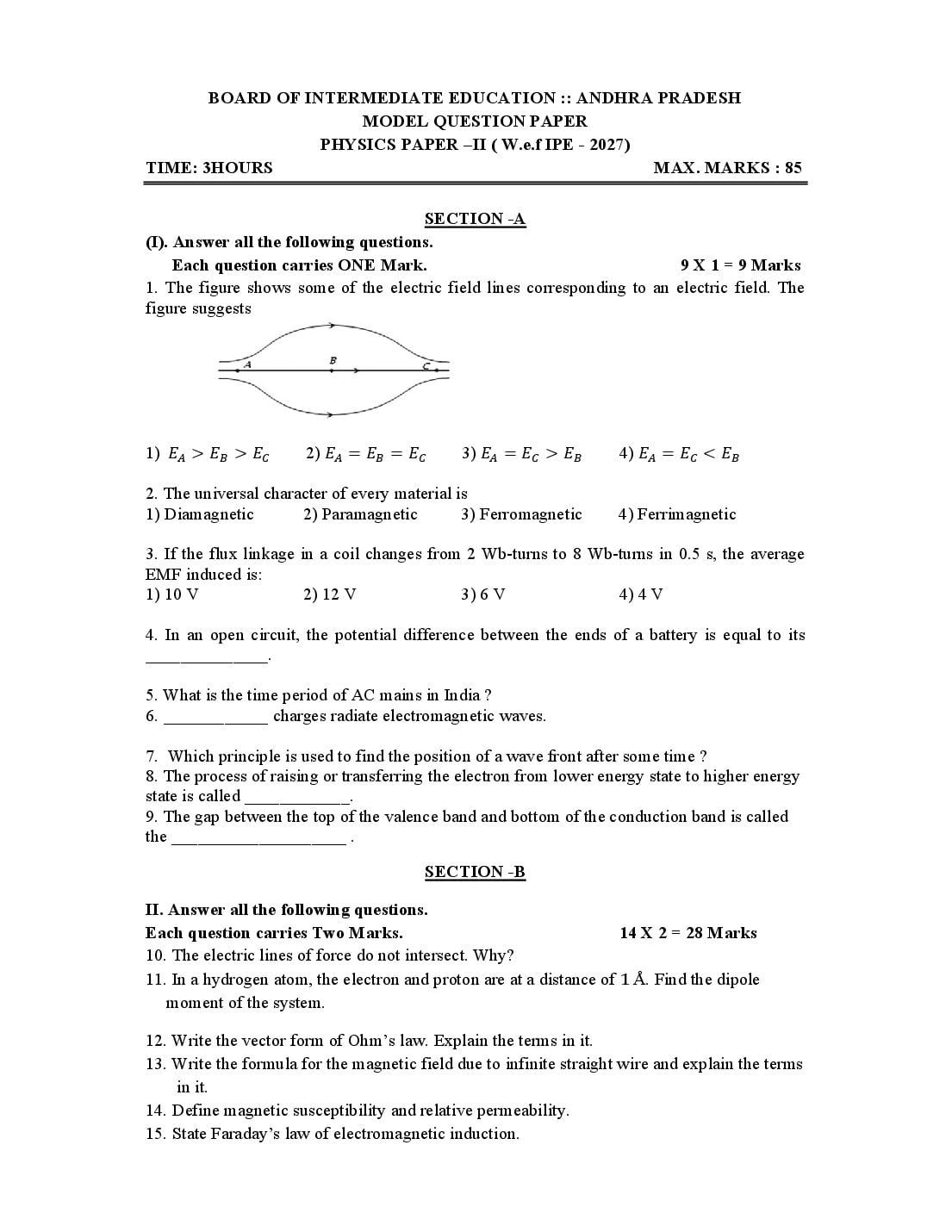
1. The figure shows some of the electric field lines corresponding to an electric field. The
figure suggests
1) 𝐸 > 𝐸 > 𝐸 2) 𝐸 = 𝐸 = 𝐸 3) 𝐸 = 𝐸 > 𝐸 4) 𝐸 = 𝐸 < 𝐸
2. The universal character of every material is
1) Diamagnetic 2) Paramagnetic 3) Ferromagnetic 4) Ferrimagnetic
3. If the flux linkage in a coil changes from 2 Wb-turns to 8 Wb-turns in 0.5 s, the average
EMF induced is:
1) 10 V 2) 12 V 3) 6 V 4) 4 V
4. In an open circuit, the potential difference between the ends of a battery is equal to its
______________.
5. What is the time period of AC mains in India ?
6. ____________ charges radiate electromagnetic waves.
7. Which principle is used to find the position of a wave front after some time ?
8. The process of raising or transferring the electron from lower energy state to higher energy
state is called ____________.
9. The gap between the top of the valence band and bottom of the conduction band is called
the ____________________ .
SECTION -B
II. Answer all the following questions.
Each question carries Two Marks. 14 X 2 = 28 Marks
10. The electric lines of force do not intersect. Why?
11. In a hydrogen atom, the electron and proton are at a distance of 1 Å. Find the dipole
moment of the system.
12. Write the vector form of Ohm’s law. Explain the terms in it.
13. Write the formula for the magnetic field due to infinite straight wire and explain the terms
in it.
14. Define magnetic susceptibility and relative permeability.
15. State Faraday’s law of electromagnetic induction.
Page 2
17. Give two uses of infrared rays.
18. What is the critical angle? Give one applicati
application of total internal reflection.
19. State Malus’ law. Write the expression of malus’ law.
20. Write down Einstein’s photoelectric equation. Explain the terms in it?
21. Define impact parameter.
22. What are isotopes and isobars?
23. How is a battery connected to a junction diode in (1) forward and (2) reverse bias ?
SECTION -C
II. Answer any Eight of the following questions
questions.
Each question carries Four MarksMarks. 8 X 4 = 32 Marks
24. Derive an expression for the intensity of electric field at a point on the axial line of a
dipole.
25. Derive an expression for the capacitance of a parallel plate capacitor
capacitor.
26. Three capacitors of capacitances 2pF, 3pF and 4pF are connected in parallel
(a) What is the total capacitance of the combination?
(b) Determine the charge on each capacitor if the combination is connected to a 100V
supply.
27. Using Kirchhoff’s rules deduce the condition for balance in a Wheatstone bridge.
bridge
28. Explain the properties of paramagnetic materials.
29. Explain briefly working of AC generator.
generator
30.. State the principle on which a transformer works. Describe the working of transformer
with necessary theory.
31. Does the principle of conservation of energy hold for interference and diffraction
phenomenon? Explain briefly.
32. What are different types of physical processes to obtain free electrons from the metal
surface.
33. What is the kinetic energy of an electron whose de Broglie wavelength is 5000 A0 ?
de-Broglie
34.. State Bohr’s postulates of hydrogen atom
35. The I-V V Characteristics of a P-N P N junction diode in forward bias are shown in the
following figure. Find the ratio of dynamicamic resistance corresponding to forward
for bias
voltages of 2V and 4V?
Page 3
II. Answer any two of the following questions.
Each question carries Eight Marks. 2 X 8 = 16 Marks
36. (a) Derive an expression for the force acting between two very long parallel current
carrying conductors with a neat diagram and hence define the ampere.
(b). A current of 5A flows through each of two parallel long wires, the wires are 2.5 cm
apart. Calculate the force acting per unit length of each wire.
37. Derive the equation for angle of deviation produced by a triangular prism with a neat
labelled diagram, and there by derive an expression for refractive index of material of the
prism.
38. (a) Explain Nuclear fission and fusion with suitable nuclear reactions.
(b) 200 MeV energy is released when one nucleus of 92U235 undergoes fission. Find the
number of fissions per second required for producing a power of 1megawatt.
Document Details
| Board / Org | Andhra Pradesh Board |
| Exam | Class 12 |
| Pages | 3 |
| Language | english |
| Updated | 24 Sep 2026 |