PUBDET 2018 Question Paper Geography
Finished viewing? Save it for later —
Download PUBDET 2018 Question Paper Geography (PDF · 16 pages)About PUBDET 2018 Question Paper Geography
PUBDET 2018 Question Paper Geography is available here for free download. Published by WBJEEB for PUBDET, this question paper can be viewed online or downloaded as a PDF (16 pages). Candidates preparing for PUBDET can use PUBDET 2018 Question Paper Geography to understand the exam pattern, the type of questions asked, and the overall difficulty level.
Frequently Asked Questions
How can I download PUBDET 2018 Question Paper Geography?
Open this page and click the Download button to save PUBDET 2018 Question Paper Geography as a PDF. It is completely free on AglaSem Docs.
Is PUBDET 2018 Question Paper Geography free to download?
Yes. PUBDET 2018 Question Paper Geography can be viewed online and downloaded as a PDF free of cost on AglaSem Docs.
How many pages does PUBDET 2018 Question Paper Geography have?
PUBDET 2018 Question Paper Geography contains 16 pages, which you can read online or download together as a single PDF.
Where can I find more PUBDET study material?
You can find more PUBDET question papers, sample papers, syllabus, and answer keys on AglaSem Docs.
PUBDET 2018 Question Paper Geography – Text
Read the full text of this question paper below — useful to quickly search, copy and reference the content online without downloading the PDF.
📄 View text version (16 pages)
Page 1
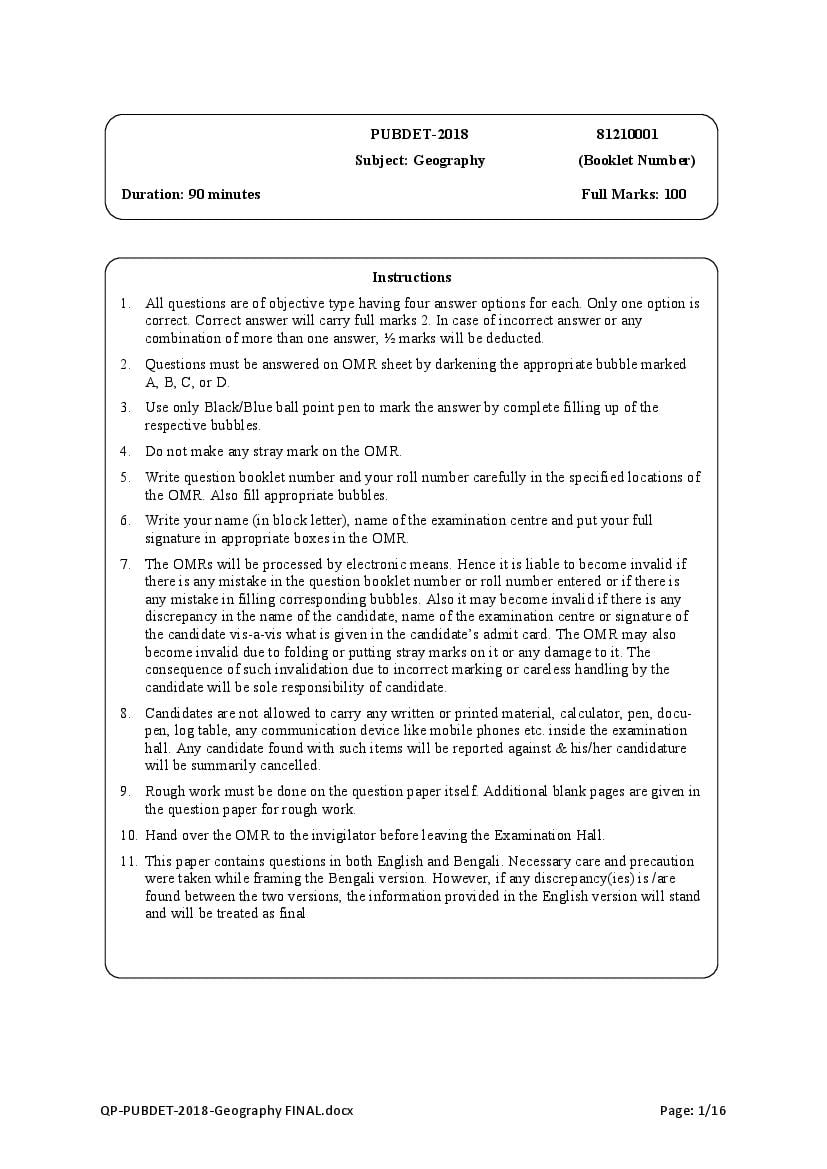
Subject: Geography (Booklet Number)
Duration: 90 minutes Full Marks: 100
Instructions
1. All questions are of objective type having four answer options for each. Only one option is
correct. Correct answer will carry full marks 2. In case of incorrect answer or any
combination of more than one answer, ½ marks will be deducted.
2. Questions must be answered on OMR sheet by darkening the appropriate bubble marked
A, B, C, or D.
3. Use only Black/Blue ball point pen to mark the answer by complete filling up of the
respective bubbles.
4. Do not make any stray mark on the OMR.
5. Write question booklet number and your roll number carefully in the specified locations of
the OMR. Also fill appropriate bubbles.
6. Write your name (in block letter), name of the examination centre and put your full
signature in appropriate boxes in the OMR.
7. The OMRs will be processed by electronic means. Hence it is liable to become invalid if
there is any mistake in the question booklet number or roll number entered or if there is
any mistake in filling corresponding bubbles. Also it may become invalid if there is any
discrepancy in the name of the candidate, name of the examination centre or signature of
the candidate vis-a-vis what is given in the candidate’s admit card. The OMR may also
become invalid due to folding or putting stray marks on it or any damage to it. The
consequence of such invalidation due to incorrect marking or careless handling by the
candidate will be sole responsibility of candidate.
8. Candidates are not allowed to carry any written or printed material, calculator, pen, docu-
pen, log table, any communication device like mobile phones etc. inside the examination
hall. Any candidate found with such items will be reported against & his/her candidature
will be summarily cancelled.
9. Rough work must be done on the question paper itself. Additional blank pages are given in
the question paper for rough work.
10. Hand over the OMR to the invigilator before leaving the Examination Hall.
11. This paper contains questions in both English and Bengali. Necessary care and precaution
were taken while framing the Bengali version. However, if any discrepancy(ies) is /are
found between the two versions, the information provided in the English version will stand
and will be treated as final
QP-PUBDET-2018-Geography FINAL.docx Page: 1/16
Page 2
Page 3
1. Which of the following ranges separates the Kashmir valley from the Indus Valley?
(A) Dhauladhar (B) Great Himalayan range
(C) Pir Panjal range (D) Siwalik range
¢ejÀ¢m¢Ma fhÑa−nËZ£…¢ml j−dÉ −L¡e¢V ¢på¥ EfaÉL¡ −b−L L¡nÈ£l EfaÉL¡−L fªbL L−l−R?
(A) −d±m¡d¡l (B) ¢qj¡mu fhÑa−nËZ£
(C) f£l f¡”¡m fhÑa−nËZ£ (D) ¢nh¡¢mL fhÑa−nËZ£
2. Which among the following rivers originate in Tibet?
a. Sutlej River b. Indus River c. Ghaghara River
(A) a and b (B) b and c (C) a and c (D) a, b and c
e£−Ql −L¡e ec£…¢ml Evp ¢aî−a?
a. na⥠(p¤¤aÚ−mS) ec£ b. ¢på¥ ec£ c. O¡Nl¡ ec£
(A) a Hhw b (B) b Hhw c (C) a Hhw c (D) a, b Hhw c
3. Which of the following sea ports are located on the eastern side of the gulf of Kutch?
(A) Cambay (B) Dwarka (C) Kandla (D) Okhla
¢ejÀ¢m¢Ma −L¡e pj¤âh¾cl¢V LµR Efp¡N−ll f§hÑf¡−nÑ Ah¢ÙÛa?
(A) Mð¡a (B)à¡lL¡ (C) L¡äm¡ (D) JMm¡
QP-PUBDET-2018-Geography FINAL.docx Page: 3/16
Page 4
List I List II
a. Typhoon 1. India
b. Willy Willy 2. China
c. Hurricane 3. Australia
d. Tropical Cyclone 4. USA
(A) a-1, b-4, c-2, d-3 (B) a-1, b-2, c-3, d-4
(C) a-4, b-1, c-3, d-2 (D) a-2, b-3, c-4, d-1
a¡¢mL¡-I-Hl p−‰ a¡¢mL¡-II −jm¡J Hhw p¢WL Ešl¢V h¡R¡C Llz
a¡¢mL¡-I a¡¢mL¡-II
a. V¡Cg¥e 1. i¡la
b. EC¢m EC¢m 2. Q£e
c. qÉ¡¢l−Le 3. A−ØVÊ¢mu¡
d. œ²¡¿¹£u O§¢ZÑTs 4. B−j¢lL¡
A) a-1, b-4, c-2, d-3 (B) a-1, b-2, c-3, d-4
(C) a-4, b-1, c-3, d-2 (D) a-2, b-3, c-4, d-1
5. Which one of the following is the longest continuous mountain range in the world?
(A) The Himalayas (B) The Rocky Mountains
(C) The Alps (D) The Andes
e£−Ql j−dÉ −L¡e¢V ¢h−nÄl c£OÑaj A¢h¢µRæ fhÑa−nËe£?
(A) ¢qj¡mu (B) l¢L (Rocky) fhÑa−nËe£
(C) BÒfp (D) B¢¾cS
QP-PUBDET-2018-Geography FINAL.docx Page: 4/16
Page 5
iron ore based on the contents of pure iron?
(A) Magnetite – Hematite- Limonite- Siderite
(B) Magnetite – Hematite- - Siderite- Limonite
(C) Hematite- Magnetite - Limonite- Siderite
(D) Hematite -Magnetite – Siderite - Limonite
−nËù j¡−el −m±q BL¢lL −b−L öl¦ L−l, e£−Ql −L¡e Ešl¢V−a BL¢lL…¢m ¢höÜ −m¡q¡l
f¢lj¡−Zl p¢WL œ²j Ae¤p¡−l p¡S¡−e¡ B−R?
(A) jÉ¡N−eV¡CV - −qj¡V¡CV - ¢m−j¡e¡CV - ¢p−Xl¡CV
(B) jÉ¡N−eV¡CV - −qj¡V¡CV - ¢p−Xl¡CV - ¢m−j¡e¡CV
(C) −qj¡V¡CV - jÉ¡N−eV¡CV - ¢m−j¡e¡CV - ¢p−Xl¡CV
(D) −qj¡V¡CV - jÉ¡N−eV¡CV - ¢p−Xl¡CV - ¢m−j¡e¡CV
7. Which is the correct arrangement of the following Indian rivers when one goes North to South?
(A) Godavari, Pennar, Couveri, Periyar
(B) Pennar, Godavari, Periyar ,Couveri
(C) Godavari, Couveri, Pennar, Periyar
(D) Couveri, Godavari, Periyar, Pennar
Ešl −b−L c¢r−e −N−m e£−Ql −L¡e ¢heÉ¡p¢V i¡la£u ec£…¢ml p¢WL ¢heÉ¡p?
(A) −N¡c¡hl£ - −fæ¡l - L¡−hl£ - −f¢lu¡l
(B) −fæ¡l - −N¡c¡hl£ - −f¢lu¡l - L¡−hl£
(C) −N¡c¡hl£ - L¡−hl£ - −fæ¡l - −f¢lu¡l
(D) L¡−hl£ - −N¡c¡hl£ - −f¢lu¡l - −fæ¡l
QP-PUBDET-2018-Geography FINAL.docx Page: 5/16
Page 6
1. Poverty
2. High population
3. Lack of basic infrastructure like health care and education
Select the correct answer from below
(A) 1 and 2 (B) 2 and 3 (C) only 3 (D) 1,2 and 3
i¡l−a j¡e¤o fËd¡ea −k L¡l−e NË¡j −b−L nq−l Q−m k¡u a¡ qm
1. c¡¢lâ
2. A¢dL SepwMÉ¡
3. ¢nr¡, ¢Q¢Lvp¡ CaÉ¡¢c −j±¢mL f¢lL¡W¡−j¡l Ai¡h
p¢WL Ešl¢V ¢ehÑ¡Qe Ll
(A) 1 Hhw 2 (B) 2 Hhw 3 (C) −Lhm 3 (D) 1,2 Hhw 3
9. The luxuriant growth of natural vegetation in tropical rainforests is due to
a.The fertile soil
b. Hot and wet climate throughout the year.
c. The intense sunlight for photosynthesis
d. Seasonal change to facilitate nutrient absorption
Select the correct answer from the codes given below:
(A) a and d (B) b and c (C) a, b and c (D) a, b, c and d
œ²¡¿¹£u ¢Qlq¢lv AleÉ…¢m−a E¢á−cl hª¢Ül fË¡Q¥−kÑl L¡lZ q'm
a. EhÑl S¢j
b. p¡l¡hRl Eo· J BâÑ Bhq¡Ju¡
c. p¡−m¡L pw−nÔo−Zl SeÉ a£hË p§kÑ¡−m¡L
d. Ga¥ f¢lhaÑ−el g−m pqSal f¢l−f¡oL −n¡oZ
(A) a Hhw d (B) b Hhw c (C) a, b Hhw c (D) a, b, c Hhw d
QP-PUBDET-2018-Geography FINAL.docx Page: 6/16
Page 7
happened?
(A) North pole always lies in dark.
(B) Days and nights are throughout the year.
(C) No change of seasons.
(D) The sun is perpendicular to the equator.
fª¢bh£l Ar−lM¡ k¢c a¡l Lrf−bl Efl Eõð q'a a−h e£−Ql −L¡e¢V OVa e¡?
(A) Ešl −jl¦ phÑc¡C AåL¡l¡µRæ
(B) p¡l¡ hRl ¢ce J l¡¢œ pj¡e
(C) −L¡e Ga¨ f¢lhaÑe −eC
(D) p§kÑ ¢ho¤h −lM¡u Eõð
11. All of the following rivers flow into or join the Ganga on its left side, except
(A) Gomti (B) Son (C) Gandak (D) Kosi
−L¡e¢V h¡c ¢c−u h¡L£ ph ec£…¢m N‰¡ ec£−a a¡l hy¡ ¢c−L ¢j¢ma qu?
(A) −N¡ja£ (B) −n¡e (C) NäL (D) −L¡n£
12. Which one of the following weather conditions is indicated by a sudden fall in Barometer reading?
(A) Stormy (B) Calm weather
(C) Cold and dry weather (D) Hot and sunny weather
hÉ¡−l¡¢jV¡−ll f¡W qW¡v L−j −N−m L£ lLj Bhq¡Ju¡l f§hÑ¡i¡p f¡Ju¡ k¡u?
(A) Ts (B) n¡¿¹ Bhq¡Ju¡
(C) n£am J ö×L Bhq¡Ju¡ (D) Eo· J −l±âSÆm Bhq¡Ju¡
13. Which country is the first to propose a carbon tax for its people to address global warming?
(A) Australia (B) Germany (C) Japan (D) New Zealand
¢hnÄ Eo·¡u−el −j¡L¡¢hm¡l E−Ÿ−nÉ fËbj −L¡e −cn a¡l SeN−el Efl L¡hÑe Ll B−l¡f Ll¡l
fËÙ¹¡h L−l?
(A) A−øÊ¢mu¡ (B) S¡jÑ¡e£ (C) S¡f¡e (D) ¢eE¢SmÉ¡ä
14. Which is the term used to denote the temperature at which the air becomes saturated with vapour
and below which the condensation begins?
(A) Condensation point (B) Evaporation point
(C) Dew point (D) Critical point
−k a¡fj¡œ¡u h¡u¤ Ef¢ÙÛa Sm£u h¡×f à¡l¡ pÇf«š² qu J Oe£ihe öl¦ qu a¡−L L£ h−m?
(A) Oe£ihe ¢h¾c¥ (B) h¡×f£ihe ¢h¾c¥
(C) ¢n¢nl ¢h¾c¥ (D) pˆV ¢h¾c¥
QP-PUBDET-2018-Geography FINAL.docx Page: 7/16
Page 8
(A) Red sea (B) South Andaman sea
(C) Persian gulf (D) Java sea
pj§â S−ml phÑ¡¢dL Eo·a¡ f¡Ju¡ k¡u
(A) −m¡¢qa pj¥−â (B) c¢rZ B¾c¡j¡e pj¥−â
(C) f¡lpÉ Efp¡N−l (D) S¡i¡ pj¥−â
16. The topography of the Atlantic Ocean floor is dominated by a central ‘S’ shaped ridge extending
from north of Iceland to
(A) Bouvet island (B)Tristan da Cunha
(C) St. Paul rock (D) South sandwich island
BVm¡¢¾VL jq¡p¡N−ll i¨fËL«¢al HL¢V °h¢nø q'm Ešl BCpmÉ¡ä −b−L _________fkÑÉ¿¹ ¢hÙ¹a
«
‘S’ BL¡−ll HL¢V °nm¢nl¡z
(A) −h¡−iV à£f (B) ¢œÙ¹¡e-c¡-L¥eq¡
(C) −p¾V fm ¢nm¡ (D) c¢rZ pÉ¡ä ECQ à£f
17. ‘Egypt is the gift of the river’ was stated first by
(A) Aristotle (B) Seneca (C) Herodotus (D) Strabo
""¢jnl ec£l Ahc¡e'' - HLb¡ fËbj −L h−m¢R−me?
(A) HÉ¡¢løVm (B) −p−eL¡ (C) −q−l−X¡V¡p (D) øÊ¡−h¡
18. In the open ocean the difference in height between high and low tides is
(A) 1.0 m (B) 1.5m (C) 0.5 m (D) 0.25m
−S¡u¡l i¡V¡u jq¡pj¥âfª−ùl EµQa¡l qÊÊ¡p-hª¢Ü O−V
(A) 1.0 m (B) 1.5m (C) 0.5 m (D) 0.25m
19. Which of the following is not an expected effect of climate change?
(A) Sea level rising (B) Expanding glaciers
(C) Flooding in coastal cities (D) Extreme weather.
e£−Ql −L¡e¢V Smh¡u¤ f¢lhaÑ−el fËaÉ¡¢na gm eu?
(A) pj¥âfª−ùl EµQa¡ hª¢Ü (B) ¢qjh¡−ql fËp¡le
(C) EfL¥mhaÑ£ nql…¢m−a heÉ¡ (D) Qlj Bhq¡Ju¡
QP-PUBDET-2018-Geography FINAL.docx Page: 8/16
Page 9
I. Avoiding crop rotation
II. Afforestation
III. Encouraging the use of chemical fertilizers
IV. Limiting shifting cultivation
Select the correct answer:
(A) I and II (B) II and IV
(C) III and IV (D) I, II and III
e£−Ql −L¡e hÉhÙÛ¡…¢m i¡l−a i¨¢j pwlr−Zl SeÉ L¡kÑLl q−a f¡−l?
I. noÉ¡haÑe Hs¡−e¡
II. hei¨¢j pªSe
III. l¡p¡u¢eL p¡l hÉhq¡−l Evp¡q fËc¡e
IV. T¥j Q¡o p£¢ja Ll¡
p¢WL Ešl¢V ¢eeÑu Ll
(A) I and II (B) II and IV
(C) III and IV (D) I, II and III
21. When it is noon 12’O clock at Allahabad in India , the time at Greenwich, London, will be
(A) midnight 12’O clock (B) 5:30 p.m.
(C) 6:30 a.m. (D) noon 12’O clock
i¡l−al Hm¡q¡h¡−c kMe c¤f¤l 12'V¡ aMe mä−el NË£eEC−Q pju La?
A) jdÉl¡¢œ 12'V¡ (B) 5:30 p.m.
(C) 6:30 a.m. (D) c¤f¤l 12 V¡
22. The main rock layer of kurst land form is
(A) Clay stone (B) Sand stone (C) Lime stone (D) Marble
ec£S¡a L¡pÑV i¨¢jl©−fl fËd¡e ¢nm¡Ù¹l q'm
(A) L¡c¡ f¡bl (B) −h−m f¡bl (C) Q¥e¡ f¡bl (D) j¡−hÑm
23. The relative ratio of mineral particles in soil is called
(A) Texture (B) Structure (C) Porosity (D) Density
j¡¢V−a Ef¢ÙÛa M¢eS Le¡l B−f¢rL Ae¤f¡a−L h−m
(A) NËbe (B) NWe (C) p¢µRâa¡ (D) OeaÆ
QP-PUBDET-2018-Geography FINAL.docx Page: 9/16
Page 10
(A) Weaver (B) Zimmerman (C) Marshal (D) Jekov
npÉ pjeÄu ¢eeÑ¡uL p§−œl B¢h×LaÑ¡ q−me
(A) ECi¡l (B) ¢Sj¡ljÉ¡e (C) j¡nÑ¡m (D) −SLi
25. Modern giant industry is
(A) Steel industry (B) Engineering industry
(C) Petrochemical industry (D) Oil refinery industry
Bd¤¢eL ¢nÒfc¡eh q'm
(A) CØf¡a ¢nÒf (B) C¢”¢eu¡¢lw ¢nÒf
(C) −f−VÊ¡lp¡ue ¢nÒf (D) −am f¢l−n¡de ¢nÒf
Basic Science
26. Which from the following is true for “Sound”?
(A) Sound cannot travel through vacuum
(B) Sound cannot travel through gases
(C) Sound cannot travel through liquids
(D) Sound cannot travel through solids
n−ël −r−œ e£−Ql −L¡e E¢š²¢V p¢WL?
(A) në n§ZÉ j¡dÉ−j Nje L−l e¡
(B) në NÉ¡p£u j¡dÉ−j Nje L−l e¡
(C) në alm j¡dÉ−j Nje L−l e¡
(D) në L¢We j¡dÉ−j Nje L−l e¡
27. 1 nanometer = ?
(A) 10 -3 meter (B) 10 -6 meter (C) 10 -9 meter (D) 10 -12 meter
1 eÉ¡−e¡¢jV¡l = ?
(A) 10 -3 ¢jV¡l (B) 10 -6 ¢jV¡l (C) 10 -9 ¢jV¡l (D) 10 -12 ¢jV¡l
28. The fluid part of blood is known as
(A) plasma (B) platelets (C) blood cells (D) hormones
l−š²l Sm£u Awn−L hm¡ qu
(A) fÔ¡Sj¡ (B) AZ¤Q¢œ²L¡ (C) lš² L¢eL¡ (D) ql−j¡e
QP-PUBDET-2018-Geography FINAL.docx Page: 10/16
Page 11
(A) 280,000 km/s (B) 300,000 km/s (C) 320,000 km/s (D) 30,000 km/s
n§ZÉ j¡dÉ−j B−m¡l −hN q'm
(A) 280,000 km/s (B) 300,000 km/s (C) 320,000 km/s (D) 30,000 km/s
30. The nearest planet to the Earth is
(A) Venus (B) Mercury (C) Mars (D) Moon
fª¢bh£l ¢eLVaj NËq q'm
(A) öœ² (B) h¤d (C) j‰m (D) Q¾cÊ
31. GPS stands for
(A) Global Poles System (B) Global Poly-Silicon Store
(C) Global Positioning System (D) Global Position Structure
GPS n−ël AbÑ
(A) −NÔ¡h¡m −f¡mpÚ ¢p−ØVj (B) −NÔ¡h¡m f¢m-¢p¢mLe −ØV¡l
(C) −NÔ¡h¡m f¢Sp¢ew ¢p−ØVj (D) −NÔ¡h¡m f¢Spe ØVÊ¡LÚQ¡l
32. At night, Plants intake __________ and release __________.
(A) Oxygen, Carbon dioxide (B) Carbon dioxide, Oxygen
(C) Oxygen, Carbon monoxide (D) Carbon monoxide, Oxygen
l¡¢œ−hm¡u E¢ác __________ NËqe L−l J __________hSÑe L−l
(A) A¢„−Se, L¡hÑe X¡CA„¡CX (B) L¡hÑe X¡CA„¡CX, A¢„−Se
(C) A¢„−Se, L¡hÑe j−e¡A„¡CX (D) L¡hÑe j−e¡A„¡CX, A¢„−Se
33. Blood is cleaned by
(A) Lungs (B) Liver (C) Heart (D) Kidneys
lš² f¢lnË¥a qu k¡l à¡l¡ a¡ q'm
(A) g¥pg¥p (B) kL«a (C) q©ck¿» (D) hª‚
34. The principal constituent of the atmosphere of the Earth is?
(A) Oxygen (B) Carbon (C) Hydrogen (D) Nitrogen
fª¢bh£l h¡u¤jä−ml j§m Awn q'm
(A) A¢„−Se (B) L¡hÑe (C) q¡C−XÊ¡−Se (D) e¡C−VÊ¡−Se
QP-PUBDET-2018-Geography FINAL.docx Page: 11/16
Page 12
(A) 3928 (B) 1590 (C) 795 (D) 7857
20 cm hÉ¡p¡dÑ ¢h¢nø HL¢V Q¡L¡ 1 km −k−a fË¡u Lah¡l O¤l−h?
(A) 3928 (B) 1590 (C) 795 (D) 7857
36. Diamond is an allotropic form of
(A) Silicon (B) Carbon (C) Iron (D) Uranium
q£lL e£−Ql −L¡e¢Vl HL¢V hq¨l©f?
(A) ¢p¢mLe (B) L¡hÑe (C) −m¡q¡ (D) CE−l¢eu¡
37. LPG used as domestic cooking gas is composed mainly of
(A) propane and butane (B) Methane
(C) Natural gas (D) Acetylene
l¡æ¡l NÉ¡−pl (LPG) -Hl j§m Ef¡c¡e q'm
(A) fË−fe J ¢hE−Ve (B) ¢j−be
(C) fË¡L«¢aL NÉ¡p (D) AÉ¡¢p¢V¢me
38. What is the lowest imaginable temperature?
(A) 0OC (B) 0OF (C) – 273OC (D) 100OF
pñ¡hÉ phÑ¢ejÀ a¡fj¡œ¡ La?
(A) 0OC (B) 0OF (C) – 273OC (D) 100OF
39. Which one has no electric charge?
(A) Electron (B) Proton (C) Positron (D) Neutron
−L¡e¢Vl −L¡e a¢sv Bd¡e −eC?
(A) C−mƒÊe (B) −fË¡Ve (C) f¢SVÊe (D) ¢eEVÊe
40. Which of the following is the main component of baking powder?
(A) NaHCO3 (B) NaCO3 (C) NaCl (D) HCl
e£−Ql −L¡e¢V M¡h¡l −p¡X¡l j§m Ef¡c¡e?
(A) NaHCO3 (B) NaCO3 (C) NaCl (D) HCl
QP-PUBDET-2018-Geography FINAL.docx Page: 12/16
Page 13
(A) Solid – Gas – Liquid – Plasma (B) Solid – Liquid – Gas – Plasma
(C) Plasma – Liquid – Solid – Gas (D) Gas – Liquid – Plasma – Solid
fc¡−bÑl AhÙÛ¡l −L¡e ¢heÉ¡p¢V p¢WL œ²−j B−R?
(A) L¢We – NÉ¡p£u – alm – fÔ¡Sj¡ (B) L¢We – alm – NÉ¡p£u – fÔ¡Sj¡
(C) fÔ¡Sj¡ – alm – L¢We – NÉ¡p£u (D) NÉ¡p£u – alm – fÔ¡Sj¡ – L¢We
42. Which one helps to define force?
(A) Newton’s 3rd law of motion (B) The theory of relativity
(C) Newton’s 1st law of motion (D) Archimedes' principle
−L¡e p§œ¢V à¡l¡ h−ml pw‘¡ ¢eeÑu Ll¡ k¡u?
(A) ¢eEV−el 3'u N¢ap§œ (B) A¡−f¢rLa¡ ašÄ
(C) ¢eEV−el 1'j N¢ap§œ (D) B¢LÑ¢j¢X−pl e£¢a
43. A small stone tied to a string is being rotated vertically. If the string snaps exactly when the stone is
at its top most point, it will fly
(A) upward (B) downward (C) leftward (D) rightward
p¤¤−a¡u hy¡d¡ HL¢V −R¡V f¡b−ll V¥L−l¡−L Eõð a−m −O¡l¡−e¡ q−µRz f¡bl¢V kMe a¡l Lrf−bl
p−hÑ¡µQ ¢h¾c¥−a ¢WL aMeC k¢c p¤¤−a¡¢V ¢Ry−s k¡u a−h f¡bl¢V −L¡e ¢c−L k¡−h?
(A) Ef−ll ¢c−L (B) e£−Ql ¢c−L (C) hy¡ ¢c−L (D) X¡e ¢c−L
44. When a running bus stops suddenly, passengers tend to lean towards the front of the bus. It is
related to
(A) friction (B) gravity (C) tension (D) momentum
HL¢V Qm¿¹ h¡p qW¡v −b−j −N−m k¡œ£l¡ h¡−pl p¡j−el ¢c−L Ty¥−L f−sz Hl L¡le
(A) OoÑZ (B) A¢iLoÑ (C) V¡e (D) il−hN
45. A boy throws a ball straight up at a velocity 10 m/s and catches it when it returns. What will be the
velocity of the ball just before the boy catches it?
(A) 20 m/s (B) 0 m/s (C) 10 m/s (D) 5 m/s
HL¢V −R−m 10 m/s −h−N HL¢V hm Ef−ll ¢c−L Ry¥−s j¡−l Hhw hm¢V ¢g−l H−m m¤−g −euz m¤−g
−eJu¡l f§hÑ j¤q¨−aÑ hm¢Vl −hN La?
(A) 20 m/s (B) 0 m/s (C) 10 m/s (D) 5 m/s
QP-PUBDET-2018-Geography FINAL.docx Page: 13/16
Page 14
(A) 340 m/s (B) 34 m/s (C) 3400 m/s (D) 3.4 m/s
ü¡i¡¢hL a¡fj¡œ¡u h¡u¤−a n−ël −hN fË¡u La?
(A) 340 m/s (B) 34 m/s (C) 3400 m/s (D) 3.4 m/s
47. White light splits in to seven colours when it passes through a prism due to
(A) diffraction (B) refraction (C) polarization (D) reflection
¢fËSÚ−jl jdÉ ¢c−u Nje L¡−m p¡c¡ B−m¡ p¡a¢V l−P ¢hi¡¢Sa qJu¡l L¡lZ q'm
(A) AfhaÑe (B) fË¢aple (C) pjhaÑe (D) fË¢agme
48. Domestic microwave cooking uses
(A) light wave (B) ultrasonic wave
(C) heat wave (D) electromagnetic wave
O−l¡u¡ j¡C−œ²¡J−ui l¡æ¡u hÉhq©a qu
(A) B−m¡L al‰ (B) n−ë¡šl al‰
(C) a¡f al‰ (D) a¢svQ¥ðL£u al‰
49. 1 GB memory is approximately ______ times larger than 1 MB memory.
(A) 10 (B) 1000 (C) 100 (D) 2
1 MB −jjl£ −b−L 1 GB −jjl£ fË¡u ______ …Z hsz
(A) 10 (B) 1000 (C) 100 (D) 2
50. Which one is a fundamental unit?
(A) Watt (B) Dyne (C) Litre (D) Metre
fË¡b¢jL HLL −L¡e¢V?
(A) Ju¡V (B) X¡Ce (C) ¢mV¡l (D) ¢jV¡l
QP-PUBDET-2018-Geography FINAL.docx Page: 14/16
Page 15
Page 16
Subject: Geography
pju: 90 ¢j¢eV phÑ¡¢dL eðl: 100
¢e−cÑn¡hm£
1. HC fËnÀf−œl ph fËnÀC Ah−S¢ƒi fËnÀ Hhw fË¢a¢V fË−nÀl Q¡l¢V pñ¡hÉ Ešl −cJu¡
B−R k¡l HL¢V j¡œ p¢WLz p¢WL Ešl ¢c−m 2 eðl f¡−hz i¥m Ešl ¢c−m Abh¡
HL¡¢dL Ešl ¢c−m ½ eðl L¡V¡ k¡−hz
2. OMR f−œ A,B,C,D ¢Q¢q²a p¢WL Ol¢V il¡V L−l Ešl ¢c−a q−hz
3. OMR f−œ Ešl ¢c−a öd¤j¡œ L¡−m¡ h¡ e£m hm f−u¾V −fe hÉ¡hq¡l Ll−hz
4. OMR f−œ ¢e¢cÑø ÙÛ¡e R¡s¡ AeÉ −L¡b¡J −L¡e c¡N −c−h e¡z
5. OMR f−œ ¢e¢cÑø ÙÛ¡−e fËnÀf−œl eðl Hhw ¢e−Sl −l¡m eðl A¢a p¡hd¡ea¡l p¡−b
¢mM−a q−h Hhw fË−u¡Se£u Ol…¢m f§lZ Ll−a q−hz
6. OMR f−œ ¢e¢cÑø ÙÛ¡−e ¢e−Sl e¡j J fl£r¡ −L−¾cÊl e¡j ¢mM−a q−h Hhw ¢e−Sl pÇf¨ZÑ
p¡rl ¢c−a q−hz
7. OMR Ešlfœ¢V C−mLVÊ¢eL k−¿»l p¡q¡−kÉ fs¡ q−hz p¤¤al¡w fËnÀ−fœl eðl h¡ −l¡m
eðl i¥m ¢mM−m Abh¡ i¥m Ol il¡V Ll−m Ešlfœ¢V A¢eh¡kÑ L¡l−Z h¡¢am q−a
f¡−lz HR¡s¡ fl£r¡bÑ£l e¡j, fl£r¡ −L−¾cÊl e¡j h¡ p¡r−l −L¡e i¥m b¡L−mJ Ešl fœ
h¡¢am q−u −k−a f¡−lz OMR Ešlfœ¢V i¡yS q−m h¡ a¡−a Ae¡hnÉL c¡N fs−mJ
h¡¢am q−u −k−a f¡−lz fl£r¡bÑ£l HC dl−el i¥m h¡ ApaÑLa¡l SeÉ Ešlfœ h¡¢am
q−m HLj¡œ fl£r¡bÑ£ ¢e−SC a¡l SeÉ c¡u£ b¡L−hz
8. −j¡h¡Cm−g¡e, LÉ¡mL¥−mVl, pÔ¡CXl¦m, mN−Vhm, −lM¡¢Qœ, NË¡g h¡ −L¡e dl−Zl a¡¢mL¡
fl£r¡ L−r Be¡ k¡−h e¡z Be−m −p¢V h¡−Su¡ç q−h Hhw fl£r¡bÑ£l JC fl£r¡
h¡¢am Ll¡ q−hz
9. fËnÀf−œl −n−o l¡g L¡S Ll¡l SeÉ gy¡L¡ S¡uN¡ −cJu¡ B−Rz AeÉ −L¡e L¡NS HC
L¡−S hÉhq¡l Ll−h e¡z
10. fl£r¡ Lr R¡s¡l B−N OMR fœ AhnÉ C f¢lcnÑL−L ¢c−u k¡−hz
11. HC fËnÀf−œ Cwl¡S£ J h¡wm¡ Eiu i¡o¡−aC fËnÀ −cJu¡ B−Rz h¡wm¡ j¡dÉ−j fËnÀ °al£l
pju fË−u¡Se£u p¡hd¡ea¡ J paLÑa¡ Ahmðe Ll¡ q−u−Rz a¡ p−šÄJ k¢c −L¡e Ap‰¢a
mr Ll¡ k¡u, −p−r−œ Cwl¡S£ j¡dÉ−j −cJu¡ fËnÀ ¢WL J Q¨s¡¿¹ h−m ¢h−h¢Qa q−hz
QP-PUBDET-2018-Geography FINAL.docx Page: 16/16
Document Details
| Board / Org | WBJEEB |
| Exam | PUBDET |
| Type | Question Paper |
| Pages | 16 |
| Updated | 22 Jul 2026 |