PUBDET 2018 Question Paper Chemistry
Finished viewing? Save it for later —
Download PUBDET 2018 Question Paper Chemistry (PDF · 15 pages)About PUBDET 2018 Question Paper Chemistry
PUBDET 2018 Question Paper Chemistry is available here for free download. Published by WBJEEB for PUBDET, this question paper can be viewed online or downloaded as a PDF (15 pages). Candidates preparing for PUBDET can use PUBDET 2018 Question Paper Chemistry to understand the exam pattern, the type of questions asked, and the overall difficulty level.
Frequently Asked Questions
How can I download PUBDET 2018 Question Paper Chemistry?
Open this page and click the Download button to save PUBDET 2018 Question Paper Chemistry as a PDF. It is completely free on AglaSem Docs.
Is PUBDET 2018 Question Paper Chemistry free to download?
Yes. PUBDET 2018 Question Paper Chemistry can be viewed online and downloaded as a PDF free of cost on AglaSem Docs.
How many pages does PUBDET 2018 Question Paper Chemistry have?
PUBDET 2018 Question Paper Chemistry contains 15 pages, which you can read online or download together as a single PDF.
Where can I find more PUBDET study material?
You can find more PUBDET question papers, sample papers, syllabus, and answer keys on AglaSem Docs.
PUBDET 2018 Question Paper Chemistry – Text
Read the full text of this question paper below — useful to quickly search, copy and reference the content online without downloading the PDF.
📄 View text version (15 pages)
Page 1
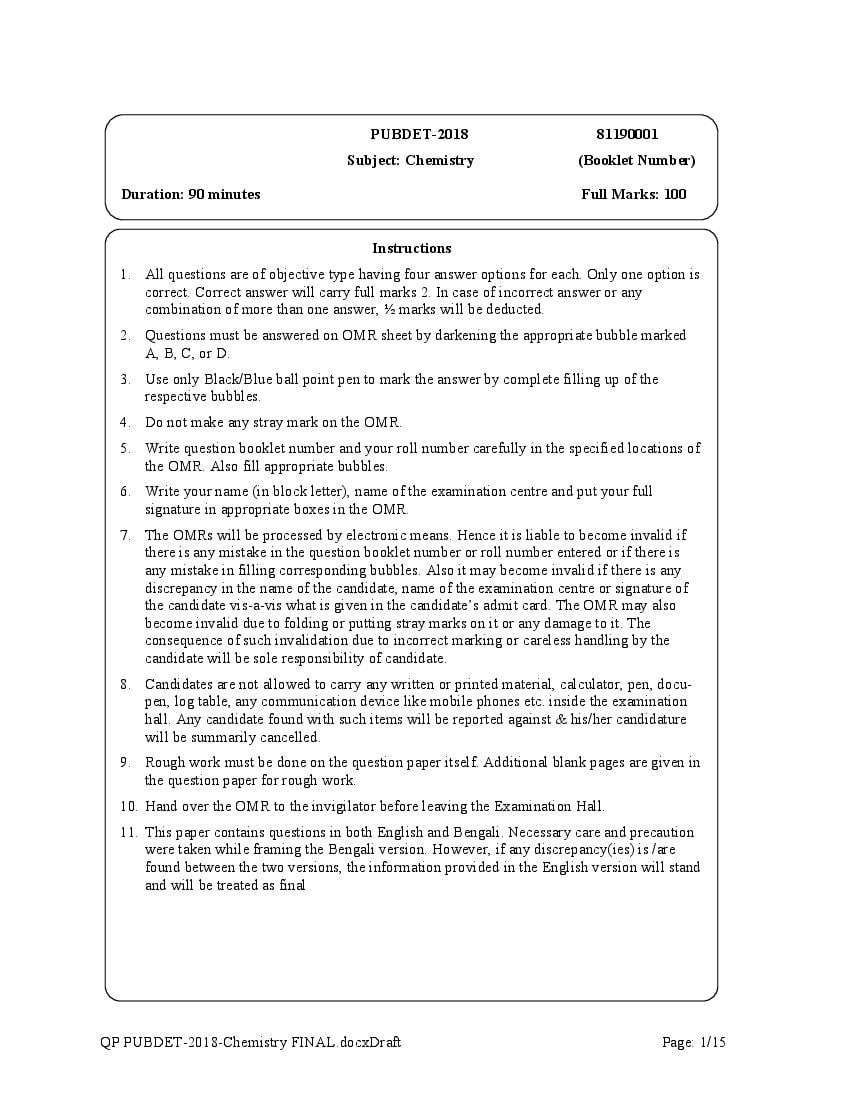
Subject: Chemistry (Booklet Number)
Duration: 90 minutes Full Marks: 100
Instructions
1. All questions are of objective type having four answer options for each. Only one option is
correct. Correct answer will carry full marks 2. In case of incorrect answer or any
combination of more than one answer, ½ marks will be deducted.
2. Questions must be answered on OMR sheet by darkening the appropriate bubble marked
A, B, C, or D.
3. Use only Black/Blue ball point pen to mark the answer by complete filling up of the
respective bubbles.
4. Do not make any stray mark on the OMR.
5. Write question booklet number and your roll number carefully in the specified locations of
the OMR. Also fill appropriate bubbles.
6. Write your name (in block letter), name of the examination centre and put your full
signature in appropriate boxes in the OMR.
7. The OMRs will be processed by electronic means. Hence it is liable to become invalid if
there is any mistake in the question booklet number or roll number entered or if there is
any mistake in filling corresponding bubbles. Also it may become invalid if there is any
discrepancy in the name of the candidate, name of the examination centre or signature of
the candidate vis-a-vis what is given in the candidate’s admit card. The OMR may also
become invalid due to folding or putting stray marks on it or any damage to it. The
consequence of such invalidation due to incorrect marking or careless handling by the
candidate will be sole responsibility of candidate.
8. Candidates are not allowed to carry any written or printed material, calculator, pen, docu-
pen, log table, any communication device like mobile phones etc. inside the examination
hall. Any candidate found with such items will be reported against & his/her candidature
will be summarily cancelled.
9. Rough work must be done on the question paper itself. Additional blank pages are given in
the question paper for rough work.
10. Hand over the OMR to the invigilator before leaving the Examination Hall.
11. This paper contains questions in both English and Bengali. Necessary care and precaution
were taken while framing the Bengali version. However, if any discrepancy(ies) is /are
found between the two versions, the information provided in the English version will stand
and will be treated as final
QP PUBDET-2018-Chemistry FINAL.docxDraft Page: 1/15
Page 2
Page 3
1 ∂V ∂V k ∂V
(A) V α (B) =k (C) =− 2 (D) = −k
T ∂T P ∂T P T ∂T P
Q¡mÑ−pl p§œ¡e¤k¡u£ , ¢ejÀ¢m¢Ma …¢ml p¢WL ¢hhª¢a¢V ne¡š² Llz (k HL¢V dË¥hL )
1 ∂V ∂V k ∂V
(A) V α (B) =k (C) =− 2 (D) = −k
T ∂T P ∂T P T ∂T P
2. What is [H]+ in mol/L of a solution that is 0.20 (M) in CH3COONa and 0.10 (M) in CH3COOH? Ka
for CH3COOH = 1.8 x 10⁻⁵.
HL¢V âh−Z CH3COONa Hl j¡œ¡ 0.20 (M) Hhw CH3COOH Hl j¡œ¡ 0.10 (M); âhZ¢V −a
[H]+ in mol/L H La?
(A) 9.0 x 10⁻⁶ (B) 3.5 x 10⁻⁴ (C) 1.1 x 10⁻⁵ (D) 1.8 x 10⁻⁵
3. The activation energy of a reaction occurring at 250C is 50.0 kJ mol-1. The approximate value of the
temperature coefficient for the reaction is
HL¢V ¢h¢œ²u¡u p¢œ²uLlZ n¢š²l (activation energy) j¡e 250C a¡fj¡œ¡u 50.0 kJ mol-1z ¢h¢œ²u¡¢V
a¡fj¡œ¡ …Z¡−ˆl (temperature coefficient) Be¤j¡¢eL j¡e
(A) 2 (B) 4 (C) 6 (D) 8
4. What will be the EMF of the following cell?
¢ejÀ¢m¢Ma −L¡o¢Vl a¢svQ¡mL hm La q−h?
Pt(s) H2 ( g,p1atm ) H + ( aq.) H2 ( g,p2 atm ) Pt(s)
RT p1 RT p1 RT p2 RT p2
(A) ln (B) ln (C) ln (D) ln
F p2 2F p2 F p1 2F p1
5. A metal has a FCC lattice. The edge length of the unit cell is 404 pm. The density of the metal is
2.72 g cm-3. The molar mass of mass of the metal is (NA = 6.02 x 10²³ mol-1)
HL¢V d¡a¥ FCC S¡mL (lattice)z HLL fË−L¡−ùl (unit cell) °cOÑÉ 404 pm. d¡a¥¢Vl OeaÆ
2.72 g cm-3. d¡a¥¢Vl Be¢hL il (NA = 6.02 x 10²³ mol-1) qm
(A) 40 g mol-1 (B) 30 g mol-1 (C) 27 g mol-1 (D) 20 g mol-1
QP PUBDET-2018-Chemistry FINAL.docxDraft Page: 3/15
Page 4
seconds, the pressure of Cl2O7 falls from 0.062 to 0.044 atm. The rate constant for the reaction is
400 K a¡fj¡œ¡u Cl2O7 (g) Hl Cl2 (g) Hhw O2 (g) H ¢hi¡Se fËbj œ²j ¢h¢œ²u¡ (first order
reaction)z 55 −p−Lä f−l Cl2O7 Hl Q¡f 0.062 −b−L 0.044 atm H qÊÊ¡p f¡uz ¢h¢œ²u¡¢Vl q¡l
d˥hL (rate constant) qm
(A) 2.25 x 10⁻² s-1 (B) 6.2 x 10⁻² s-1 (C) 6.2 x 10⁻³ s-1 (D) 2.25 x 10⁻³ s-1
7. What is the solubility product of Ag2CO3 in water at 250C if for the following reaction
∆G 0 = 63.3 kJ mol−1 ? (R = 8.314 JK-1 mol-1)
k¢c ¢ejÀ¢m¢Ma ¢h¢œ²u¡¢Vl SeÉ ∆G 0 = 63.3 kJ mol−1 qu a¡q−m S−m 250C a¡fj¡œ¡u Ag2CO3l
â¡hÉa¡ …e¡ˆ La q−h? (R = 8.314 JK-1 mol-1)
Ag2 CO3 (s) ⇌ 2Ag + (aq.) + CO32− (aq.)
(A) 3.2 x 10 - 26 (B) 8.0 x 10 – 12 (C) 2.9 x 10 - 3 (D) 7.9 x 10 - 2
8. The pH of a saturated solution of Ba(OH)2 is 12. The value of solubility product (Ksp) of Ba(OH)2 is
Ba(OH)2 Hl HL¢V pÇf«š² âh−Zl (saturated solution) pH Hl j¡e 12, Ba(OH)2 Hl â¡hÉa¡
…e¡−ˆl (solubility product ) (Ksp) j¡e qm
(A) 5.0 x 10 -6 (B) 3.0 x 10 – 7 (C) 5.0 x 10 -7 (D) 4.0 x 10 - 6
9. If the E0cell for a given reaction has a negative value, then which of the following gives the correct
relationship for the values of ∆G 0 and Keq?
HL¢V fËcš ¢h¢œ²u¡l SeÉ E0cell Hl j¡e k¢c GZ¡aÈL qu, a¡q−m ∆G 0 Hhw Keq Hl ¢ejÀ¢m¢Ma
pÇfLÑ…¢ml j−dÉ −L¡e¢V p¢WL?
(A) ∆G > 0; K eq > 1
0
(B) ∆G 0 < 0; K eq > 1
(C) ∆G 0 < 0; K eq < 1 (D) ∆G 0 > 0; K eq < 1
10. What will be the mass of a non-volatile solute (having a molar mass of 40.0 g mol-1 ) which should
be dissolved 114 g of octane to reduce its vapor pressure to 80 %?
La i−ll H¢V Ae§à¡u£ â¡hL−L (k¡l BZ¢hL il 40.0 g mol-1 ) 114 g octane H âh£i¥a Ll−m
âhZ¢Vl h¡×fQ¡f 80 % qÊÊ¡p f¡−h?
(A) 10 g (B) 100 g (C) 15 g (D) 150 g
QP PUBDET-2018-Chemistry FINAL.docxDraft Page: 4/15
Page 5
2
given as 6.25 x 10 -3 mol L-1 s -1. The rate of formation of NO2 and O2 is given respectively as
fËcš ¢h¢œ²u¡¢Vl SeÉ, N2 O 5 (g) → 2 NO2 (g) + 1 2 O2 (g), N2 O 5 Hl qÊÊ¡−pl q¡l
6.25 x 10 -3 mol L-1s -1. a¡q−m NO2 Hhw O2 Hl Evfæ qh¡l q¡l kb¡œ²−j
(A) 6.25 x 10⁻³ mol L-1s-1 and 6.25 x 10⁻³ mol L-1s-1
(B) 6.25 x 10⁻³ mol L-1s-1 and 3.125 x 10⁻³ mol L-1s-1
(C) 1.25 x 10⁻² mol L-1s-1 and 6.25 x 10⁻³ mol L-1s-1
(D) 1.25 x 10⁻² mol L-1s-1 and 3.125 x 10⁻³ mol L-1s-1
12. For the aqueous solution of strong electrolytes NaOH, NaCl and BaCl2 the molar conductivities at
infinite dilution, Λ 0 m at 250C are 248.1 x 10 – 4, 126.5 x 10 – 4, and 280.2 x 10 sm2 mol-1
respectively. Λ 0 m ”for aqueous Ba(OH)2 solution at 250 C is
a£hË a¢sv¢h−nÔoÉ NaOH, NaCl J BaCl2 Hl Sm£u âh−Zl mO¤a¡u BZh f¢lh¡¢qa¡ Λ 0 m 250C
Eo·a¡u kb¡œ²−j 248.1 x 10 – 4, 126.5 x 10 – 4 Hhw 280.2 x 10 sm2 mol-1 . 250 C Eo·a¡u Ba(OH)2
âh−Zl Λ 0 m q−h
(A) 649.7 x 10⁻⁴ sm2 mol -1 (B) 401.6 X 10⁻⁴ sm2 mol -1
(C) 523.2 x 10⁻⁴ sm2 mol -1 (D) 311.6 x 10⁻⁴ sm2 mol -1
13. For a first order reaction A → products, the fraction of reactant which reacts in one second is
[a = initial concentration of the reactant, x = decrease in concentration of reactant in time, t,
k = rate constant]
HL¢V fËbj œ²−jl ¢h¢œ²u¡l, A → ¢h¢œ²u¡S¡a fc¡bÑ, HL −p−L−ä ¢h¢œ²u−Ll −k iNÀ¡wn ¢h¢œ²u¡
L−l a¡ qm [a = ¢h¢œ²u−Ll fË¡l¢ñL N¡taÆ , x = t pj−u ¢h¢œ²u−Ll N¡t−aÆl qÊ¡Ê p, k = ¢h¢œ²u¡l
q¡l dË¥hL ]
a a−x
(A) 2.303 log (B) 2.303 log (C) 1 − e − k (D) 1 + e− k
a−x a
14. The rate of the homogeneous gaseous reaction 2X(g) + Y(g) → 2Z(g) is doubled when
concentration of Y is doubled and becomes 8 times when concentration of each of X and Y is
doubled. Orders with respect to X and Y are respectively
2X(g) + Y(g) → 2Z(g) pjpaÆ NÉ¡p£u ¢h¢œ²u¡l q¡l ¢à…e qu kMe Y Hl N¡taÆ ¢à…e Ll¡ qu
Hhw ¢h¢œ²u¡l q¡l BV…e qu kMe X J Y Hl fË¢a¢Vl N¡taÆ ¢à…e Ll¡ quz X J Y Hl
p¡−f−r ¢h¢œ²u¡l œ²j kb¡œ²−j
(A) 0 and 2 (B) 1 and 2 (C) 2 and 1 (D) 1 and 0
QP PUBDET-2018-Chemistry FINAL.docxDraft Page: 5/15
Page 6
M1) is isotonic with a y percent (w/v) solution of an organic non-volatile solute (molecular weight,
M2) then M2 equals to
HL¢V âh−Zl fË¢a ¢mV¡−l x NË¡j A-a¢sv¢h−nÔoÉ J Ae¤à¡u£ â¡h (BZ¢hL …l¦aÆ, M1) Hhw Afl
HL¢V âh−Z y na¡wn Ae¤à¡u£ °Sh â¡h (BZ¢hL …l¦aÆ , M2) âh£i¨a B−Rz k¢c âhZ c¤¢V
pj¡¢ip¡lL âhZ qu , a−h M2 Hl j¡e
10M1 y 10M1 10xy M1 y
(A) (B) (C) (D)
x xy M1 10x
16. In a body centered cubic (bcc) lattice of a metal the distance between the centers of two atoms along
an edge of a unit cell is
(A) 2 times the atomic diameter (B) twice the atomic diameter
3
(C) equal to the atomic diameter (D) 2 times the atomic diameter
3
HL¢V d¡a¥l −cq-−L¢¾cÊL OeL¡L¡l S¡m−Ll HLL −L¡−ol d¡l hl¡hl c¤¢V flj¡e¤l −L−¾cÊl
j−dÉL¡l c§laÆ
(A) f¡lj¡e¢hL hÉ¡−pl 2 …Z (B) f¡lj¡e¢hL hÉ¡−pl ¢à…e
3
(C) f¡lj¡e¢hL hÉ¡−pl pj¡e (D) f¡lj¡e¢hL hÉ¡−pl 2 …Z
3
17. For a reversible exothermic reaction if E1 is the activation energy for the forward reaction and E2 is
that for the backward reaction then
HL¢V Eij¤M£ a¡fc¡u£ ¢h¢œ²u¡l pÇj¥M ¢h¢œ²u¡l p¢œ²uLlZ n¢š², E1 Hhw ¢hfl£a ¢h¢œ²u¡l
p¢œ²uLlZ n¢š² E2 q−m
E2 E2 E2 E2
(A) <1 (B) =1 (C) >1 (D) =0
E1 E1 E1 E1
18. An alloy of Au and Cu crystallise in a cubic space lattice where Au atoms occupy the lattice points
at the corners and Cu atoms occupy the centres of the faces of the cubic unit cell. The formula of
the compound
Au Hhw Cu Hl HL¢V pˆl −k±N OeL¡L¡l ¢œj¡¢œL S¡mL °al£ L−l k¡l OeL¡L¡l −L¡−ol fË¢a¢V
−L±¢eL ¢h¾c¥−a Au flj¡e¤ Hhw fË¢a¢V a−ml −L−¾cÊ Cu flj¡e¤ AhÙÛ¡e L−lz pˆl −k±−Nl
pw−La qm
(A) Au8Cu6 (B) Au4Cu3 (C) AuCu (D) AuCu3
QP PUBDET-2018-Chemistry FINAL.docxDraft Page: 6/15
Page 7
V volt is [ h = Planck constant, v = velocity of electron, e =charge of electron]
V −i¡ÒV ¢hihfË−i−cl jdÉ ¢c−u HL¢V C−mLVÊe (il, m) fËh¡¢qa q−m a¡l ¢X hËN¢Ú m al‰°cOÑÉ
( λ ) qm [h = fÔÉ¡−ˆl dË¥hL, v = C−mLVÊe −hN, e = C−mLVÊe Bd¡e]
h h h h
(A) (B) (C) (D)
mev mev 2mev 2mev
20. A system of a gas surrounded by an impermeable, adiabatic and non-rigid wall is an example of
(A) isolated system (B) open system
(C) closed system (D) heterogeneous system
HL¢V NÉ¡−pl a¿» AfË−hnÉ, l¦Üa¡f£u J Acªt f¢lp£j¡ à¡l¡ BhÜ z a¿»¢V qm
(A) ¢exp‰ a¿» (B) j¤š² a¿» (C) hÜ a¿» (D) ApjpšÄ a¿»
21. h
The orbital angular momentum of an electron obeying the relation n = ℓ + 1 is 1.5 . Identify
π
the electron.
h
HL¢V C−mLVÊe k¡ n = ℓ + 1 pÇfLÑ −j−e Q−m, a¡l Lr£u −L±¢eL il−hN qm 1.5 .
π
C−mLVÊe¢V ¢e−cÑn Llz
(A) 1s (B) 2p (C) 3d (D) 4f
22. The oxoanion XO y z − is isoelectronic with Mg3N2. Which of the following options is correct?
(standard symbols for elements are used)
XO y z − Bue¢Vl Mg3N2 −k±−Nl p¡−b pja¡¢saz ¢ejÀ¢m¢Ma…¢ml j−dÉ −L¡e¢V p¢WL ?
(A) X = B, y = 2, z = 1 (B) X = C, y = 3, z = 2
(C) X = N, y = 3, z = 1 (D) X = P, y = 4, z = 3
23. Which force operate between the homonuclear diatomic molecules?
(A) ion – dipole (B) dipole - dipole
(C) instantaneous dipole – induced dipole (D) dipole – induced dipole
c¤¢V pj¢eELÓ£u ¢à-flj¡e¤L Ae¤l j−dÉ −L¡e hm¢V L¡S L−l?
(A) Bue - ¢à−jl¦ (B) ¢à−jl¦ - ¢à−jl¦
(C) a¡vr¢ZL ¢à−jl¦ - B¢hø ¢à−jl¦ (D) ¢à−jl¦ - B¢hø ¢à−jl¦
QP PUBDET-2018-Chemistry FINAL.docxDraft Page: 7/15
Page 8
The number of ∝ and β particles emitted respectively when 90 Th changes to 84 are?
kMe 90 Th234 l©f¡¿¹¢la q−µR 84 Po218 -−a, aMe ¢expªa ∝ Hhw β LZ¡l pwMÉ¡ kb¡œ²−j qm :
(A) 2 and 4 (B) 6 and 8 (C) 4 and 2 (D) 4 and 4
25. A sample of 14CH4 gas kept in a closed vessel shows increase in pressure with time. This is due to:
(A) The formation of 14NH3 and H2 (B) The formation of 11BH3 and H2
(C) The formation of 14C2H4 and H2 (D) The formation of 12CH4, 14NH3 and H2
HL¢V hÜ f¡−œ 14CH4-Hl NÉ¡p£u ej¤e¡ l¡M¡ q−m, pj−ul p¡−b a¡l Q¡f hª¢Ü f¡uz L¡lZ¢V qm
(A) 14NH3 Hhw H2 °al£ qJu¡ (B) 11BH3 Hhw H2 °al£ qJu¡
(C) 14C2H4 Hhw H2 °al£ qJu¡ (D) 12CH4, 14NH3 Hhw H2 °al£ qJu¡
26. A solution of A acidified with dil. H2SO4 was mixed with H2O2. On being shaken with ether, a deep
blue ethereal solution is formed. On standing or warming gently, a green solution of B is formed. A
and B respectively can be:
HL¢V −k±−Nl mO¤ H2SO4 à¡l¡ AÇm£L«a âh−Z H2O2 −k¡N Ll¡ −q¡mz ¢jnËe¢V Cb¡l ¢c−u T¡yL¡−e¡
q−m HL¢V N¡t e£m Cb¡l¡Cm âhZ f¡Ju¡ −Nmz ¢LR¥rZ −l−M ¢c−m Abh¡ mO¤a¡f fË−u¡N Ll−m
HL¢V B −k±−Nl ph¤S âhZ f¡Ju¡ −Nmz A Hhw B kb¡œ²−j q−a f¡−l :
(A) Co2 O3 , Co2 ( SO 4 )3 (B) K 2 CrO4 , Cr2 ( SO 4 )3
(C) CuSO4, Cu2O (D) K 4 [ Fe(CN)6 ] , FeSO 4
27. Which among the following is not a source of sulphur
(A) Willemite (B) Heavy spar (C) Limonite (D) Wavelite
¢ejÀ¢m¢Ma −L¡e¢V p¡mg¡−ll Evp eu
(A) Eq¢mj¡CV (B) −q¢i Øf¡l (C) ¢m−j¡e¡CV (D) J−uim¡CV
28. Stereochemically inactive lone pair is observed in
−L¡e¢V−a ¢ØV¢lJ−L¢jLÉ¡m ¢e¢×œ²u ¢exp‰ −S¡s −cM¡ k¡u :
(C) [ TeCl6 ]
2−
(A) SF4 (B) TeF5− (D) XeF6
QP PUBDET-2018-Chemistry FINAL.docxDraft Page: 8/15
Page 9
a violet solution. The solution may contain:
fV¡¢nu¡−jl c¤¢V −k±N ¢j¢nËa HL¢V hZÑq£Z âh−Z HL −g¡yV¡ mO¤ AÉ¡¢pX −k¡N Ll¡ q−m âh−Zl hZÑ
−h…e£ qmz pñ¡hÉ −k±N c¤¢V qm
(A) KNO3 and KI (B) KIO3 and K2SO4
(C) KIO3 and KNO3 (D) KBrO3 and KI
30. Which of the following is correct for NO?
(A) It can act as oxidizing agent only.
(B) It can act as reducing agent only.
(C) It can act as both an oxidizing and a reducing agent.
(D) It can act neither as oxidizing nor as reducing agent.
NO-l −r−œ ¢ejÀ¢m¢Ma −L¡e¢V p¢WL?
(A) H¢V HLj¡œ S¡lL âhÉ ¢qp¡−h L¡S L−lz
(B) H¢V HLj¡œ ¢hS¡lL âhÉ ¢qp¡−h L¡S L−lz
(C) H¢V S¡lL Hhw ¢hS¡sL âhÉ c¤C ¢qp¡−hC L¡S L−lz
(D) H¢V S¡lL Hhw ¢hS¡sL âhÉ −L¡eJi¡−hC L¡S L−l e¡z
31. A violet coloured solution of I2 in water will turn brown if
(A) concentrated acetic acid is added to it. (B) KIO3 is added to it.
(C) concentrated NaOH is added to it. (D) concentrated HNO3 is added to it.
B−u¡¢X−el HL¢V −h…e£ Sm£u âhe h¡c¡j£ hZÑ d¡lZ L−l k¢c
(A) âh−Z Oe AÉ¡−p¢VL AÉ¡¢pX −k¡N Ll¡ qu (B) âh−Z KIO3 −k¡N Ll¡ qu
(C) âh−Z Oe NaOH −k¡N Ll¡ qu (D) âh−Z Oe HNO3 −k¡N Ll¡ qu
32. Which of the following metal centers have a lone pair ?
¢ejÀ¢m¢Ma −L¡e d¡a¥−L−¾cÊ ¢exp‰ −S¡s B−R?
(A) Cu(H2 O)62+ (B) V(H2O)62+ (C) Cr(H2 O)63+ (D) Cr 2O72−
33. Which of the following ions have the highest magnetic moment?
¢ejÀ¢m¢Ma −L¡e Bue¢Vl −Q±ðLï¡jL phÑ¡¢dL q−h?
(A) Cu 2+ (B) Fe3+ (C) Zn2+ (D) V2+
QP PUBDET-2018-Chemistry FINAL.docxDraft Page: 9/15
Page 10
¢ejÀ¢m¢Ma −L¡e hÙ¹¥¢V Apjam£u q−h?
(A) N2 O (B) NO2− (C) PO32− (D) KO2
35. When a solution of a thiol is added to a blue solution of CuSO4, it turns colourless. What may have
happened?
(A) Cupric thiolate compound is formed. (B) A cuprous compound is formed.
(C) Cu(OH)2 is formed. (D) Cu(H2O)62+ is formed.
CuSO4 -Hl e£m âh−Z b¡um âhZ −k¡N Ll−m −p¢V hZÑq£e q−u k¡uz L£ L¡l−Z a¡ q−a f¡−l?
(A) ¢LE¢fËL b¡−u¡−mV −k±N Evfæ qu (B) ¢LEfË¡p −k±N Evfæ qu
(C) Cu(OH)2 Evfæ qu (D) Cu(H2O)62+ Evfæ qu
36. How many stereoisomers are possible for this molecule?
HC AZ¤¢Vl La…¢m ¢œj¡¢œL pj¡huh pñh?
CH 3 CH Br CH = CH CH 2 CH 3
(A) 2 (B) 4 (C) 6 (D) 8
37. The major product in the following reaction is
¢e−Ql ¢h¢œ²u¡¢V−a Evfæ j¤MÉ −k±N¢V qm-
( C2 H 5O )2 C = O
CH MgBr
3
aq.NH Cl
→
4
O
(A) CH3COCH3 (B) CH3 C OC2H5
OH
(C) (CH3)3COH (D) CH3 C CH3
OC2H5
38. Arrange the following carbocations in order of decreasing stability :
L¡−hÑ¡LÉ¡V¡ue…¢ml p¤¤¢ÙÛla¡l Adxœ²j Ae¤k¡u£ p¡S¡J.
(II) (IV)
(I) (III)
(A) II>III>I>IV (B) III>II>I>IV
(C) III>II>IV>I (D) III>IV>II>I
QP PUBDET-2018-Chemistry FINAL.docxDraft Page: 10/15
Page 11
¢e−Ql Cb¡l…¢ml j−dÉ −L¡e¢V EC¢mu¡jpe Cb¡l pw−nÔoZ à¡l¡ fËÙ¹¥a Ll¡ k¡u e¡?
(A) CH2OCMe3
(B) OCHMe2
(D) C(Me2)CH2OMe
(C) OCMe3
40. Which compound does not possess sp – hybridized carbon atom :
−L¡e −k±N¢Vl j−dÉ sp-pwLl¡uZ L¡hÑe flj¡e¤ −eC?
(A) (B) HC C CH CH2
(C) H2C C CH2 (D) H2C C O
41. Which one of the following compound is most reactive towards
mCPBA ( m – chloroperoxy benzoic acid)?
¢e−Ql −k±N…¢ml j−dÉ −L¡e¢V m-CPBA (−jV¡-−LÓ¡−l¡f¡lA¢„−h−¾S¡¢uL AÉ¡¢pX) Hl p¢qa phÑ¡¢dL
p¢œ²u
Me
(A) (B)
Me
Me
Me
(D)
(C)
Me
Me
42. Among the following which one is not planer?
HC …−m¡l j−dÉ −L¡e¢V pjam£u eu?
(C) (D)
(A) (B)
QP PUBDET-2018-Chemistry FINAL.docxDraft Page: 11/15
Page 12
‘X’ −k±N¢Vl NWepw−La q"−m¡
Na / NH3 (liquid) 1. Br2
'X' 'X'
- 780C 2. NaNH2(excess)
(A) CH3 CH2 CH = CH2 (B) CH3 CH2 C ≡ CH
(C) CH2 = C = CH CH3 (D) CH3 − C ≡ C − CH3
44. The products ( X and Y) are respectively
Evf¡¢ca âhÉ…¢m (X Hhw Y) kb¡œ²−j
1. Tollens reagent NH2OH . HCl
'Y' 'X'
2. SOCl2 NaOAC
CHO
3. NH3
(A) (CH3)2 CH – CH=NOH and (CH3)2 CH C - NH2
O
(B) (CH3)2 CH NH – CHO and (CH3)2 C= C(OH) NH2
(C) (CH3)2 C = CH – NHOH and (CH3)2 CH - C = NH
OH
(D) (CH3)2 CH CH=NOH and CH3 CH2 CH2 CONH2
45. The major products obtained in the reaction given below are
e£−Ql ¢h¢œ²u¡u j¤MÉ Evf¡¢ca âhÉ…¢m q"−m¡
O CH3 HI (1 equiv.)
CH3
I
(A) CH3 and CH3 CH2 OH
I
(B) and CH3 CH2 OH
(C) CH3 CH2 CHO and CH3 CH2 I
OH
(D) and CH3 CH2 I
QP PUBDET-2018-Chemistry FINAL.docxDraft Page: 12/15
Page 13
(A) two sp3 and four sp2 carbons (B) two sp3 and four sp carbons
(C) six sp2 carbons (D) six sp carbons
C6H6 Be¢hL pw−La ¢h¢nø HL¢V j¤š²nª‰m q¡C−XÊ¡L¡hÑ−Z b¡L−a f¡−l
(A) c¤¢V sp3 Hhw Q¡l¢V sp2 L¡hÑe (B) c¤¢V sp3 Hhw Q¡l¢V sp L¡hÑe
(C) Ru¢V sp2 L¡hÑe (D) Ru¢V sp L¡hÑe
47. Which is the incorrect resonance structure of p- nitroaniline?
−L¡e¢V p-e¡C−VÊ¡AÉ¡¢e¢m−el p¢WL pwØf¾ce NWepw−La eu?
NH2 NH2 NH2 NH2
(A) (B) (C) (D)
-
N+ N+ N N
O O- O O-
O O- -
O O-
48. The major product formed in the following reaction sequence is
e£−Ql ¢h¢œ²u¡u j¤MÉ Evfæ âhÉ¢V qm,
CH 3CH2 CH = CH CH 2 CH 3 1. O3
2. Zn /CH3 COOH
→
3. aqueous KOH / ∆
(A) CH3 CH2 CH = CH CH2 CHO (B) CH3 CH2 CH = C(CH3) CHO
(C) CH3 CH2 CH = C(CH3) CH2OH (D) CH3 CH2 CH2OH
49. Considering following reaction sequence the compound X is
¢ejÀ¢m¢Ma ¢h¢œ²u¡…¢ml p¡−f−r X −k±N¢V q"−m¡
COCH3
PCl5 NaNH2 HgSO4
X
dil. H2SO4
(A) PhCONH2 (B) PhCH2CHO
(C) PhCOCH3 (D) PhCHOHCH3
QP PUBDET-2018-Chemistry FINAL.docxDraft Page: 13/15
Page 14
¢ejÀ¢m¢Ma ¢h¢œ²u¡…¢ml p¡−f−r Y Hhw Z −k±N…¢ml kb¡œ²−j qm
dil. HCl
Y ethanol + Z
50% NaOH
benzyl alcohol
(one of the products)
(A) Y = PhCO2C2H5, Z = PhCO2H
(B) Y = Ph CH (OC2H5)2, Z = Ph CHO
(C) Y = Ph CH (OC2H5)2, Z = Ph CH2OC2H5
(D) Y = Ph CH2 CO2 C2H5, Z = Ph CH2 CO2H
QP PUBDET-2018-Chemistry FINAL.docxDraft Page: 14/15
Page 15
Subject: Chemistry
pju: 90 ¢j¢eV phÑ¡¢dL eðl: 100
¢e−cÑn¡hm£
1. HC fËnÀf−œl ph fËnÀC Ah−S¢ƒi fËnÀ Hhw fË¢a¢V fË−nÀl Q¡l¢V pñ¡hÉ Ešl −cJu¡
B−R k¡l HL¢V j¡œ p¢WLz p¢WL Ešl ¢c−m 2 eðl f¡−hz i¥m Ešl ¢c−m Abh¡
HL¡¢dL Ešl ¢c−m ½ eðl L¡V¡ k¡−hz
2. OMR f−œ A,B,C,D ¢Q¢q²a p¢WL Ol¢V il¡V L−l Ešl ¢c−a q−hz
3. OMR f−œ Ešl ¢c−a öd¤j¡œ L¡−m¡ h¡ e£m hm f−u¾V −fe hÉ¡hq¡l Ll−hz
4. OMR f−œ ¢e¢cÑø ÙÛ¡e R¡s¡ AeÉ −L¡b¡J −L¡e c¡N −c−h e¡z
5. OMR f−œ ¢e¢cÑø ÙÛ¡−e fËnÀf−œl eðl Hhw ¢e−Sl −l¡m eðl A¢a p¡hd¡ea¡l p¡−b
¢mM−a q−h Hhw fË−u¡Se£u Ol…¢m f§lZ Ll−a q−hz
6. OMR f−œ ¢e¢cÑø ÙÛ¡−e ¢e−Sl e¡j J fl£r¡ −L−¾cÊl e¡j ¢mM−a q−h Hhw ¢e−Sl pÇf¨ZÑ
p¡rl ¢c−a q−hz
7. OMR Ešlfœ¢V C−mLVÊ¢eL k−¿»l p¡q¡−kÉ fs¡ q−hz p¤a
¤ l¡w fËnÀ−fœl eðl h¡ −l¡m
eðl i¥m ¢mM−m Abh¡ i¥m Ol il¡V Ll−m Ešlfœ¢V A¢eh¡kÑ L¡l−Z h¡¢am q−a
f¡−lz HR¡s¡ fl£r¡bÑ£l e¡j, fl£r¡ −L−¾cÊl e¡j h¡ p¡r−l −L¡e i¥m b¡L−mJ Ešl fœ
h¡¢am q−u −k−a f¡−lz OMR Ešlfœ¢V i¡yS q−m h¡ a¡−a Ae¡hnÉL c¡N fs−mJ
h¡¢am q−u −k−a f¡−lz fl£r¡bÑ£l HC dl−el i¥m h¡ ApaÑLa¡l SeÉ Ešlfœ h¡¢am
q−m HLj¡œ fl£r¡bÑ£ ¢e−SC a¡l SeÉ c¡u£ b¡L−hz
8. −j¡h¡Cm−g¡e, LÉ¡mL¥−mVl, pÔ¡CXl¦m, mN−Vhm, −lM¡¢Qœ, NË¡g h¡ −L¡e dl−Zl a¡¢mL¡
fl£r¡ L−r Be¡ k¡−h e¡z Be−m −p¢V h¡−Su¡ç q−h Hhw fl£r¡bÑ£l JC fl£r¡
h¡¢am Ll¡ q−hz
9. fËnÀf−œl −n−o l¡g L¡S Ll¡l SeÉ gy¡L¡ S¡uN¡ −cJu¡ B−Rz AeÉ −L¡e L¡NS HC
L¡−S hÉhq¡l Ll−h e¡z
10. fl£r¡ Lr R¡s¡l B−N OMR fœ AhnÉ C f¢lcnÑL−L ¢c−u k¡−hz
HC fËnÀf−œ Cwl¡S£ J h¡wm¡ Eiu i¡o¡−aC fËnÀ −cJu¡ B−Rz h¡wm¡ j¡dÉ−j fËnÀ °al£l pju
fË−u¡Se£u p¡hd¡ea¡ J paLÑa¡ Ahmðe Ll¡ q−u−Rz a¡ p−šÄJ k¢c −L¡e Ap‰¢a mr Ll¡
k¡u, −p−r−œ Cwl¡S£ j¡dÉ−j −cJu¡ fËnÀ ¢WL J Q¨s¡¿¹ h−m ¢h−h¢Qa q−hz
QP PUBDET-2018-Chemistry FINAL.docxDraft Page: 15/15
Document Details
| Board / Org | WBJEEB |
| Exam | PUBDET |
| Type | Question Paper |
| Pages | 15 |
| Updated | 22 Jul 2026 |