ICSE Class 10 Question Paper 2019 for History & Civics
Finished viewing? Save it for later —
Download ICSE Class 10 Question Paper 2019 for History & Civics (PDF · 5 pages)About ICSE Class 10 Question Paper 2019 for History & Civics
ICSE Class 10 Question Paper 2019 for History & Civics is available here for free download. Published by CISCE for Class 10, this question paper can be viewed online or downloaded as a PDF (5 pages). Candidates preparing for Class 10 can use ICSE Class 10 Question Paper 2019 for History & Civics to understand the exam pattern, the type of questions asked, and the overall difficulty level.
Frequently Asked Questions
How can I download ICSE Class 10 Question Paper 2019 for History & Civics?
Open this page and click the Download button to save ICSE Class 10 Question Paper 2019 for History & Civics as a PDF. It is completely free on AglaSem Docs.
Is ICSE Class 10 Question Paper 2019 for History & Civics free to download?
Yes. ICSE Class 10 Question Paper 2019 for History & Civics can be viewed online and downloaded as a PDF free of cost on AglaSem Docs.
How many pages does ICSE Class 10 Question Paper 2019 for History & Civics have?
ICSE Class 10 Question Paper 2019 for History & Civics contains 5 pages, which you can read online or download together as a single PDF.
Where can I find more Class 10 study material?
You can find more Class 10 question papers, sample papers, syllabus, and answer keys on AglaSem Docs.
ICSE Class 10 Question Paper 2019 for History & Civics – Text
Read the full text of this question paper below — useful to quickly search, copy and reference the content online without downloading the PDF.
📄 View text version (5 pages)
Page 1
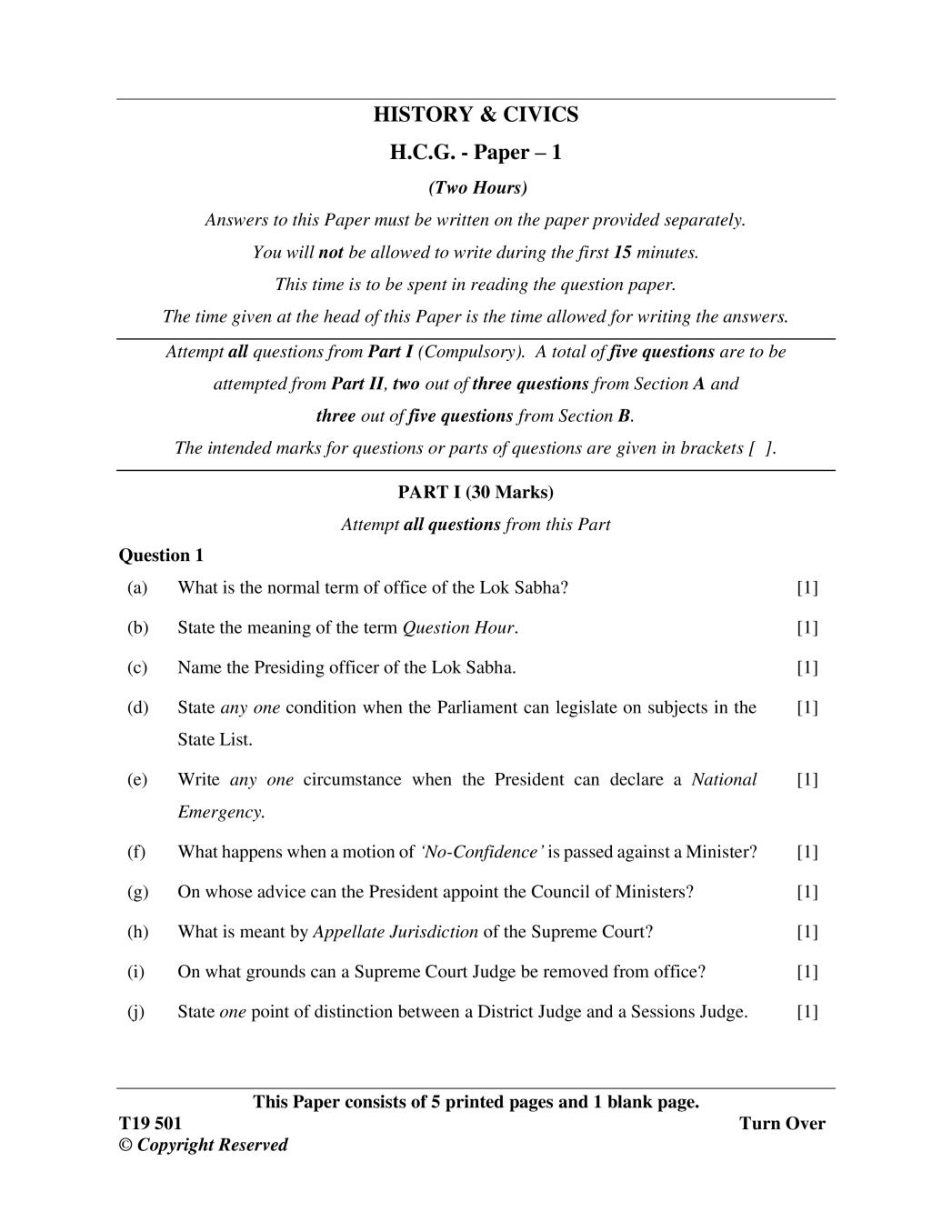
H.C.G. - Paper – 1
(Two Hours)
Answers to this Paper must be written on the paper provided separately.
You will not be allowed to write during the first 15 minutes.
This time is to be spent in reading the question paper.
The time given at the head of this Paper is the time allowed for writing the answers.
Attempt all questions from Part I (Compulsory). A total of five questions are to be
attempted from Part II, two out of three questions from Section A and
three out of five questions from Section B.
The intended marks for questions or parts of questions are given in brackets [ ].
PART I (30 Marks)
Attempt all questions from this Part
Question 1
(a) What is the normal term of office of the Lok Sabha? [1]
(b) State the meaning of the term Question Hour. [1]
(c) Name the Presiding officer of the Lok Sabha. [1]
(d) State any one condition when the Parliament can legislate on subjects in the [1]
State List.
(e) Write any one circumstance when the President can declare a National [1]
Emergency.
(f) What happens when a motion of ‘No-Confidence’ is passed against a Minister? [1]
(g) On whose advice can the President appoint the Council of Ministers? [1]
(h) What is meant by Appellate Jurisdiction of the Supreme Court? [1]
(i) On what grounds can a Supreme Court Judge be removed from office? [1]
(j) State one point of distinction between a District Judge and a Sessions Judge. [1]
This Paper consists of 5 printed pages and 1 blank page.
T19 501 Turn Over
© Copyright Reserved
Page 2
(a) What was the General Service Enlistment Act? [2]
(b) Name the two books that Dadabhai Naoroji authored explaining the ‘Drain of [2]
India’s Wealth’.
(c) Name each of the organizations founded by Jyothiba Phule and Raja Rammohan [2]
Roy.
(d) Write any two contributions of Lala Lajpat Rai to the National Movement. [2]
(e) State any two provisions of the Indian Independence Act of 1947 that was to [2]
decide the fate of the Princely States?
(f) Write any two reasons for the acceptance of the Mountbatten Plan by the [2]
Congress.
(g) State any two objections imposed by the Treaty of Versailles on the German [2]
military power.
(h) Name the Signatory Countries of the Triple Alliance. [2]
(i) What is meant by the term ‘Veto’ power? [2]
(j) Why was the League of Nations established? [2]
PART II (50 Marks)
SECTION A
Attempt any two questions from this Section
Question 3
The Parliament is the body of people’s representatives who have Supreme power in a
democracy. With reference to the Union Legislature answer the following:
(a) How are the members of the Rajya Sabha elected? [3]
(b) Why is it called a Permanent house? [3]
(c) State any two Financial and any two Legislative powers of the Indian Parliament. [4]
T19 501 2
Page 3
The Council of Ministers headed by the Prime Minister, is the most Powerful
Institution in the Indian Polity. In this context, answer the following:
(a) State briefly the position of the Prime Minister in the Parliamentary system of [3]
Government. State any two powers the Prime Minister has as a leader of the
Nation.
(b) Distinguish between the Council of Ministers and the Cabinet. [3]
(c) Write any four functions of the ‘Cabinet’. [4]
Question 5
India has a single integrated judicial system that is Independent and Supreme.
With reference to the Judiciary, answer the following:
(a) (i) Who appoints the Judges of the High Court? [3]
(ii) State any two qualifications required for a person to be appointed as a High
Court judge.
(b) Explain briefly the term ‘Court of Record’ with reference to the High Court. [3]
(c) List any four writs that the High Court can issue for the enforcement of [4]
Fundamental Rights.
SECTION B
Attempt any three questions from this Section
Question 6
The Second half of the 19th century witnessed the growth of a strong feeling of
Nationalism. With reference to the statement, answer the following:
(a) Write any three repressive Colonial policies of the British. [3]
(b) State any three ways in which the Press played an important role in developing [3]
nationalism amongst Indians.
(c) Explain briefly any three differences in the methods adopted between the [4]
Early Nationalists and Radicals, in the National Movement.
T19 501 3 Turn Over
Page 4
With reference to the picture given below, answer the following questions:
(a) (i) Identify the Memorial built for those who were killed in this incident. [3]
(ii) Where did this incident take place?
(iii) Name the movement launched by Gandhi in 1920 as a consequence.
(b) Explain briefly the reason for the suspension of this particular movement by [3]
Gandhi in 1922.
(c) State any four impacts of the movement. [4]
Question 8
With reference to the National Movement from 1930 to 1947, answer the following:
(a) State any three features of the Programme of the Civil Disobedience Movement [3]
launched in 1930.
(b) What was the significance of the Second Round Table Conference held in 1931? [3]
(c) State any four clauses of the Cabinet Mission Plan of 1946. [4]
T19 501 4
Page 5
With reference to the Rise of Dictatorships and the Second World War, answer the
following:
(a) State any three reasons for the Rise of Fascism in Italy. [3]
(b) Explain any three consequences of World War II. [3]
(c) Name the two rival blocs that fought against each other during World War II [4]
and state its signatory countries.
Question 10
The necessity to maintain International peace led to the establishment of the United
Nations Organisation. With reference to the statement, answer the following:
(a) Write any three functions of UNESCO that preserves our ‘Cultural Heritage’. [3]
(b) State the Composition of the Security Council. [3]
(c) Write any four functions of the General Assembly. [4]
T19 501 5
Document Details
| Board / Org | CISCE |
| Exam | Class 10 |
| Type | Question Paper |
| Pages | 5 |
| Updated | 22 Jul 2026 |