PUBDET 2018 Question Paper History
Finished viewing? Save it for later —
Download PUBDET 2018 Question Paper History (PDF · 14 pages)About PUBDET 2018 Question Paper History
PUBDET 2018 Question Paper History is available here for free download. Published by WBJEEB for PUBDET, this question paper can be viewed online or downloaded as a PDF (14 pages). Candidates preparing for PUBDET can use PUBDET 2018 Question Paper History to understand the exam pattern, the type of questions asked, and the overall difficulty level.
Frequently Asked Questions
How can I download PUBDET 2018 Question Paper History?
Open this page and click the Download button to save PUBDET 2018 Question Paper History as a PDF. It is completely free on AglaSem Docs.
Is PUBDET 2018 Question Paper History free to download?
Yes. PUBDET 2018 Question Paper History can be viewed online and downloaded as a PDF free of cost on AglaSem Docs.
How many pages does PUBDET 2018 Question Paper History have?
PUBDET 2018 Question Paper History contains 14 pages, which you can read online or download together as a single PDF.
Where can I find more PUBDET study material?
You can find more PUBDET question papers, sample papers, syllabus, and answer keys on AglaSem Docs.
PUBDET 2018 Question Paper History – Text
Read the full text of this question paper below — useful to quickly search, copy and reference the content online without downloading the PDF.
📄 View text version (14 pages)
Page 1
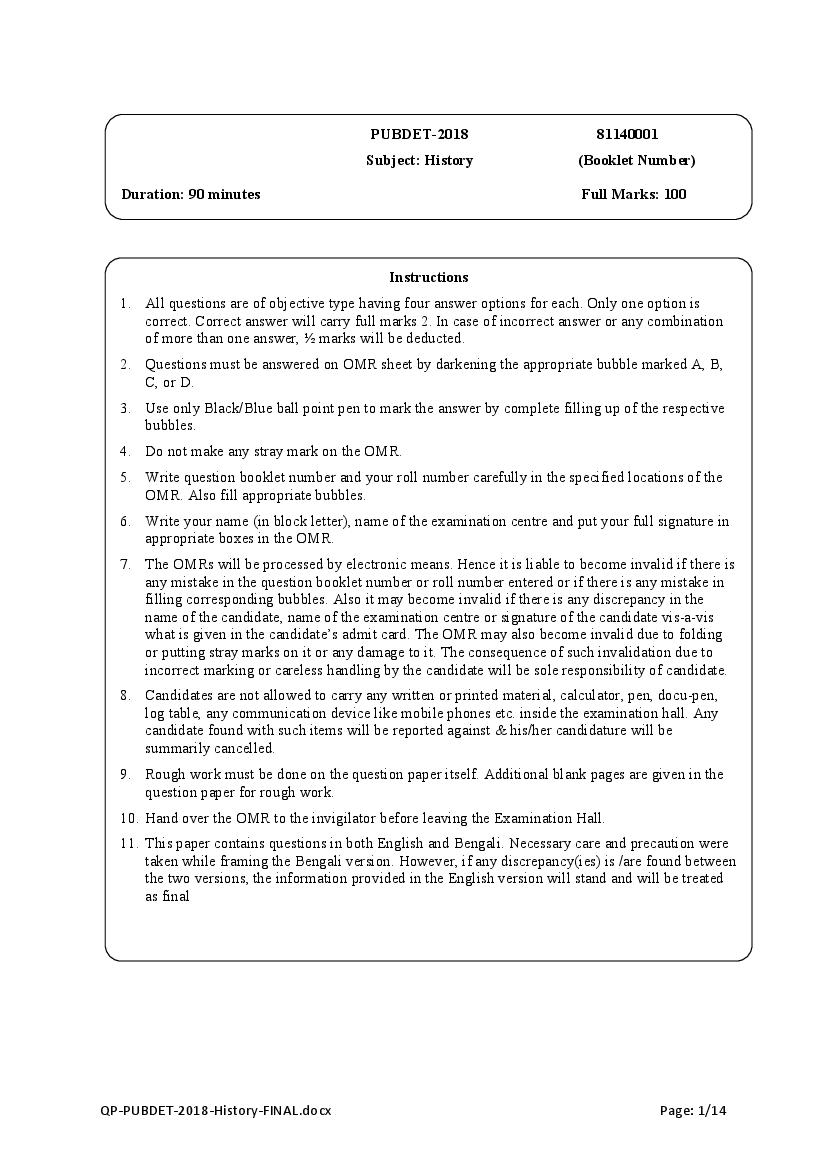
Subject: History (Booklet Number)
Duration: 90 minutes Full Marks: 100
Instructions
1. All questions are of objective type having four answer options for each. Only one option is
correct. Correct answer will carry full marks 2. In case of incorrect answer or any combination
of more than one answer, ½ marks will be deducted.
2. Questions must be answered on OMR sheet by darkening the appropriate bubble marked A, B,
C, or D.
3. Use only Black/Blue ball point pen to mark the answer by complete filling up of the respective
bubbles.
4. Do not make any stray mark on the OMR.
5. Write question booklet number and your roll number carefully in the specified locations of the
OMR. Also fill appropriate bubbles.
6. Write your name (in block letter), name of the examination centre and put your full signature in
appropriate boxes in the OMR.
7. The OMRs will be processed by electronic means. Hence it is liable to become invalid if there is
any mistake in the question booklet number or roll number entered or if there is any mistake in
filling corresponding bubbles. Also it may become invalid if there is any discrepancy in the
name of the candidate, name of the examination centre or signature of the candidate vis-a-vis
what is given in the candidate’s admit card. The OMR may also become invalid due to folding
or putting stray marks on it or any damage to it. The consequence of such invalidation due to
incorrect marking or careless handling by the candidate will be sole responsibility of candidate.
8. Candidates are not allowed to carry any written or printed material, calculator, pen, docu-pen,
log table, any communication device like mobile phones etc. inside the examination hall. Any
candidate found with such items will be reported against & his/her candidature will be
summarily cancelled.
9. Rough work must be done on the question paper itself. Additional blank pages are given in the
question paper for rough work.
10. Hand over the OMR to the invigilator before leaving the Examination Hall.
11. This paper contains questions in both English and Bengali. Necessary care and precaution were
taken while framing the Bengali version. However, if any discrepancy(ies) is /are found between
the two versions, the information provided in the English version will stand and will be treated
as final
QP-PUBDET-2018-History-FINAL.docx Page: 1/14
Page 2
Page 3
1. Bhimbetka is famous for
(A) Bead makers factory (B) Temples
(C) Painted rock shelters (D) Monasteries
i£j−hVL¡ ¢L−pl SeÉ ¢hMÉ¡a?
(A) fy¥¢a °al£l L¡lM¡e¡ (B) j¢¾cl
(C) °nm ¢Qœ (D) jW
2. Which site is famous for pit dwelling?
(A) Burzahom (B) Kalibangan (C) Dholavira (D) Mehergarh
−L¡e S¡uN¡l j¡e¤o N−aÑ h¡p Lla?
(A) h¤SÑ¡−q¡j (B) L¡¢mh‰¡e (C) −d¡m¡¢hl¡ (D) −j−qlNs
3. Which veda is not a part of ‘trayi’?
(A) Rig veda (B) Sama veda (C) Yajur veda (D) Atharva veda
−L¡e −hc ‘œu£’l Awn?
(A) GL −hc (B) p¡j −hc (C) kSÑ¥ −hc (D) AbhÑ −hc
4. Gautamiputra Satkarni was a
(A) Kushana ruler (B) Gupta ruler
(C) Satavahana ruler (D) Vakataka ruler
−N±aj£f¤œ p¡aL¢ZÑ ¢R−me
(A) L¥o¡Z n¡pL (B) …ç n¡pL
(C) p¡ah¡qe n¡pL (D) h¡L¡VL n¡pL
5. Maitreyi and Gargi are women mentioned in
(A) Upanishads (B) Kamasutra (C) Meghaduta (D) Puranas
°j−œu£ J N¡NÑ£ HC j¢qm¡NZ −kM¡−e E−õ¢Ma B−Re -
(A) Ef¢eoc (B) L¡jp§œ (C) −jOc§a (D) f¤l¡Z
QP-PUBDET-2018-History-FINAL.docx Page: 3/14
Page 4
(A) Banocharita (B) Ramacharita
(C) Harshacharita (D)Vikramankadevacharita
h¡ei−–l lQe¡ Ll¡ NË¿Û qm -
(A) h¡eQ¢la (B) l¡jQ¢la
(C) qoÑQ¢la (D) ¢hœ²j¡ˆ−ch Q¢la
7. Sangam literature is composed in
(A) Kannada (B)Tamil (C) Telegu (D)Malayalam
p‰j p¡¢qaÉ −L¡e i¡o¡u lQe¡ Ll¡ q−u¢Rm?
(A) Læs (B) a¡¢jm (C) −a−m… (D) j¡mumj
8. Who was the composer of Rajatarangini?
(A) Rajaraja (B) Kalidasa (C) Rajashekhar (D) Kalhana
l¡Sal¢‰e£l lQ¢ua¡ −L ¢R−me?
(A) l¡Sl¡S (B) L¡¢mc¡p (C) l¡S−nMl (D) Lmqe
9. How many Greek rulers are mentioned in Asokan Inscriptions?
(A)One (B) Two (C) Five (D) Seven
A−n¡−Ll ¢nm¡−mM−a LaSe NË£L n¡p−Ll E−õM f¡Ju¡ k¡u?
(A) HL (B) c¤C (C) fy¡Q (D) p¡a
10. Name the work composed by Megasthenese
(A) Si –yu-ki (B) Periplus Maris Erythraii
(C) Indica (D)Rajatarangini
−jN¡¢ÙÛ¢e−pl −mM¡ NË−¿Ûl e¡j
(A) ¢p CE ¢L (B) −f¢lfÔ¡p j¡¢l H¢lbË¡C
(C) C¢äL¡ (D) l¡Sal¢‰e£
QP-PUBDET-2018-History-FINAL.docx Page: 4/14
Page 5
(A) Mahendraditya (B) Vikramditya
(C) Chandraditya (D) Narendraditya
¢àa£u Q¾cÊ…ç −L¡e Ef¡d£ ¢e−u¢R−me?
(A) j−q¾cÊ¡¢caÉ (B) ¢hœ²j¡¢caÉ (C) Q¾cÊ¡¢caÉ (D) e−l¾cÊ¡¢caÉ
12. Who was the last Gupta ruler?
(A) Srigupta (B) Vishnugupta (C) Chandragupta II (D) Kumargupta II
−no …ç n¡pL −L ¢R−me?
(A) nË£…ç (B) ¢ho·¥…ç (C) ¢àa£u Q¾cÊ…ç (D) ¢àa£u L¥j¡l…ç
13. Ajanta and Ellora are located in which district?
(A) Aurangabad (B) Raichur (C) Purulia (D) Karimnagar
AS¿¹¡ J C−m¡l¡ −L¡e −Sm¡u Ah¢ÙÛa?
(A) Kl‰¡h¡c (B) l¡uQ¨s (C) f¤l¦¢mu¡ (D) L¢ljeNl
14. Alvars and Nayanars are associated with
(A) Temple architecture (B) Bhakti movement
(C) Sculptural art (D) Money
¢ejÀ¢m¢Ma −L¡e¢Vl p¡−b Bmh¡l J e¡ue¡lNZ pÇf¢LÑa?
(A) j¢¾cl ÙÛ¡faÉ (B) i¢š² B−¾c¡me
(C) i¡úkÑ Lm¡ (D) AbÑ
15. Which of the following is not the name of a coin?
(A)Karshapana (B)Dinara (C) Mashaka (D)Hiranya
¢e−Ql −L¡e¢V HL¢V j¤â¡ eu?
(A) L¡oÑ¡fZ (B) ¢ce¡l (C) j¡oL (D) ¢qlZÉ
QP-PUBDET-2018-History-FINAL.docx Page: 5/14
Page 6
(A) Indica (B) Si-yu –ki (C) Arthasastra (D) Gathasaptasati
¢e−Ql −L¡e¢V l¡øÊe£¢a pðå£u NË¿Û?
(A) C¢äL¡ (B) ¢p CE ¢L (C) AbÑn¡Ù» (D) N¡b¡ pçna£
17. A group of officers collectively known as umrahs were –
(A) Iqtadars (B) Nobles (C)Provincial governors (D) Revenue officials
Jjl¡q e¡−j f¢l¢Qa fc¡¢dL¡l£l¡ q−me
(A) Cš²¡c¡l (B) A¢iS¡ahNÑ (C) fË¡−c¢nL n¡pL (D) M¡Se¡ Bc¡uL¡l£
18. The first sultan of Delhi to issue regular currency and declare Delhi as the capital of his empire was
(A) Iltutmish (B) Alauddin Khilji (C) Nasir – ud- din - Mahmud (D) Balban
¢cõ£l fËbj p¤¤ma¡e −L ¢R−me,¢k¢e °ce¢¾ce hÉhq¡−ll SeÉ j¤â¡ fËQme L−le J ¢cõ£−L ¢e−Sl
l¡Sd¡e£ ¢qp¡−h −O¡oe¡ L−le?
(A) Cma¥vj£p (B) Bm¡EŸ£e MmS£ (C) e¡¢pl EŸ£e j¡qj¤c (D) hmhe
19. Who was the revenue minister under Akbar?
(A) Khwaja Abdus Samad (B) Todarmal
(C) Thakkar Pheru (D) man Singh
BLh−ll pjuL¡−m ay¡l AbÑj¿»£ −L ¢R−me?
(A) −M¡S¡ Bë¤p p¡j¡c (B) −V¡Xljm
(C) W‚l g¡l¦ (D) j¡e ¢pwq
20. Ain –i- Akbari was composed by
(A) Akbar (B) Barani (C) Abul Fazl (D) Alberuni
BCe C BLhl£ lQe¡ −L L−l¢R−me?
(A) BLhl (B) h¡lZ£ (C) Bh¤m gSm (D) Bm−hl¦Z£
QP-PUBDET-2018-History-FINAL.docx Page: 6/14
Page 7
(A) Sultan of Delhi (B) Marathas (C) Senas (D)Nizam of Hyderabad
h¢š²u¡l ¢MmS£ −k l¡SÉ−L Bœ²jZ L−le −p¢V qm
(A) ¢cõ£l p¤¤ma¡e (B) j¡l¡W¡ (C) −pe (D) q¡uâ¡h¡−cl ¢eS¡j
22. Which ruler owed his elevation to the throne to the two Sayyid brothers –
(A) Ahmad Shah (B) Farrukh Siyar (C) Muhammad Shah (D) Shah Alam
°puc ï¡a«àu Hl pq−k¡N£a¡u −L ¢pwq¡p−e Bp£e qe?
A) Bqjc n¡q (B) g¡l¦M ¢nu¡l (C) j¤qÇjc n¡q (D) n¡q Bmj
23. The term ‘Dustak’ implies
(A) Duty free trade (B) A riot (C) A port near Hooghly (D) Market place
cÙ¹L në¢V à¡l¡ −h¡T¡−e¡ q−u b¡−L
(A) öój¤š²h¡¢ZSÉ (B) c¡‰¡ (C) ýNm£l ¢eLVhaÑ£ HL¢V h¾cl (D) h¡S¡l
24. Branding of horses was known as
(A) Dagh (B) Dustak (C) Din – i- ilahi (D) Ghursawar
¢ejÀ¢m¢Ma −L¡e në −O¡s¡l hËÉ¡¢äw Ll¡−L −h¡T¡u?
(A) c¡N (B) cÙ¹L (C) c£e C- Cm¡q£ (D) −O¡spJu¡l
25. Nadir Shah invaded India from
(A) Persia (B) Central Asia (C) Gujarat (D) Deccan
e¡¢cl n¡q −k A’m −b−L Bœ²jZ L−l−Re
(A) f¡¢pÑu¡ (B) jdÉ H¢nu¡ (C) …Sl¡V (D) c¡¢rZ¡aÉ
26. Harihara and Bukka were eminent kings of
(A)Bahmani Kingdom (B) Pratihara Kingdom
(C) Vijaynagar Kingdom (D) Rashtrakuta Kingdom
q¢lql J h¤‚¡ ¢R−me ¢ejÀ¢m¢Ma l¡−SÉl ¢h¢nø n¡pL
(A)h¡qj¡e (B) fË¢aq¡l
(C) ¢hSueNl (D) l¡øÊL¨V
QP-PUBDET-2018-History-FINAL.docx Page: 7/14
Page 8
(A) Sakta Cult (B) Saiva Cult (C) Krishna Cult (D) None of the above
hõi¡Q¡kÑ ¢ejÀ¢m¢Ma −L¡e pÇfËc¡−ul djÑ…l¦ ¢R−me?
(A) n¢š (B) °nh (C) L«o· (D) Ef−ll −L¡e¢V eu
28. During the reign of which Mughal emperor there was a famine in Deccan and Gujrat?
(A) Akbar (B) Jahangir (C) Shahjahan (D) Aurangazeb
−L¡e j¤Om pjË¡−Vl l¡SaÆL¡−m c¡¢rZ¡aÉ J …Sl¡−V c¤¢iÑr qu?
(A) BLhl (B) S¡q¡‰£l (C) n¡qS¡q¡e (D) Kl‰−Sh
29. Who granted the Diwani of Bengal, Bihar and Orissa to the east India Company in 1765?
(A) Shah Alam I (B)Mir – Jafar
(C) Siraj ud daulla (D) Shah Alam II
1765 MË£ø¡−ë Cø C¢äu¡ −L¡Çf¡e£−L h¡wm¡ ¢hq¡l J J¢soÉ¡l −cJu¡e£ −L ¢c−u¢R−me?
(A) n¡q Bmj (fËbj) (B)j£l S¡gl
(C) p£l¡S Ec −c±õ¡ (D)¢àa£u n¡q Bmj
30. Who was the founder of the autonomous kingdom of Awadh?
(A) Saadat khan (B) Nawab Rai (C) Safdar Jang (D) None of the above
BJd Hl üa¿» l¡SaÆ fË¢aù¡ L−le
(A) p¡ca M¡e (B) eh¡h l¡C (C) pgcl Sw (D) Ef−l¡š² −L¡e¢V eu
31. Tipu ruled Mysore till
(A) 1899 (B) 1789 (C) 1799 (D) 1779
¢Vf¤ p¤¤ma¡e j¡C−p¡l n¡pe L−le −k pjuL¡m fkÑ¿¹
(A) 1899 (B) 1789 (C) 1799 (D) 1779
QP-PUBDET-2018-History-FINAL.docx Page: 8/14
Page 9
(A)Balaji Baji Rao (B) Baji Rao I
(C) Raja Ram (D) None of the above
h¡m¡S£ ¢hnÄe¡b Hl fl rja¡u H−p¢R−me
(A) h¡m¡S£ h¡S£l¡J (B) h¡S£l¡J (fËbj )
(C) l¡S¡ l¡j (D) Ef−l¡š² −LE eu
33. In which year was the third Battle of Panipat Fought ?
(A) 1761 (B) 1781 (C) 1751 (D) 1762
a«a£u f¡¢ef−bl k¤Ü −L¡e MË£ø¡−ë q−u¢Rm?
(A) 1761 (B) 1781 (C) 1751 (D) 1762
34. Sir Thomas Roe reached Mughal Court during the reign of
(A) Babur (B) Akbar (C) Humayun (D) Jahangir
pÉ¡l Vj¡p −l¡ j¤Om clh¡−l H−p¢R−me ky¡l l¡SaÆL¡−m ¢a¢e q−me
(A) h¡hl (B) BLhl (C) ýj¡u¤e (D) S¡q¡‰£l
35. Sikhs were organized into how many misls?
(A) 10 (B) 8 (C)12 (D)14
¢nMl¡ La…¢m ¢jp−m ¢hiš² ¢Rm?
(A) 10 (B) 8 (C) 12 (D) 14
36. Diwan – i- Bandagan is
(A) Department of justice (B) Department of slaves
(C) Department of Appeals (D) Department of Agriculture
¢cJu¡e -C - h¾c¡N¡e qm
(A) eÉ¡u ¢hi¡N (B) c¡p ¢hi¡N
(C) B¢fm ¢hi¡N (D) L«¢o ¢hi¡N
QP-PUBDET-2018-History-FINAL.docx Page: 9/14
Page 10
(A) Siraj –ud- Daula (B) Nizam – ud – Daula
(C) Mir Kasim (D) Shija – ud- Daula
j£l S¡g−ll jªaÉ¥l fl ¢pwq¡p−e −L h−pe?
(A) ¢pl¡S -EcÚ - −c±m¡ (B) ¢eS¡j -EcÚ -−c±m¡
(C) j£l L¡¢nj (D) p¤¤S¡ -EcÚ -−c±m¡
38. The first session of Indian National Congress was held at
(A) Pune (B) Calcutta (C) Bombay (D) Surat
i¡la£u S¡a£u Lw−NË−pl fËbj A¢d−hne B−u¡¢Sa −L¡b¡u q−u¢Rm?
(A) f¤−Z (B) LmL¡a¡ (C) −h¡−ð (D) p¤¤l¡V
39. Champaran Satyagraha was related with
(A)Indigo planters (B) Slaves of Champaran
(C) Peasantry of Bihar (D)None of the above
QÇf¡lZ paÉ¡NËq Hl p¡−b pÇf¢LÑa qm,
(A) e£m Q¡o (B) QÇf¡l−Zl c¡p pÇfËc¡u
(C) ¢hq¡−ll L«oL pÇfËc¡u (D) Ef−ll −L¡e¢V eu
40. Who founded the Asiatic Society of Bengal?
(A) Bankim Chandra Chatterjee (B) Madhusudan Dutta
(C) Charles Wilkins (D) Sir William Jones
H¢nu¡¢VL −p¡p¡C¢V Ag −h‰m −L fË¢aù¡ L−le?
(A) h¢ˆj Q¾cÊ Q−–¡f¡dÉ¡u (B) jd§p¤ce cš
(C) Q¡mÑp ECmÚ¢L¾p (D) pÉ¡l EC¢mu¡j −S¡epÚ
QP-PUBDET-2018-History-FINAL.docx Page: 10/14
Page 11
(A) Revenue Collectors (B) Village headmen
(C) Money lenders (D) Zaminders
f¡jÑ¡−e¾V −pVÚm−j¾V h¡ ¢QlÙÛ¡u£ h−¾c¡hÙ¹ Hl j¡dÉ−j L«oL pÇfËc¡u k¡−cl Lh−m f−s¢Rm , a¡l¡
qm
(A) M¡Se¡ pwNË¡qL (B) NË¡j fËd¡e
(C) GZ fËc¡eL¡l£ (D) S¢jc¡l
42. Who founded the Ramkrishna Mission in 1896?
(A) Ramkrishna Paramahamsa (B) Narendra Nath Datta
(C) Gopal Krishna Gokhale (D) Ishwar Chandra Vidyasagar
l¡jL«o· ¢jne 1896 p¡−m −L fË¢aù¡ L−le?
(A) l¡jL«o· fljqwp−ch (B) e−l¾cÊ e¡b cš
(C) −N¡f¡m L«o· −N¡M−m (D) DnÄl Q¾cÊ ¢hcÉ¡p¡Nl
43. Savitri Bai Phule was
(A)Member of INA (B)Member of Indian National Congress
(C) Indian social reformer and poet (D) None of the above
p¡¢hœ£ h¡D g¥−m ¢R−me -
(A) BC. He. H. -Hl pcpÉ¡ (B) i¡la£u S¡a£u Lw−NËp -Hl pcpÉ¡
(C) i¡la£u pj¡S −ph£ J L¢h (D) Ef−ll −L¡e¢V eu
QP-PUBDET-2018-History-FINAL.docx Page: 11/14
Page 12
(A) Jyotiba Phule (B) Dadabhai Naroji
(C) M.K.Gandhi (D) Lord Clive
‘pÇfc ¢eNÑje’ Hl ašÄ −L fËbj fËhaÑe L−le?
(A) −SÉ¡¢ah¡ g¥−m (B) c¡c¡i¡C eJl¡S£
(C) Hj −L N¡å£ (D) mXÑ LÓ¡Ci
45. The most important French Settlement in Bengal was at
(A) Hooghly (B) Murshidabad
(C) Chitagong (D) Chandannagar
h¡wm¡l gl¡p£ hp¢a…¢ml j−dÉ phÑ−fr¡ …l¦aÆf§ZÑ qm,
(A) ýNm£ (B) j¤¢nÑc¡h¡c (C) ¢QV¡N¡w (D) Q¾ceeNl
ENGLISH
46. Choose the correct option that best expresses the meaning of the underlined word.
“Who framed Roger rabbit?”
(A) befooled (B) painted a picture of
(C) made appear guilty (D) caught red handed
47. Choose the correct option that best expresses the given sentence in passive voice.
“The Romans expected to conquer Carthage”
(A) Carthage was expected to be conquered by the Romans
(B) It was expected by the Romans that they would conquer Carthage
(C) The Romans were expected to conquer Carthage
(D) The Romans expected to have conquered Carthage
48. Choose the correct option to begin with to replace the two given sentences by one sentence.
“You will not recover fast. Refrain from smoking.”
a. Unless you recover ……..
b. If you want to refrain from smoking ……
c. In spite of refraining from ……
(A) a (B) b (C) c (D) None of these
49. Choose the correct option which means opposite to the word ‘exonerate’.
(A) Admit (B) Accuse (C) Allow (D) Excuse
50. Choose the correct option, which replaces the words, ‘life history of a person written by another’
(A) Autobiography (B) Biography (C) Bibliography (D) Obituary
QP-PUBDET-2018-History-FINAL.docx Page: 12/14
Page 13
Page 14
Subject: History
pju: 90 ¢j¢eV phÑ¡¢dL eðl: 100
¢e−cÑn¡hm£
1. HC fËnÀf−œl ph fËnÀC Ah−S¢ƒi fËnÀ Hhw fË¢a¢V fË−nÀl Q¡l¢V pñ¡hÉ Ešl −cJu¡
B−R k¡l HL¢V j¡œ p¢WLz p¢WL Ešl ¢c−m 2 eðl f¡−hz i¥m Ešl ¢c−m Abh¡
HL¡¢dL Ešl ¢c−m ½ eðl L¡V¡ k¡−hz
2. OMR f−œ A,B,C,D ¢Q¢q²a p¢WL Ol¢V il¡V L−l Ešl ¢c−a q−hz
3. OMR f−œ Ešl ¢c−a öd¤j¡œ L¡−m¡ h¡ e£m hm f−u¾V −fe hÉ¡hq¡l Ll−hz
4. OMR f−œ ¢e¢cÑø ÙÛ¡e R¡s¡ AeÉ −L¡b¡J −L¡e c¡N −c−h e¡z
5. OMR f−œ ¢e¢cÑø ÙÛ¡−e fËnÀf−œl eðl Hhw ¢e−Sl −l¡m eðl A¢a p¡hd¡ea¡l p¡−b
¢mM−a q−h Hhw fË−u¡Se£u Ol…¢m f§lZ Ll−a q−hz
6. OMR f−œ ¢e¢cÑø ÙÛ¡−e ¢e−Sl e¡j J fl£r¡ −L−¾cÊl e¡j ¢mM−a q−h Hhw ¢e−Sl pÇf¨ZÑ
p¡rl ¢c−a q−hz
7. OMR Ešlfœ¢V C−mLVÊ¢eL k−¿»l p¡q¡−kÉ fs¡ q−hz p¤¤al¡w fËnÀ−fœl eðl h¡ −l¡m
eðl i¥m ¢mM−m Abh¡ i¥m Ol il¡V Ll−m Ešlfœ¢V A¢eh¡kÑ L¡l−Z h¡¢am q−a
f¡−lz HR¡s¡ fl£r¡bÑ£l e¡j, fl£r¡ −L−¾cÊl e¡j h¡ p¡r−l −L¡e i¥m b¡L−mJ Ešl fœ
h¡¢am q−u −k−a f¡−lz OMR Ešlfœ¢V i¡yS q−m h¡ a¡−a Ae¡hnÉL c¡N fs−mJ
h¡¢am q−u −k−a f¡−lz fl£r¡bÑ£l HC dl−el i¥m h¡ ApaÑLa¡l SeÉ Ešlfœ h¡¢am
q−m HLj¡œ fl£r¡bÑ£ ¢e−SC a¡l SeÉ c¡u£ b¡L−hz
8. −j¡h¡Cm−g¡e, LÉ¡mL¥−mVl, pÔ¡CXl¦m, mN−Vhm, −lM¡¢Qœ, NË¡g h¡ −L¡e dl−Zl a¡¢mL¡
fl£r¡ L−r Be¡ k¡−h e¡z Be−m −p¢V h¡−Su¡ç q−h Hhw fl£r¡bÑ£l JC fl£r¡
h¡¢am Ll¡ q−hz
9. fËnÀf−œl −n−o l¡g L¡S Ll¡l SeÉ gy¡L¡ S¡uN¡ −cJu¡ B−Rz AeÉ −L¡e L¡NS HC
L¡−S hÉhq¡l Ll−h e¡z
10. fl£r¡ Lr R¡s¡l B−N OMR fœ AhnÉ C f¢lcnÑL−L ¢c−u k¡−hz
11. HC fËnÀf−œ Cwl¡S£ J h¡wm¡ Eiu i¡o¡−aC fËnÀ −cJu¡ B−Rz h¡wm¡ j¡dÉ−j fËnÀ °al£l
pju fË−u¡Se£u p¡hd¡ea¡ J paLÑa¡ Ahmðe Ll¡ q−u−Rz a¡ p−šÄJ k¢c −L¡e Ap‰¢a
mr Ll¡ k¡u, −p−r−œ Cwl¡S£ j¡dÉ−j −cJu¡ fËnÀ ¢WL J Q¥s¡¿¹ h−m ¢h−h¢Qa q−hz
QP-PUBDET-2018-History-FINAL.docx Page: 14/14
Document Details
| Board / Org | WBJEEB |
| Exam | PUBDET |
| Type | Question Paper |
| Pages | 14 |
| Updated | 22 Jul 2026 |