PUBDET 2018 Question Paper Mathematics
Finished viewing? Save it for later —
Download PUBDET 2018 Question Paper Mathematics (PDF · 19 pages)About PUBDET 2018 Question Paper Mathematics
PUBDET 2018 Question Paper Mathematics is available here for free download. Published by WBJEEB for PUBDET, this question paper can be viewed online or downloaded as a PDF (19 pages). Candidates preparing for PUBDET can use PUBDET 2018 Question Paper Mathematics to understand the exam pattern, the type of questions asked, and the overall difficulty level.
Frequently Asked Questions
How can I download PUBDET 2018 Question Paper Mathematics?
Open this page and click the Download button to save PUBDET 2018 Question Paper Mathematics as a PDF. It is completely free on AglaSem Docs.
Is PUBDET 2018 Question Paper Mathematics free to download?
Yes. PUBDET 2018 Question Paper Mathematics can be viewed online and downloaded as a PDF free of cost on AglaSem Docs.
How many pages does PUBDET 2018 Question Paper Mathematics have?
PUBDET 2018 Question Paper Mathematics contains 19 pages, which you can read online or download together as a single PDF.
Where can I find more PUBDET study material?
You can find more PUBDET question papers, sample papers, syllabus, and answer keys on AglaSem Docs.
PUBDET 2018 Question Paper Mathematics – Text
Read the full text of this question paper below — useful to quickly search, copy and reference the content online without downloading the PDF.
📄 View text version (19 pages)
Page 1
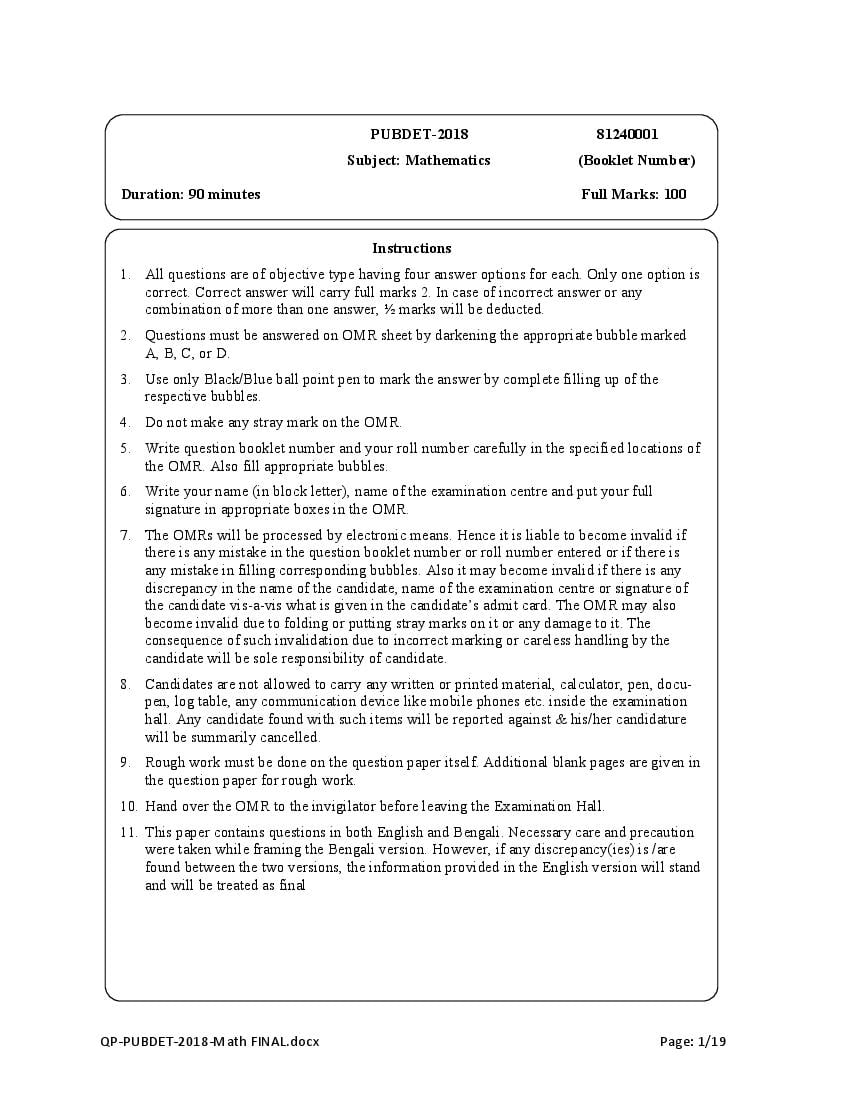
Subject: Mathematics (Booklet Number)
Duration: 90 minutes Full Marks: 100
Instructions
1. All questions are of objective type having four answer options for each. Only one option is
correct. Correct answer will carry full marks 2. In case of incorrect answer or any
combination of more than one answer, ½ marks will be deducted.
2. Questions must be answered on OMR sheet by darkening the appropriate bubble marked
A, B, C, or D.
3. Use only Black/Blue ball point pen to mark the answer by complete filling up of the
respective bubbles.
4. Do not make any stray mark on the OMR.
5. Write question booklet number and your roll number carefully in the specified locations of
the OMR. Also fill appropriate bubbles.
6. Write your name (in block letter), name of the examination centre and put your full
signature in appropriate boxes in the OMR.
7. The OMRs will be processed by electronic means. Hence it is liable to become invalid if
there is any mistake in the question booklet number or roll number entered or if there is
any mistake in filling corresponding bubbles. Also it may become invalid if there is any
discrepancy in the name of the candidate, name of the examination centre or signature of
the candidate vis-a-vis what is given in the candidate’s admit card. The OMR may also
become invalid due to folding or putting stray marks on it or any damage to it. The
consequence of such invalidation due to incorrect marking or careless handling by the
candidate will be sole responsibility of candidate.
8. Candidates are not allowed to carry any written or printed material, calculator, pen, docu-
pen, log table, any communication device like mobile phones etc. inside the examination
hall. Any candidate found with such items will be reported against & his/her candidature
will be summarily cancelled.
9. Rough work must be done on the question paper itself. Additional blank pages are given in
the question paper for rough work.
10. Hand over the OMR to the invigilator before leaving the Examination Hall.
11. This paper contains questions in both English and Bengali. Necessary care and precaution
were taken while framing the Bengali version. However, if any discrepancy(ies) is /are
found between the two versions, the information provided in the English version will stand
and will be treated as final
QP-PUBDET-2018-Math FINAL.docx Page: 1/19
Page 2
Page 3
6.732 + 7.9 45 -−L 4 à¡l¡ i¡N Ll−m i¡N−no q−h
(A) 2 (B) 3 (C) 1 (D) 0
2. 2+6 2+2 x 6 2+3 x 6 2 + 99 x 6 2 + 100 x 6
The value of 100
+ 99
+ 98
+ ⋯⋯ + + is equal to
4 4 4 42 4
2+6 2+2 x 6 2+3 x 6 2 + 99 x 6 2 + 100 x 6
100
+ 99
+ 98
+ ⋯⋯ + + -Hl j¡e q−h
4 4 4 42 4
1 1 1 1
(A) 604 − 98 (B) 600 − 98
2 4 3 4
604
(C) (D) 200
3
3. The set of all real numbers in open interval ( - 2, 2) satisfying 2 x − 2x −1 − 1 = 2x −1 + 1 is
( - 2, 2) j¤š² A¿¹−ll −k pjÙ¹ h¡Ù¹h pwMÉ¡ 2 x − 2x −1 − 1 = 2x −1 + 1 pj£LlZ−L ¢pÜ L−l, −p…¢m
qm
(A) {−1,1} (B) {−1} ∪ [1,2 )
(C) ( −2, −1] ∪ [1,2 ) (D) ( −2, −1) ∪ {1}
4. 351 when divided by 8 leaves the remainder
351 -−L 8 à¡l¡ i¡N Ll−m i¡N−no q−h
(A) 6 (B) 5 (C) 7 (D) 3
QP-PUBDET-2018-Math FINAL.docx Page: 3/19
Page 4
f g be defined by ( f g )( x ) = f [ g(x)] for all x ∈ ℝ . Then
(A) f g ≡ g f on ℝ
(B) f g ≡ g f for all x ≥ 0 but not for x < 0.
(C) f g ≡ g f for all x < 0 but not for x ≥ 0.
(D) f g ≠ g f on ℝ
j−e Ll f,g : ℝ → ℝ ¢ejÀi¡−h pw‘¡a:
f(x) = x + x Hhw g(x) = x − x , pLm x ∈ ℝ -Hl SeÉ z
f g Hi¡−h pw‘¡a B−R −k ( f g )( x ) = f [ g(x)] ,pLm x ∈ ℝ -Hl SeÉz a−h
(A) ℝ -H f g ≡ g f
(B) pLm x ≥ 0 -Hl SeÉ f g ≡ g f , ¢L¿¹¥ x < 0 -Hl SeÉ eu
(C) pLm x < 0 -Hl SeÉ f g ≡ g f , ¢L¿¹¥ x ≥ 0 -Hl SeÉ eu
(D) ℝ -H f g ≠ g f
6. 3π
The principal value of argument of z (arg z) for z = 1 + i tan is
5
3π
z = 1 + i tan -Hl Bl…−j¾V-Hl j¤MÉj¡e (arg z) qm
5
3π 2π 2π 3π
(A) (B) (C) − (D) −
5 5 5 5
7. If log x ax, log x bx and log x cx are in A.P, where a, b, c, x belong to (1,∞ ) , then a, b, c are in
(A) A.P (B) G.P
(C) H.P (D) no specific relation exists between a, b and c
k¢c log x ax, log x bx J log x cx pj¡¿¹l −nËe£−a b¡−L,
−kM¡−e a, b, c, x ∈ (1,∞ ) , a−h a, b, c
(A) pj¡¿¹l −nËe£i¥š² q−h (B) …−Z¡šl −nËe£i¥š² q−h
(C) ¢hfl£a −nËe£i¥š² q−h (D) a, b J c-Hl j−dÉ −L¡e p¤¤¢e¢cÑø pÇfLÑ −eCz
QP-PUBDET-2018-Math FINAL.docx Page: 4/19
Page 5
(A) Every non-singular matrix is orthogonal
(B) Every orthogonal matrix is non-singular
(C) Every symmetric matrix is orthogonal
(D) Every skew-symmetric matrix is non-singular
p¢WL E¢š²¢V h¡R¡C Ll :
(A) fË¢a¢V A¢h¢nø jÉ¡¢VÊ„ q−h mð jÉ¡¢VÊ„
(B) fË¢a¢V mð jÉ¡¢VÊ„ q−h A¢h¢nø jÉ¡¢VÊ„
(C) fË¢a¢V fË¢apj jÉ¡¢VÊ„ q−h mð jÉ¡¢VÊ„
(D) fË¢a¢V ¢h-fË¢apj q−h A¢h¢nø jÉ¡¢VÊ„z
9. a b aα + b
If the determinant b c bα + c is equal to zero, & b2 ≠ ac , then
aα + b bα + c 0
(A) a, b, c are in A. P
(B) a, b, c are in H.P
(C) α is a root of the equation ax 2 + 2bx + c = 0
(D) α is not a root of the equation ax 2 + 2bx + c = 0
a b aα + b
k¢c ¢eZÑ¡uL b c bα + c -Hl j¡e n§ZÉ qu J b2 ≠ ac qu, a−h
aα + b bα + c 0
(A) a, b, c pj¡¿¹l −nËe£−a b¡L−h
(B) a, b, c ¢hfl£a fËN¢a−a b¡L−h
(C) α , pj£LlZ ax 2 + 2bx + c = 0 -Hl HL¢V h£S q−h
(D) α , pj£LlZ ax 2 + 2bx + c = 0 -Hl HL¢V h£S q−h e¡
QP-PUBDET-2018-Math FINAL.docx Page: 5/19
Page 6
100
probability that x + > 50 is
x
fËbj 100 ¢V ü¡i¡¢hL pwMÉ¡ −b−L ü¡i¡¢hL pwMÉ¡ x kcªµRi¡−h −h−R −eJu¡ qmz −p−r−œ
100
x+ > 50 qJu¡l pñ¡he¡ qm
x
53 11 27 1
(A) (B) (C) (D)
100 20 50 2
If (1 + x ) = a0 + a1x + a2x 2 + ⋯ + anxn , ( n is positive integer) then the finite series
n
11.
a0 + a4 + a8 + a12 +⋯⋯ is equal to
k¢c (1 + x ) = a0 + a1x + a2x2 + ⋯ + anxn , qu ( n de¡aÈL f§ZÑpwMÉ¡), a−h pp£j −nËe£
n
a0 + a4 + a8 + a12 +⋯⋯ -Hl j¡e q−h
n
−1 nπ n
−2 nπ
(A) 2n−1 + 2 2 .cos (B) 2n−2 + 2 2 .cos
4 4
n− 2
n
−1 nπ n −1
n
−2 nπ
(C) 2 + 2 .cos
2
(D) 2 +2 2
.cos
4 4
12. k (k + 1)
Let n and k be positive integers such that n ≥ . The number of solutions
2
( x1 ,x 2 ,⋯ ,xk ) , x1 ≥ 1, x 2 ≥ 2,⋯xk ≥ k, all integers, satisfying the condition
x1 + x 2 + ⋯ + xk = n is
k (k + 1 )
n J k fËcš de¡aÈL f§ZÑpwMÉ¡ Hhw n ≥ −cJu¡ B−Rz x1 + x 2 + ⋯ + xk = n naÑ¢V−L ¢pÜ
2
L−l Hje pj¡d¡e {x1 ,x 2 ,⋯ ,xk } , −kM¡−e x1 ≥ 1, x2 ≥ 2,⋯xk ≥ k -Hl pwMÉ¡ qm
(m + k − 1)! (m − k − 1)!
(A) (B)
(k − 1)!m! (k + 1)!m!
(m + k + 1)! (m − k + 1)!
(C) (D)
(k + 1)!m! (k − 1)!m!
k (k + 1) k (k + 1)
Where m = n - H−r−œ m = n -
2 2
QP-PUBDET-2018-Math FINAL.docx Page: 6/19
Page 7
drawn; where it cuts the curve again and another tangent is drawn & so on. Then
(A) There is no particular mathematical relation between the co-ordinates of the
points of contact.
(B) The ordinates of the points of contact form an A.P. where as the abscissas of the
points form a G.P.
(C) The abscissas of the points of contact form an A.P. where as the ordinates of the
points form a G.P.
(D) Both abscissas & ordinates form G.P.
HL¢V hœ²−lM¡l fË¢a¢V ¢h¾c¥l −L¡¢V, i¥−Sl ¢œO¡−al p−‰ plm−i−c B−Rz HL¢V ¢h¾c¥−a A¢ˆya
ØfnÑL hœ²−lM¡−L −k ¢h¾c¥−a −Rc L−l −pC ¢h¾c¥−a A¢ˆya ØfnÑL hœ²−lM¡¢V−L Bl HL¢V ¢h¾c¥−a
−Rc L−l Hhw HC fË¢œ²u¡ Qm−aC b¡−Lz −p−r−œ
(A) ØfnÑ ¢h¾c¥…¢ml ÙÛ¡e¡−ˆl j−dÉ −L¡e p¤¤¢e¢cÑø N¡¢Z¢aL pÇfLÑ −eC
(B) ØfnÑ ¢h¾c¥ pj§−ql −L¡¢V…¢m pj¡¿¹l −nËe£ NWe L−l Hhw i¥Spj§q …−Z¡šl −nËe£ NWe L−l
(C) ØfnÑ ¢h¾c¥ pj§−ql i¥S…¢m pj¡¿¹l −nËe£ NWe L−l Hhw −L¡¢Vpj§q …−Z¡šl −nËe£ NWe L−l
(D) i¥S J −L¡¢V ph…¢m …−Z¡šl −nËe£i¥š² q−hz
14. f(1 − h) − f(1)
Let f(x) = 3x10 − 7x 8 + 5x 6 − 21x 3 + 3x2 − 7 . Then lim
h→ 0 h3 + 3h
50 53 22
(A) does not exist (B) is (C) is (D) is
3 3 3
f(1 − h) − f(1)
j−e Ll f(x) = 3x10 − 7x 8 + 5x 6 − 21x 3 + 3x 2 − 7 z a−h lim -Hl
h→ 0 h3 + 3h
50 53 22
(A) A¢Ù¹aÆ b¡L−h e¡ (B) j¡e q−h (C) j¡e q−h (D) j¡e q−h
3 3 3
QP-PUBDET-2018-Math FINAL.docx Page: 7/19
Page 8
(A) f, g both must be continuous at x0.
(B) One of them must be continuous at x0, the other may not be
(C) both f, g may be discontinuous at x0.
(D) In case of discontinuity of any of them, the discontinuity must be removable
discontinuity.
j−e Ll f,g : ℝ → ℝ Hje −k f(x) g(x) A−frL x 0 ∈ ℝ ¢h¾c¥−a p¿¹az −p−r−œ
(A) f, g −L AhnÉC x0 ¢h¾c¥−a p¿¹a q−a q−h
(B) A−frLc¤¢Vl j−dÉ HL¢V−L AhnÉC x0 ¢h¾c¥−a p¿¹a q−a q−h
(C) f, g Ei−uC x0 ¢h¾c¥−a Ap¿¹a q−a f¡−l
(D) −L¡e HL¢V A−fr−Ll Ap¿¹¢al −r−œ Ap¿¹¢a¢V AhnÉC Afp¡lZ−k¡NÉ Ap¿¹¢a q−hz
16. 2 1 x
x sin + , x ≠ 0
Let f(x) = x 2
0, x=0
Then, (A) f is increasing in any interval containing zero
(B) f is decreasing in any interval containing zero
(C) f is neither increasing nor decreasing in any interval containing zero
(D) Rolle’s theorem is applicable to f in [ - 1 , 1]
2 1 x
x sin + , x ≠ 0
j−e Ll f(x) = x 2
0, x=0
−p−r−œ (A) n§ZÉ d¡lZ L−l Hje fË¢a A¿¹l¡−m f œ²jhdÑj¡e
(B) n§ZÉ d¡lZ L−l Hje fË¢a A¿¹l¡−m f œ²jqÊÊ¡pj¡e
(C) n§ZÉ d¡lZ L−l Hje −k−L¡e A¿¹l¡−m f œ²jhdÑj¡e-J eu, œ²jqÊÊ¡pj¡e-J eu
(D) [ - 1 , 1]-H −l¡−ml Eff¡cÉ f-Hl −r−œ fËk¤š² euz
17. Let y = x be tangent to the curve y = ax , a > 0, a ≠ 1 . Then
y = ax , a > 0, a ≠ 1 -hœ²−lM¡l ØfnÑL y = x. a−h
1 1 1 1
(A) a = (B) a = (C) a = e e (D) a =
2 e ee
QP-PUBDET-2018-Math FINAL.docx Page: 8/19
Page 9
A man 5 ft. long walks away from the foot of a lamp-post 12 ft high at the rate of 3
2
m.p.h. Then,
(A) the shadow is decreasing at the rate of 1 m.p.h
(B) the shadow is increasing at the rate of 1 m.p.h
(C) the shadow is decreasing at the rate of 2 m.p.h
(D) the shadow is increasing at the rate of 2 m.p.h
1
12 g¥V EµQa¡ ¢h¢nø −L¡e h¡¢aÙ¹ñ-l f¡c¢h¾c¥ −b−L 5 g¥V EµQa¡pÇfæ −L¡e hÉ¢š² O¾V¡u 3
2
j¡Cm −h−N k¡œ¡ öl¦ L−lez −p−r−œ
(A) a¡yl R¡u¡ O¾V¡u 1 j¡Cm q¡−l qÊÊ¡p f¡u
(B) a¡yl R¡u¡ O¾V¡u 1 j¡Cm q¡−l c£OÑ qu
(C) a¡yl R¡u¡ O¾V¡u 2 j¡Cm q¡−l qÊÊ¡p f¡u
(D) a¡yl R¡u¡ O¾V¡u 2 j¡Cm q¡−l c£OÑ qu
19. P is the point of contact of the tangent from the origin to the curve y = log e x . The length
of the perpendicular drawn from the origin to the normal at P is
j§m ¢h¾c¥ −b−L hœ²−lM¡ y = log x -Hl A¢ˆa ØfnÑ−Ll ØfnÑ¢h¾c¥ qm Pz P ¢h¾c¥−a A¢ˆa
e
A¢imðl Efl j§m¢h¾c¥ −b−L A¢ˆa m−ðl °cOÑÉ q−h
1 1
(A) e2 + 1 (B) 2 e2 + 1 (C) (D)
e 2e
x
20.
The intercepts on x-axis made by the tangents to the curve, y = ∫ t dt, x ∈ ℝ which are
0
parallel to the line y = 2x are equal to
x
y = 2x Hl pj¡¿¹l¡m J y = ∫ t dt, x ∈ ℝ -Hl ØfnÑ−Ll x-A−r −R¢ca¡wn q−h
0
(A) 1 (B) 2 (C) 3 (D) 4
QP-PUBDET-2018-Math FINAL.docx Page: 9/19
Page 10
21.
If Ι1 = ∫ f(sin2x).sinx dx, Ι2 = ∫ f(cos2x).cosx dx, then Ι1 : Ι2 =
0 0
π2 π4
¢c Ι1 = ∫ f(sin2x).sinx dx, Ι2 = ∫ f(cos2x).cosx dx, qu, a−h Ι1 : Ι2 =
0 0
(A) 1:1 (B) 2 :1 (C) 2 : 3 (D) 2:1
22. Given P(x) = x 4 + ax 3 + bx 2 + cx + d such that x = 0 is the only real root of P′(x) = 0 . If
P(−1) < P(1) , then in the interval [ - 1, 1]
(A) P(−1) is the minimum but P(1) is not the maximum
(B) neither P(−1) is the minimum nor P(1) is the maximum
(C) P(−1) is the minimum and P(1) is the maximum
(D) P(−1) is not minimum but P(1) is the maximum
fËcš P(x) = x 4 + ax 3 + bx 2 + cx + d -Hhw P′(x) = 0 -Hl HLj¡œ h¡Ù¹h h£S qm x = 0z k¢c
P(−1) < P(1) qu, a−h A¿¹l¡m [ - 1, 1] -H
(A) P(−1) phÑ¢ejÀ ¢L¿¹¥ P(1) p−hÑ¡µQ eu
(B) P(−1) -J phÑ¢ejÀ eu Hhw P(1) J p−hÑ¡µQ eu
(C) P(−1) phÑ¢ejÀ J P(1) p−hÑ¡µQ j¡e
(D) P(−1) phÑ¢ejÀ eu ¢L¿¹¥ P(1) p−hÑ¡µQ
23. Suppose f(x) is differentiable for all x and f ′(x) ≤ 2 for all x. If f(1)=2 and f(4) =8, then f(2) =
j−e Ll pLm x-Hl SeÉ f(x) AhLme−k¡NÉ A−frL Hhw pLm x-Hl SeÉ f ′(x) ≤ 2 q−hz
k¢c f(1)=2 J f(4) =8 qu, a−h f(2) =
(A) 3 (B) 4 (C) 6 (D) 8
24. 3
2
The value of ∫
xsin πx dx is
−1
3
2
∫ xsin πx dx -Hl j¡e qm
−1
1 1 1 1 11
(A) π + 3 (B) π − 3 (C) + 3 (D) − 3
π π π π π π
QP-PUBDET-2018-Math FINAL.docx Page: 10/19
Page 11
The line y = mx bisects the area enclosed by the lines x = 0 , y = 0, x = and the curve
2
y = 1 + 4x − x 2 . Then m equals to
3
y = mx plm−lM¡ x = 0,y = 0,x = J hœ²−lM¡ y = 1 + 4x − x 2 -Hl à¡l¡ p£j¡hÜ −rœ−L ¢àd¡¢hiš²
2
L−lz −p−r−œ m-Hl j¡e q−h
15 14 13 16
(A) (B) (C) (D)
6 5 6 7
26. π π π
The area bounded by the curve y = tanx, x ∈ − , the tangent to this curve at x =
2 2 4
and x- axis in the first quadrant is
1 1 1
(A) log2 − square units (B) (A) log2 − 1 square units
2 4 2
1 1 1
(C) (A) log2 + square units (D) (A) log2 + 1 square units
2 4 2
π π π
hœ²−lM¡ y = tanx, x ∈ − , Hhw x = ¢h¾c¥−a Eš² hœ²−lM¡l ØfnÑL J x-Ar à¡l¡ fËbj
2 2 4
f¡−c p£j¡hÜ A’−ml −rœgm qm
1 1 1
(A) log2 − hNÑ HLL (B) (A) log2 − 1 hNÑ HLL
2 4 2
1 1 1
(C) (A) log2 + hNÑ HLL (D) (A) log2 + 1 hNÑ HLL
2 4 2
QP-PUBDET-2018-Math FINAL.docx Page: 11/19
Page 12
27. x −[ x ]
Let [x] denote the greatest integer less than or equal to x. The value of ∫ [ x ] dx equals to
1
n x −[ x ]
[x], x-Hl −Q−u −R¡V h¡ pj¡e p−îÑ¡µQ f§ZÑpwMÉ¡ ¢e−cÑ¢na L−lz −p−r−œ ∫ [ x ] dx Hl j¡e q−h
1
n−1
(n − 1 ) (n − 1 )
n
23 22 34 33
(A) 1 + − + − +⋯ + −
loge 2 log e 2 log e 3 loge 3 log e (n − 1) loge (n − 1)
1 2 n−2
(B) 1 + + +⋯ +
log e 2 log e 3 log e (n − 1)
1 22 nn+1
(C) + +⋯ +
2 3 n+1
23 − 1 34 − 23 nn+1 − (n − 1)n
(D) + + ⋯⋯ +
3 4 n+1
28. Let Ι ( π ) = π3 , J( π ) = 3π . Then
j−e Ll Ι ( π ) = π3 , J( π ) = 3π z −p−r−œ
(A) Ι ( π ) > J( π ) (B) Ι ( π ) < J( π )
(C) Ι ( π ) = J( π ) (D) Ι ( π ) + J( π ) = 1
29. ax + b
Consider the function f(x) = , a,b,c,d ∈ ℝ & ad − bc ≠ 0 . Then
cx + d
(A) f(x) has maxima but no minima
(B) f(x) has minima but no maxima
(C) f(x) has both maxima & minima
(D) f(x) has neither maxima nor minima
ax + b
f(x) = , a,b,c,d ∈ ℝ J ad − bc ≠ 0 A−frL¢V ¢h−hQe¡ Ll : −p−r−œ
cx + d
(A) f(x) -Hl p−îÑ¡µQ j¡e B−R ¢L¿¹¥ phÑ¢ejÀ j¡e −eC
(B) f(x) -Hl phÑ¢ejÀ j¡e B−R ¢L¿¹¥ p−îÑ¡µQ j¡e −eC
(C) f(x) -Hl p−îÑ¡µQ J phÑ¢ejÀ Eiu j¡e-C B−R
(D) f(x) -Hl p−îÑ¡µQ j¡e-J −eC, phÑ¢ejÀ j¡e-J −eC
QP-PUBDET-2018-Math FINAL.docx Page: 12/19
Page 13
The domain of the function f ( x ) = sin log2 is given by
−1
2
x2
f ( x ) = sin−1 log2 A−fr−Ll p‘¡l A’m qm
2
(A) [ 0, π] (B) [ −2, −1] ∪ [1,2] (C) [ −2, −1] (D) [1,2]
31. 1 dy
If 3f(x) + 2f = x + 2 and y = xf(x) , then at x = - 1 equals to
x dx
k¢c 3f(x) + 2f = x + 2 Hhw y = xf(x) qu, a−h x = - 1 ¢h¾c¥−a
1 dy
-Hl j¡e q−h
x dx
4 4 1 1
(A) − (B) (C) − (D)
5 5 5 5
32. Let f : ℝ → ℝ be such that f ( x ) − f ( y ) < x − y α where α is constant. Then
(A) f is derivable for all α (B) f is derivable for α > 1
(C) f is derivable for α < 1 (D) f is never differentiable.
j−e Ll f : ℝ → ℝ Hi¡−h pw”¡a B−R −k f ( x ) − f ( y ) < x − y α −kM¡−e α dË¥hLz −p−r−œ
(A) pLm α-Hl SeÉ f AhLme−k¡NÉ (B) pLm α > 1 -Hl SeÉ f AhLme−k¡NÉ
(C) pLm α < 1-Hl SeÉ f AhLme−k¡NÉ (D) f LM−e¡C AhLme−k¡NÉ eu
Let f : ℝ → ℝ not identically zero be such that f ( x + y 2n+1 ) = f(x) + [ f(y)]
2n +1
33. , n ∈ ℕ and x, y
are any two elements of domain of f and f ′ ( 0 ) ≥ 0 , then the value of f (5) is
j−e Ll f : ℝ → ℝ A−ic−k¡NÉ n§ZÉ eu Hhw Hje −k f ( x + y2n+1 ) = f(x) + [ f(y)]2n+1 , n ∈ ℕ J
f-Hl pw”¡l A’−ml A¿¹iѨš² −k−L¡e c¤¢V ¢h¾c¥ x J y Hhw f ′ ( 0 ) ≥ 0 z −p−r−œ f (5) -Hl j¡e
qm
(A) 0 (B) 1 (C) 3 (D) 5
QP-PUBDET-2018-Math FINAL.docx Page: 13/19
Page 14
1 − cos(ax 2 + bx + c)
then lim is
x →α (x − α)2
k¢c α, β ¢àO¡a pj£LlZ ax 2 + bx + c = 0 (a,b,c ∈ ℝ) -Hl h£S qu,
1 − cos(ax 2 + bx + c)
a−h lim q−h
x →α (x − α)2
a a2 a2
(B) ( α − β ) (C) − ( α − β ) (D) ( α − β )
2 2 2
(A) 0
2 2 2
35. Let f be twice differentiable function with f(0) = f(1) = f ′(0) = 0 , Then
(A) f ′′(x) is zero function. (B) f ′′(x) = 0
(C) f ′′(x) = 0 for some x ∈ ( 0,1 ) (D) f ′′(x) never vanishes
j−e Ll f A−frL¢V Hje −k f ′′ -Hl A¢Ù¹aÆ B−R Hhw f(0) = f(1) = f ′(0) = 0 quz a−h
(A) f ′′(x) n§ZÉ -A−frL (B) f ′′(x) = 0
(C) Hje ¢h¾c¥ x ∈ ( 0,1 ) f¡Ju¡ k¡−h k¡l SeÉ f ′′(x) = 0 q−h (D) f ′′(x) LM−e¡C n§ZÉ q−h e¡
36. Given log10 3 = 0.4771, log10 e = 0.4343 , the value of log10 30.5 , correct upto 3 places of
decimals is
−cJu¡ B−R log10 3 = 0.4771, log10 e = 0.4343 z −p−r−œ log10 30.5 -Hl j¡e ¢ae cn¢jL ÙÛ¡e
fkÑ¿¹ q−h
(A) 0.272 (B) 1.484 (C) 1.615 (D) 1.027
37. Consider the equation 2x + 5x = 3x + 4 x . Then
(A) the equation has only one solution in Z, the set of integers
(B) the equation has infinitely many solutions in Z
(C) the equation has exactly two solutions & both are in Z
(D) the equation has no solution in ℝ
2x + 5x = 3x + 4 x pj£LlZ¢Vl
(A) f§ZÑpwMÉ¡l −pV Z-l j¡œ HL¢V pj¡d¡e B−R
(B) Z-H Ap£j pwMÉL pj¡d¡e ¢hcÉj¡e
(C) pj£LlZ¢Vl j¡œ c¤¢V pj¡d¡e B−R Hhw Ei−uC Z-H A¿¹iѨš²
(D) ℝ -H pj£LlZ¢Vl −L¡e pj¡d¡e −eCz
QP-PUBDET-2018-Math FINAL.docx Page: 14/19
Page 15
Ax 2 + 2Hxy + By 2 = 1 by referring to parallel axes through a properly chosen point. The
point is
h¡R¡C Ll¡ ¢h¾c¥ ¢c−u pj¡¿¹l¡m Arà−ul p¡−f−r 6x2 + 4xy + 3y2 + 8x − 2y + 4 = 0 pj£LlZ¢V
Ax 2 + 2Hxy + By 2 = 1 BL¡−l f¢lh¢aÑa quz I ¢h¾c¥¢V qm
(A) ( −1,2 ) (B) ( −1,1 ) (C) (1, −2 ) (D) ( 2,0 )
39. A circle x 2 + y 2 + 2g1x + 2f1 y + c1 = 0 will bisect the circumference of the circle
2x 2 + 2y 2 + 4g 2x + 4f2 y + 2c2 = 0 is
hªš x2 + y2 + 2g1x + 2f1 y + c1 = 0 Bl HL¢V hªš 2x2 + 2y2 + 4g2x + 4f2 y + 2c2 = 0 -Hl f¢l¢d−L
¢àO¢äa L−lz −p−r−œ
(A) 2g1 ( g1 − g2 ) + 2f2 ( f1 − f2 ) = c1 − c2 (B) 2g2 ( g1 − g2 ) + 2f1 ( f1 − f2 ) = c1 − c2
(C) 2g1 ( g1 − g2 ) + 2f1 ( f1 − f2 ) = c2 − c1 (D) 2g2 ( g1 − g2 ) + 2f2 ( f1 − f2 ) = c1 − c2
40. MN is a chord of the parabola y 2 = 4ax, a > 0 , with vertex M. NP is drawn perpendicular to
MN meeting the axis at P. The projection of NP on the axis of the parabola is
A¢dhªš y 2 = 4ax, a > 0 -Hl MN HL¢V SÉ¡, M n£oÑ¢h¾c¥z NP , MN −lM¡l Efl mð J Ar−L P
¢h¾c¥−a −Rc L−lz A¢dhª−šl A−rl Efl NP-Hl fË−rf qm
(A) a (B) 2a (C) 3a (D) 4a
41. Let ℓ be the length of focal chord of a parabola y 2 = 4ax, (a > 0) & let d be its distance
from the vertex. Then
A¢dhªš y 2 = 4ax, (a > 0) -Hl e¡¢iN¡j£ SÉ¡-Hl °cOÑÉ ℓ HLLz j−e Ll n£oÑ ¢h¾c¥ −b−L I SÉ¡-Hl
c§laÆ d HLLz −p−r−œ
1 1
(A) ℓ ∞ d2 (B) ℓ ∞ d (C) ℓ ∞ (D) ℓ ∞
d2 d
QP-PUBDET-2018-Math FINAL.docx Page: 15/19
Page 16
(A) a circle whose center is mid-point of BC
(B) a circle whose center is on BC but not the mid-point of BC
(C) a straight line
(D) a parabola
BC q’m ¢œi¥S ABC-Hl ¢e¢ŸÑø i¨¢jz k¢c AB : AC = 1 : 2 qu, a−h n£oÑ¢h¾c¥ A-Hl p’¡lfb q−h
(A) HL¢V hªš k¡l −L¾cÊ BC-Hl jdÉ¢h¾c¥
(B) HL¢V hªš k¡l −L¾cÊ BC-Hl Efl Ah¢ÙÛa ¢L¿¹¥ BC-Hl jdÉ¢h¾c¥ eu
(C) HL¢V plm−lM¡
(D) HL¢V A¢dhªš
43. The differential equation of the family of ellipse with the axes along x- axis and y-axis is
x-Ar J y-Ar àu−L Efhª−šl Aràu ¢h−hQe¡ L−l Efhªš-f¢lh¡−ll AhLm pj£LlZ q−h
2 2
d2 y dy dy d2 y dy dy
(A) xy 2 + x − y = 0 (B) xy 2 + y − x = 0
dx dx dx dx dx dx
2 2
d2 y dy dy d2 y dy dy
(C) xy 2 − x + y = 0 (D) xy 2 − y + x = 0
dx dx dx dx dx dx
44. PQRS is a rectangle whose sides are parallel to fixed directions. P lies on x-axis while Q and
S lie on the lines x = a and x = - a respectively. The locus of R is
(A) circle (B) straight line (C) pair of straight lines (D) parabola
PQRS HL¢V Bua−rœ k¡l h¡ý…¢m ¢e¢ŸÑø ¢c−Ll p−‰y pj¡¿¹l¡mz P, x-A−rl Efl Ah¢ÙÛa Hhw
Q J S kb¡œ²−j x = a J x = - a-Hl Efl Ah¢ÙÛaz R-Hl p’¡lfb q−h
(A) hªš (B) plm−lM¡ (C) plm−lM¡ k¤Nm (D) A¢dhªš
45. Let P be a point on the hyperbola x 2 − y 2 = a2 where a is a parameter such that P is nearest
to the line y = 2x. The locus of P is
j−e Ll P ¢h¾c¥¢V fl¡hªš x2 − y2 = a2 -Hl Efl Ah¢ÙÛa, −kM¡−e ‘a’HL¢V fËQmz P ¢h¾c¥¢V y = 2x
−lM¡l ¢eLVajz P-Hl p’¡lfb q−h
(A) 2x − y = 0 (B) 2y − x = 0 (C) 2x + y = 0 (D) x + 2y = 0
QP-PUBDET-2018-Math FINAL.docx Page: 16/19
Page 17
points ( −1,3,4 ) & ( 5,2, −1 ) is
(1,2, −3 ) ¢h¾c¥N¡j£ Hhw ( −1,3,4 ) J ( 5,2, −1) ¢h¾c¥à−ul pw−k¡SL plm−lM¡l Efl A¢imð
a−ml pj£LlZ
(A) 3x − 2y − 5z − 19 = 0 (B) 6x − y − 5z − 19 = 0
(C) x − 2y − 3z − 17 = 0 (D) 6x − y + 5z − 19 = 0
47. Let A,B,C be three vectors in ℝ3 such that (B − A ) X ( C − A ) = O . Then
(A) A,B,C lie on a line (B) A,B,C do not lie on a line
(C) A,B,C are on a circle (D) Each is equidistant from the origin.
j−e Ll ℝ3 -−a A,B,C Hje −k (B − A ) X ( C − A ) = O z −p−r−œ
(A) A,B,C pj−lM q−h (B) A,B,C pj−lM eu
(C) A,B,C HL¢V hª−šl Ef−l Ah¢ÙÛa (D)fË¢a¢V j§m¢h¾c¥ −b−L pjc§lhaÑ£z
48. The unit vector which is orthogonal to the vector 2 ˆi − ˆj + 2 kˆ and is coplanar with the
vectors ˆi + ˆj − kˆ and 2 ˆi + ˆj − kˆ is
HL¢V HLL (unit) −iƒl 2 ˆi − ˆj + 2 kˆ −iƒ−ll Efl mð Hhw 2 ˆi + ˆj − kˆ J ˆi + ˆj − kˆ −iƒlà−ul
p−‰y HLC a−m B−Rz −iƒl¢V q−h
3 ˆi + 2 ˆj − 2 kˆ 3 ˆi − 2 ˆj − 2 kˆ 3 ˆi + 2 ˆj + 2 kˆ 3 ˆi − 2 ˆj + 2 kˆ
(A ) − (B) (C) (D)
17 17 17 17
49. A curve passing through the point (3, 2) for which the segment of any tangent line
contained between the co-ordinate axes is bisected at the point of tangency is given by
HL¢V hœ²−lM¡ (3, 2) ¢h¾c¥N¡j£ Hhw I hœ²−lM¡l −k−L¡e ØfnÑL Arà−ul j−dÉ Eš² ØfnÑ ¢h¾c¥−a
pj¢àM¢äa quz hœ²−lM¡¢Vl pj£LlZ qm
x 2 y2
(A) y 2 = 2cx (B) x 2 = 2cy (C) xy = 6 (D) + =1
2 3
( c is arbitrary constant) ( c HL¢V kcªµR dË¥hL )
QP-PUBDET-2018-Math FINAL.docx Page: 17/19
Page 18
If cot sin−1 = sin ( tan θ ) , then Ѳ is
−1
17
13
k¢c cot sin−1 = sin ( tan θ ) qu, a−h Ѳ q−h
−1
17
2 13 2 2
(A) (B) (C) (D)
17 17 13 3
QP-PUBDET-2018-Math FINAL.docx Page: 18/19
Page 19
Subject: Mathematics
pju: 90 ¢j¢eV phÑ¡¢dL eðl: 100
¢e−cÑn¡hm£
1. HC fËnÀf−œl ph fËnÀC Ah−S¢ƒi fËnÀ Hhw fË¢a¢V fË−nÀl Q¡l¢V pñ¡hÉ Ešl −cJu¡
B−R k¡l HL¢V j¡œ p¢WLz p¢WL Ešl ¢c−m 2 eðl f¡−hz i¥m Ešl ¢c−m Abh¡
HL¡¢dL Ešl ¢c−m ½ eðl L¡V¡ k¡−hz
2. OMR f−œ A,B,C,D ¢Q¢q²a p¢WL Ol¢V il¡V L−l Ešl ¢c−a q−hz
3. OMR f−œ Ešl ¢c−a öd¤j¡œ L¡−m¡ h¡ e£m hm f−u¾V −fe hÉ¡hq¡l Ll−hz
4. OMR f−œ ¢e¢cÑø ÙÛ¡e R¡s¡ AeÉ −L¡b¡J −L¡e c¡N −c−h e¡z
5. OMR f−œ ¢e¢cÑø ÙÛ¡−e fËnÀf−œl eðl Hhw ¢e−Sl −l¡m eðl A¢a p¡hd¡ea¡l p¡−b
¢mM−a q−h Hhw fË−u¡Se£u Ol…¢m f§lZ Ll−a q−hz
6. OMR f−œ ¢e¢cÑø ÙÛ¡−e ¢e−Sl e¡j J fl£r¡ −L−¾cÊl e¡j ¢mM−a q−h Hhw ¢e−Sl pÇf¨ZÑ
p¡rl ¢c−a q−hz
7. OMR Ešlfœ¢V C−mLVÊ¢eL k−¿»l p¡q¡−kÉ fs¡ q−hz p¤a
¤ l¡w fËnÀ−fœl eðl h¡ −l¡m
eðl i¥m ¢mM−m Abh¡ i¥m Ol il¡V Ll−m Ešlfœ¢V A¢eh¡kÑ L¡l−Z h¡¢am q−a
f¡−lz HR¡s¡ fl£r¡bÑ£l e¡j, fl£r¡ −L−¾cÊl e¡j h¡ p¡r−l −L¡e i¥m b¡L−mJ Ešl fœ
h¡¢am q−u −k−a f¡−lz OMR Ešlfœ¢V i¡yS q−m h¡ a¡−a Ae¡hnÉL c¡N fs−mJ
h¡¢am q−u −k−a f¡−lz fl£r¡bÑ£l HC dl−el i¥m h¡ ApaÑLa¡l SeÉ Ešlfœ h¡¢am
q−m HLj¡œ fl£r¡bÑ£ ¢e−SC a¡l SeÉ c¡u£ b¡L−hz
8. −j¡h¡Cm−g¡e, LÉ¡mL¥−mVl, pÔ¡CXl¦m, mN−Vhm, −lM¡¢Qœ, NË¡g h¡ −L¡e dl−Zl a¡¢mL¡
fl£r¡ L−r Be¡ k¡−h e¡z Be−m −p¢V h¡−Su¡ç q−h Hhw fl£r¡bÑ£l JC fl£r¡
h¡¢am Ll¡ q−hz
9. fËnÀf−œl −n−o l¡g L¡S Ll¡l SeÉ gy¡L¡ S¡uN¡ −cJu¡ B−Rz AeÉ −L¡e L¡NS HC
L¡−S hÉhq¡l Ll−h e¡z
10. fl£r¡ Lr R¡s¡l B−N OMR fœ AhnÉ C f¢lcnÑL−L ¢c−u k¡−hz
11. HC fËnÀf−œ Cwl¡S£ J h¡wm¡ Eiu i¡o¡−aC fËnÀ −cJu¡ B−Rz h¡wm¡ j¡dÉ−j fËnÀ °al£l
pju fË−u¡Se£u p¡hd¡ea¡ J paLÑa¡ Ahmðe Ll¡ q−u−Rz a¡ p−šÄJ k¢c −L¡e Ap‰¢a
mr Ll¡ k¡u, −p−r−œ Cwl¡S£ j¡dÉ−j −cJu¡ fËnÀ ¢WL J Q¥s¡¿¹ h−m ¢h−h¢Qa q−hz
QP-PUBDET-2018-Math FINAL.docx Page: 19/19
Document Details
| Board / Org | WBJEEB |
| Exam | PUBDET |
| Type | Question Paper |
| Pages | 19 |
| Updated | 22 Jul 2026 |