ISC Class 12 Specimen Paper 2022 Computer Science Semester 1
Finished viewing? Save it for later —
Download ISC Class 12 Specimen Paper 2022 Computer Science Semester 1 (PDF · 15 pages)About ISC Class 12 Specimen Paper 2022 Computer Science Semester 1
ISC Class 12 Specimen Paper 2022 Computer Science Semester 1 is available here for free download. Published by CISCE for Class 12, this sample paper can be viewed online or downloaded as a PDF (15 pages). Candidates preparing for Class 12 can use ISC Class 12 Specimen Paper 2022 Computer Science Semester 1 to understand the exam pattern, the type of questions asked, and the overall difficulty level.
Frequently Asked Questions
How can I download ISC Class 12 Specimen Paper 2022 Computer Science Semester 1?
Open this page and click the Download button to save ISC Class 12 Specimen Paper 2022 Computer Science Semester 1 as a PDF. It is completely free on AglaSem Docs.
Is ISC Class 12 Specimen Paper 2022 Computer Science Semester 1 free to download?
Yes. ISC Class 12 Specimen Paper 2022 Computer Science Semester 1 can be viewed online and downloaded as a PDF free of cost on AglaSem Docs.
How many pages does ISC Class 12 Specimen Paper 2022 Computer Science Semester 1 have?
ISC Class 12 Specimen Paper 2022 Computer Science Semester 1 contains 15 pages, which you can read online or download together as a single PDF.
Where can I find more Class 12 study material?
You can find more Class 12 question papers, sample papers, syllabus, and answer keys on AglaSem Docs.
ISC Class 12 Specimen Paper 2022 Computer Science Semester 1 – Text
Read the full text of this sample paper below — useful to quickly search, copy and reference the content online without downloading the PDF.
📄 View text version (15 pages)
Page 1
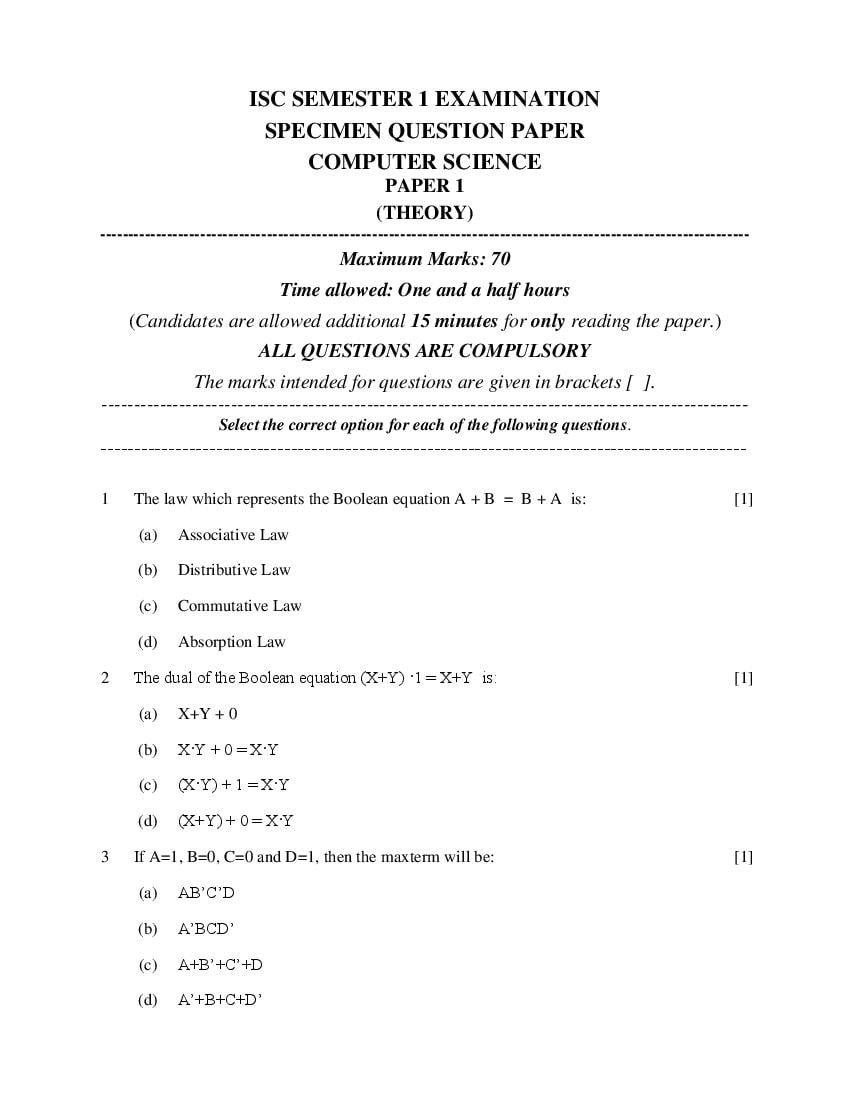
SPECIMEN QUESTION PAPER
COMPUTER SCIENCE
PAPER 1
(THEORY)
---------------------------------------------------------------------------------------------------------------------
Maximum Marks: 70
Time allowed: One and a half hours
(Candidates are allowed additional 15 minutes for only reading the paper.)
ALL QUESTIONS ARE COMPULSORY
The marks intended for questions are given in brackets [ ].
----------------------------------------------------------------------------------------------------
Select the correct option for each of the following questions.
-----------------------------------------------------------------------------------------------
1 The law which represents the Boolean equation A + B = B + A is: [1]
(a) Associative Law
(b) Distributive Law
(c) Commutative Law
(d) Absorption Law
2 The dual of the Boolean equation (X+Y) ·1 = X+Y is: [1]
(a) X+Y + 0
(b) X·Y + 0 = X·Y
(c) (X·Y) + 1 = X·Y
(d) (X+Y) + 0 = X·Y
3 If A=1, B=0, C=0 and D=1, then the maxterm will be: [1]
(a) AB’C’D
(b) A’BCD’
(c) A+B’+C’+D
(d) A’+B+C+D’
Page 2
(a) P’Q’R’
(b) P’ + Q’ + R’
(c) P + (Q’+R’)
(d) (P+Q) + R’
5 The propositional operator => represents: [1]
(a) Conjunction
(b) Implication
(c) Disjunction
(d) Negation
6 Encoders are used for: [1]
(a) Adding two bits
(b) Converting Decimal to Binary
(c) Converting Binary to Decimal
(d) Data transmission
7 NAND gate is formed by the combinations of: [1]
(a) AND gate and OR gate
(b) OR gate and NOT gate
(c) NAND gate and NOT gate
(d) AND gate and NOT gate
8 The combinational circuit which adds two binary bits is: [1]
(a) Full Adder
(b) Decoder
(c) Half Adder
(d) Multiplexer
Page 3
(a) One variable
(b) Four variables
(c) Three Variables
(d) Two variables
10 The proposition (a <=> b ) is represented by: [1]
(a) a'b’ + ab
(b) (a'+b’) · (a+b)
(c) (a+b)’
(d) (a·b)’
11 If the input in a decoder is A’BC’D, then the decimal equivalent output will be: [2]
(a) 8
(b) 10
(c) 5
(d) 6
12 A matrix MAT[10][15] is stored in the memory in Row Major Wise with each element
requiring 2 bytes of storage. If the base address at MAT[1][2] is 2215, then the address [2]
of MAT[3][7] will be:
(a) 2285
(b) 2315
(c) 2319
(d) None of the above
13 With reference to the given proposition ~P => Q , answer the following questions:
(a) the converse of the proposition is: [1]
(i) ~Q => P
(ii) Q => ~P
(iii) ~Q => ~P
(iv) ~P => ~Q
Page 4
(i) ~P => Q
(ii) Q => P
(iii) ~Q => P
(iv) ~ P => ~Q
14 The reduced expression for the Boolean expression F(X,Y,Z) = ∑(0,1,2,3,4,5,6,7) is: [2]
(a) XY’ + X’Y
(b) 1
(c) 0
(d) None of the above
15 What is the output of the code given below?
int i,j;
for( i=1; i<=5;i++); [2]
for(j=i+1;j<1;j++);
System.out.print(i + "+" + j) ;
(a) 67
(b) 1+2
(c) 6+7
(d) 12
16 What is the output of the statement given below?
[2]
System.out.print(Integer.parseInt(“234”)+’A’);
(a) 234+65
(b) 234A
(c) 299
(d) ERROR
Page 5
[2]
System.out.print(‘A’+’1’+’C’);
(a) 65+1+66
(b) 10+1+67
(c) 181
(d) 65+49+67
18 The basic logic gate that represents the simplification of the Boolean expression
[2]
A.(A’+B). (A+B) is:
(a) OR gate
(b) NOT gate
(c) AND gate
(d) None of the above
19 What is the conditional statement to check for the Non-boundary elements in a double
dimensional array of ‘M’ number of rows and ‘N’ number of columns? The row index [2]
is represented by ‘r’ and the column index is represented by ‘c’.
(a) (r>0 || r<M-1 && c>0 || c<N-1)
(b) (r>0 && r<M-1 || c>0 && c<N-1)
(c) (r>0 && r<M-1 && c>0 && c<N-1)
(d) (r>0 || r<M-1 || c>0 || c<N-1)
20 The proposition ~( a ∧ b ) V (~a => b) is a: [2]
(a) Contradiction
(b) Contingency
(c) Tautology
(d) Implication
Page 6
4-variable Karnaugh map and answer the following questions:
(a) What will be the least number of groups and their types formed for reduction? [1]
(i) 6 pairs
(ii) 2 quad and 2 pairs
(iii) 1 quad and 3 pairs
(iv) 3 quads
(b) The reduced expression of the Boolean function given above is: [2]
(i) ACD’ + B’D’ + BD
(ii) (A+C’+D’).(B’+D’).(A+C’)
(iii) C’D’ + AC’ + B’D’
(iv) (C+D’). (B’+D’).(A+B+D)
22 A school intends to select candidates for an Inter school competition as per the criteria
given below:
• The student has participated in an earlier competition and is very creative
Or
• The student is very creative and has excellent general awareness, but has not
participated in any competition earlier
Or
• The student has excellent general awareness and has won prize in an inter -house
competition
The inputs are:
Inputs
A Participated in a competition earlier
B Is very creative
C Won prize in an inter house competition
D Has excellent general awareness
( In all the above cases 1 indicates yes and 0 indicates no).
Output: X [ 1 indicates yes and 0 indicates no for all cases].
Draw the truth table for the inputs and outputs given above and answer the following
questions:
Page 7
(i) F(A,B,C,D) = ∑ (3, 5, 7, 11, 12, 13, 14, 15)
(ii) F(A,B,C,D) = π (3, 5, 7, 11, 12, 13, 14, 15)
(iii) F(A,B,C,D) = π (0, 1, 2, 4, 6, 8, 9, 10)
(iv) F(A,B,C,D) = ∑ (0, 1, 2, 4, 6, 8, 9, 10)
(b) The maximum input combinations for the above truth table will be: [1]
(i) 24
(ii) 16
(iii) 8
(iv) 4
23 Reduce the given Boolean function F(A,B,C,D) = π(3,4,5, 6, 7, 11,13,15) by using
4-variable Karnaugh map and answer the following questions:
(a) What will be the least number of groups and their types formed for reduction? [1]
(i) 6 pairs
(ii) 3 quads
(iii) 1 quad and 3 pairs
(iv) 2 quad and 3 pairs
(b) The reduced expression of the Boolean function given above is: [2]
(i) (B+C).(B+D).(A’+D)
(ii) BC + BD + A’D
(iii) AB’ + C’D’ + B’D’
(iv) (A+B’).(C’+D’).(B’+D’)
Page 8
From the logic diagram given above, where A,B and C are inputs and F is the output,
answer the following questions:
(a) The expression at (1) is: [1]
(i) A.B
(ii) A’+B’
(iii) A+B’
(iv) A+B
(b) The expression at (3) is: [1]
(i) A+B.C’
(ii) ((A+B)’.C)’
(iii) ((A+B).C)’
(iv) (A+B).C
(c) The final expression F(A,B,C) is: [1]
(i) F=((A+B)’.C)’ + (A+B)
(ii) F= (A+B)’.(C+A+B)
(iii) F=( (A+B).C)’ + (A+B)
(iv) F= (AB + C)’ +(A+B)
Page 9
(a) The complement of the expression: [2]
(i) P’R’ + (P’+Q’).(Q’+R)
(ii) (P’+R’) . (P’+Q’) + (Q+R’)
(iii) P’R’ .(PQ’ + Q’R)
(iv) (P+R)’ .(P’+Q).(Q’+R)
(b) The law used: [1]
(i) Distributive Law
(ii) De Morgan Law
(iii) Associative Law
(iv) Idempotent Law
26 With reference to the program code given below, answer the questions that follow:
void fun(int n)
{ int i,f;
for( i=1,f=1;i<=n;i++,f*=i);
System.out.print(f);
}
(a) What is the output of the method fun() when the value of n=4? [2]
(i) 24
(ii) 72
(iii) 120
(iv) ERROR
(b) What is the method fun() performing? [1]
(i) Checking for Prime Numbers
(ii) Product of odd numbers
(iii) Factors of a number
(iv) Finding the factorial
Page 10
int test(int n)
{ if(n==1) return 0;
for (int i=2;i<=(int)(Math.sqrt(n));i++)
if( n%i==0)
return 0;
return 1;
}
(a) What will the method test() return when the value of n=9? [2]
(i) 1
(ii) true
(iii) 0
(iv) Error
(b) What is the method test() performing? [1]
(i) Prime number/Composite number
(ii) Armstrong number
(iii) Palindrome number
(iv) Perfect number
28 With reference to the program code given below, answer the questions that follow:
void dimen(int n[ ][ ])
{ int p=0;
for (int i=0;i<n.length;i++)
for(int j=0;j<n[0].length;j++)
{ if(i==0 ||i==n.length-1 || j==0 || j==n[0].length-1)
p=p+n[i][j];
}
System.out.print(p);
}
(a) What will be the output of the method dimen() when the value of
n[ ][ ] ={{2,3,7},{1,5,9},{10,-3,8}} ? [2]
(i) 42
(ii) 33
(iii) 5
(iv) 37
Page 11
(i) Finding the product of the boundary elements
(ii) Finding the sum of the non-boundary elements
(iii) Finding the sum of the boundary elements
(iv) Finding the sum of the matrix elements
29 With reference to the program code given below, answer the questions that follow:
void single(int x[])
{ int w=1;
for(int y=0;y<x.length;y++)
{ if(x[y]%2==0 && x[y]>0)
w=w*x[y];
}
System.out.print(w);
}
What will be the output of the method single() when the value of
(a) [2]
x[] = {10,2,9,-6,5,6} ?
(i) 120
(ii) 45
(iii) 720
(iv) 18
(b) What is the method single( ) performing? [1]
(i) Sum of the positive odd elements
(ii) Product of the even elements
(iii) Product of the positive even elements
(iv) Sum of the positive even elements
Page 12
int solve(int a, int b)
{ int i,l=0;
for(i=1;i<=a*b;i++)
{ if(i%a==0&& i%b==0)
{ l=i; break;}
}
return l;
}
(a) What will be the output of the method solve() when the value of a=8 and b=12? [2]
(i) 4
(ii) 96
(iii) 0
(iv) 24
(b) What is the method solve( ) performing? [1]
(i) HCF of ‘a’ and ‘b’
(ii) Prime Factors of ‘a’ and ‘b’
(iii) LCM of ‘a’ and ‘b’
(iv) None of the above
31 The following program code checks if the positive integer ‘N’ is a palindrome number
by returning true or false. There are some places in the code marked as ?1?, ?2?, ?3?,
?4? and ?5? which are to be replaced by a statement/expression so that the code works
properly.
boolean Palindrome(int N)
{ int rev = ?1? ;
int num = N;
while (num>0)
{ int f = num/10;
int s = ?2? ;
int digit = num − ?3? ;
rev = ?4? + digit;
num /= ?5?;
}
if(rev == N)
return true;
else
return false;
}
Page 13
(a) What is the statement or expression at ?1? [1]
(i) -1
(ii) 0
(iii) 10
(iv) 2
(b) What is the statement or expression at ?2? [1]
(i) s *10
(ii) f /10
(iii) rev
(iv) f *10
(c) What is the statement or expression at ?3? [1]
(i) s
(ii) rev
(iii) f
(iv) digit * 10
(d) What is the statement or expression at ?4? [1]
(i) s * 10
(ii) rev *10
(iii) f
(iv) rev
(e) What is the statement or expression at ?5? [1]
(i) 1
(ii) 100
(iii) 10
(iv) rev
Page 14
Insertion Sort technique. There are some places in the code marked as ?1?, ?2?,
?3?, ?4? and ?5? which are to be replaced by a statement/expression so that the code
works properly.
void insertionSort(int array[])
{ int n = ?1?;
for (int j = 1; j < n; j++)
{
int key = ?2?;
int i = j-1;
while ( (i > -1) && ( array [i] > ?3? ) )
{
array [i+1] = ?4?;
i--;
}
?5? = key;
}
Answer the following question:
(a) What is the statement or expression at ?1? [1]
(i) array.length()
(ii) array.length
(iii) length
(iv) -1
(b) What is the statement or expression at ?2? [1]
(i) j
(ii) array[j+1]
(iii) array[j]
(iv) 0
(c) What is the statement or expression at ?3? [1]
(i) key
(ii) array[j]
(iii) i+1
(iv) n
Page 15
(i) j+1
(ii) key
(iii) array[j]
(iv) array[i]
(e) What is the statement or expression at ?5? [1]
(i) array[i+1]
(ii) i+1
(iii) j
(iv) array[i]
Document Details
| Board / Org | CISCE |
| Exam | Class 12 |
| Type | Sample Paper |
| Pages | 15 |
| Language | english |
| Updated | 22 Jul 2026 |